

AI Search Visibility for Clinics: A Practical Guide
Improve AI Search Visibility for clinics with practical SEO, GEO, AEO, local search, and content strategies to reach more patients online.
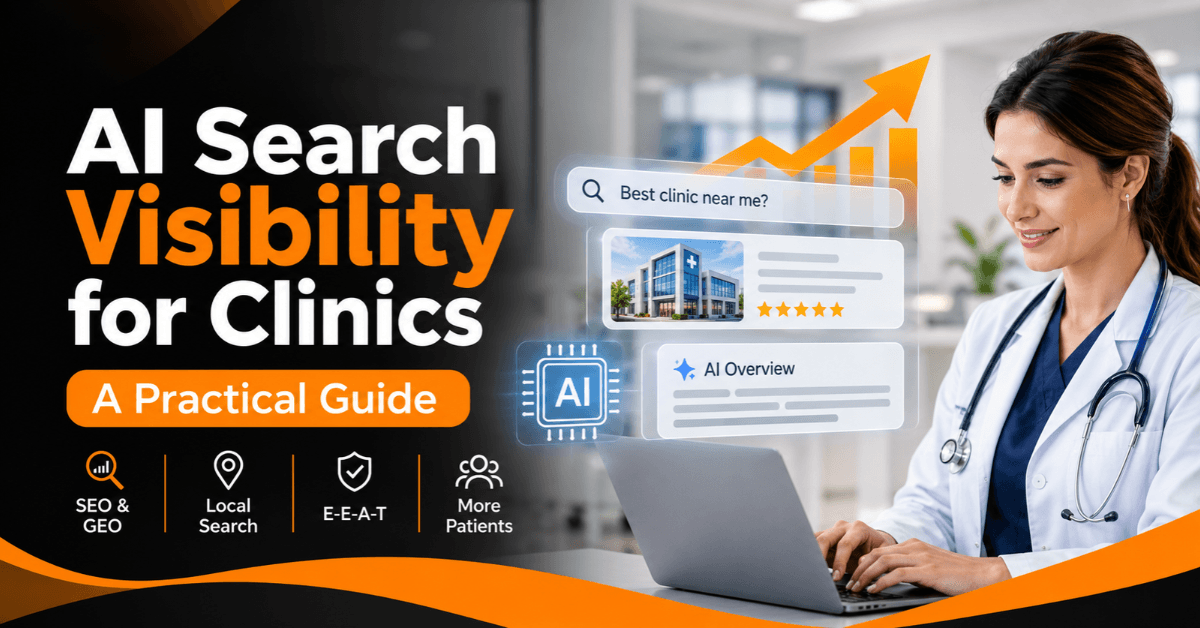
As patients increasingly use AI-powered search tools to find doctors, compare medical services, and explore treatment options, clinics need to rethink how they build their online presence. Traditional search engine optimization remains important, but patients now encounter information through Google AI Overviews, ChatGPT, Gemini, and Perplexity. This shift makes AI Search Visibility an important part of healthcare digital marketing. Clinics need more than keyword-focused websites. They need accurate medical information, credible doctor profiles, useful service pages, consistent business details, and content that helps search engines and AI systems understand their expertise.
However, appearing in AI-generated answers requires more than adding keywords or publishing AI-written articles. Clinics must build a trustworthy digital presence that supports patient needs and provides reliable information.
1. What Is AI Search Visibility for Clinics?
AI Search Visibility refers to how easily people can find, understand, and encounter a clinic's information through AI-powered search experiences. These experiences include Google AI Overviews, ChatGPT search, Gemini, and Perplexity.
Unlike traditional search results, which usually display a list of web pages, AI-powered search tools can summarize information, answer questions, and reference relevant sources.
For example, a patient might ask, "Which dental clinic offers cosmetic dentistry near me?" An AI-powered search experience may present information about relevant clinics, their services, locations, and other useful details.
For a medical practice, improving AI search visibility means making its online information accurate, accessible, relevant, and easy to understand.
Where Do Clinics Need AI Search Visibility?
Clinics should consider their presence across several search experiences:
Google AI Overviews: AI-generated summaries that appear for selected Google searches.
ChatGPT Search: Conversational search that can provide answers and reference websites.
Google Gemini: An AI assistant that helps users explore information.
Perplexity AI: An answer engine that provides researched responses with source references.
Traditional Google Search: Organic listings and local search results.
Voice Search: Conversational searches through smartphones and voice assistants.
Each platform works differently. Therefore, clinics should build a strong overall digital presence instead of relying on one platform.
2. Why AI Search Is Changing How Patients Find Medical Clinics
Patients no longer depend only on traditional Google searches when choosing healthcare providers. Many begin with specific questions about symptoms, medical procedures, specialists, and nearby clinics.
AI-powered search makes it easier to explore these questions and compare available information.
For example, someone looking for a dermatologist might search for:
Best dermatologist near me.
Which clinic offers acne treatment?
What should I consider before choosing a skin specialist?
How much does a dermatology consultation cost?
Which clinic provides laser skin treatment?
These searches reveal different stages of the patient journey.
Understanding the Patient Search Journey
Awareness: A person searches for general information about a health concern.
Consideration: They explore available treatments and medical specialists.
Evaluation: They compare clinic locations, doctor qualifications, reviews, and services.
Action: They contact a clinic, request information, or book an appointment.
Clinics that provide useful information throughout this journey can create more opportunities to reach potential patients.
AI search visibility also supports patient acquisition by helping people encounter relevant clinic information before making a healthcare decision. However, visibility alone does not guarantee appointments. Website experience, reputation, accessibility, and patient communication also influence conversions.
3. Traditional Medical SEO vs AI Search Optimization
Traditional medical SEO and AI search optimization share the same foundation, but they address different search experiences.
Traditional SEO helps search engines discover, understand, and rank website pages. AI search optimization focuses on making useful information accessible and understandable within AI-generated responses.
Clinics should combine both approaches rather than treat them as competing strategies.
Traditional SEO Focuses On
Keyword research and search intent.
Website structure and internal linking.
Technical SEO and indexing.
Relevant backlinks.
Organic search rankings.
Local search optimization.
AI Search Optimization Focuses On
Clear answers to specific patient questions.
Accurate medical and clinic information.
Credible doctor profiles and professional credentials.
Well-organized service and educational content.
Consistent brand information across relevant platforms.
Useful references and trustworthy external mentions.
For example, a clinic targeting "dental implants in Dubai" should create a detailed service page that explains the procedure, consultation process, relevant qualifications, location, and appointment options.
This page can support traditional organic search while providing useful information for AI-powered search experiences.
The important distinction: Good traditional SEO can support AI search visibility, but high rankings do not guarantee that an AI platform will mention or recommend a clinic.
4. How Do AI Search Engines Find and Recommend Local Clinics?
AI-powered search experiences use different systems to retrieve and interpret information. Depending on the platform and query, they may consider indexed web pages, business information, relevant sources, and other available online content.
When someone searches for a local healthcare provider, accurate and relevant information helps search systems understand which clinics may match the request.
Important Factors That Support Clinic Discoverability
Website content: Detailed information about medical services, treatments, and specialties.
Business information: Accurate clinic name, address, phone number, and opening hours.
Doctor profiles: Qualifications, professional experience, specialties, and credentials.
Patient reviews: Genuine feedback that helps people evaluate patient experiences.
Local SEO: Relevant location pages and accurate Google Business Profile details.
Technical accessibility: Website pages that search engines can crawl and index.
Online reputation: Consistent and credible information across relevant websites.
What Information Helps AI Understand a Clinic?
A clinic should make important business and service details easy to find.
For example, a dermatology clinic's website should clearly explain:
Clinic name and location.
Dermatology services and treatments.
Doctor qualifications and specialties.
Consultation procedures.
Operating hours.
Contact details.
Appointment booking options.
Avoid hiding essential information inside images or complicated website elements. Present important details as readable website text so visitors and search engines can understand them.
5. How to Improve AI Search Visibility for Clinics
Improving AI search visibility requires a consistent strategy that combines helpful content, technical SEO, local optimization, and credible healthcare information.
Clinics should start with the information patients need most and gradually strengthen their online presence.
1. Create Helpful and Patient-Focused Medical Content
Healthcare content should answer real questions rather than exist only to target keywords.
Patients want understandable information about treatments, procedures, medical specialists, and consultation processes.
Clinics can develop content around common patient concerns while ensuring qualified healthcare professionals review medical information.
Useful content formats include:
Treatment and procedure guides.
Medical service pages.
Doctor biographies.
Condition-related educational articles.
Patient preparation guides.
Frequently asked questions.
Aftercare information reviewed by qualified professionals.
For example, a dental clinic could publish an article explaining dental implant procedures, who may be suitable for treatment, possible risks, recovery considerations, and questions to discuss with a dentist.
This provides more value than a short page repeating the phrase "best dental implants."
2. Optimize Your Website for Generative Engine Optimization (GEO)
Generative Engine Optimization (GEO) focuses on improving how content can be discovered, understood, and referenced in AI-generated answers.
For healthcare clinics, this starts with clear information and reliable content.
Practical GEO improvements include:
Use descriptive headings that explain each topic.
Answer common questions directly.
Create dedicated pages for important medical services.
Include relevant doctor and clinic information.
Reference trustworthy medical sources.
Keep treatment information accurate and updated.
Build meaningful internal links between related pages.
For example, a physiotherapy clinic can connect its sports injury rehabilitation page to relevant educational articles about recovery, treatment options, and preparing for an appointment.
This creates a clearer content structure for both visitors and search engines.
3. Strengthen Your Clinic's E-E-A-T Signals
Google's E-E-A-T framework stands for Experience, Expertise, Authoritativeness, and Trustworthiness. These concepts are especially important for healthcare content because medical information can influence people's health decisions.
Clinics should demonstrate why visitors can trust the information they publish.
Ways to strengthen healthcare content credibility:
Display accurate doctor qualifications and experience.
Include the name and credentials of medical reviewers.
Reference reputable medical organizations and research.
Update outdated treatment information.
Provide clear clinic contact details.
Explain the purpose and limitations of medical content.
Maintain transparent editorial and review practices.
A medical article about diabetes management, for example, should receive appropriate review from a qualified healthcare professional before publication.
A generic author biography or unsupported medical claim does not establish genuine expertise. Clinics should provide verifiable information that helps readers assess the source.
4. Optimize Your Google Business Profile
Google Business Profile plays an important role in local healthcare discovery.
Patients often use Google Maps and local search results to find clinics based on location, specialty, and availability.
Clinics should maintain accurate and complete business information.
Google Business Profile optimization checklist:
Use the correct clinic name.
Select the most relevant business category.
Add an accurate address and phone number.
Maintain updated opening hours.
Include relevant medical services.
Upload genuine clinic photographs.
Provide a link to the official website.
Respond professionally to patient reviews.
A clinic should also keep its business information consistent across its website and relevant business directories.
5. Build Strong Doctor and Medical Practice Profiles
Patients often evaluate individual doctors before selecting a clinic. Therefore, doctor profile pages should provide clear and accurate professional information.
Each profile should include:
Doctor's full professional name.
Medical qualifications.
Relevant experience.
Areas of specialization.
Professional registrations, where applicable.
Languages spoken, if relevant.
Associated clinic location.
Available consultation services.
For example, a cardiology clinic should provide separate profiles for its cardiologists rather than placing all doctor information on one general page.
This helps patients understand which specialist provides a particular service.
6. Improve Website Technical SEO and Structured Data
Technical SEO helps search engines access and interpret clinic website content.
Even high-quality medical content may struggle to gain visibility if important pages cannot be crawled, indexed, or accessed properly.
Clinics should review the following areas:
Mobile-friendly website design.
Secure HTTPS connection.
Fast page loading.
Logical website navigation.
XML sitemap.
Search engine crawling and indexing.
Clear internal linking.
Accurate page titles and meta descriptions.
Accessible text-based content.
Healthcare schema markup
Structured data can help search engines understand specific information about a business, professional, or article.
Relevant schema types may include:
MedicalClinic– For eligible clinic business information.Physician– For individual doctor profiles.MedicalOrganization– For applicable healthcare organizations.Organization– For the publishing or business organization.ArticleorBlogPosting– For educational articles.BreadcrumbList– For website navigation.
Only use schema that accurately reflects visible page content. Structured data can support search understanding and eligibility for certain search features, but it does not guarantee higher rankings or AI recommendations.
6. How Can Clinics Appear in Google AI Overviews and ChatGPT Recommendations?
AI-generated search results create additional opportunities for clinics to reach people who are actively researching healthcare services. However, no SEO technique guarantees that a clinic will appear in Google AI Overviews or receive a recommendation from ChatGPT.
The best approach is to build a website that provides useful, reliable, and accessible information.
Google confirms that its AI search experiences rely on existing Search foundations. Websites should continue following established SEO practices rather than relying on special AI ranking tricks.
How to Improve Visibility in Google AI Overviews
Clinics can strengthen their chances of being discovered by:
Publishing original and useful healthcare content.
Answering common patient questions clearly.
Creating detailed service and location pages.
Providing accurate doctor information.
Supporting medical claims with reliable references.
Improving website crawling and indexing.
Maintaining a positive and credible online presence.
Google does not require special AI-specific schema or additional technical optimization for AI Overviews. Pages must meet the usual Search eligibility requirements, and inclusion is never guaranteed.
How to Get a Clinic Recommended by ChatGPT
Clinics cannot directly control ChatGPT recommendations. However, they can strengthen their online presence by:
Maintaining accurate clinic information.
Publishing detailed doctor biographies.
Creating helpful treatment and service pages.
Building a consistent brand identity.
Earning genuine mentions from relevant and reputable sources.
Making important website content publicly accessible.
For example, a clinic offering physiotherapy services should explain its treatment areas, specialist qualifications, location, consultation process, and available services.
How to Improve Perplexity AI Visibility for Clinics
Perplexity provides answers with references to supporting sources. Clinics should focus on publishing well-researched content that provides clear information and links to credible medical references.
Useful practices include:
Writing factual, well-structured articles.
Referencing reputable healthcare organizations.
Updating outdated information.
Using descriptive headings.
Providing clear doctor and clinic details.
Ensuring important pages remain accessible to search crawlers.
Rather than creating separate content for every AI platform, clinics should prioritize high-quality information that serves patients across different search experiences.
7. Answer Engine Optimization (AEO): Make Your Clinic's Content Easy to Understand
Answer Engine Optimization focuses on creating content that directly answers questions people ask through search engines, voice assistants, and conversational AI tools.
Patients often search using complete questions rather than short keywords. For example, instead of searching for "physiotherapy clinic," someone may ask, "Where can I find a physiotherapist for a sports injury?"
Clinics should structure their content around these real questions.
Use Question-Based Headings
Create headings that reflect common patient searches, such as:
What services does a medical clinic provide?
How do I choose the right medical specialist?
What should I expect during my first consultation?
How can I book an appointment with a doctor?
What should I consider before choosing a treatment?
Provide Clear and Direct Answers
Place a concise answer immediately below each question-based heading. A response of around 40–50 words can work well when the question allows a straightforward explanation.
However, do not force every answer into the same length. Medical topics often require additional context, qualifications, and safety information.
For example:
Question: What should I bring to my first clinic appointment?
Patients may need to bring relevant medical records, a list of current medications, previous test results, identification, and insurance information where applicable. Clinics should provide appointment-specific instructions so patients know what to prepare before arriving.
Optimize for Voice and Conversational Searches
Voice searches often use natural language. Clinics can address these searches by:
Including location-based questions.
Using straightforward language.
Creating dedicated service pages.
Answering common appointment questions.
Providing accurate contact and opening-hour information.
A well-organized FAQ section can also help patients find essential information without navigating several website pages.
8. Local SEO and Online Reputation: Build Trust Before Patients Visit
Local SEO for healthcare clinics helps patients find relevant medical services in their area. It also gives clinics an opportunity to communicate their specialties, location, and contact information.
For example, someone searching for a dental clinic in Dubai may compare nearby practices based on location, available treatments, reviews, and doctor profiles.
A clinic with accurate local information and a useful website can make this decision easier.
Local SEO Checklist for Medical Clinics
Maintain consistent clinic name, address, and phone number (NAP).
Complete and update Google Business Profile.
Create relevant location-specific service pages.
Add accurate business hours.
Maintain genuine patient reviews.
List the clinic in relevant healthcare directories.
Provide clear appointment and contact information.
Keep website and business profile details consistent.
Why Patient Reviews Matter for Clinic Visibility
Patient reviews help people understand other patients' experiences with a healthcare provider. They can also influence whether someone decides to contact a clinic.
Clinics should develop a professional approach to online reputation management.
Encourage genuine feedback without offering incentives or pressuring patients. Respond to reviews politely and avoid revealing confidential medical or personal information.
For negative feedback, acknowledge the concern and provide an appropriate private contact channel. A professional response can demonstrate that the clinic takes patient concerns seriously.
9. Common AI SEO Mistakes Clinics Should Avoid
Many healthcare businesses focus on publishing more content without considering its accuracy, originality, or usefulness.
This approach can weaken trust and create an inconsistent online presence.
Clinics should avoid these common mistakes:
Publishing unreviewed AI-generated medical content: AI tools can produce inaccurate health information. Qualified professionals should review medical claims.
Overusing keywords: Repeating phrases such as "best medical clinic" does not create useful content.
Making unsupported medical claims: Avoid exaggerated treatment benefits or guaranteed results.
Using misleading patient reviews: Publish only genuine feedback and follow applicable privacy requirements.
Ignoring doctor credentials: Make professional qualifications and relevant experience clear.
Creating duplicate location pages: Each location page should provide genuinely useful, location-specific information.
Neglecting technical SEO: Important content should remain accessible, crawlable, and indexable.
Using inaccurate schema markup: Structured data must match the information visible on the page.
Expecting immediate AI recommendations: AI visibility develops through broader discoverability and content quality.
Treating AI citations as guaranteed outcomes: No agency or optimization method can guarantee inclusion in every AI-generated answer.
Google also warns against producing large amounts of low-value, automatically generated content. AI can support research and content development, but accuracy, originality, and human review remain essential.
10. How to Measure AI Search Visibility and SEO Performance
Clinics should measure whether their optimization efforts improve online discovery and generate meaningful patient enquiries.
Traditional SEO metrics remain important, but businesses should also monitor how AI-powered platforms reference their content.
Important Metrics to Track
Organic website traffic: Visitors arriving through unpaid search results.
Keyword rankings: Positions for relevant medical services and location-based searches.
Google Business Profile interactions: Website clicks, calls, and direction requests.
Appointment enquiries: Calls, forms, and booking requests.
Conversion rates: The percentage of visitors who complete a desired action.
AI referral traffic: Website visits referred by AI platforms.
AI brand mentions: Instances where AI tools mention the clinic.
AI citations: Instances where platforms reference the clinic's website.
Local search visibility: Performance for relevant searches within the clinic's service area.
Tools Clinics Can Use to Monitor Performance
Google Search Console: Monitor organic search performance, indexing, and search queries.
Google Analytics 4: Analyze website traffic, referral sources, and conversions.
Google Business Profile: Review available business interactions and local performance data.
SEO tracking tools: Monitor keyword positions, technical issues, and competitor visibility.
Manual AI search testing: Test relevant patient queries across ChatGPT, Gemini, and Perplexity.
For consistent tracking, record the search query, platform, date, location, clinic mention, and cited website. AI responses can change, so repeat testing rather than relying on a single search.
Google's published guidance also describes reporting for generative AI performance in Search Console, providing another reason to monitor official search performance data.
11. A Practical 90-Day AI Search Visibility Strategy for Clinics
Clinics do not need to change their entire digital marketing strategy at once. A phased approach helps them identify weaknesses, improve important pages, and measure progress.
First 30 Days: Build the Foundation
Start by reviewing the clinic's current online presence.
Audit the website and existing service pages.
Check website crawling and indexing.
Review Google Business Profile information.
Verify doctor biographies and credentials.
Identify important patient search queries.
Check contact information across online directories.
Record current traffic and enquiry levels.
Goal: Identify the most important visibility and website issues.
Days 31–60: Improve Content and Authority
Once the foundation is in place, focus on content quality and local discoverability.
Update existing medical service pages.
Publish patient-focused educational articles.
Add detailed doctor profiles.
Improve internal linking.
Implement relevant structured data.
Add trustworthy medical references.
Strengthen local business information.
Goal: Make the clinic's services and expertise easier to understand.
Days 61–90: Measure and Refine
Use performance data to understand which improvements are working.
Test relevant searches across AI platforms.
Monitor brand mentions and website citations.
Review organic traffic and keyword performance.
Analyze appointment enquiries.
Identify missing patient information.
Update content based on performance.
Refine local SEO and website conversion elements.
Goal: Build a repeatable optimization process based on real performance rather than assumptions.
FAQs
What Is AI Search Visibility for Clinics?
AI Search Visibility refers to how easily patients can find and encounter clinic information through AI-powered search experiences. It involves helpful website content, accurate business details, credible doctor profiles, technical SEO, and a trustworthy online presence.
How Can a Medical Clinic Appear in ChatGPT Search Results?
Clinics should maintain accurate website information, publish useful medical content, provide detailed doctor profiles, and build a credible online presence. They should also ensure important website pages are publicly accessible. However, no optimization method guarantees a ChatGPT recommendation.
Does Traditional SEO Help Clinics Appear in AI Search?
Yes. Traditional SEO supports website discovery, crawling, indexing, and content relevance. These foundations can also support AI search visibility. However, strong organic rankings do not automatically guarantee citations or recommendations from AI platforms.
How Can Clinics Improve Their Visibility in Google AI Overviews?
Clinics should follow established Google SEO practices, publish helpful and accurate information, improve website accessibility, and organize content clearly. Their pages must meet Google's Search eligibility requirements, but appearing in AI Overviews is not guaranteed.
What Is Generative Engine Optimization for Healthcare?
Generative Engine Optimization (GEO) focuses on improving how healthcare information can be discovered, interpreted, and referenced by AI-powered search experiences. It involves useful content, credible sources, clear website structure, and accurate clinic information.
Does Google Business Profile Help Clinics Improve AI Search Visibility?
Google Business Profile helps clinics maintain accurate local business information and improve their presence in Google Maps and local search. It supports local discovery, although it does not guarantee that AI systems will recommend the clinic.
How Long Does It Take to Improve AI Search Visibility?
There is no fixed timeline. Results depend on the clinic's existing website, competition, content quality, technical condition, and optimization efforts. Clinics should monitor performance regularly and treat AI visibility as a long-term digital marketing activity.
Can Small Medical Clinics Compete in AI Search?
Yes. Smaller clinics can focus on specific medical specialties, local search queries, detailed doctor profiles, and helpful educational content. A focused strategy can help them communicate their expertise and reach relevant patients without competing for every broad healthcare keyword.
How BrandVexo Supports Your Digital Growth
BrandVexo helps businesses build practical digital growth systems through SEO, website development, AI automation, and digital marketing. Our approach focuses on improving online visibility, strengthening digital experiences, and connecting marketing activities with measurable business goals.
We help businesses improve their search presence, develop conversion-focused websites, and create strategies that support sustainable growth.
Whether you want to strengthen local search performance or improve your website's ability to attract enquiries, our team can help you identify the right opportunities.
Explore our services:
SEO & Local SEO Services – Improve search visibility, technical SEO, and local discovery.
Website Development Services – Build fast, responsive, search-ready websites.
BrandVexo Digital Services – Explore connected digital marketing and business growth solutions.
Ready to strengthen your online presence?
Contact BrandVexo to discuss a digital growth strategy aligned with your business goals.
Contact Details
Phone: +971 56 410 4881
Email: info@brandvexo.com
Website: www.brandvexo.com
Conclusion
AI-powered search is changing how patients discover healthcare providers, compare medical services, and make decisions about their care. Clinics that focus only on traditional keyword rankings may overlook opportunities to reach patients through emerging search experiences. A strong AI Search Visibility strategy combines traditional SEO, Generative Engine Optimization, Answer Engine Optimization, local SEO, and trustworthy medical content.
Start by improving your website, publishing useful healthcare information, strengthening doctor profiles, and maintaining accurate business details. Then monitor search performance and refine your approach based on real results.
Disclaimer: This article provides general information about AI search optimization and digital marketing for healthcare clinics. AI search platforms frequently change their systems, and no SEO strategy can guarantee rankings, citations, or recommendations. Clinics should ensure that all medical information is reviewed by qualified healthcare professionals and complies with applicable healthcare advertising, privacy, and regulatory requirements.
Free growth plan
Ready to grow your business?
Reading is a start — now let's build it. Tell us where you want to grow and a senior strategist will map the fastest, most profitable way to get there. Free, no obligation.
Discussion
Join the conversation
Be the first to comment. Comments are reviewed before they appear, so yours won't show up instantly — but we read every one.
Leave a comment
Keep reading
All articles
How UAE Businesses Can Reduce Customer Acquisition Costs
IT Services for Small Businesses: A Complete Guide for Medical Clinics
Explore IT services for small businesses and how managed IT support helps medical clinics improve cybersecurity, protect patient data and reduce downtime.
Marketing KPI Dashboard: Choose Metrics Your Team Can Act On
Build a marketing KPI dashboard that tracks meaningful metrics, measures campaign performance, and helps your team make smarter, data-driven marketing decisions.