

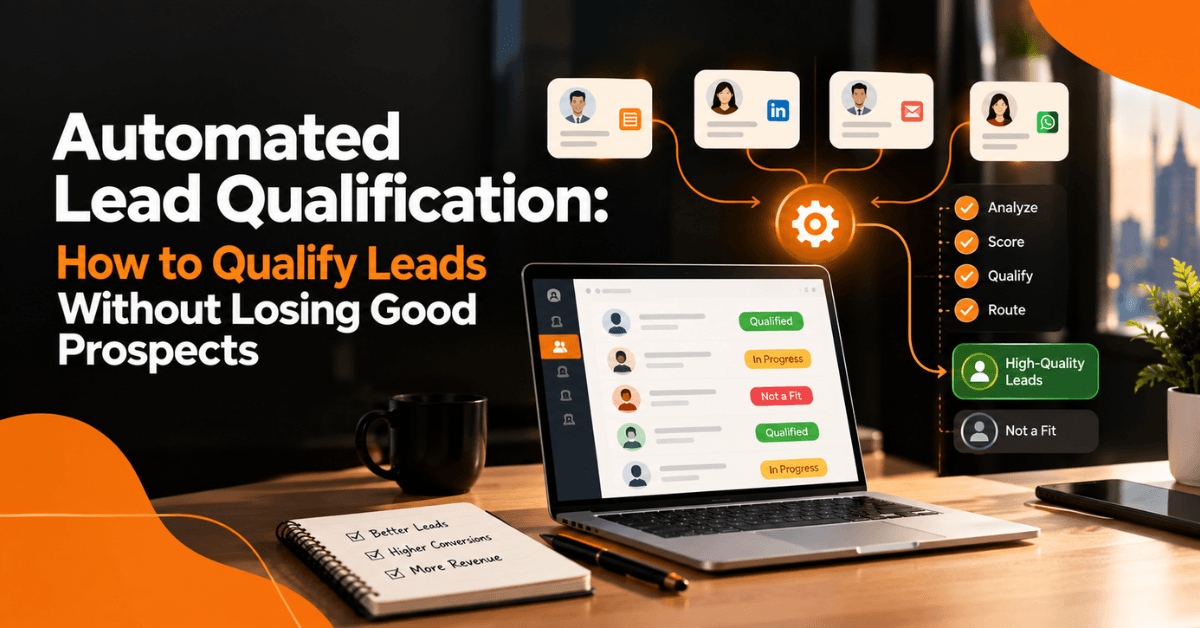
Automated Lead Qualification: How to Qualify Leads Without Losing Good Prospects
Getting more leads is useful only when your sales team can identify which prospects deserve attention. As lead volume grows, manually reviewing every form submission, email inquiry, website visitor, or campaign response becomes difficult. This is where automated lead qualification can help. The challenge is that automation can create a new problem: a good prospect may look unqualified because they have incomplete information, unusual buying behavior, or do not match rigid rules.
Effective automation should not simply reject leads faster. It should help businesses prioritize, route, nurture, and review prospects more intelligently. A strong system combines automated rules, AI lead scoring, behavioral signals, and human judgment so potentially valuable opportunities do not disappear.
What Is Automated Lead Qualification?
Automated lead qualification is the process of using software, predefined rules, CRM data, and sometimes artificial intelligence to evaluate incoming prospects and determine what should happen next. Instead of asking a sales representative to manually review every new contact, an automated system can analyze available information and place leads into different paths.
For example, a new prospect might be:
Sent directly to a salesperson
Added to a nurturing sequence
Assigned to a specific sales representative
Flagged for manual review
Re-evaluated later
Marked as unsuitable based on clear criteria
The goal is not to automate every sales decision. The goal is to reduce repetitive work while keeping important opportunities visible.
How Automated Lead Qualification Works
A basic lead qualification automation process usually follows this sequence:
Lead enters → Data is collected → Lead is scored → Qualification rules are applied → Lead is routed → Sales or marketing follows up
The system might evaluate information such as company size, job role, service interest, website activity, form responses, previous interactions, or CRM history.
The quality of the outcome depends heavily on the quality of the information and rules behind the system.
Automated Qualification vs. Manual Qualification
Manual qualification gives salespeople more context and judgment, but it can become slow when lead volume increases. Automation provides consistency and speed, particularly when businesses receive repetitive inquiries. However, neither approach needs to work alone. A practical system can automate straightforward decisions while sending uncertain cases to a human.
That hybrid approach is especially useful when one missed prospect could represent a significant business opportunity.
Why Good Prospects Get Lost in Automated Qualification
One of the biggest risks of lead qualification automation is false rejection. A lead may receive a low score even though the person has genuine buying intent. This can happen when businesses build qualification rules around assumptions rather than actual customer behavior.
For example, imagine a software company automatically reduces the score of companies with fewer than 50 employees. A smaller company may still have an urgent problem, sufficient budget, and a strong reason to buy.
The system sees "small company."
A salesperson might see "high-intent prospect."
Common Reasons a Good Lead Gets Rejected
Good prospects can fall through automated systems when:
Company size is used as an absolute qualification rule.
A prospect uses a personal email address.
The lead leaves some form fields blank.
Website activity is low because the buyer prefers direct communication.
The prospect has not requested a demo yet.
CRM information is outdated.
The scoring model relies too heavily on one data point.
A new customer segment does not resemble historical customers.
The prospect's buying journey happens outside tracked channels.
This is why automated qualification should account for uncertainty rather than forcing every lead into a simple "good" or "bad" category.
The Difference Between a Low Score and a Bad Lead
A low score does not automatically mean that a prospect is unsuitable.
Consider four possible categories:
High confidence: Strong evidence suggests that the lead fits the target customer profile and has buying intent.
Medium confidence: The lead shows potential but requires additional information or nurturing.
Low confidence: There is currently limited evidence of buying intent.
Disqualified: The available information clearly shows that the lead does not fit the business's requirements.
This distinction is important because a low-confidence lead can become valuable later.
How AI Lead Scoring Helps Identify Sales-Ready Prospects
AI lead scoring can help businesses evaluate multiple signals instead of relying only on manually assigned points. Traditional lead scoring might give a fixed number of points for actions such as downloading content or requesting a consultation.
An AI-based system can potentially identify patterns across historical customer and prospect data. The exact capabilities depend on the platform, available data, model design, and implementation.
What Signals Can AI Lead Scoring Analyze?
Depending on the system, lead scoring may consider:
Job role
Company characteristics
Website behavior
Email engagement
Form submissions
Content interactions
Service or product interest
Previous CRM activity
Sales conversations
Purchase intent signals
Customer history
The important point is not to collect every possible signal. It is to identify signals that actually correlate with meaningful sales outcomes.
Rule-Based Lead Scoring vs. AI Lead Scoring
Rule-based scoring uses explicit conditions created by the business.
For example:
A prospect requests pricing +10 points.
AI-based scoring can analyze patterns within available historical data and identify relationships that may be difficult to define manually.
However, AI does not eliminate the need for oversight. If historical data is incomplete, biased, outdated, or poorly classified, the resulting scoring model can also produce unreliable recommendations.
For that reason, businesses should treat AI lead scoring as a decision-support mechanism rather than an unquestionable verdict.
How to Build a Lead Qualification Automation Workflow
A useful qualification workflow begins with the sales process, not the automation software. Before choosing rules or AI tools, define what your business actually considers a qualified lead.
Step 1: Define What a Qualified Lead Means
Start with practical qualification criteria.
Consider:
Does the prospect have a genuine need?
Does the business fit your target market?
Does the prospect have decision-making authority?
Is the timing realistic?
Does your service or product solve the stated problem?
Is there evidence of buying intent?
Does the opportunity justify sales involvement?
Your criteria should reflect your actual customers rather than generic lead-scoring formulas.
Step 2: Identify the Data You Actually Need
More data does not automatically produce better qualification. If a form asks for 15 pieces of information before someone can contact the business, some prospects may leave before submitting it.
Separate your information into three groups:
Essential: Information needed immediately to determine the next step.
Useful: Information that improves qualification but can be collected later.
Optional: Information that may help segmentation but should not create unnecessary friction.
This approach supports progressive profiling, where businesses collect additional information as the relationship develops.
Step 3: Create Lead Scoring Rules
Build scoring around meaningful signals.
For example, a B2B service company could assign stronger signals to:
A request for pricing
A consultation request
A relevant business profile
A detailed project inquiry
A high-intent service page visit
Lower scores could apply when a visitor shows only general research behavior.
The exact scoring values should come from your own sales process rather than arbitrary numbers.
Step 4: Create Qualification Thresholds
Avoid creating only two outcomes: qualified or rejected.
A more flexible model could look like this:
High score → Sales follow-up
Medium score → Nurturing + monitoring
Low score → Automated nurture
Uncertain → Human review
This structure helps prevent promising prospects from being permanently removed simply because they do not meet one automated threshold.
Step 5: Route Leads Automatically
Once qualification occurs, automation can send each lead to the appropriate destination.
For example:
Sales-ready leads → CRM sales pipeline
Medium-intent leads → Email nurturing
Specific service inquiries → Relevant sales representative
Uncertain leads → Manual review queue
Existing customers → Customer success team
This is where lead qualification automation becomes more useful than simple lead scoring. The system does not just assign a number; it determines the next practical action.
How to Prevent Automation From Rejecting Good Leads
The safest qualification systems include safeguards. Automation should reduce unnecessary manual work without creating a blind spot in the sales pipeline.
Use a Human Review Layer
Create a "review required" category for leads that do not clearly fit either side of the qualification model.
This could include prospects with:
Unusual company profiles
High-intent behavior but incomplete information
Significant potential value
New types of customer profiles
Conflicting data points
A salesperson can then make the final decision.
Set a Requalification Path
Lead qualification should not always be a one-time decision. A lead initially classified as low priority might return to your website two weeks later, visit a pricing page, download a product guide, and request a consultation.
That new behavior should trigger another evaluation.
A requalification workflow can respond when a prospect:
Returns to the website
Requests pricing
Books a meeting
Engages with high-intent content
Responds to an email
Updates company information
Starts a new conversation
This gives leads a path back into the active sales process.
Review False Positives and False Negatives
Two measurements deserve particular attention.
A false positive occurs when an unsuitable lead receives sales attention.
A false negative occurs when a potentially valuable lead receives a low score or gets rejected.
Many businesses focus heavily on false positives because sales teams dislike wasting time. But excessive concern about false positives can cause the system to become too restrictive.
Review both outcomes regularly.
A Practical Example of Automated Lead Qualification
Consider a digital marketing agency that receives 500 inquiries each month. Sending every inquiry directly to a salesperson could create a large manual workload. Instead, the agency creates a qualification workflow.
First, the system collects basic information about the company, service interest, inquiry type, and available engagement signals. Next, the system evaluates the information.
A high-intent prospect requesting a consultation is routed to sales.
A prospect researching services but not ready to speak with sales enters a nurturing sequence.
A prospect with unusual information but potentially strong buying signals enters manual review.
A clearly irrelevant inquiry follows a separate low-priority path.
The agency then reviews the results each month.
If several leads with a particular profile convert successfully despite receiving low scores, the qualification model can be adjusted.
The important lesson is that automation becomes a feedback system, not a one-time configuration.
Metrics to Monitor After Automating Lead Qualification
Lead volume alone cannot tell you whether your qualification system works.
Track metrics such as:
Lead-to-opportunity rate
Qualified lead rate
Sales acceptance rate
Conversion rate by lead-score segment
False-positive rate
False-negative rate
Response time
Meeting-booking rate
Pipeline generated
Percentage of leads requiring manual review
One particularly useful measurement is conversion by score range.
If high-scoring leads consistently produce opportunities while medium-scoring leads also convert at a meaningful rate, your thresholds may need refinement.
Likewise, if many closed opportunities originally received low scores, investigate why.
Common Automated Lead Qualification Mistakes
Automating Before Defining Qualification Criteria
Software cannot fix an unclear sales process. Define what makes a lead valuable before building automation around it.
Using Too Many Scoring Rules
A complicated scoring model can become difficult to understand and maintain. Start with the signals that have the strongest relationship with your sales outcomes.
Treating AI Scores as Final Decisions
AI can support prioritization, but unusual prospects still need human context. Use review paths instead of assuming every score is correct.
Ignoring Data Quality
Duplicate records, missing fields, outdated CRM information, and inconsistent sales classifications can weaken your qualification process. Clean data should be part of the workflow.
Never Reviewing the Model or Rules
Customer behavior changes. Your ideal customer profile may change. Your services may change. Your marketing channels may change. Review qualification performance regularly rather than setting the workflow once and forgetting it.
Optimizing for Lead Volume Instead of Revenue Quality
A system that produces thousands of low-quality leads is not necessarily creating a better sales pipeline. Measure what happens after qualification.
When Should You Automate Lead Qualification?
Automation can be useful when your business has:
A consistent flow of incoming leads
Repetitive qualification criteria
A functioning CRM
Defined sales stages
Enough data to identify meaningful patterns
A repeatable follow-up process
Manual qualification may still make sense when every opportunity is highly customized or the sales cycle involves complex decisions.
In many cases, the most practical solution is a combination of both.
Automate the repetitive steps.
Keep humans involved where context matters.
How BrandVexo Digital Solutions Can Support Lead Qualification Automation
BrandVexo Digital Solutions helps businesses build practical digital systems across digital marketing, SEO, web development, AI automation, and business solutions. For businesses looking to improve lead handling, this can include connecting lead capture with CRM processes, designing qualification workflows, supporting AI automation, organizing follow-up sequences, and improving the connection between marketing and sales activities.
The goal should not be to automate everything. It should be to create a system that gives your team better information, faster routing, and fewer repetitive tasks while keeping valuable opportunities visible.
BrandVexo Digital Solutions
Phone: +971 52 356 5409
Email: info@brandvexo.com
Website: www.brandvexo.com
FAQ
What is automated lead qualification?
Automated lead qualification uses software, rules, CRM information, behavioral signals, and sometimes AI to determine how incoming prospects should be prioritized, routed, nurtured, or reviewed.
How does AI lead scoring work?
AI lead scoring can analyze available prospect and customer data to identify patterns associated with sales outcomes. Its usefulness depends on the quality, relevance, and consistency of the underlying data.
Can automated lead qualification replace sales teams?
No. Automation can handle repetitive qualification and routing tasks, but salespeople still provide context, relationship building, judgment, and decision-making for complex opportunities.
How do you prevent automated lead scoring from rejecting good prospects?
Use multiple qualification paths instead of a simple pass-or-fail system. Add a manual review category, monitor false negatives, and allow leads to be requalified when their behavior changes.
What data is needed for automated lead qualification?
Useful data can include company characteristics, job role, service interest, website behavior, form responses, CRM history, engagement, and buying-intent signals. The exact data required depends on the sales process.
What is the difference between lead scoring and lead qualification?
Lead scoring assigns a value or priority based on defined signals. Lead qualification determines whether and how the prospect should move through the sales process. Scoring can therefore be one component of a broader qualification workflow.
How can businesses improve their qualification workflow?
Start with clear qualification criteria, use meaningful data, create multiple routing paths, add human review for uncertain leads, and regularly compare qualification decisions with actual sales outcomes.
When should a lead be sent to a salesperson?
A lead should generally be routed to sales when available evidence indicates a strong fit and meaningful buying intent. Businesses should also define exceptions for high-value or unusual prospects that require human review.
Conclusion
Automated lead qualification can help sales teams handle growing lead volumes without manually reviewing every inquiry. But automation works best when it supports judgment rather than attempting to replace it. A strong system combines AI lead scoring, lead qualification automation, clear qualification criteria, flexible routing, nurturing, and human review.
Disclaimer: This article provides general information about automated lead qualification, AI lead scoring, and sales automation. Results can vary depending on your business, data quality, tools, and implementation, so evaluate your specific requirements before making automation decisions.
Free growth plan
Ready to grow your business?
Reading is a start — now let's build it. Tell us where you want to grow and a senior strategist will map the fastest, most profitable way to get there. Free, no obligation.
Discussion
Join the conversation
Be the first to comment. Comments are reviewed before they appear, so yours won't show up instantly — but we read every one.
Leave a comment
Keep reading
All articles Growth
Lead Generation Strategies for Service Businesses
Explore lead generation strategies for service businesses, including online lead generation, local SEO, Google Ads, content, referrals, and lead nurturing.
 Growth
B2B Lead Generation: A Full-Funnel Framework
Build a stronger B2B lead generation funnel with practical strategies for demand generation, lead qualification, appointment setting, and pipeline growth.
 Growth
Social Media Marketing Dubai: Agency vs In-House
Compare social media marketing in Dubai with an in-house team vs agency. Explore costs, expertise, scalability and which model fits your business.