

B2B Lead Generation: A Full-Funnel Framework
B2B Lead Generation is not simply about getting more contact form submissions. A strong strategy attracts the right businesses, builds interest, identifies buying intent, qualifies potential customers, and moves suitable prospects toward genuine sales opportunities.
For B2B companies, the buying journey can involve multiple decision-makers, longer consideration periods, research, comparisons, and several interactions before someone is ready to speak with sales. That makes a full-funnel approach more effective than relying on a single channel or campaign.
What Is B2B Lead Generation?
B2B lead generation is the process of attracting potential business customers and converting their interest into identifiable prospects that a company can qualify and follow up with. A B2B lead could come from an organic search, LinkedIn interaction, webinar, paid campaign, referral, industry event, content download, or direct enquiry. However, not every lead has the same commercial value.
For example, someone downloading an educational guide may still be researching a problem. Someone requesting a product demonstration may have much stronger buying intent.
That distinction makes lead qualification an important part of the process.
How B2B Lead Generation Works
A typical B2B journey looks like this:
Target audience
Awareness
Engagement
Lead capture
Qualification
Sales conversation
Opportunity
Customer
Each stage needs a different message. Educational content can work well when someone is researching a problem, while a consultation or demo may be more appropriate when a prospect is comparing providers.
B2B Leads vs. Qualified Leads
A B2B lead simply represents an identifiable potential buyer. A qualified lead has characteristics that make the prospect more relevant to the business.
Qualification can consider:
Company size and industry
Job role
Business need
Budget
Buying authority
Purchase timeline
Engagement and intent
This helps sales teams spend more time on opportunities with a reasonable fit instead of treating every enquiry equally.
Why a Full-Funnel B2B Lead Generation Strategy Matters
Many companies focus heavily on lead capture while overlooking what happens before and after the form submission. A prospect may interact with several pieces of content before becoming ready to talk to sales. Another prospect may arrive through a high-intent search and need only a simple next step. A full-funnel approach accounts for these differences.
It connects awareness, consideration, conversion, qualification, sales engagement, and pipeline development. This creates a clearer path between marketing activity and commercial outcomes.
Demand Generation vs. Lead Generation vs. Pipeline Generation
These terms describe different parts of the customer journey.
Demand generation creates awareness and interest around a problem, category, or solution.
Lead generation captures identifiable prospects who have shown enough interest to enter a marketing or sales process.
Pipeline generation focuses on creating qualified sales opportunities that can potentially produce revenue.
The distinction matters because a campaign can generate hundreds of leads without creating meaningful sales opportunities. A smaller campaign that produces fewer but better-qualified opportunities may have greater commercial value.
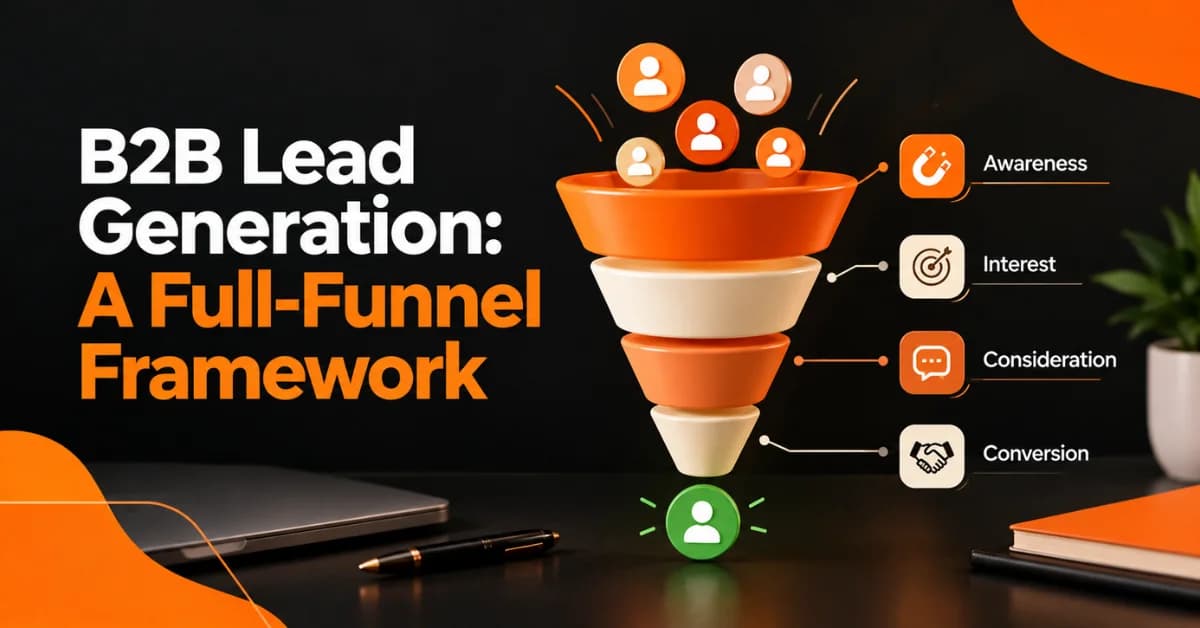
The B2B Lead Generation Funnel
A full-funnel strategy should move prospects through several connected stages rather than treating lead generation as one isolated activity.
Stage 1: Awareness — Reach the Right B2B Audience
At the awareness stage, potential buyers may understand that they have a problem but may not yet know which solution they need.
Businesses can attract them through:
SEO content
Educational articles
Industry research
LinkedIn content
Thought leadership
Search advertising
Webinars
Industry events
The focus should remain on the buyer's problem. Instead of immediately promoting a service, create content that answers the questions prospects ask while researching.
For example, a company struggling with inefficient sales processes might initially search for ways to improve lead management rather than search for a specific software provider.
Stage 2: Consideration — Turn Interest Into Engagement
Once prospects understand their problem, they begin evaluating potential approaches.
Useful content at this stage includes:
Comparison guides
Case studies
Webinars
Detailed service pages
Product information
ROI explanations
Expert insights
Retargeting campaigns
The objective is to help prospects evaluate their options while demonstrating relevant expertise.
Stage 3: Conversion — Capture High-Intent B2B Leads
Conversion happens when a prospect takes an action that identifies them or indicates stronger buying intent.
Possible conversion points include:
Demo requests
Consultation forms
Contact forms
Pricing enquiries
Assessments
Resource downloads
Webinar registrations
A good landing page should make the next step obvious.
What Makes a B2B Lead Conversion Page Effective?
An effective conversion page usually includes:
A clear headline
One primary offer
Relevant supporting information
A simple form
Trust signals
Evidence or examples where available
A clear call to action
A mobile-friendly experience
The page should answer a simple question: Why should this prospect take the next step now?
Stage 4: Qualification — Identify Sales-Ready Leads
Not every person who submits a form should immediately enter the sales process.
A practical qualification model can consider three factors:
Fit: Does the company match the ideal customer profile?
Intent: Has the prospect demonstrated meaningful interest?
Timing: Is there a realistic opportunity to buy within a relevant period?
Combining these factors helps marketing and sales teams prioritize their attention.
Stage 5: Appointment Setting — Turn Qualified Leads Into Conversations
Appointment setting connects qualified interest with a sales conversation. Once a prospect meets agreed qualification criteria, the business can use personalised follow-up to arrange a call, consultation, product demonstration, or discovery meeting.
Effective appointment setting should feel relevant rather than intrusive. The sales representative should understand why the prospect engaged and use that context when starting the conversation.
Fast follow-up also matters because a highly interested prospect can lose momentum if the next step becomes difficult or unclear.
Stage 6: Pipeline Generation — Move Opportunities Toward Revenue
The final objective is not simply to create a larger database. It is to create genuine sales opportunities. Pipeline generation tracks prospects that have moved beyond general interest and entered a defined sales process.
At this point, teams can monitor:
Sales-qualified opportunities
Opportunity value
Deal stages
Expected close dates
Sales activity
Proposal or quotation status
Closed-won revenue
This creates a more useful connection between marketing activity and business performance.
B2B Lead Generation Channels That Support the Full Funnel
Different channels can support different stages of the buyer journey.
SEO and Organic Search
SEO can attract prospects while they research problems, compare solutions, or look for providers. Strong B2B SEO should cover different search intents instead of publishing only broad informational articles.
Useful content can include educational guides, comparison pages, service pages, industry pages, and problem-focused resources.
LinkedIn and Social Selling
LinkedIn can help B2B businesses reach professional audiences and decision-makers.
Effective approaches include:
Expert-led content
Industry insights
Employee advocacy
Thought leadership
Personalised outreach
Relevant conversations
The goal should be to build credibility and relevance rather than repeatedly promote an offer.
Email Marketing and Lead Nurturing
Email nurturing helps maintain engagement when prospects are not yet ready to buy. A useful sequence might include educational content, practical resources, relevant case examples, and a suitable sales invitation when buying intent increases.
Paid Search and Retargeting
Paid search can capture high-intent demand when prospects actively search for solutions. Retargeting can then reconnect with people who previously visited important pages but did not convert.
The strongest results usually come when the advertisement, landing page, offer, and follow-up experience work together.
How to Build a B2B Lead Generation Strategy Step by Step
1. Define the Ideal Customer Profile
Start by identifying the businesses most likely to benefit from your offering.
Consider:
Industry
Company size
Location
Business model
Revenue characteristics
Technology environment
Common challenges
A clear ideal customer profile prevents marketing teams from targeting everyone.
2. Identify Buyer Personas
B2B purchases can involve multiple people.
You may need to consider:
Decision-makers
Influencers
End users
Procurement teams
Financial stakeholders
Executive leadership
Each person may care about different outcomes.
3. Map Buyer Intent
Group prospects by their level of intent.
Low intent: Researching a problem.
Medium intent: Evaluating possible solutions.
High intent: Comparing providers or looking for a next step.
This makes it easier to match content and calls to action with the prospect's situation.
4. Match Content to Funnel Stage
Use content according to buyer needs.
Awareness → Educational articles and guides
Consideration → Comparisons, case studies, and webinars
Conversion → Consultations, demos, and assessments
Sales → Proposals, ROI analysis, and implementation information
5. Create a Lead Qualification Process
Marketing and sales should agree on what makes a lead worth pursuing. Document qualification criteria and make them easy for both teams to apply consistently.
6. Build a Follow-Up Workflow
Define what happens after someone becomes a lead.
A workflow can include:
CRM entry
Lead assignment
Initial response
Qualification
Nurturing
Appointment setting
Sales handoff
Opportunity creation
Automation can reduce manual work, but human review remains important for complex B2B decisions.
7. Measure Pipeline, Not Just Leads
Lead volume can provide useful information, but it should not become the main success metric. Track whether leads become qualified prospects, appointments, opportunities, and eventually customers.
How to Qualify and Prioritize B2B Leads
Lead scoring can help teams prioritize prospects based on fit and behaviour.
Signals may include:
Visiting important service pages
Requesting a demo
Downloading several resources
Returning to the website
Engaging with commercial content
Asking specific questions
Booking a meeting
The scoring model should reflect the company's actual sales process. A prospect should not receive a high score simply because they opened an email if they do not fit the target market.
When Should Marketing Hand a Lead to Sales?
Marketing should hand a lead to sales when it meets clearly defined qualification criteria. This might happen when the prospect matches the ideal customer profile and demonstrates a strong buying signal, such as requesting a consultation or discussing a specific business requirement.
A shared definition prevents two common problems: sales receiving irrelevant leads and marketing losing visibility into what happens after handoff.
Common B2B Lead Generation Mistakes
Businesses often weaken their funnel by:
Chasing lead volume instead of quality
Targeting an overly broad audience
Using one message for every funnel stage
Sending traffic to weak landing pages
Ignoring qualification
Following up too slowly
Keeping poor CRM data
Separating marketing from sales
Measuring only cost per lead
Stopping nurturing too early
Fixing one weak stage can sometimes create more value than simply increasing traffic.
How to Measure B2B Lead Generation Performance
A useful measurement framework follows the complete journey.
Top-of-Funnel Metrics
Track:
Relevant website traffic
Organic visibility
Content engagement
Target-account visits
Audience growth
Lead Generation Metrics
Monitor:
Lead volume
Conversion rate
Cost per lead
MQL volume
Lead qualification rate
Pipeline and Revenue Metrics
The most commercially meaningful metrics include:
SQL rate
Appointment rate
Opportunity creation
Pipeline value
Cost per opportunity
Lead-to-customer conversion
Customer acquisition cost
Revenue generated
The key is to connect channel activity with downstream outcomes rather than judging every campaign by its initial lead count.
B2B Lead Generation Example: From First Search to Sales Opportunity
Consider a B2B software company targeting growing businesses. A potential buyer first searches for information about improving an inefficient sales process. They find an educational article and later download a practical guide. The company continues the relationship through relevant email content. After several interactions, the prospect visits a service page and requests a demonstration.
The marketing team qualifies the enquiry based on company fit, business need, and buying intent. The lead then moves to appointment setting, where a sales representative arranges a discovery call.
If the conversation confirms a genuine opportunity, the sales team creates an opportunity in the CRM and moves it into the sales pipeline.
This example shows why B2B Lead Generation should be viewed as a connected system rather than a single campaign.
B2B Lead Generation in the UAE: What Businesses Should Consider
For B2B companies operating in the UAE, targeting should reflect the specific market and buyer group rather than relying on broad audience definitions. Businesses can strengthen their approach by creating relevant location and industry pages, targeting professional audiences through platforms such as LinkedIn, and making enquiry processes simple.
Clear business information, credible expertise, relevant case examples, and responsive communication can also support trust during a longer B2B buying process.
Where appropriate, businesses can connect website forms, CRM systems, email workflows, and direct communication channels to reduce friction between initial enquiry and sales follow-up.
How to Improve B2B Lead Generation Over Time
A strong funnel requires continuous optimisation.
Test One Funnel Element at a Time
Test elements such as:
Landing page headlines
Calls to action
Form length
Content offers
Email sequences
Follow-up timing
Avoid changing everything simultaneously because it becomes difficult to identify what actually improved performance.
Identify Where Leads Drop Off
Review the complete journey:
Traffic → Engagement → Lead → MQL → SQL → Appointment → Opportunity → Customer
If traffic is strong but lead conversion is weak, investigate the landing page or offer. If lead volume is strong but sales opportunities remain low, investigate targeting and qualification. If qualified opportunities are being created but few become customers, review the sales process, offer, positioning, and follow-up.
Align Marketing and Sales Around One Funnel
Marketing and sales should share definitions, data, goals, and feedback. Sales can explain which leads become genuine opportunities. Marketing can use that information to improve targeting and content.
This creates a feedback loop that gradually improves the entire B2B lead generation process.
FAQ
What is B2B lead generation?
B2B lead generation is the process of attracting potential business customers, capturing their interest, qualifying suitable prospects, and moving them toward a sales conversation or opportunity.
What is the difference between B2B lead generation and demand generation?
Demand generation focuses on creating awareness and interest around a problem, category, or solution. B2B lead generation focuses on identifying and capturing interested prospects so a business can qualify and follow up with them.
What are the best sources of B2B leads?
The best source depends on the target audience, buying cycle, industry, offer, and search intent. SEO, LinkedIn, email marketing, paid search, referrals, events, webinars, and outbound prospecting can all contribute to B2B lead generation.
How do you generate high-quality B2B leads?
Start with a clear ideal customer profile, create content around real buyer problems, target relevant intent, provide useful conversion opportunities, qualify leads carefully, and connect marketing activity with sales follow-up.
What is appointment setting in B2B sales?
Appointment setting is the process of arranging a sales conversation between a qualified prospect and a sales representative. It helps bridge the gap between demonstrated interest and a structured sales discussion.
How do you measure B2B lead generation?
Measure the full journey from traffic and engagement through lead conversion, qualification, appointments, opportunities, pipeline value, customer acquisition, and revenue.
How long does B2B lead generation take?
The timeframe varies significantly by industry, audience, deal size, buying process, offer, and channel. Shorter sales cycles can produce opportunities quickly, while complex B2B purchases may require longer nurturing and multiple decision-maker interactions.
Final Takeaway
Effective B2B Lead Generation is not about collecting the largest possible number of contacts. It is about creating a reliable path from audience awareness to genuine sales opportunities. The strongest approach connects demand generation, useful content, lead capture, qualification, appointment setting, and pipeline generation. It also gives marketing and sales teams a shared view of what makes a prospect valuable.
Disclaimer: This article provides general information about B2B lead generation and digital marketing strategies and should not be considered professional business or marketing advice. Results may vary depending on your industry, target audience, market conditions, budget, and implementation.
Free growth plan
Ready to grow your business?
Reading is a start — now let's build it. Tell us where you want to grow and a senior strategist will map the fastest, most profitable way to get there. Free, no obligation.
Discussion
Join the conversation
Be the first to comment. Comments are reviewed before they appear, so yours won't show up instantly — but we read every one.
Leave a comment
Keep reading
All articles Growth
Lead Generation Strategies for Service Businesses
Explore lead generation strategies for service businesses, including online lead generation, local SEO, Google Ads, content, referrals, and lead nurturing.
 Growth
Social Media Marketing Dubai: Agency vs In-House
Compare social media marketing in Dubai with an in-house team vs agency. Explore costs, expertise, scalability and which model fits your business.
 Growth
Social Media Marketing for Restaurants: What Works
Learn what works in social media marketing for restaurants, including Instagram, TikTok, local strategy, content ideas, and measurable F&B marketing tactics.