

Brand Guidelines: What to Include and Why They Matter
Learn what Brand Guidelines include, from logos and colors to typography and brand voice, and how they help businesses maintain consistent branding.
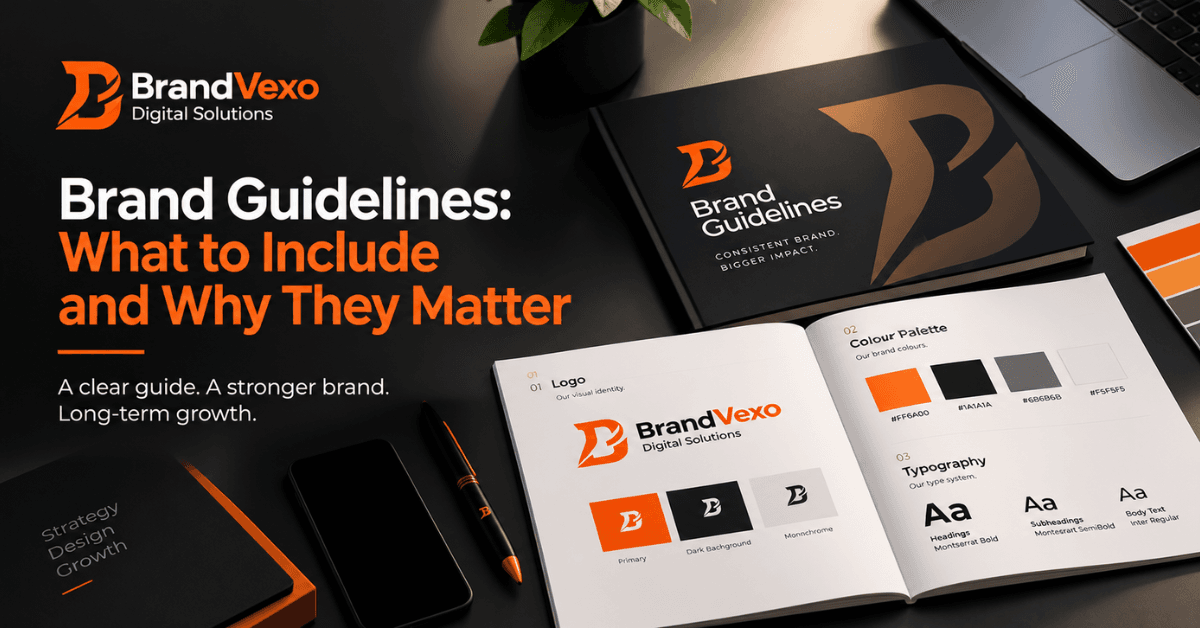
A brand can have a great logo, attractive colors, and a strong message, but inconsistent use can quickly weaken the overall experience. One social media post may use different fonts, another may use an outdated logo, while website copy may sound completely different from the brand's usual voice. This is where Brand Guidelines become important. They provide a clear reference for how a business should look, sound, and communicate across different channels. A well-developed guide helps teams, designers, marketers, developers, and external partners work from the same standards.
From logo usage and typography to brand voice and messaging, this guide explains what to include in Brand Guidelines, why they matter, and how businesses can create guidelines that people can actually use.
What Are Brand Guidelines?
Brand Guidelines are a set of rules that explain how a brand should be represented across visual and communication channels. They document the key elements of a brand identity and show people how to apply them consistently. A complete guide can cover the brand's purpose, logo, color palette, typography, imagery, design elements, messaging, and tone of voice.
The goal is not to restrict creativity. Instead, guidelines give creative teams a reliable foundation so that different pieces of content still feel like they belong to the same brand.
What Is a Brand Style Guide?
A brand style guide is often used as another name for brand guidelines, although the exact scope can vary between organizations. A style guide commonly focuses on practical rules for visual identity and communication. It may explain which logo variation to use, which fonts and colors are approved, how imagery should look, and how the brand should communicate.
For example, a designer creating a website and a marketer creating a LinkedIn post should be able to use the same guide and produce work that feels connected.
Adobe similarly describes a brand style guide as a practical rulebook covering areas such as fonts, logo treatments, brand colors, imagery, and brand voice.
What Should Brand Guidelines Include?
The exact contents depend on the size and needs of the business. However, an effective guide should cover the elements people regularly use when representing the brand.
1. Brand Purpose, Mission, and Values
Start with the foundation of the brand before explaining its visual elements.
Include:
Brand purpose
Mission statement
Vision
Core values
Target audience
Brand personality
Positioning
Key differentiators
This information gives creative and marketing teams context. Without it, people may follow visual rules correctly while still communicating the wrong personality or message.
2. Logo Usage Guidelines
Your logo is one of the most recognizable parts of your visual identity, so its usage needs clear rules.
Your guidelines should explain:
Primary logo
Secondary logo variations
Horizontal and vertical versions
Minimum size
Clear space
Approved backgrounds
Color variations
Placement rules
Incorrect usage
Also show examples of what people should avoid, such as stretching the logo, changing its colors, adding effects, rotating it, or placing it on an unsuitable background.
Clear do-and-don't examples make logo rules much easier to follow than written instructions alone.
3. Brand Color Palette
A defined color system helps teams reproduce the same visual identity across digital and printed materials.
Include:
Primary brand colors
Secondary colors
Accent colors
HEX codes
RGB values
CMYK values
Pantone references where needed
For example, simply saying "use dark blue" leaves room for interpretation. Providing the exact color codes allows designers and developers to reproduce the intended shade more accurately.
Brand guidelines should also explain where each color belongs. A primary color may be used for major brand elements, while accent colors might be reserved for buttons, highlights, or supporting graphics.
4. Typography and Font Guidelines
Typography affects how a brand looks and feels.
A typography section should identify:
Primary typeface
Secondary typeface
Heading font
Body font
Font weights
Font sizes
Line spacing
Text alignment
Digital usage
Print usage
For example, a business might use one font family for headings and another for body copy. The guide should explain when and how each one should be used.
Consistency matters across websites, presentations, social media graphics, advertisements, and business documents.
5. Imagery and Photography Style
Images can communicate brand personality just as strongly as words.
Define the type of imagery your business should use. Consider:
Photography style
Composition
Lighting
Subject matter
Image treatment
Illustration style
Stock photography preferences
Image examples to use
Image examples to avoid
For instance, a professional consulting business may prefer authentic workplace photography instead of heavily edited stock images.
The most useful guidelines do not simply say "use professional images." They show what professional means for that particular brand.
6. Iconography, Graphics, and Design Elements
Supporting visual elements can make a brand easier to recognize.
Your guidelines can document:
Icons
Illustrations
Shapes
Patterns
Borders
Graphic textures
Background treatments
Layout principles
These elements become especially useful when different designers create content for the same company.
Instead of every designer developing a completely different visual style, they can work within the same design system.
7. Brand Voice and Tone
Brand identity is not only visual. The way a company communicates also shapes how people experience it.
Your guidelines should explain:
Brand personality
Voice characteristics
Tone
Vocabulary
Sentence style
Level of formality
Words to use
Words to avoid
For example, a technology company may want to sound knowledgeable but approachable. Its guidelines could encourage simple explanations while discouraging unnecessary technical jargon.
A useful brand style guide should give writers practical examples rather than vague instructions such as "sound professional."
8. Messaging and Content Guidelines
Messaging guidelines explain what the business should communicate and how it should communicate it.
Include:
Value proposition
Key messages
Taglines
Product or service descriptions
Messaging hierarchy
Calls to action
Social media guidelines
Email communication style
Content principles
This helps maintain consistency even when different people create content.
Brand Standards vs Brand Guidelines: What Is the Difference?
The terms brand standards and Brand Guidelines are sometimes used interchangeably, but businesses may use them with slightly different meanings. Brand standards often refer to specific requirements that must be followed. For example, a company may have strict standards for logo placement, approved colors, typography, and messaging.
Brand Guidelines can be broader. They may explain not only what the rules are but also why they exist and how to apply them in real situations.
The terminology is less important than the usefulness of the document. What matters is that people can understand the rules and apply them consistently.
Are Brand Guidelines the Same as Visual Identity Guidelines?
Not necessarily.
Visual identity guidelines usually focus on the visual side of a brand, including:
Logo
Colors
Typography
Photography
Illustrations
Icons
Layout
Brand Guidelines can go beyond visual identity by including brand purpose, voice, messaging, audience, and communication principles.
In other words, visual identity is one important part of a broader brand system.
Why Are Brand Guidelines Important for Businesses?
A good guide does more than protect a logo. It creates a shared system for presenting the business consistently.
Build Brand Consistency
Customers may interact with a business through a website, social media account, advertisement, email, presentation, or physical material. When these touchpoints use consistent visual and verbal elements, the overall brand experience becomes more cohesive.
Adobe notes that brand guides can help designers, copywriters, developers, and other contributors work from the same building blocks.
Make Marketing Production Faster
Without guidelines, teams repeatedly make basic decisions:
"Which font should we use?"
"Which blue is the correct one?"
"Can we change the logo?"
"How should this caption sound?"
A clear reference document answers these questions quickly.
Improve Team and Agency Collaboration
Businesses often work with multiple people at the same time. An internal marketing team may collaborate with freelance designers, web developers, advertising agencies, or content writers. Brand Guidelines give everyone a common reference point.
This reduces unnecessary back-and-forth and makes it easier for external partners to produce work that matches the brand.
Strengthen Brand Recognition
Repeated use of recognizable colors, typography, imagery, messaging, and other brand elements can help audiences identify a business across different touchpoints. The goal is not to make every piece of content identical. The goal is to make different pieces feel connected.
Reduce Inconsistent Brand Usage
A brand guide can prevent common mistakes such as:
Using an outdated logo
Changing approved colors
Mixing unrelated fonts
Using unsuitable imagery
Writing in an inconsistent tone
Creating conflicting messages
How to Create Effective Brand Guidelines
Creating a useful guide does not mean producing the longest possible document. It means documenting the decisions that people need to make repeatedly.
Step 1: Define Your Brand Foundation
Start with your:
Purpose
Mission
Vision
Values
Audience
Positioning
Personality
These decisions should guide the visual and verbal identity.
Step 2: Document Your Visual Identity
Bring the visual system together in one place.
Document your:
Logo system
Colors
Typography
Photography
Graphics
Icons
Layout principles
Include actual examples wherever possible.
Step 3: Define Your Brand Voice
Decide how the business should sound.
Instead of simply writing "friendly," explain what that means.
For example:
Use: Clear, conversational language that helps the reader understand the solution.
Avoid: Excessive jargon, complicated sentences, and overly promotional language.
Specific instructions are easier for writers to apply than abstract descriptions.
Step 4: Add Real-World Examples
This is one of the areas where many basic brand documents fall short.
Rules tell people what to do. Examples show them how to do it.
Include examples from:
Website pages
Social media posts
Advertisements
Presentations
Email communication
Sales documents
Digital campaigns
A designer can understand a layout rule much faster when they can see an approved example next to an incorrect one.
Step 5: Make the Guidelines Easy to Access
Even excellent guidelines are ineffective if nobody can find them.
Depending on your business, you could provide the guide as:
PDF documentation
Online brand portal
Shared workspace
Design-system documentation
Internal knowledge base
Keep the latest version clearly identified so teams do not accidentally use outdated assets.
Common Brand Guideline Mistakes to Avoid
Avoid these common problems when creating or updating your guidelines:
Focusing only on the logo
Providing rules without examples
Making the document unnecessarily complicated
Leaving brand voice undefined
Using vague color descriptions
Failing to explain incorrect usage
Ignoring digital channels
Keeping the guide difficult to access
Creating rules that teams cannot realistically follow
Never reviewing the guide after a major business change
A good guide should support real work, not become a document that sits unused.
Brand Guidelines Example: A Simple Business Guide
Consider a Dubai-based digital marketing company that works across SEO, web development, social media, and AI automation.
Its Brand Guidelines might define:
Logo: Primary logo for websites and presentations, simplified version for smaller digital placements.
Colors: A defined primary palette with exact HEX, RGB, and CMYK values.
Typography: One font family for major headings and another approved style for supporting text.
Imagery: Modern business photography with authentic people and practical workplace settings.
Voice: Professional, clear, helpful, and conversational.
Messaging: Focus on business outcomes rather than vague marketing claims.
Social media: Educational content should use the same visual system and communication style.
The company does not need every social post to look identical. Instead, each post should feel like part of the same brand.
How Often Should You Update Brand Guidelines?
There is no universal update schedule. Review your guidelines when the business or its brand system changes significantly.
You may need an update when:
The company rebrands
The target audience changes
New services or products launch
The logo changes
The visual identity evolves
New communication channels become important
Existing rules no longer work
The aim is to keep the guide accurate without changing the brand unnecessarily.
Brand Guidelines Checklist
Before publishing your guide, check that it includes:
✓ Brand purpose, mission, and values
✓ Target audience and positioning
✓ Logo variations and usage rules
✓ Clear-space requirements
✓ Color palette and color codes
✓ Typography rules
✓ Photography and imagery direction
✓ Icons and supporting graphics
✓ Brand voice and tone
✓ Messaging guidelines
✓ Do's and don'ts
✓ Real-world examples
✓ Digital and print applications
✓ Version or update information
✓ Easy access for internal and external teams
Frequently Asked Questions
What are the main elements of Brand Guidelines?
The main elements usually include brand purpose, logo usage, colors, typography, imagery, graphic elements, brand voice, tone, and messaging. The exact structure should reflect how the business communicates with its audience.
Why does a business need a brand style guide?
A brand style guide gives teams a shared reference for presenting the business consistently. It can reduce confusion, improve collaboration, and make it easier to produce marketing materials that align with the brand.
What are brand standards?
Brand standards are defined rules that help maintain consistency in how a brand appears and communicates. They can cover areas such as logo usage, colors, typography, messaging, and other identity elements.
How long should Brand Guidelines be?
There is no required length. A small business may need a concise guide, while a larger organization with multiple teams and markets may need more detailed documentation. The important factor is whether the guide provides enough practical information to support consistent execution.
Can Brand Guidelines include social media rules?
Yes. Social media guidelines can define visual styles, caption tone, terminology, hashtags, content formats, image treatments, and approved messaging approaches.
About BrandVexo Digital Solutions
BrandVexo Digital Solutions helps businesses build practical digital growth systems across digital marketing, SEO, web development, AI automation, and business solutions. Our approach focuses on creating useful strategies that connect branding, content, technology, and measurable business outcomes.
For support with brand strategy, digital marketing, SEO, web development, or other digital growth needs, you can contact our team.
Phone: +971 52 356 5409
Email: info@brandvexo.com
Website: www.brandvexo.com
Final Thoughts
Brand Guidelines provide a practical system for keeping a business visually and verbally consistent. They bring together the decisions behind your logo, colors, typography, imagery, voice, and messaging so different people can represent the brand with greater confidence. The strongest guidelines are not simply collections of rules. They explain what to use, how to use it, what to avoid, and where the rules apply.
Disclaimer: This article provides general information about Brand Guidelines and brand identity practices. Specific branding requirements can vary depending on a business, industry, audience, and communication channels.
Free growth plan
Ready to grow your business?
Reading is a start — now let's build it. Tell us where you want to grow and a senior strategist will map the fastest, most profitable way to get there. Free, no obligation.
Discussion
Join the conversation
Be the first to comment. Comments are reviewed before they appear, so yours won't show up instantly — but we read every one.
Leave a comment
Keep reading
All articles
Brand Guidelines for Remote Teams: Keep Every Channel Aligned
Learn how to create brand guidelines for remote teams, maintain brand consistency across channels, and align distributed employees with one identity.

Brand Consistency Audit: How to Review Every Customer Touchpoint
Conduct a Brand Consistency Audit to review your website, social media, emails, and customer touchpoints while building a stronger brand identity.

How to Build a Brand Voice Guide for Your Business
How to build a brand voice guide for your business with practical steps, examples, and templates to create consistent messaging and strengthen brand identity.