

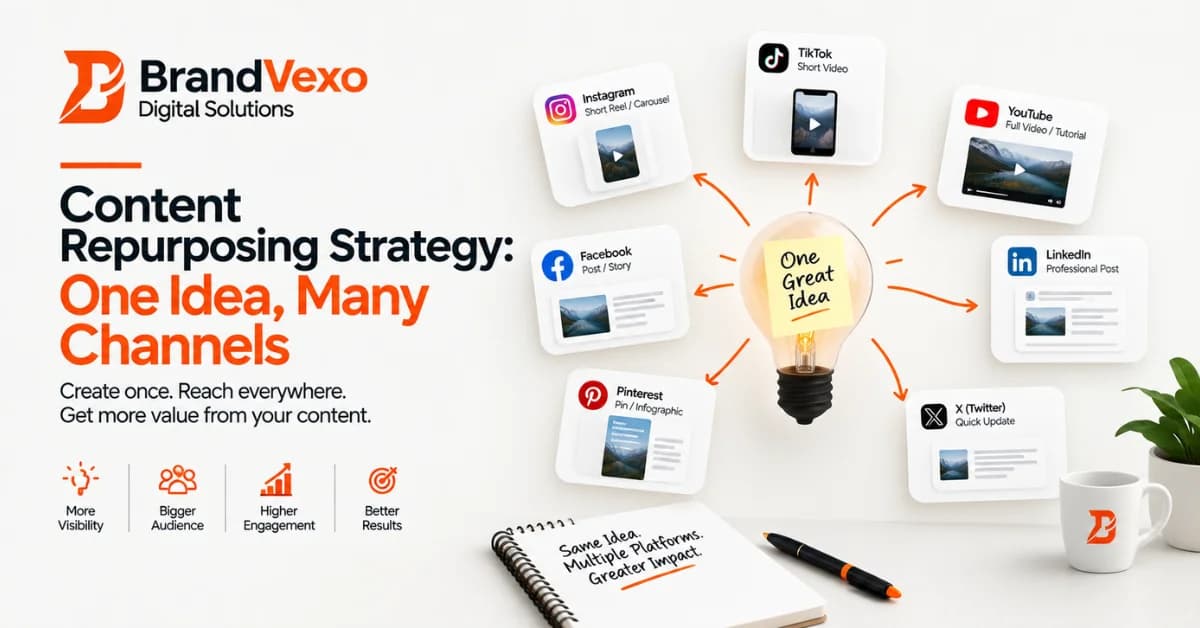
Content Repurposing Strategy: One Idea, Many Channels
Creating valuable content takes time. But many businesses make one common mistake: they publish a blog post, social media update, video, or email once and then move on to the next idea. A Content Repurposing Strategy changes that approach. Instead of creating something completely new for every platform, you can take one strong idea and adapt it into multiple useful content formats.
For example, one detailed blog post can become a LinkedIn post, Instagram carousel, short-form video, email, infographic, and several FAQ answers. Each version can serve a different audience need while keeping the central message consistent.
What Is a Content Repurposing Strategy?
A Content Repurposing Strategy is a planned process for turning an existing piece of valuable content into different formats for different channels. Instead of treating every content asset as a one-time publication, businesses use the original idea as a foundation for additional content.
For example, a business might create a comprehensive article about improving ecommerce conversions. That article could then provide material for:
LinkedIn educational posts
Instagram carousel slides
Short-form videos
Email newsletter content
YouTube explanations
Customer FAQs
Sales presentation points
Downloadable checklists
The key is to create something useful for each channel rather than simply copying and pasting the original article.
Content Repurposing vs. Content Recycling
Content repurposing and content recycling are related, but they are not exactly the same. Content repurposing changes an existing idea into a new format or experience. A 2,000-word article might become a five-minute video or a visual checklist. Content recycling usually involves bringing older content back to an audience with limited changes. For example, a business might reshare an older social media post that is still relevant.
Both approaches can have a place in a content plan. However, repurposing creates more opportunities to adapt the original information to different user preferences.
Why Businesses Repurpose Content
A thoughtful repurposing process can help businesses:
Reduce the pressure to create new ideas constantly
Extend the useful life of valuable content
Reach audiences on different platforms
Build consistent brand messaging
Create more opportunities for engagement
Support different stages of the customer journey
Make better use of existing research and expertise
The strategy works particularly well for small marketing teams because it focuses on getting more value from strong ideas instead of producing a large volume of unrelated content.
Why One Idea Can Become Multi-Channel Content
People do not consume information in exactly the same way. One person may prefer reading a detailed article, while another may watch a short video or save an Instagram carousel. Someone else may prefer receiving the same insight through an email newsletter. That is why multi-channel content can make a content strategy more flexible.
The core idea can remain consistent, while the format changes according to the channel.
Start With One Strong Content Pillar
The original content asset becomes your content pillar. This could be:
A detailed blog post
A case study
A webinar
A podcast episode
A YouTube video
Original research
An expert interview
A comprehensive guide
A frequently asked customer question
Choose a topic that contains enough useful information to create smaller pieces of content.
A weak or very narrow idea may not provide enough material for meaningful repurposing.
Adapt the Idea to the Audience and Platform
Do not publish identical versions everywhere. A LinkedIn audience may respond well to a professional lesson or business insight. An Instagram audience may prefer a visual checklist. A YouTube audience may want a detailed explanation.
The subject can remain the same, but the presentation should change.
How to Repurpose Content Step by Step
A successful Content Repurposing Strategy needs a repeatable workflow. The following process can help turn one strong idea into several useful assets.
1. Choose a High-Value Original Idea
Start with content that answers a genuine audience question. Look at topics that demonstrate expertise, solve a customer problem, explain a process, or provide useful examples.
Evergreen topics are particularly useful because you can update and repurpose them over a longer period.
2. Break the Core Idea Into Smaller Topics
Read through the original content and identify its strongest individual ideas.
Look for:
Important statistics
Common mistakes
Step-by-step instructions
Frequently asked questions
Examples
Definitions
Expert insights
Practical tips
Key takeaways
Each point can potentially become another content asset.
3. Match Each Point to the Right Channel
Once you have extracted the important ideas, decide where each one makes sense.
For example:
Blog post → LinkedIn post → Instagram carousel → Short-form video → Email
The same core topic can move through several channels without requiring the team to start from zero every time.
4. Reformat Instead of Copying
This step separates effective repurposing from simple duplication. Change the introduction, hook, examples, length, visual format, and call to action according to the platform. For instance, a detailed SEO article might explain ten strategies. A short video could focus on only one strategy and give viewers a practical action to take.
5. Schedule and Distribute the Assets
Creating several versions is only part of the process. You also need a content distribution plan.
Decide:
Where each asset will be published
When it will go live
Who it is intended for
What action you want users to take
Which performance metric matters
This turns repurposing from an occasional activity into a structured content system.
Content Repurposing Examples: One Idea, Many Formats
Consider a digital marketing agency that publishes a detailed article titled “How Small Businesses Can Improve Their SEO.”
Instead of using that article only on its website, the agency could repurpose it into:
Blog: Complete SEO guide
LinkedIn: Five common SEO mistakes
Instagram: SEO checklist carousel
Short-form video: Three SEO improvements businesses can make today
Email: One practical SEO lesson with a link to the complete guide
YouTube: Detailed SEO tutorial
FAQ content: Individual answers to common SEO questions
Lead magnet: Downloadable SEO checklist
The original article remains the main content pillar, while each additional format serves a specific purpose.
This approach also creates opportunities to connect related topics such as content marketing strategy, SEO content strategy, social media content, evergreen content, and content distribution.
How Content Distribution Makes Repurposing More Effective
Creating content does not automatically mean people will see it. Content distribution is the process of getting useful content in front of the audiences and channels where it can provide value. A business may have excellent content but still struggle to reach its audience if it publishes once and stops.
Owned Distribution Channels
Owned channels are platforms the business controls, such as:
Website
Blog
Email newsletter
Company social profiles
YouTube channel
These channels can provide a consistent home for the brand's content.
Social and Community Distribution
Social platforms can help businesses present smaller parts of larger content ideas. For example, a long article can provide several educational LinkedIn posts or short videos. The objective should not be to publish everywhere. Choose channels where the target audience actually spends time.
Search Distribution
Search is another important part of content distribution. A well-structured article can target relevant informational queries, while internal links can help users move between related pages on a website.
Google's guidance recommends using words that people actually use to search for content and creating pages primarily to help people rather than manipulating rankings.
Best Content Formats to Repurpose
Different formats serve different purposes, so choose the format based on the information and audience.
Blog Posts
Blog posts work well for detailed explanations, search-focused topics, tutorials, and evergreen information. A comprehensive article can also provide the source material for multiple smaller assets.
Short-Form Videos
Short videos can turn individual tips, questions, statistics, or mistakes into quick educational content. One long article might provide several video topics without requiring completely new research.
Social Media Posts and Carousels
Social posts work well for:
Quick tips
Checklists
Quotes
Statistics
Mistakes
Step-by-step processes
Key takeaways
Carousels can break a complicated topic into smaller, easier-to-follow sections.
Email Content
Email provides another way to deliver existing insights directly to subscribers. Instead of sending the entire original article, select one useful lesson and explain why it matters. Then direct interested readers to the complete resource.
Podcasts, Webinars, and Long-Form Videos
Long-form content can produce many smaller assets. A webinar, for example, can become short clips, social posts, email insights, FAQs, quotes, blog sections, and video highlights.
Content Repurposing Strategy for Small Businesses
Small businesses often have limited time and marketing resources. That makes a structured Content Repurposing Strategy especially useful.
Consider a Dubai-based digital agency that publishes a guide about local SEO for UAE businesses.
The agency could turn that one guide into:
A website article targeting informational search queries
LinkedIn posts for business owners
An Instagram carousel about local SEO mistakes
A short video answering one common question
An email explaining one practical improvement
A downloadable local SEO checklist
FAQ content addressing related customer questions
The team does not need seven completely different ideas. It needs one strong idea and a clear process for adapting that idea.
A simple weekly system can make this easier: choose one core topic, create one primary asset, extract the strongest insights, and distribute those insights across selected channels.
Common Content Repurposing Mistakes to Avoid
Copying the Same Post Everywhere
A piece of content should feel native to the platform where it appears. Users should not have to read a long article pasted into a social media caption to understand the point.
Repurposing Weak Content
Repurposing does not automatically make poor content valuable. Start with useful information, then adapt it carefully. Google recommends creating original, substantial, reliable content that provides value beyond simply repeating what already exists online.
Ignoring Search Intent
Different content formats can answer different needs. Someone searching for a detailed guide may want comprehensive information. Someone watching a 30-second video may want one quick answer.
Keep the audience's purpose in mind when adapting content.
Publishing Without a Distribution Plan
Creating ten pieces from one article is not enough. You also need to determine where those pieces will appear, when they will be published, and what outcome you want from each channel.
Chasing Every Platform
You do not need to maintain an active presence on every social network. Focus on channels that match your audience, resources, and business goals.
Focusing Only on Quantity
The purpose of repurposing is not to create the largest possible number of posts. The purpose is to make valuable information more accessible in useful formats.
How to Measure a Content Repurposing Strategy
Measure the performance of each channel according to its purpose.
Useful metrics include:
Organic search traffic
Search impressions
Engagement
Video views and watch time
Email clicks
Social saves and shares
Referral traffic
Leads
Enquiries
Conversions
Content production time
A blog post may generate organic traffic, while a social post may generate saves and shares. An email may generate clicks, while a video may introduce your brand to a new audience.
Do not expect every format to produce the same result.
The more useful question is whether each content asset is contributing to the larger marketing system.
A Simple Content Repurposing Workflow
You can turn the strategy into a repeatable process:
One idea → One pillar asset → Key insights → Platform adaptations → Content distribution → Performance tracking → Update and reuse
Weekly Repurposing Workflow
Monday: Publish the main content asset.
Tuesday: Extract two or three important insights for social media.
Wednesday: Create a short-form video from one practical point.
Thursday: Turn another insight into an email.
Friday: Review performance and identify content worth updating or repurposing again.
This workflow reduces the pressure to invent something completely new every day.
How to Build a Sustainable Multi-Channel Content System
A sustainable system starts with audience needs rather than a desire to publish more. Build content around questions customers actually ask. Keep a library of existing articles, videos, research, FAQs, and other useful assets.
Create templates for common formats so your team does not need to reinvent the process every time.
A simple content repurposing matrix can track:
Original content asset
Core idea
Target audience
Platform
New format
Publishing date
Call to action
Performance metric
Repurposing status
Over time, your analytics can reveal which topics and formats deserve further investment.
Google's current guidance for AI features also emphasizes unique, useful, people-first content rather than commodity content that simply repeats information already available elsewhere.
FAQs
What is a Content Repurposing Strategy?
A Content Repurposing Strategy is a planned method for turning one valuable content idea into multiple formats for different audiences and channels.
How do you repurpose content effectively?
Start with a strong original asset, identify its most useful insights, adapt those insights to appropriate platforms, distribute each format strategically, and measure the results.
What content can be repurposed?
You can repurpose blog posts, videos, podcasts, webinars, case studies, research, newsletters, interviews, guides, customer questions, and other valuable content.
Is repurposing content good for SEO?
Repurposing can help businesses make useful information available in different formats and support broader content distribution. However, simply duplicating the same content across pages does not automatically create SEO value. The focus should remain on useful, original content that satisfies the user's needs.
How often should you repurpose content?
There is no universal frequency. Repurpose content when the topic remains relevant, the information can provide value in another format, and the new version fits the target audience and channel.
What is the difference between repurposing and reposting?
Reposting usually shares existing content again with little change. Repurposing adapts the original idea into a new format, presentation, or experience for a different channel or audience.
How BrandVexo Can Help!
BrandVexo helps businesses build practical digital growth systems across digital marketing, SEO, web development, AI automation, and business solutions. Our approach focuses on measurable business outcomes rather than vanity metrics, helping businesses turn digital activity into clearer, more practical growth opportunities.
We can help you develop a content strategy, identify opportunities to repurpose existing assets, improve SEO visibility, and build a more consistent multi-channel content system.
Phone: +971 52 356 5409
Email: info@brandvexo.com
Website: www.brandvexo.com
If your business already has valuable content but is not getting enough from it, reviewing your existing content library can be a practical place to start.
Conclusion
A strong Content Repurposing Strategy helps businesses move away from creating every piece of content from scratch. The process starts with one valuable idea. From there, you can identify useful insights, adapt them to different formats, distribute them through relevant channels, and measure what works.
Disclaimer: Content marketing and SEO results vary based on industry, audience, competition, content quality, and implementation. The strategies discussed in this article are general guidance and should be adapted to your business objectives and audience.
Free growth plan
Ready to grow your business?
Reading is a start — now let's build it. Tell us where you want to grow and a senior strategist will map the fastest, most profitable way to get there. Free, no obligation.
Discussion
Join the conversation
Be the first to comment. Comments are reviewed before they appear, so yours won't show up instantly — but we read every one.
Leave a comment
Keep reading
All articles Growth
AI Content for SEO: How to Use It Without Publishing Slop
Learn how to use AI content for SEO without publishing low-quality content. Explore AI writing, human editing, fact-checking, and practical SEO workflows.
 Growth
Blog SEO: How to Turn Articles Into Organic Growth
Learn how Blog SEO can turn useful articles into organic growth with search intent, content optimization, internal linking, measurement, and content refreshes.
 Growth
Content Audit Checklist: What to Update, Merge or Delete
Use this Content Audit Checklist to find outdated, duplicate, and low-value pages, then decide what to update, merge, redirect, or delete.