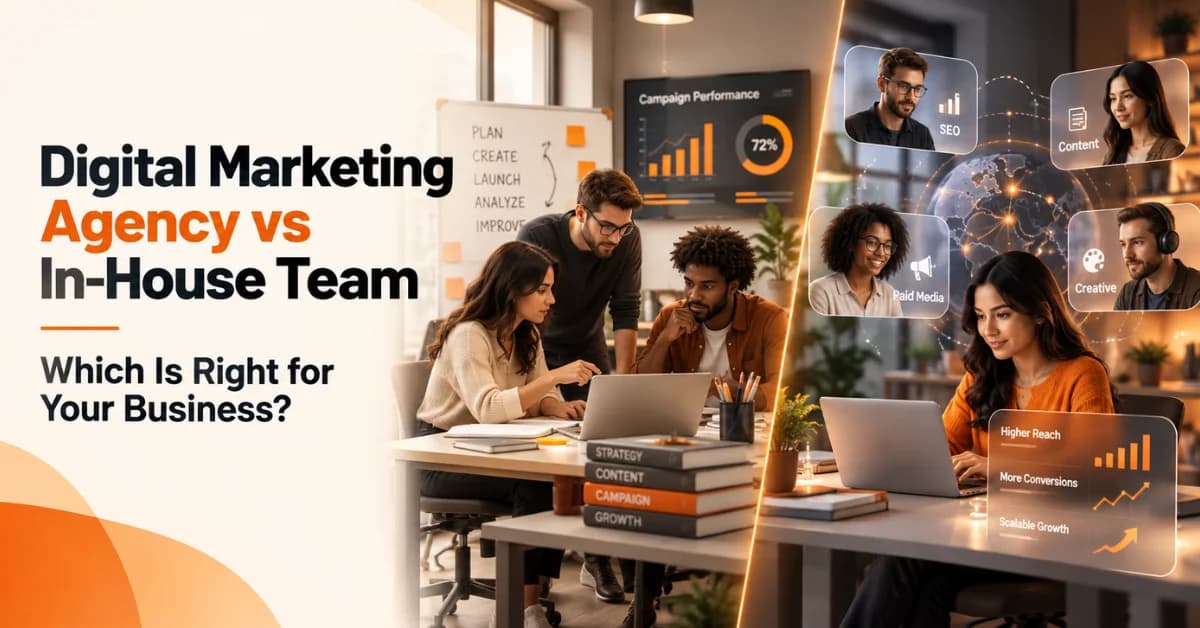
Digital Marketing Agency vs In-House Team: Which Is Right for Your Business?
Choosing between a digital marketing agency and an in-house marketing team is not simply a question of hiring employees or outsourcing work. It is a strategic decision that can affect your budget, speed, expertise, scalability, brand consistency, and long-term growth.
For a startup, hiring several specialists may be difficult. For an established company, building an internal team may provide greater control and deeper product knowledge. There is also a third option that businesses often overlook: a hybrid marketing model that combines internal expertise with external specialists.
What Is the Difference Between an In-House Marketing Team and a Digital Marketing Agency?
Before comparing the two approaches, it helps to understand how each one works.
What Is an In-House Marketing Team?
An in-house marketing team consists of employees who work directly for your company. Depending on the size of the business, the team might include a marketing manager, SEO specialist, content writer, social media manager, paid advertising specialist, designer, or marketing analyst.
The main advantage is proximity. Internal employees work closely with management, sales, product teams, and customer service. Over time, they can develop a strong understanding of the company's products, customers, positioning, and goals.
However, building a complete team can require significant investment in salaries, recruitment, training, software, management, and employee development.
What Does a Digital Marketing Agency Do?
A digital marketing agency provides marketing services as an external partner. Instead of hiring every specialist internally, a company can work with an agency that already has expertise across areas such as:
Search engine optimization
Content marketing
Social media marketing
Paid advertising
Website development
Conversion optimization
Analytics
Marketing strategy
AI automation
This can give a business access to multiple skill sets without building an equally large internal department.
Digital Marketing Agency vs In-House: Key Differences
The right model depends on what your business values most.
Factor | In-House Team | Digital Marketing Agency |
|---|---|---|
Control | High | Shared |
Company knowledge | Very strong | Develops over time |
Specialist expertise | Depends on team size | Usually broader |
Recruitment | Required | Usually not required |
Software costs | Business pays | Often included or shared |
Scalability | Requires hiring | Usually more flexible |
Communication | Direct internal access | Requires coordination |
Flexibility | Depends on employee capacity | Can often scale services |
Long-term internal knowledge | Strong | Less centralized |
Multiple marketing channels | Requires multiple specialists | Often available through one partner |
Neither model automatically wins. The better choice depends on your marketing workload, budget, internal capabilities, and growth plans.
Cost of an In-House Marketing Team vs Outsourcing Marketing
Cost is one of the biggest factors businesses consider when comparing these models. However, comparing an employee's salary with an agency's monthly fee gives an incomplete picture.
What Does an In-House Marketing Team Really Cost?
An internal team can involve more than payroll.
Consider:
Recruitment costs
Salaries
Employee benefits
Training
Marketing software
SEO platforms
Design tools
Advertising management tools
Management time
Office and operational costs
Employee replacement costs
For example, a company may hire one marketing executive and expect that person to handle SEO, content, social media, paid advertising, analytics, and strategy.
That approach may work for a small operation, but one person rarely has advanced expertise in every marketing discipline.
The company may eventually need to hire additional specialists.
How Outsourcing Marketing Changes the Cost Structure
With outsourcing marketing, a company can access external expertise without adding every specialist to its payroll. For example, an agency may provide access to SEO, content, design, paid advertising, social media, analytics, and strategy through one relationship.
That does not mean outsourcing is always cheaper. An agency can cost more than one employee while still providing significantly more specialist capacity.
The better question is:
What business outcome do you get from the total investment?
Which Option Is More Cost-Effective?
An in-house team may become more cost-effective when a business has a large and consistent marketing workload that justifies full-time employees. Outsourcing may make more sense when the company needs several specialist skills but does not have enough work to justify hiring each person full-time.
Expertise and Skills: Agency vs In-House Marketing Team
Expertise can significantly influence marketing performance.
Advantages of an Agency's Specialized Expertise
A good agency may provide access to specialists working across different channels.
This can include:
SEO specialists
Content strategists
PPC professionals
Social media managers
Web developers
Designers
Analytics specialists
Conversion optimization experts
This breadth can be particularly useful when a business wants to expand its digital presence quickly.
Advantages of In-House Expertise
Internal marketers have a different advantage: deep organizational knowledge.
They can understand:
Products and services
Customer objections
Sales processes
Internal priorities
Company culture
Brand positioning
Industry-specific challenges
An employee who works with the company every day can develop knowledge that an external partner may take longer to acquire.
Which Model Gives You Better Marketing Expertise?
Think of the difference as breadth versus depth. An agency can provide access to multiple specialists and experiences. An internal team can develop deep knowledge of one organization.
The best option depends on which capability your business currently lacks.
Control, Communication and Brand Knowledge
Control is another important part of the digital marketing agency vs in house decision.
Control With an In-House Marketing Team
An internal team usually provides direct access to employees.
Managers can:
Set priorities directly
Change campaigns quickly
Coordinate with sales
Review work internally
Share company information immediately
This can be valuable for businesses where marketing closely connects with product development or daily operations.
Control When Working With an Agency
Working with an agency does not mean giving up control.
Businesses can establish:
Monthly objectives
Campaign approval processes
Reporting schedules
Key performance indicators
Content guidelines
Brand guidelines
Communication procedures
The key is to establish clear expectations before work begins.
A strong agency relationship should feel like a structured partnership rather than simply handing marketing responsibilities to an outside company.
Scalability and Flexibility: Which Marketing Model Adapts Faster?
Marketing requirements can change quickly. A business might launch a new product, enter a new market, increase advertising expenditure, or suddenly need technical SEO support.
Scaling an In-House Team
Growing an internal team usually requires additional recruitment.
That means the company may need to:
Identify the required skill.
Advertise the position.
Interview candidates.
Hire someone.
Train the employee.
Integrate the employee into existing processes.
This can work well for long-term needs, but it takes time.
Scaling With a Digital Marketing Agency
An agency may provide greater flexibility when marketing requirements change. For example, a business could initially need SEO and content marketing and later add paid advertising, web development, or conversion optimization. The company can potentially expand its external support without going through a new recruitment process for every capability.
Digital Marketing Agency vs In-House: Pros and Cons
There is no perfect model. Each option has trade-offs.
Pros of an In-House Marketing Team
Direct management
Strong company knowledge
Close collaboration with internal departments
Dedicated attention
Long-term organizational knowledge
Direct access to internal data
Cons of an In-House Marketing Team
Recruitment takes time
Salaries create fixed costs
Specialist hiring can become expensive
Employee turnover can disrupt campaigns
Training requires resources
More software may be required
Pros of a Digital Marketing Agency
Access to multiple specialists
Flexible resources
Experience across different businesses
Established marketing processes
Potential access to professional tools
Easier to expand services
Cons of a Digital Marketing Agency
Requires effective communication
Less direct day-to-day control
Quality varies between agencies
The agency needs time to understand the business
Poorly defined expectations can create problems
The important point is to evaluate the specific agency and business requirements, rather than assuming all agencies operate in the same way.
When Should You Hire an In-House Marketing Team?
An internal team can be a strong choice when marketing has become a core business function.
Consider building an in-house team if:
You have consistent marketing work throughout the year.
Marketing requires daily collaboration with internal departments.
You have sufficient budget for recruitment and salaries.
Your business needs deep product knowledge.
You already have experienced marketing leadership.
You want direct control over daily marketing operations.
You expect to maintain a large marketing operation long term.
For example, a large e-commerce company running campaigns continuously across multiple product categories may benefit from dedicated internal marketing employees.
When Should You Choose a Digital Marketing Agency?
A digital marketing agency can make sense when a business needs specialist support without building a large department.
You may consider an agency if:
You are launching a new business.
Your internal marketing resources are limited.
You need several specialist skills.
You want to strengthen SEO.
You need professional content production.
You want external paid advertising expertise.
You need flexible marketing capacity.
You do not want to manage multiple specialist hires.
For example, a growing service business may need SEO, content, website improvements, social media, and lead-generation support but may not have enough workload to employ a full-time specialist for each area.
What About a Hybrid Marketing Model?
Businesses do not always need to choose between only two options. A hybrid marketing model combines an internal team with external specialists.
How a Hybrid Marketing Team Works
The internal team might handle:
Brand direction
Product knowledge
Customer insights
Internal communication
Marketing leadership
Sales alignment
An external agency might handle:
SEO
Technical SEO
Content production
Paid advertising
Website development
Analytics
Marketing automation
This approach allows the business to keep strategic knowledge internally while accessing specialist expertise externally.
When Is a Hybrid Model the Best Choice?
A hybrid structure can work particularly well for growing companies that already have some marketing capabilities but need additional expertise. For example, an internal marketing manager could manage strategy and brand direction while an external agency handles SEO, content, technical development, and specialized campaigns.
This creates a useful combination:
Internal knowledge + external expertise + flexible resources.
How to Choose Between a Digital Marketing Agency and an In-House Team
Instead of choosing based purely on price, ask these questions.
1. What Is Your Marketing Budget?
Calculate the total cost of salaries, tools, management, recruitment, advertising, and external services.
2. How Many Skills Do You Need?
If you need SEO, PPC, content, social media, design, web development, and analytics, determine whether you can realistically build those capabilities internally.
3. How Quickly Do You Need Support?
If you need specialist resources immediately, outsourcing may provide a faster route than recruitment.
4. How Much Control Do You Need?
Businesses requiring close daily management may prefer internal employees. Others may be comfortable managing an external partner through agreed processes.
5. Is Your Marketing Workload Stable?
A consistent, long-term workload can justify internal hiring. Variable requirements may favor external support.
6. What Does Your Business Need Over the Next 12–24 Months?
Avoid making the decision based only on today's needs. Your marketing structure should support your expected growth.
A Simple Decision Rule
Small business + limited expertise → Digital marketing agency
Established business + consistent marketing workload → In-house team
Growing company + internal marketing leadership → Hybrid model
Short-term specialist requirement → Agency
Need for deep internal product knowledge → In-house
Need for both internal knowledge and specialist expertise → Hybrid
How to Compare Digital Marketing Agencies Before Hiring One
A proper agency comparison should look beyond price.
Check Relevant Experience
Look for experience with:
Your industry
Similar business models
Similar customer groups
Similar marketing challenges
Relevant experience does not guarantee results, but it can reduce the learning curve.
Review Strategy and Reporting
Ask potential agencies how they measure performance.
Important areas include:
KPIs
Conversion tracking
Organic traffic
Qualified leads
Campaign performance
Content performance
Reporting frequency
Avoid agencies that focus only on surface-level metrics without connecting marketing activity to business outcomes.
Understand Pricing and Deliverables
Before signing an agreement, clarify:
Monthly fees
Services included
Advertising budget
Contract length
Reporting
Communication
Revision policies
Additional charges
Clear expectations reduce misunderstandings later.
Do Not Choose an Agency Based Only on Price
The cheapest option may not provide the expertise, strategy, communication, or resources your business requires.
Instead, compare expected value, capabilities, processes, transparency, and fit.
Digital Marketing Agency vs In-House Team: Which Is Better?
There is no universally better option. An in-house marketing team can be the better choice when your business needs direct control, deep company knowledge, and consistent full-time marketing operations. A digital marketing agency can be the better choice when you need specialist expertise, flexible resources, multiple marketing capabilities, or faster access to experienced professionals.
A hybrid model may be the strongest option when your business wants internal strategic control while using external specialists for areas that require additional expertise.
The right question is not simply:
“Should I hire an agency or an employee?”
Instead ask:
“Which marketing structure gives my business the capabilities it needs at its current stage of growth?”
How BrandVexo Can Support Your Digital Marketing Strategy
Choosing between an internal team and outsourcing marketing can be difficult when you are unsure which capabilities your business actually needs. BrandVexo helps businesses build practical digital growth systems across digital marketing, SEO, web development, AI automation, content strategy, social media, and business solutions.
Rather than assuming every business needs the same solution, the right approach starts with understanding your goals, audience, existing capabilities, and growth priorities.
If you need help evaluating your current marketing structure or identifying areas where external expertise could complement your internal team, BrandVexo can help you develop a practical strategy.
Contact BrandVexo
Phone: +971 52 356 5409
Email: info@brandvexo.com
Website: www.brandvexo.com
Frequently Asked Questions
Is it cheaper to hire an in-house marketing team or an agency?
It depends on the scope of work. An in-house team involves salaries, benefits, recruitment, training, software, and management costs. An agency provides external expertise through a service fee. Compare the total cost against the capabilities and business outcomes you need.
What are the disadvantages of outsourcing marketing?
Potential disadvantages include less direct control, communication requirements, inconsistent agency quality, and the time needed for an external partner to understand your business. A clear strategy, defined responsibilities, and regular reporting can reduce these challenges.
Is an in-house marketing team better than an agency?
Not necessarily. In-house teams provide direct control and deep company knowledge, while agencies can provide broader specialist expertise and flexible resources. The right choice depends on the company's requirements.
When should a small business hire a digital marketing agency?
A small business may consider an agency when it needs specialist marketing skills but does not have enough budget or workload to employ multiple full-time specialists.
Can an in-house team work with a digital marketing agency?
Yes. This is the basis of the hybrid model. An internal team can manage brand strategy and business knowledge while an agency provides specialist services such as SEO, content, paid advertising, web development, or analytics.
What is the biggest difference between agency and in-house marketing?
The biggest difference is where marketing capabilities sit. An in-house team works directly inside the business, while an agency provides marketing expertise externally across an agreed scope of work.
How do I choose the right digital marketing agency?
Compare relevant experience, strategy, communication, reporting, pricing, services, transparency, and how well the agency understands your business goals. Avoid selecting a provider based only on the lowest price.
Conclusion
The digital marketing agency vs in house decision should be based on your business—not on a universal rule that one model is always better. An internal team can provide control, company knowledge, and long-term ownership. An agency can provide specialist expertise, flexibility, and access to multiple capabilities. A hybrid approach can combine both when a business has an internal marketing foundation but needs additional expertise.
Before deciding, evaluate your budget, marketing workload, required skills, growth plans, desired control, and expected outcomes.
Disclaimer: This article provides general information for educational purposes only. Digital marketing results, costs, and business outcomes vary depending on industry, strategy, budget, competition, and execution. Businesses should assess their specific needs before choosing an in-house, agency, or hybrid marketing model.
Free growth plan
Ready to grow your business?
Reading is a start — now let's build it. Tell us where you want to grow and a senior strategist will map the fastest, most profitable way to get there. Free, no obligation.
Discussion
Join the conversation
Be the first to comment. Comments are reviewed before they appear, so yours won't show up instantly — but we read every one.
Leave a comment
Keep reading
All articles Growth
TikTok Marketing for Business: Is It Worth It in 2026?
TikTok Marketing for Business in 2026: explore TikTok strategy, TikTok ads, TikTok search, content ideas, costs, KPIs, and practical growth tips.
 Growth
Instagram Marketing Strategy for Service Businesses: A Practical Guide
Build an Instagram Marketing Strategy for service businesses with practical tips for content, engagement, lead generation, trust, and measurable growth.
 Growth
LinkedIn Marketing for B2B: How to Build Demand
Learn how LinkedIn Marketing for B2B builds demand through content, founder branding, audience targeting, lead generation, and measurable strategy.