

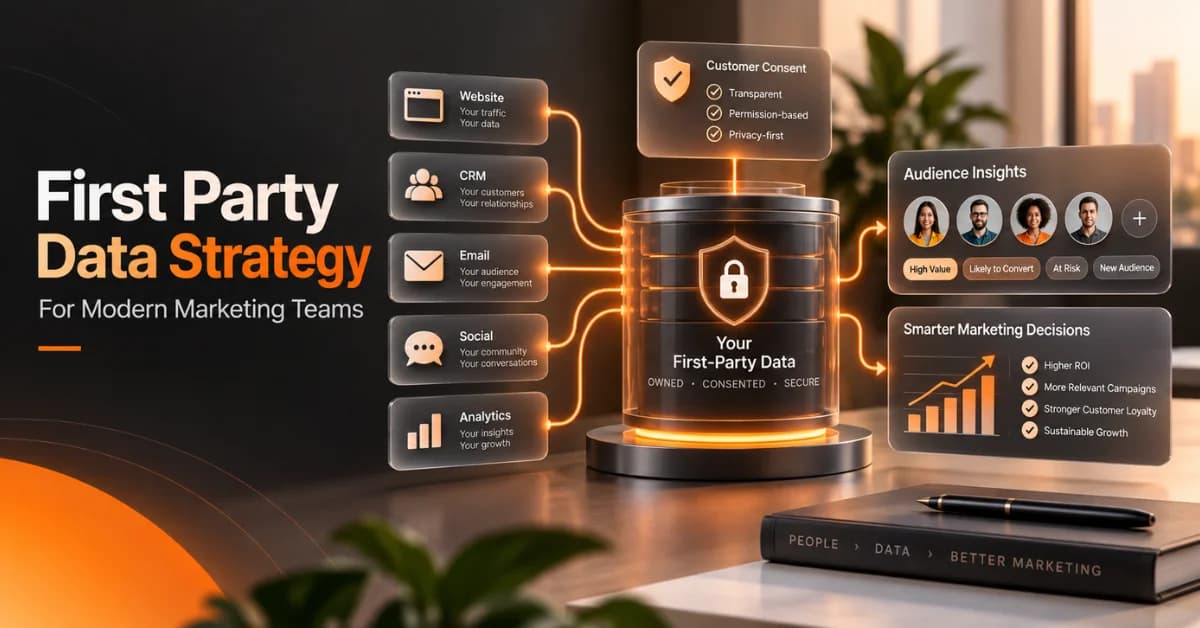
First Party Data Strategy for Modern Marketing Teams
Marketing teams have more data than ever, but having more data does not automatically lead to better marketing. The real advantage comes from knowing what information to collect, how to organize it, and how to turn it into useful customer experiences. That is where a first party data strategy becomes important.
First-party data gives businesses a direct source of customer information collected through their own websites, apps, CRM systems, purchases, forms, email interactions, surveys, and other customer touchpoints. When businesses manage this information responsibly, they can improve personalization, audience segmentation, conversion tracking, customer retention, and marketing decisions.
A strong strategy also connects CRM data, customer insights, marketing data, analytics, and conversion tracking instead of keeping each source in isolation.
What Is a First Party Data Strategy?
A first party data strategy is a structured plan for collecting, organizing, protecting, analyzing, and activating information that a business obtains directly from its customers or audience. For example, when someone creates an account on your website, subscribes to your newsletter, purchases a product, fills out a lead form, or interacts with your customer service team, the resulting information can become part of your first-party data ecosystem.
Unlike purchased or externally sourced information, first-party data comes from interactions that your business owns or directly manages.
Examples of First-Party Data
Common examples include:
Website form submissions
Customer account information
Purchase history
Email subscriptions
CRM records
Customer service interactions
Loyalty program activity
App engagement
Website behavioral data
Survey responses
Event registrations
Product preferences
Customer feedback
The value of this information depends on its quality, relevance, consent, and how effectively your team uses it.
A business should not collect information simply because it is technically possible. Every data point should have a clear purpose.
Why First-Party Data Matters for Modern Marketing
Marketing has become increasingly dependent on measurable customer signals, while privacy expectations and data restrictions continue to evolve. A first-party approach gives businesses greater control over information gathered through their own customer relationships. It can also create a stronger foundation for personalization and measurement.
A well-designed customer data strategy can help businesses:
Understand customer behavior
Improve audience segmentation
Personalize campaigns
Strengthen customer relationships
Improve conversion measurement
Support retention campaigns
Identify high-value customers
Improve marketing decisions
Reduce dependence on external audience data
However, first-party data is not automatically valuable simply because a company collected it. Poor-quality, outdated, duplicated, or disconnected information can create the same problems as having too little data.
First-Party Data vs. Third-Party Data
First-party data is collected directly through a company's own customer interactions. Third-party data is obtained from external organizations that collect or aggregate information across different sources.
The practical difference is important.
First-party data:
Comes directly from your audience
Provides context from your own customer relationships
Can support personalized experiences
Gives businesses greater control over collection and use
Third-party data:
Comes from external providers
May provide broader audience information
Creates dependency on outside sources
Can involve additional privacy and data-quality considerations
The goal is not simply to collect more data. The goal is to develop trusted, useful, and actionable customer information.
How to Build a First Party Data Strategy Step by Step
Building a strategy does not require an enterprise-level technology stack from day one. Start with your business objectives, understand the data you already have, and improve the system gradually.
1. Define Your Business and Marketing Goals
Start with the outcome you want to achieve.
Your goal might be to:
Increase qualified leads
Improve conversion rates
Reduce customer acquisition costs
Increase repeat purchases
Improve customer retention
Personalize marketing campaigns
Increase customer lifetime value
Improve advertising measurement
For example, an e-commerce business might want to increase repeat purchases. Instead of collecting every possible customer attribute, it could focus on purchase history, product preferences, purchase frequency, and engagement.
This keeps data collection connected to a real business purpose.
2. Identify the First-Party Data You Already Have
Before investing in new tools, conduct a data audit.
Look at the information already available through:
Website analytics
CRM systems
Email marketing platforms
E-commerce platforms
Lead-generation forms
Customer support software
Mobile applications
Loyalty programs
Sales interactions
Customer surveys
This step often reveals that businesses already have valuable CRM and marketing data, but that data is fragmented across different systems.
3. Create Valuable Data Collection Touchpoints
Customers are more likely to share useful information when they understand what they receive in return.
Businesses can create voluntary data-sharing opportunities through:
Newsletter subscriptions
Account creation
Product recommendations
Downloadable resources
Surveys
Quizzes
Loyalty programs
Free tools
Webinars
Preference centers
For example, an online retailer could ask customers about their product preferences to provide better recommendations.
The important principle is simple: provide value in exchange for information.
4. Connect Your Data Across Platforms
Data becomes much more useful when marketing, sales, customer service, and analytics systems can work together.
A typical customer journey may involve:
Website → Lead Form → CRM → Email Platform → Sales Team → Purchase → Retention Campaign
If every system stores information separately, the marketing team may struggle to understand the complete customer journey.
Depending on the size and complexity of the organization, businesses may use CRM integrations, customer data platforms, analytics systems, data warehouses, or other technologies to connect these sources.
5. Clean and Organize Customer Data
Poor data quality can undermine an otherwise sophisticated marketing system.
Regularly look for:
Duplicate customer records
Missing information
Invalid email addresses
Outdated customer details
Inconsistent naming conventions
Incorrect lead sources
Incomplete purchase records
Data hygiene should become an ongoing process rather than a one-time cleanup project.
6. Segment Customers Based on Useful Signals
Not every customer should receive the same message.
Useful segments can include:
New visitors
New leads
First-time customers
Repeat customers
High-value customers
Abandoned-cart users
Inactive customers
Product-interest groups
Customers approaching renewal
Effective segmentation allows marketing teams to make campaigns more relevant without treating every customer as an individual manually.
How CRM Data Strengthens a First Party Data Strategy
CRM data can become one of the most valuable components of a first-party data strategy because it connects marketing activity with actual customer and sales relationships. A CRM may contain information about leads, opportunities, purchases, communication history, customer status, and sales activity.
When marketing teams connect this information with behavioral data, they can make more informed decisions.
CRM Data You Should Track
Depending on your business model, useful CRM information can include:
Lead source
Customer lifecycle stage
Purchase history
Deal value
Communication history
Product interest
Customer interactions
Renewal status
Sales activity
Customer value
The exact fields should depend on your business needs and privacy requirements.
Turning CRM Data Into Marketing Actions
Consider a simple example. A company discovers through its CRM that a group of customers made one purchase six months ago but has not purchased again. Instead of sending another generic promotional email to its entire database, the company can create a re-engagement segment for these customers.
The campaign might offer relevant educational content, product recommendations, or a suitable incentive.
The CRM did not create the marketing strategy on its own. It provided the customer context needed to make the strategy more relevant.
Using Conversion API With First-Party Data
The Conversion API (CAPI) is another important concept for modern digital marketing teams. In simple terms, server-side conversion tracking allows businesses to send certain conversion events from their server or backend systems to an advertising platform instead of relying entirely on browser-based tracking.
This can support more reliable measurement when browser environments, privacy controls, connectivity issues, or tracking limitations affect the availability of signals.
First-Party Data and Conversion API
Conversion API and first-party data are related, but they are not the same thing. First-party data describes information a business collects directly from its audience or customers. Conversion API describes a method of transmitting certain conversion events to an advertising platform.
A business may use both as part of a broader measurement strategy.
For example, an e-commerce company could use its own order system to understand purchases and use server-side conversion events to communicate relevant conversion information to an advertising platform.
The implementation should still respect applicable privacy requirements, consent choices, data minimization principles, and platform requirements.
How to Use First-Party Data Across the Marketing Funnel
A strong strategy should support the complete customer journey rather than focusing only on advertising.
Awareness
At the awareness stage, marketing teams can analyze:
Content interests
Website engagement
Landing-page behavior
Topic preferences
The goal is to understand which content attracts relevant audiences.
Consideration
During consideration, businesses can use signals such as:
Lead activity
Content downloads
Product interest
Email engagement
Repeat website visits
These signals can help identify prospects who need more information before making a decision.
Conversion
At the conversion stage, businesses can analyze:
Purchase intent
Cart activity
Lead scoring
Conversion events
Sales interactions
This can help marketing and sales teams focus on higher-value opportunities.
Retention
After conversion, first-party data can support:
Re-engagement
Product education
Customer support
Cross-selling
Repeat purchases
Renewal campaigns
Loyalty
Long-term customer information can help identify:
Repeat purchasers
High-value customers
Loyal customers
Referral opportunities
Customers with strong engagement
The result is a customer journey that continues after the first transaction.
First-Party Data Examples for Different Businesses
The best strategy depends on the business model.
E-commerce
An online retailer can connect purchase history, product interests, and customer engagement.
For example:
Purchase history → customer segment → personalized recommendation → repeat purchase
SaaS
A SaaS company can combine CRM records with product usage.
For example:
Product engagement → usage segment → onboarding campaign → retention
B2B
A B2B company can connect lead behavior with CRM information.
For example:
Content engagement → lead scoring → sales qualification → targeted follow-up
Local and Service Businesses
A service business can use inquiry history, customer preferences, appointment records, and previous interactions.
For example:
Service inquiry → CRM record → follow-up sequence → customer conversion
These examples show why the value of first-party data comes from activation, not simply collection.
Privacy, Consent, and First-Party Data Governance
A strong customer data strategy must put privacy and responsible data management at the center.
Businesses should consider:
Consent management
Data minimization
Access controls
Secure storage
Data retention
Customer preferences
Privacy policies
Appropriate data governance
Teams should also understand which data they actually need.
Collecting unnecessary personal information increases complexity without necessarily improving marketing performance.
What Marketing Teams Should Avoid
Avoid:
Collecting unnecessary information
Buying questionable customer lists
Using customer information outside its intended purpose
Keeping inaccurate data indefinitely
Ignoring customer privacy choices
Giving unrestricted access to customer databases
Treating privacy as only a legal or technical issue
Trust is an important part of the customer relationship.
A privacy-first approach can therefore support both responsible marketing and long-term brand value.
Common First Party Data Strategy Mistakes
Collecting Too Much Data
More data does not automatically mean better insights.
Better approach: Define the business purpose before deciding what information to collect.
Keeping Data in Separate Systems
Marketing, sales, and support may each have different versions of the same customer.
Better approach: Establish common customer identifiers, consistent data standards, and appropriate integrations.
Ignoring Data Quality
Duplicate or outdated records can distort segmentation and reporting.
Better approach: Build regular data-quality checks into your workflow.
Focusing Only on Acquisition
Some companies use customer data heavily for lead generation but neglect existing customers.
Better approach: Use first-party information throughout acquisition, conversion, retention, and loyalty.
Treating Privacy as an Afterthought
Privacy should not be added after the technology is already deployed.
Better approach: Consider consent, access, retention, security, and appropriate usage when designing the system.
How to Measure the Success of Your First Party Data Strategy
The number of records in a database is not a meaningful success metric by itself.
Measure whether your data strategy improves business outcomes.
Key First-Party Data KPIs
Track metrics such as:
Lead-to-customer conversion rate
Customer acquisition cost
Return on ad spend
Email conversion rate
Repeat purchase rate
Customer lifetime value
Engagement rate
Lead quality
Audience match rate
Data completeness
Customer retention rate
For example, if your database grows by 30% but conversion rates remain unchanged, the additional records may not be creating meaningful business value.
A better question is:
Is better customer information helping us make better marketing decisions?
First Party Data Strategy for Small Businesses
Small businesses do not need a complex enterprise data infrastructure to get started.
A practical foundation might include:
Website analytics
A CRM
Email marketing software
Conversion tracking
A customer database
A simple reporting dashboard
Start with a small number of useful customer signals.
For example, a service business might initially track:
Lead source → service requested → sales status → customer outcome
Once the process works reliably, the business can add more sophisticated segmentation, automation, and analytics.
This gradual approach is often more practical than purchasing multiple platforms before establishing a clear data strategy.
A Practical First Party Data Strategy Framework
Marketing teams can use this seven-step framework as a starting point:
1. Set Goals
Identify the business outcome you want to improve.
2. Audit Existing Data
Find out what information you already collect and where it lives.
3. Identify Valuable Collection Points
Choose customer touchpoints that provide genuine value.
4. Establish Appropriate Consent
Make privacy and customer choices part of the collection process.
5. Unify and Clean Data
Remove duplicates and create consistent data standards.
6. Activate Customer Segments
Use relevant information to personalize campaigns and customer experiences.
7. Measure and Improve
Track business outcomes and continuously improve the strategy.
The framework is simple, but execution matters more than the number of tools involved.
FAQs
What is a first party data strategy?
A first party data strategy is a plan for collecting, organizing, protecting, analyzing, and using information that a business obtains directly through interactions with its customers or audience.
What is an example of first-party data?
Examples include customer purchase history, website forms, account information, newsletter subscriptions, CRM records, customer service interactions, survey responses, and loyalty activity.
Why is first-party data important for marketing?
It can help businesses understand their own customers, improve segmentation, personalize campaigns, measure customer journeys, and make better marketing decisions while maintaining greater control over how customer information is collected and used.
How does CRM data support marketing?
CRM data gives marketing teams information about leads, customers, sales activity, purchase history, lifecycle stages, and interactions. Connecting this information with marketing activity can improve segmentation and campaign relevance.
What is Conversion API?
Conversion API is a server-side method for sending certain conversion events to an advertising platform. It can complement browser-based tracking and support measurement when implemented appropriately.
Is first-party data better than third-party data?
First-party data can be particularly valuable because it comes directly from a business's own customer relationships. However, its usefulness depends on data quality, relevance, consent, governance, and how effectively the business activates it.
How can small businesses collect first-party data?
Small businesses can start with website forms, CRM records, email subscriptions, purchases, customer surveys, loyalty programs, bookings, and other voluntary customer interactions.
How do you protect first-party customer data?
Businesses should use appropriate security controls, access restrictions, retention policies, consent processes, data minimization, and privacy governance based on their circumstances and applicable laws.
What tools are used for first-party data collection?
Common tools include CRM systems, analytics platforms, email marketing software, e-commerce platforms, customer data platforms, forms, customer support systems, and server-side measurement technologies.
Final Takeaway
A successful first party data strategy is not about collecting as much customer information as possible. It is about collecting the right information, maintaining its quality, protecting customer privacy, and turning useful signals into better experiences and business decisions.
When CRM data, marketing data, customer insights, segmentation, analytics, and conversion measurement work together, marketing teams can build a stronger understanding of the customer journey.
Disclaimer: This article provides general information for educational purposes and should not be considered legal, privacy, or professional marketing advice. Businesses should assess applicable laws, regulations, and platform policies before implementing a first-party data strategy.
Free growth plan
Ready to grow your business?
Reading is a start — now let's build it. Tell us where you want to grow and a senior strategist will map the fastest, most profitable way to get there. Free, no obligation.
Discussion
Join the conversation
Be the first to comment. Comments are reviewed before they appear, so yours won't show up instantly — but we read every one.
Leave a comment
Keep reading
All articles Growth
TikTok Marketing for Business: Is It Worth It in 2026?
TikTok Marketing for Business in 2026: explore TikTok strategy, TikTok ads, TikTok search, content ideas, costs, KPIs, and practical growth tips.
 Growth
Instagram Marketing Strategy for Service Businesses: A Practical Guide
Build an Instagram Marketing Strategy for service businesses with practical tips for content, engagement, lead generation, trust, and measurable growth.
 Growth
LinkedIn Marketing for B2B: How to Build Demand
Learn how LinkedIn Marketing for B2B builds demand through content, founder branding, audience targeting, lead generation, and measurable strategy.