

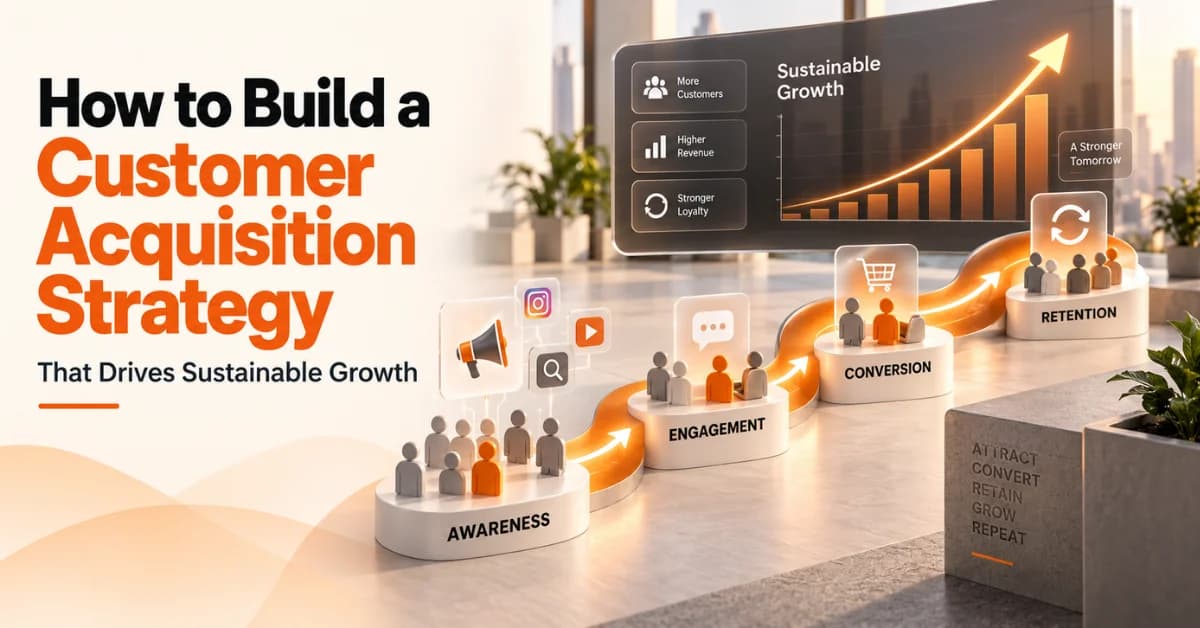
How to Build a Customer Acquisition Strategy That Drives Sustainable Growth
Getting more customers is one of the biggest challenges for any growing business. You can have a strong product, competitive pricing, and a professional website, but growth becomes difficult when you do not have a reliable way to attract and convert the right people. A customer acquisition strategy gives your business a structured approach to finding potential customers, engaging them, converting them into buyers, and measuring the results. Instead of spending money across random marketing channels, you can identify where your ideal customers spend time, understand what influences their decisions, and invest in activities that support measurable growth.
The right strategy also helps you control customer acquisition cost (CAC), improve conversion rates, and build a predictable acquisition funnel.
What Is a Customer Acquisition Strategy?
A customer acquisition strategy is a structured plan for attracting potential customers and converting them into paying customers. It connects different marketing and sales activities, such as SEO, content marketing, paid advertising, social media, email marketing, referrals, and partnerships, to specific business objectives.
A strong acquisition strategy answers three important questions:
Who are you trying to reach?
Where can you reach them?
What will convince them to become customers?
Customer acquisition is closely related to lead generation, but the two terms are not identical. Lead generation focuses primarily on attracting and capturing potential customers, while customer acquisition covers the broader journey from initial awareness through conversion.
Customer Acquisition Strategy vs. Marketing Strategy
A marketing strategy covers the wider direction of a company's marketing activities, including positioning, branding, communication, research, and customer relationships. A customer acquisition strategy focuses more specifically on bringing new customers into the business.
For example, a company might have a marketing strategy based on becoming a trusted provider for small businesses. Its acquisition strategy could then use SEO, Google Ads, LinkedIn content, referrals, and educational resources to reach and convert business owners.
Why Customer Acquisition Matters for Business Growth
Without a reliable acquisition process, growth can depend heavily on referrals, occasional campaigns, or unpredictable demand.
A well-planned strategy can help businesses:
Generate a consistent flow of qualified prospects
Increase sales opportunities
Improve marketing efficiency
Reduce wasted advertising spend
Understand customer behavior
Build sustainable revenue growth
Identify the channels producing the best customers
The goal is not simply to acquire more customers. It is to acquire the right customers at an economically sustainable cost.
Start With Your Ideal Customer Profile
Before choosing customer acquisition channels, understand exactly who you want to acquire. Many businesses make the mistake of targeting everyone. A broad audience may sound attractive, but unclear targeting often produces weak messaging, low conversion rates, and wasted marketing budgets.
Define Your Target Audience
Your target audience depends on your business model.
For a B2B company, you might define customers based on:
Industry
Company size
Location
Job role
Budget
Business needs
Purchasing authority
For a B2C business, factors may include:
Age
Location
Interests
Income
Lifestyle
Buying behavior
Product preferences
You should also understand the problem your customer is trying to solve.
Ask:
What problem causes them to search for a solution?
What makes the problem urgent?
What alternatives do they currently use?
What objections could prevent a purchase?
Which factors influence their final decision?
Create a Buyer Persona
A buyer persona turns audience research into a practical customer profile. For example, a UAE-based digital marketing company might target SME owners who need more qualified leads but do not have an internal marketing team.
That profile immediately gives the company useful information about its messaging, content topics, service pages, and potential acquisition channels.
Set Clear Customer Acquisition Goals
A customer acquisition strategy should connect directly to measurable business objectives. Instead of saying, “We need more customers,” define what success actually means.
Choose the Right Acquisition Goals
Your goals could include:
Generate 100 qualified leads per month
Acquire 30 new customers each month
Reduce CAC by 15%
Increase website conversion rate
Improve lead-to-customer conversion
Increase recurring revenue
Enter a new geographic market
Build a predictable sales pipeline
Your goals should match your business model and available resources.
Use SMART Goals and Business Metrics
A measurable goal might look like:
Generate 100 qualified leads per month while maintaining a customer acquisition cost below AED 300.
This is much more useful than simply aiming to “increase leads.”
Clear goals also make it easier to determine whether a marketing channel is actually contributing to business growth.
Map Your Acquisition Funnel
An acquisition funnel represents the stages a potential customer moves through before becoming a customer. Understanding these stages helps you create the right message for each point in the customer journey.
Awareness
At the awareness stage, people may not know your company yet.
You can reach them through:
SEO
Social media
Content marketing
Paid advertising
Video content
Industry publications
Partnerships
Referrals
The goal is to attract people who have a relevant problem, need, or interest.
Consideration
At this stage, prospects know they have a problem and are researching potential solutions.
Useful content includes:
Educational blog posts
Case studies
Reviews
Comparison guides
Webinars
Product demonstrations
Service pages
Detailed FAQs
Your job is to reduce uncertainty and demonstrate why your solution deserves consideration.
Conversion
Conversion is where a prospect takes a valuable action.
Depending on the business, that could mean:
Making a purchase
Booking a consultation
Starting a free trial
Requesting a quote
Filling out a lead form
Calling the business
Landing pages, offers, calls to action, testimonials, and trust signals can all influence conversion.
Post-Purchase and Retention
Customer acquisition should not operate separately from retention.
A positive customer experience can lead to:
Repeat purchases
Upselling
Cross-selling
Referrals
Reviews
Higher customer lifetime value
Acquiring a customer is only valuable when the relationship produces sustainable business value.
Choose the Right Customer Acquisition Channels
There is no single best acquisition channel for every business. The right customer acquisition channels depend on your audience, sales cycle, budget, product, location, and customer behavior.
Organic Search and SEO
SEO can help businesses attract people who are actively searching for relevant solutions.
An effective SEO acquisition strategy can include:
Search-intent-focused blog content
Commercial landing pages
Local SEO
Long-tail keywords
Comparison content
Service pages
Helpful guides
FAQ content
SEO often requires consistent effort before producing significant results, but successful organic content can continue attracting relevant traffic over time.
Paid Advertising
Paid acquisition can provide faster access to potential customers.
Common options include:
Google Ads
Meta Ads
LinkedIn Ads
Retargeting campaigns
Display advertising
However, clicks alone do not indicate success. Track leads, customers, conversion rates, revenue, and CAC.
Social Media Marketing
Social media can support both awareness and consideration.
Businesses can use:
Educational posts
Short-form videos
Customer stories
Industry insights
Demonstrations
Community engagement
User-generated content
Choose platforms based on where your target customers actually spend time rather than trying to maintain a presence everywhere.
Email Marketing
Email marketing can nurture prospects who are not ready to purchase immediately.
Useful campaigns include:
Welcome sequences
Educational emails
Product updates
Promotional campaigns
Lead nurturing
Re-engagement campaigns
Email becomes especially valuable when a business has a longer sales cycle.
Referral and Partnership Marketing
Existing customers, complementary businesses, and strategic partners can become valuable acquisition sources.
Referral strategies may include:
Customer referral programs
Partner introductions
Affiliate relationships
Industry collaborations
Client incentives
Referrals can be particularly effective when trust plays a major role in purchasing decisions.
Content Marketing
Content marketing supports multiple stages of the acquisition funnel.
Examples include:
Blog articles
Guides
Videos
Case studies
Webinars
Research reports
Checklists
Industry insights
The strongest content answers real customer questions instead of simply adding keywords to a page.
Build a Customer Acquisition Strategy Around Your Budget
Your budget should influence your channel mix, but it should not determine your entire strategy.
Low-Budget Customer Acquisition
Smaller businesses can start with channels that require more time than advertising spend.
Examples include:
SEO
Organic social media
Referral marketing
Networking
Partnerships
Email marketing
Educational content
These channels may take longer to develop, but they can create valuable long-term assets.
Paid Customer Acquisition
Businesses with advertising budgets can test:
Search campaigns
Social media advertising
Retargeting
Lead-generation campaigns
Sponsored content
Start with controlled experiments instead of immediately committing a large budget.
Test Before You Scale
Use a simple process:
Test → Measure → Optimize → Scale
First test the channel. Then measure actual business outcomes. Improve weak areas and scale campaigns that demonstrate sustainable performance.
Calculate Customer Acquisition Cost
Customer acquisition cost (CAC) measures how much a business spends to acquire a new customer.
The basic formula is:
CAC = Total Sales and Marketing Costs ÷ Number of New Customers Acquired
For example, suppose a business spends AED 10,000 on sales and marketing during a month and acquires 50 new customers.
AED 10,000 ÷ 50 = AED 200 CAC
That means the business spent an average of AED 200 to acquire each new customer.
CAC becomes more useful when you compare it with customer lifetime value (LTV).
A customer who costs AED 200 to acquire but generates only AED 150 in total value may not represent a sustainable acquisition model.
A customer who costs AED 200 to acquire and generates AED 2,000 in long-term value may provide a much stronger economic case.
Measure the Performance of Your Acquisition Strategy
Traffic and social media followers can be useful indicators, but they do not tell the complete story. Track metrics that connect marketing activity to business outcomes.
Key Customer Acquisition Metrics
Important metrics include:
Customer Acquisition Cost (CAC)
Conversion rate
Cost per lead
Lead-to-customer rate
Customer lifetime value
Return on ad spend (ROAS)
Marketing ROI
Website-to-lead conversion rate
Customer retention rate
Revenue by acquisition channel
The most important question is not always, “Which channel generated the most leads?”
Instead ask:
Which channel generated the best customers at a sustainable cost?
Optimize Your Acquisition Funnel
Once you have data, look for areas where prospects leave the funnel.
Improve Landing Pages
A strong landing page should make the next step obvious.
Focus on:
Clear headlines
Specific value propositions
Relevant calls to action
Social proof
Simple forms
Mobile usability
Relevant supporting information
Improve Conversion Rates
Small improvements can have a meaningful impact when traffic levels are high.
Test:
Headlines
Offers
Calls to action
Form length
Page layouts
Trust signals
Supporting copy
Do not assume that one design or message will work forever. Use real performance data to guide optimization.
Remove Friction From the Buying Journey
Common friction points include:
Complicated forms
Slow website performance
Unclear pricing
Weak calls to action
Slow sales responses
Poor mobile experiences
Insufficient trust signals
Removing unnecessary friction can improve the percentage of visitors who become leads or customers.
Common Customer Acquisition Strategy Mistakes
Avoid these common mistakes:
Targeting everyone: Broad targeting often creates weak messaging.
Using too many channels: Spreading limited resources across every platform can reduce effectiveness.
Choosing channels without research: A popular channel may not reach your ideal customers.
Focusing only on traffic: More visitors do not automatically mean more revenue.
Ignoring CAC: High acquisition costs can make growth unprofitable.
Failing to track conversions: Without conversion data, optimization becomes guesswork.
Scaling too quickly: Increasing ad spend before proving campaign economics can waste money.
Ignoring retention: Losing customers quickly makes acquisition more expensive.
Creating content without intent: Traffic that does not match customer needs rarely produces strong business results.
Customer Acquisition Strategy Example
Consider a UAE-based B2B professional services company that wants to acquire more SME clients. Instead of using every available marketing platform, the company could create a focused acquisition strategy.
First, it identifies SME decision-makers as its primary audience.
Next, it creates service-specific landing pages targeting high-intent searches and publishes useful content addressing common business challenges.
The company then combines:
SEO for long-term organic acquisition
Google Ads for high-intent searches
LinkedIn content for authority building
Email marketing for lead nurturing
Retargeting for visitors who do not convert
Referral marketing for existing customers
The company measures qualified leads, conversion rates, CAC, and revenue by channel.
After several months of data collection, it can identify which channels produce the strongest customers and shift resources accordingly.
The important lesson is that the strategy is data-driven rather than channel-driven.
How to Build a Customer Acquisition Strategy Step by Step
You can turn the entire process into seven practical steps:
Define your ideal customer — Understand who you want to reach and what problem they need to solve.
Set measurable acquisition goals — Decide how many customers, leads, or revenue you want to generate.
Map the acquisition funnel — Identify how prospects move from awareness to consideration and conversion.
Select the right customer acquisition channels — Prioritize channels based on customer behavior and economics.
Create channel-specific campaigns — Match your message and offer to each channel.
Track CAC and conversion metrics — Measure performance beyond traffic and engagement.
Optimize and scale what works — Invest more resources in channels that consistently produce valuable customers.
This framework gives businesses a repeatable process instead of relying on random marketing activities.
How to Create a Sustainable Growth Strategy
A strong growth strategy should not depend on one acquisition source. If all of your customers come from one advertising platform, a change in costs, competition, or platform performance could significantly affect your business. A more resilient approach combines different acquisition methods.
For example, a business might use SEO and content for long-term organic visibility, paid advertising for immediate demand, email for nurturing, and referrals for lower-cost customer acquisition.
You can also improve sustainable growth by:
Increasing customer retention
Improving customer lifetime value
Building brand authority
Developing referral systems
Diversifying acquisition channels
Improving conversion rates
Testing new customer segments
Automating repetitive marketing processes
The goal is not simply to spend more on acquisition. It is to build a system that becomes more efficient as you learn from your customers and campaign data.
How BrandVexo Can Support Your Customer Acquisition Strategy
BrandVexo helps businesses build a stronger digital foundation through digital marketing, SEO, web development, AI automation, and business solutions. A well-planned combination of search visibility, compelling content, conversion-focused websites, social media, and automation can help businesses create a more connected customer acquisition system.
If your business is ready to move from disconnected marketing activities to a more structured growth strategy, BrandVexo can help you identify opportunities, strengthen your digital presence, and build strategies around measurable business goals.
Contact BrandVexo:
Phone: +971 52 356 5409
Email: info@brandvexo.com
Website: www.brandvexo.com
Frequently Asked Questions
What is a customer acquisition strategy?
A customer acquisition strategy is a structured plan for attracting potential customers and converting them into paying customers through channels such as SEO, paid advertising, content, social media, email, referrals, and partnerships.
What are the most effective customer acquisition channels?
The most effective channels depend on the target audience and business model. Common options include SEO, paid search, social media, email marketing, content marketing, referrals, partnerships, and paid social advertising.
How do you create a customer acquisition plan?
Start by defining your ideal customer, setting measurable goals, mapping the acquisition funnel, choosing relevant channels, creating campaigns, tracking CAC and conversion rates, and continuously optimizing performance.
What is the difference between CAC and LTV?
CAC measures the average cost of acquiring a new customer, while LTV estimates the total value a customer generates during their relationship with the business. Comparing both helps businesses evaluate acquisition profitability.
How can small businesses acquire customers with a low budget?
Small businesses can prioritize SEO, referrals, partnerships, organic social media, content marketing, networking, and email marketing. The best approach depends on where their target customers already search and make purchasing decisions.
How long does a customer acquisition strategy take to produce results?
The timeframe varies by channel and business model. Paid advertising can generate results quickly, while SEO, content marketing, and organic brand-building generally require more time and consistent effort.
How do you measure customer acquisition success?
Track CAC, conversion rate, cost per lead, lead-to-customer rate, customer lifetime value, revenue by channel, retention, ROAS, and overall marketing ROI. These metrics provide a clearer picture than traffic or engagement alone.
Final Thoughts
A successful customer acquisition strategy is not about finding one magic marketing channel. It is about understanding your customers, creating a clear acquisition funnel, selecting appropriate channels, and measuring what actually contributes to business growth.
Start with your ideal customer. Set realistic goals. Test different acquisition channels. Track CAC and conversion rates. Then use the data to improve your campaigns and scale what works.
Disclaimer: This article provides general marketing and business information for educational purposes. Customer acquisition results vary based on industry, audience, competition, budget, offer, and execution.
Free growth plan
Ready to grow your business?
Reading is a start — now let's build it. Tell us where you want to grow and a senior strategist will map the fastest, most profitable way to get there. Free, no obligation.
Discussion
Join the conversation
Be the first to comment. Comments are reviewed before they appear, so yours won't show up instantly — but we read every one.
Leave a comment
Keep reading
All articles Growth
TikTok Marketing for Business: Is It Worth It in 2026?
TikTok Marketing for Business in 2026: explore TikTok strategy, TikTok ads, TikTok search, content ideas, costs, KPIs, and practical growth tips.
 Growth
Instagram Marketing Strategy for Service Businesses: A Practical Guide
Build an Instagram Marketing Strategy for service businesses with practical tips for content, engagement, lead generation, trust, and measurable growth.
 Growth
LinkedIn Marketing for B2B: How to Build Demand
Learn how LinkedIn Marketing for B2B builds demand through content, founder branding, audience targeting, lead generation, and measurable strategy.