

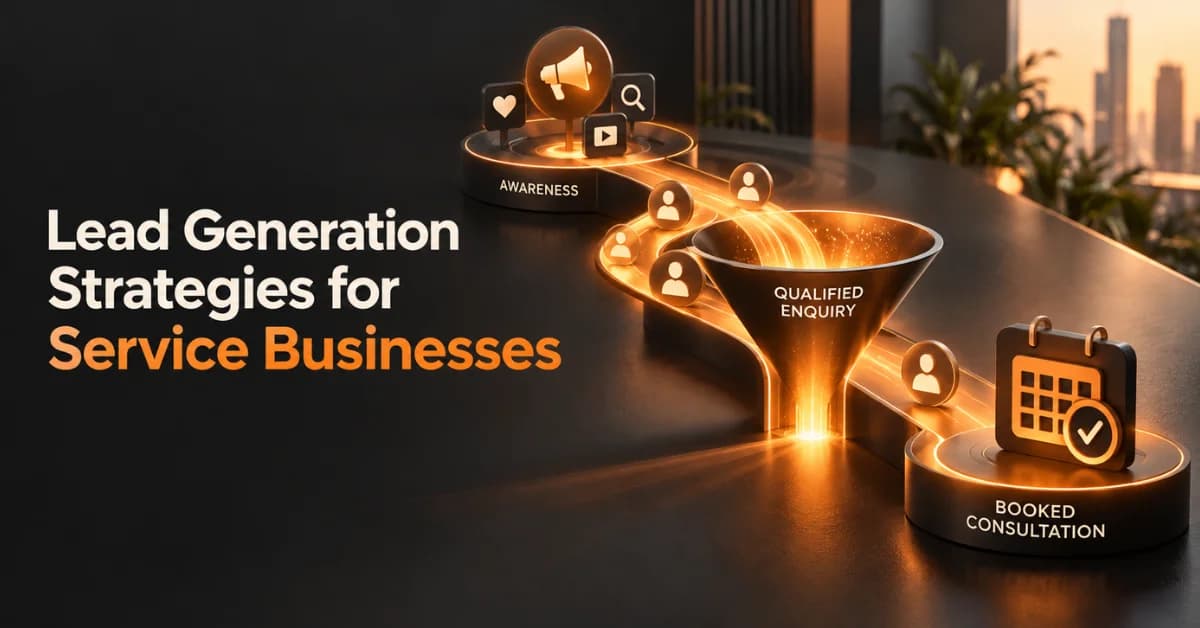
Lead Generation Strategies for Service Businesses
Getting consistent leads is one of the biggest challenges for service businesses. Unlike physical products, services are often harder to evaluate before purchase. Prospects want to know whether a business understands their problem, has relevant experience, provides reliable support, and can deliver the expected result. That makes effective lead generation strategies more than a matter of attracting website traffic. A service business needs to reach the right audience, build trust, create a clear reason to enquire, and make it easy for prospects to take the next step.
A strong approach can combine SEO, online lead generation, local visibility, paid advertising, referrals, content marketing, and lead nurturing. The right mix depends on the service, target market, location, buying cycle, and customer value.
What Is Lead Generation for a Service Business?
Lead generation is the process of attracting potential customers and encouraging them to express interest in a product or service.
For a service business, a lead might:
Complete a contact form
Request a quotation
Book a consultation
Call the business
Send a WhatsApp enquiry
Download a useful resource
Register for a webinar
Request an assessment or audit
The goal is not simply to generate as many enquiries as possible. The goal is to attract qualified service business leads that have a genuine need, suitable budget, and realistic buying intent.
How Service Business Leads Move Through the Funnel
A typical service-business funnel looks like this:
Awareness → Interest → Lead → Qualification → Consultation → Proposal → Customer
For example, someone searching for ways to improve their website may initially read an SEO article. Later, they may search for an SEO agency, visit a service page, review case studies, and finally request a consultation.
This is why businesses should build multiple touchpoints instead of expecting every visitor to contact them immediately.
Why Traditional Lead Generation Strategies Often Fail
Many businesses invest in marketing but still struggle to generate useful enquiries. The problem often comes from the system rather than the marketing channel itself.
Common issues include:
Targeting an audience that is too broad
Using generic service descriptions
Sending advertising traffic to weak pages
Offering no clear next step
Ignoring local search opportunities
Failing to demonstrate expertise
Taking too long to respond to enquiries
Measuring clicks instead of qualified leads
A business can receive thousands of website visitors and still generate very few customers if the message, offer, targeting, or conversion process does not match the visitor's needs.
Lead Generation vs. Lead Conversion
Lead generation attracts potential customers. Lead conversion turns those prospects into customers. For example, SEO may bring a prospect to your website, but a clear service page, strong proof, simple enquiry form, and timely follow-up can determine whether that visitor becomes a sales opportunity.
Effective marketing therefore needs both lead acquisition and lead conversion.
10 Lead Generation Strategies for Service Businesses
There is no single strategy that works for every service company. However, the following approaches can create a strong foundation for generating and converting qualified prospects.
1. Define Your Ideal Customer Profile
Start by deciding exactly who you want to attract.
Consider:
Industry
Company size
Location
Decision-maker
Budget range
Main business problem
Buying timeline
Required service
For example, an agency could target “B2B companies looking for ongoing SEO support” instead of simply targeting “business owners.”
A specific audience makes it easier to create relevant content, advertising, offers, and landing pages.
2. Build a High-Converting Service Website
Your website should answer the questions a potential customer has before making contact.
Important elements include:
Clear value proposition
Dedicated service pages
Specific calls to action
Simple contact forms
Phone or WhatsApp options
Testimonials
Relevant case studies
Client experience or credentials
Frequently asked questions
Clear service descriptions
Avoid forcing visitors to search through several pages to understand what you offer.
A strong service page should quickly communicate what you do, who you help, what problem you solve, and what the visitor should do next.
3. Use SEO to Capture High-Intent Searches
SEO can attract prospects who are already searching for solutions. Instead of targeting only broad keywords, build content around different levels of search intent.
Examples include:
“How to improve local SEO”
“SEO services for small businesses”
“SEO agency for B2B companies”
“SEO agency in Dubai”
“SEO consultant near me”
The closer a search is to a commercial decision, the more directly the corresponding page should address the service and conversion path.
Good SEO also requires useful, original content that genuinely helps the reader. Google continues to emphasize creating content for people first rather than producing pages primarily to manipulate rankings.
4. Strengthen Online Lead Generation With Content Marketing
Content can introduce your expertise before a prospect contacts your business.
Useful formats include:
How-to guides
Case studies
Industry reports
Checklists
Comparison articles
Webinars
Expert opinions
Short educational videos
FAQs
Templates
For example, an accounting firm could publish a guide explaining common bookkeeping mistakes. A reader facing those problems may later become interested in professional bookkeeping services.
This makes content marketing an important part of online lead generation because it can support prospects at different stages of the buying journey.
5. Invest in Local Lead Generation
Local visibility matters when customers prefer providers in a specific city or service area.
A strong local lead generation strategy can include:
Google Business Profile optimization
Local SEO
Location-specific service pages
Customer reviews
Consistent business information
Local content
Location-based advertising
Relevant local directories
For example, a local accounting firm could create separate pages for its main services and target locations rather than relying only on its homepage.
Reviews also help prospective customers evaluate trust and reputation before contacting a service provider.
For eligible businesses, structured data can also help Google understand business information. Google specifically documents LocalBusiness structured data for providing details about businesses.
6. Use Google Ads for High-Intent Leads
Paid search can help service businesses reach people who are actively looking for a solution.
The strongest campaigns usually connect:
Search query → relevant advertisement → dedicated landing page → clear conversion action
For example, someone searching for “commercial accounting services” should ideally reach a page specifically addressing commercial accounting rather than a generic homepage.
Monitor:
Cost per lead
Qualified leads
Conversion rate
Search terms
Lead-to-customer rate
Customer acquisition cost
Do not judge a campaign only by clicks. A lower number of highly qualified enquiries can be more valuable than a large volume of poorly matched leads.
7. Use Social Media to Build Demand and Trust
Social media can support both awareness and lead generation.
Service businesses can share:
Client results
Educational tips
Industry insights
Short videos
Frequently asked questions
Behind-the-scenes expertise
Testimonials
Founder or expert content
The platform should match the audience. For example, LinkedIn may be particularly useful for B2B services, while Instagram or TikTok may work better for visually driven consumer services.
The goal should not be to post simply for engagement. Content should help prospects understand your expertise and move toward a meaningful next step.
8. Create Lead Magnets That Solve a Specific Problem
A useful lead magnet gives prospects a reason to share their contact information.
Examples include:
Free checklist
Website audit
Industry report
Calculator
Template
Assessment
Consultation
Planning guide
A specific offer usually works better than a vague “download our brochure” message.
For example, an SEO company could offer a “10-Point Website SEO Audit Checklist” to people who want to identify common optimization problems.
9. Build a Referral and Review Engine
Satisfied customers can become an important source of new service business leads.
Create a simple process for:
Requesting reviews
Asking for referrals
Collecting testimonials
Developing case studies
Building professional partnerships
Referrals can be especially valuable because the prospect often receives some level of trust before speaking with the business.
However, businesses should avoid manufacturing testimonials or making unsupported claims. Authentic customer experiences provide stronger credibility.
10. Retarget Interested Prospects
Not every visitor will contact you during their first visit. Retargeting can help reconnect with people who previously interacted with your website or content, where appropriate and with the required privacy and consent controls.
You can create campaigns around audiences such as:
Service-page visitors
Previous website visitors
Video viewers
Content readers
Prospects who started but did not complete an enquiry
The messaging should provide additional value rather than repeatedly showing the same sales message.
How to Generate More Qualified Service Business Leads
Generating more leads does not automatically mean generating more customers.
Improve Your Offer
Your offer should make the next step clear.
Instead of simply saying:
“We provide digital marketing services.”
A stronger message might explain:
“We help service businesses improve organic visibility, attract qualified website enquiries, and build measurable digital growth systems.”
Specific positioning helps prospects decide whether your service fits their needs.
Add Lead Qualification
Ask relevant questions before or during the enquiry process.
For example:
What service do you need?
What is your business type?
Where is your business located?
What is your expected timeline?
What problem are you trying to solve?
This information can help sales teams prioritize opportunities.
Respond Quickly to New Enquiries
A strong campaign can lose effectiveness if enquiries sit unanswered.
Create a defined process for:
Receiving the enquiry
Acknowledging it
Qualifying the prospect
Scheduling a call
Providing relevant information
Following up
Automation can help organize this process, but human communication remains important for complex or high-value services.
How to Choose the Right Lead Generation Strategy
Different businesses need different acquisition channels.
For Local Service Businesses
Prioritize:
Local SEO
Google Business Profile
Customer reviews
Location pages
Google Ads
Referral marketing
For B2B Service Businesses
Consider:
SEO
LinkedIn marketing
Thought leadership
Case studies
Email nurturing
Search advertising
Industry-specific content
For New Service Businesses
Start with the fundamentals:
Clear positioning
Strong website
Defined ideal customer
Referral network
Local visibility where relevant
High-intent content
Conversion tracking
Do not launch every channel at once. Test the channels most closely aligned with your audience and buying behaviour.
Lead Generation Strategies: Organic vs. Paid
Organic and paid channels serve different purposes.
Organic channels can include:
SEO
Content marketing
Local SEO
Referrals
Social media content
Paid channels can include:
Google Ads
Social advertising
Retargeting
Sponsored campaigns
Organic marketing can take time to build but may create sustainable visibility. Paid campaigns can provide faster access to relevant searches and audiences but require ongoing budget and optimization.
For many service businesses, combining both approaches creates a more balanced acquisition system.
How to Measure Lead Generation Performance
Track metrics that connect marketing activity with actual business outcomes.
Important metrics include:
Website conversion rate
Number of qualified leads
Cost per lead
Cost per qualified lead
Lead-to-customer conversion rate
Customer acquisition cost
Sales response time
Revenue by marketing channel
Return on advertising spend
Avoid relying only on impressions, followers, or clicks.
A campaign generating 20 highly qualified leads may create more value than one generating 200 low-intent enquiries.
Common Lead Generation Mistakes to Avoid
Watch for these problems:
Targeting everyone
Using the same message for every audience
Creating generic service pages
Ignoring local search
Publishing content without considering search intent
Sending paid traffic to irrelevant pages
Using weak calls to action
Failing to track conversions
Responding slowly to enquiries
Buying low-quality leads
Stopping campaigns before collecting enough useful data
A successful system improves over time because the business learns which audiences, offers, channels, and messages produce real customers.
A Practical Lead Generation Plan for Service Businesses
Week 1: Build the Foundation
Define your ideal customer
Review your service positioning
Audit your website
Identify your primary conversion goal
Set up basic conversion tracking
Week 2: Improve Visibility
Optimize important service pages
Strengthen local search visibility
Publish high-intent content
Add testimonials and relevant proof
Improve calls to action
Week 3: Start Acquisition
Test high-intent Google Ads where appropriate
Promote useful content
Activate referral opportunities
Create a focused lead magnet
Improve social content around customer problems
Week 4: Measure and Optimize
Review:
Which channel generated leads?
Which leads were qualified?
Which pages converted?
What did customers ask about?
Which campaigns produced opportunities?
Where did prospects drop out?
Use those findings to improve the next month rather than simply increasing marketing spend.
How BrandVexo Digital Solutions Can Help With Lead Generation
BrandVexo Digital Solutions helps businesses build practical digital growth systems across SEO, digital marketing, website development, AI automation, social media, and content strategy. Our approach focuses on connecting marketing activity with meaningful business outcomes rather than vanity metrics. If you are reviewing your current lead generation strategies, we can help identify opportunities across visibility, conversion, and digital workflows.
Phone: +971 52 356 5409
Email: info@brandvexo.com
Website: www.brandvexo.com
FAQ
What is the best lead generation strategy for a service business?
There is no universal best strategy. The right approach depends on the target audience, service type, location, customer value, competition, and buying cycle. SEO, Google Ads, referrals, local SEO, content, and social media can all work when they match the audience and offer.
How can I generate service business leads online?
Start with a clear target audience and strong service website. Then combine high-intent SEO, useful content, paid search, social media, lead magnets, retargeting, and conversion-focused landing pages based on your customers' behaviour.
What is online lead generation?
Online lead generation uses digital channels to attract potential customers and encourage them to take an action, such as completing a form, requesting a quote, calling a business, or booking a consultation.
How does local lead generation work?
Local lead generation focuses on attracting customers within a defined geographic area. It can involve local SEO, Google Business Profile optimization, reviews, location-specific pages, local advertising, and other location-based marketing activities.
How do I get more qualified leads instead of more leads?
Define your ideal customer, make your service positioning more specific, target high-intent searches, use relevant landing pages, add qualification questions, and measure lead quality rather than enquiry volume alone.
How much does lead generation cost for a service business?
Costs vary significantly by industry, competition, location, advertising channel, service value, and conversion rate. Instead of using a fixed benchmark, businesses should monitor cost per qualified lead and customer acquisition cost.
How long does SEO take to generate leads?
SEO usually requires time to build visibility and authority. Results depend on competition, website quality, content, technical SEO, search demand, and the existing strength of the website. Businesses should evaluate SEO using relevant traffic, enquiries, qualified leads, and revenue over time.
Should a service business use SEO or Google Ads?
Both can be useful. Google Ads can provide access to high-intent searches quickly, while SEO can build organic visibility over time. The right combination depends on budget, competition, goals, and customer buying behaviour.
Conclusion
Effective lead generation strategies do more than bring visitors to a website. They connect the right audience with the right message, create trust, provide a clear next step, and give the business a process for qualifying and converting enquiries. Start by defining your ideal customer and improving your core offer. Then build visibility through SEO, online lead generation, local search, paid advertising, content, referrals, and other channels that fit your audience.
Disclaimer: This article provides general digital marketing information and should not be treated as a guaranteed lead-generation or revenue forecast. Results vary based on industry, audience, competition, budget, offer, and execution.
Free growth plan
Ready to grow your business?
Reading is a start — now let's build it. Tell us where you want to grow and a senior strategist will map the fastest, most profitable way to get there. Free, no obligation.
Discussion
Join the conversation
Be the first to comment. Comments are reviewed before they appear, so yours won't show up instantly — but we read every one.
Leave a comment
Keep reading
All articles Growth
B2B Lead Generation: A Full-Funnel Framework
Build a stronger B2B lead generation funnel with practical strategies for demand generation, lead qualification, appointment setting, and pipeline growth.
 Growth
Social Media Marketing Dubai: Agency vs In-House
Compare social media marketing in Dubai with an in-house team vs agency. Explore costs, expertise, scalability and which model fits your business.
 Growth
Social Media Marketing for Restaurants: What Works
Learn what works in social media marketing for restaurants, including Instagram, TikTok, local strategy, content ideas, and measurable F&B marketing tactics.