

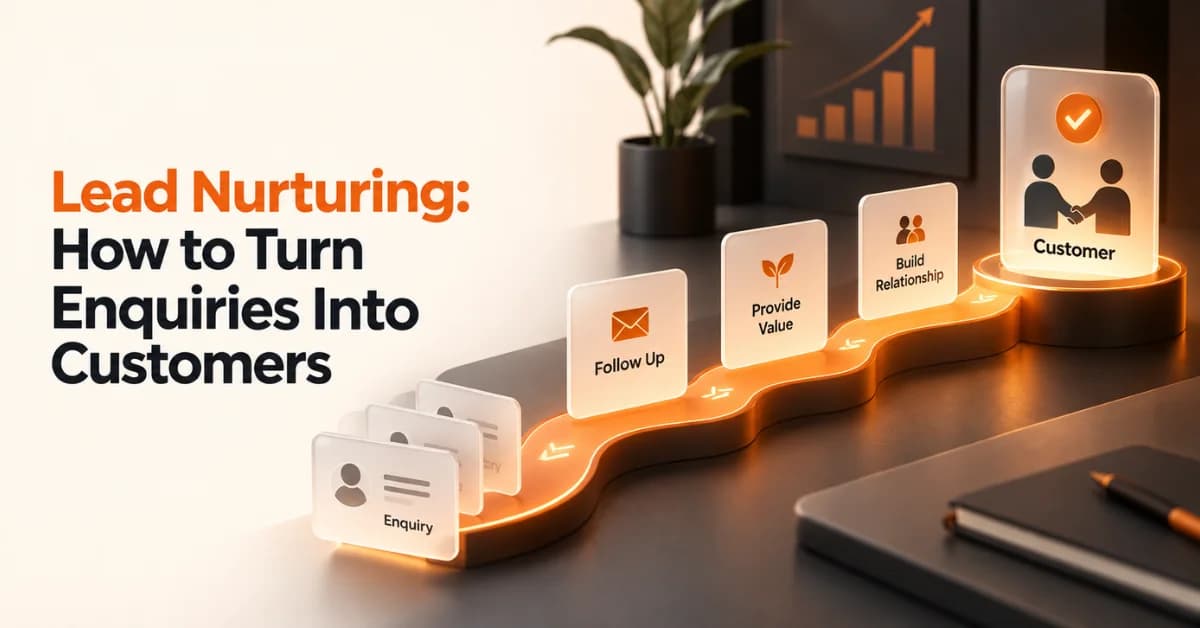
Lead Nurturing: How to Turn Enquiries Into Customers
Getting an enquiry is only the beginning of the sales process. A person may request a quote, fill out a contact form, download a resource, or ask about a service without being ready to buy immediately. If a business stops communicating after the first interaction, many of those potential customers can quietly disappear. Lead Nurturing helps businesses stay relevant throughout the buyer journey. Instead of repeatedly asking, “Are you ready to buy?”, a good nurturing process provides useful information, answers questions, addresses objections, and creates a natural path toward a sales conversation.
A practical lead nurture strategy combines timely communication, audience segmentation, useful content, follow-up sequences, email nurturing, and sales involvement. The goal is not to pressure every enquiry into becoming a customer. It is to give the right information at the right stage so qualified prospects can make informed decisions.
What Is Lead Nurturing?
Lead nurturing is the process of developing relationships with potential customers through relevant and timely communication until they are ready to take the next step. Not every lead is ready to purchase when they first contact a business. Some may still be researching their options, comparing providers, checking pricing, discussing the purchase internally, or waiting for the right time.
Lead nurturing keeps these prospects engaged without overwhelming them.
For example, imagine a company receives an enquiry from a business owner interested in website development. The prospect may not immediately approve a project. Instead of sending several generic sales messages, the company could provide information about website planning, common development mistakes, project timelines, and relevant examples. When the prospect becomes ready, the business is already part of their consideration process.
Lead Nurturing vs Lead Generation
Lead generation focuses on attracting and capturing potential customers.
Lead nurturing begins after the prospect enters the business's pipeline.
A simple way to understand the difference is:
Lead generation: Gets the prospect's attention.
Lead qualification: Determines whether the prospect is relevant and potentially valuable.
Lead nurturing: Builds trust and maintains engagement.
Sales conversion: Moves an appropriate prospect toward a purchase.
Businesses need all four stages to create a consistent customer acquisition process.
Why Do Leads Need Nurturing?
A prospect may need nurturing because:
They are researching different solutions.
They are not ready to purchase yet.
They need approval from another decision-maker.
They have questions about pricing or implementation.
They are comparing competitors.
Their current priority has changed.
They need more evidence before making a decision.
This is why an enquiry should not automatically be treated as a lost opportunity simply because the person does not buy immediately.
How Lead Nurturing Turns Enquiries Into Customers
Effective lead nurturing creates a bridge between the first enquiry and a sales conversation.
The journey can look like this:
Enquiry → Qualification → Relevant Follow-Up → Trust Building → Sales Conversation → Conversion
Each stage has a different purpose.
1. Respond Quickly to New Enquiries
The first response should acknowledge the enquiry and make the next step clear. For example, if someone submits a form asking about SEO services, the initial response can confirm that the request has been received and explain what information the business needs to provide a useful recommendation.
Avoid turning every first response into a long sales pitch. A helpful response creates a better starting point for the relationship.
2. Understand What the Lead Actually Needs
Effective nurturing depends on context.
Where appropriate, collect information such as:
What problem does the prospect want to solve?
Which service or product interests them?
How soon do they need a solution?
What stage are they at in their research?
What questions have they already asked?
Who is involved in the buying decision?
This information allows businesses to send more relevant communication instead of treating every contact in the same way.
3. Send Relevant Information at the Right Time
Relevance matters more than message volume. A pricing enquiry may need information about packages, scope, and what affects cost. A prospect who is still researching may benefit more from an educational guide or comparison.
The objective is to match the message with the prospect's current intent.
How to Build an Effective Lead Nurture Strategy
A strong lead nurture strategy starts with the buyer rather than the technology. Before creating automated emails or CRM workflows, understand what prospects need at different stages of their decision-making process.
Define Your Ideal Customer and Buyer Journey
Start by identifying:
Target customer types
Common problems
Buying triggers
Typical questions
Common objections
Decision-making factors
Expected purchase timeframe
Then map these factors against the buyer journey.
For example, someone discovering a problem needs different information from someone who has already requested a proposal.
Segment Leads by Intent
Lead segmentation helps businesses deliver more relevant messages.
Useful segments can include:
New enquiries
High-intent prospects
Information seekers
Returning prospects
Unresponsive leads
Existing customers with additional needs
Segmentation does not have to be complicated. Even a basic CRM structure can help a business distinguish between someone who is casually researching and someone actively requesting a proposal.
Match Content to the Buyer's Stage
Different stages require different types of content.
Awareness stage: Provide educational content that explains the problem and possible approaches.
Consideration stage: Use FAQs, comparisons, case studies, service explanations, demonstrations, and practical examples.
Decision stage: Provide relevant pricing information, proposals, consultations, implementation details, and answers to final objections.
This approach makes nurturing more useful because every interaction has a clear purpose.
Set Clear Nurturing Goals
Your nurturing program should have measurable objectives.
Possible goals include:
Increasing qualified sales conversations
Improving enquiry-to-customer conversion
Re-engaging inactive prospects
Reducing lost leads
Improving sales pipeline quality
Supporting faster movement through the sales process
Follow-Up Sequences That Keep Leads Engaged
Good follow-up sequences do more than remind a prospect that a company exists.
Each follow-up should provide a reason for the prospect to continue the conversation.
A simple sequence might look like this:
Day 0: Confirm the enquiry and provide the immediate next step.
Day 1–2: Answer common questions related to the enquiry.
Day 4–5: Share a relevant example, case study, or useful resource.
Day 7: Address a common objection or concern.
Day 10–14: Offer a clear consultation, proposal, demo, or other appropriate next step.
Later: Move non-responsive contacts into a longer-term nurture process.
This is a framework rather than a universal schedule. The right timing depends on the industry, buying cycle, lead intent, and previous engagement.
What to Do When a Lead Stops Responding
Silence does not always mean rejection. The prospect may be busy, distracted, waiting for approval, or no longer have the same priority.
Instead of sending repeated “Just checking in” messages, change the value of the communication.
You could send:
A short answer to a common question
A useful resource
A relevant case study
A new insight related to their original enquiry
A simple re-engagement message
If a prospect clearly opts out, businesses should respect that preference and stop promotional communication as appropriate.
Email Nurturing: What Should You Send Leads?
Email nurturing can keep prospects engaged between direct sales conversations. However, successful nurturing emails should not feel like an endless stream of advertisements.
Useful email types include:
Enquiry confirmation emails
Educational content
Frequently asked questions
Case studies
Service or product explanations
Comparison content
Customer examples
Webinar or event invitations
Re-engagement emails
Sales follow-up messages
How to Write Better Lead Nurturing Emails
Keep every email focused on one useful purpose.
A good nurturing email should generally have:
A clear subject line
A relevant message
Short, readable paragraphs
Useful information
One primary call to action
A natural connection to the prospect's previous interaction
Personalization should also go beyond inserting a first name. Use actual context, such as the service requested, content viewed, questions asked, or stage in the buying process.
Sales Nurture: Connecting Marketing Follow-Up With Sales
Sales nurture focuses on continuing the relationship when a prospect needs more direct interaction. Marketing automation can educate and engage prospects, but sales teams often need to take over when the conversation becomes specific or commercially significant.
For example, a prospect asking general questions about website development may continue receiving educational content. A prospect asking about implementation dates, project scope, or a proposal may require direct sales involvement.
When Should a Lead Be Passed to Sales?
Useful buying-intent signals can include:
Requesting a quote or proposal
Asking detailed pricing questions
Requesting a consultation
Repeatedly engaging with relevant content
Asking implementation questions
Replying with specific project requirements
No single action proves that a prospect is ready to buy. Businesses should consider the overall context and lead history.
Lead Nurturing Automation: What to Automate and What Not to Automate
Automation can make nurturing more consistent, but it should support the customer experience rather than replace thoughtful communication.
Tasks Worth Automating
Businesses can automate repetitive activities such as:
Lead assignment
Follow-up reminders
Email sequences
Basic segmentation
CRM updates
Engagement tracking
Re-engagement workflows
Internal notifications
Tasks That Still Need a Human Touch
Human involvement remains important for:
Complex questions
High-value enquiries
Custom proposals
Negotiations
Sensitive concerns
Strategic recommendations
Relationship-building conversations
The strongest systems combine automation for consistency with human involvement where context matters.
Common Lead Nurturing Mistakes to Avoid
Even a well-designed nurturing system can perform poorly when businesses focus on activity instead of relevance.
Avoid these common mistakes:
Following up without adding value
Sending identical messages to every prospect
Contacting people too frequently
Ignoring buying intent
Failing to track previous interactions
Passing every enquiry directly to sales
Automating every conversation
Making every email promotional
Forgetting older leads
Ignoring communication preferences and unsubscribe requests
The goal is not to contact leads as often as possible. The goal is to make each relevant interaction useful.
How to Measure Lead Nurturing Performance
Lead nurturing should connect to meaningful business outcomes.
Useful metrics include:
Lead-to-Customer Conversion Rate
This shows how many nurtured leads eventually become customers.
Response and Engagement Rates
Track how prospects interact with emails, messages, content, and sales follow-ups.
Qualified Lead Volume
Measure whether nurturing helps identify prospects that are genuinely relevant to the business.
Sales Pipeline Generated
Look beyond clicks and opens. Track whether nurturing contributes to actual sales opportunities.
Time to Conversion
Monitor how long it takes prospects to move from initial enquiry to customer.
Re-Engagement Rate
Track whether older or inactive prospects return to the conversation after receiving relevant communication. Businesses can then test different messaging, timing, segmentation, content, and sales handoff points.
Lead Nurturing Example for a Service Business
Consider a digital service business in Dubai that receives enquiries through its website. A prospect asks for information about digital marketing but does not immediately schedule a consultation.
Instead of sending several promotional messages, the business can create a simple nurturing path:
The prospect receives an enquiry confirmation.
The business identifies the prospect's main service requirement.
The prospect receives relevant educational content.
A follow-up answers common questions.
A suitable case study demonstrates how the service works.
The prospect receives an invitation for a consultation.
If the prospect shows strong buying intent, a sales representative follows up directly.
If there is no response, the prospect moves into a longer-term nurture sequence.
This approach creates a structured process without assuming that every enquiry is ready to buy immediately.
How to Create a Lead Nurturing System for Your Business
You can start with a relatively simple framework.
1. Define your ideal customer.
Know who you want to attract and what problems they need to solve.
2. Map the buyer journey.
Identify what prospects need to know before they can make a decision.
3. List common questions and objections.
Turn these into useful content and follow-up topics.
4. Segment your enquiries.
Separate prospects based on intent, service interest, or buying stage.
5. Create relevant content.
Prepare FAQs, guides, case studies, comparisons, and service information.
6. Build follow-up sequences.
Give each message a clear purpose.
7. Connect marketing and sales.
Make sure sales teams can see relevant lead history.
8. Automate repetitive tasks.
Use CRM and marketing automation where it improves consistency.
9. Measure outcomes.
Track qualified opportunities, conversions, pipeline, and revenue-related results.
10. Improve the process continuously.
Use real customer interactions to identify where leads are being lost.
FAQ
What is lead nurturing in simple terms?
Lead nurturing is the process of building relationships with potential customers through useful and relevant communication until they are ready to take the next step. It helps businesses stay connected with prospects instead of treating an enquiry as a one-time interaction.
What is a lead nurture strategy?
A lead nurture strategy is a planned approach for communicating with prospects at different stages of their buyer journey. It typically includes segmentation, relevant content, follow-up sequences, email nurturing, sales involvement, and performance measurement.
What are the stages of lead nurturing?
Lead nurturing commonly follows the awareness, consideration, and decision stages of the buyer journey. Prospects receive educational information early on, more detailed evaluation content during consideration, and decision-focused information when they show stronger purchase intent.
How often should you follow up with a lead?
There is no single follow-up frequency that works for every business. Timing should depend on the buying cycle, lead intent, previous interactions, and communication preferences. Businesses should avoid excessive messaging and prioritize relevant communication.
What is email nurturing?
Email nurturing uses relevant email communication to educate, engage, and guide prospects through their buyer journey. Emails can include educational content, FAQs, case studies, product or service information, and appropriate sales calls to action.
What is sales nurture?
Sales nurture is the process of maintaining and developing relationships with prospects through direct sales communication. It becomes particularly useful when prospects have specific questions, requirements, objections, or stronger buying intent.
Can lead nurturing be automated?
Yes. Businesses can automate repetitive tasks such as email sequences, reminders, lead assignment, segmentation, and CRM updates. However, complex questions, high-value opportunities, negotiations, and relationship-focused conversations often require human involvement.
How do you measure lead nurturing success?
Businesses can measure lead nurturing through metrics such as qualified leads, response rates, conversion rates, sales opportunities, pipeline generated, time to conversion, and revenue-related outcomes. The most useful metrics depend on the business model and sales cycle.
About BrandVexo Digital Solutions
BrandVexo Digital Solutions helps businesses build practical digital growth systems across digital marketing, SEO, web development, AI automation, and business solutions. Our approach focuses on connecting digital activity with measurable business outcomes rather than chasing vanity metrics. From attracting the right audience to improving lead management and conversion processes, we help businesses build digital systems that support sustainable growth.
Phone: +971 52 356 5409
Email: info@brandvexo.com
If your business is generating enquiries but losing potential customers during follow-up, reviewing your lead nurturing process can reveal where opportunities are being missed. A clearer journey, better segmentation, useful content, and consistent follow-up can make it easier for qualified prospects to move toward the right sales conversation.
Conclusion
Lead nurturing is not about sending more messages. It is about making communication more relevant, timely, and useful. A strong lead nurture strategy helps businesses understand where prospects are in the buyer journey and provide the information they need at that stage. Follow-up sequences create consistency, email nurturing keeps prospects engaged, and sales nurture gives high-intent leads the personal attention they need.
Disclaimer: This article provides general information about lead nurturing, sales follow-up, and digital marketing practices. Strategies and results may vary depending on your business, audience, industry, and customer journey.
Free growth plan
Ready to grow your business?
Reading is a start — now let's build it. Tell us where you want to grow and a senior strategist will map the fastest, most profitable way to get there. Free, no obligation.
Discussion
Join the conversation
Be the first to comment. Comments are reviewed before they appear, so yours won't show up instantly — but we read every one.
Leave a comment
Keep reading
All articles Growth
Lead Response Time: How Quickly Should You Respond?
Learn how lead response time affects conversions, why speed to lead matters, and how to build faster lead response and follow-up workflows.
 Growth
Sales Funnel vs Marketing Funnel: What’s the Difference?
Sales funnel vs marketing funnel explained with stages, examples, metrics, conversion funnel differences, and practical tips for improving both.
 Growth
Automated Lead Qualification: How to Qualify Leads Without Losing Good Prospects
Learn how automated lead qualification uses AI lead scoring and smart workflows to prioritize leads, reduce missed opportunities, and keep good prospects visible.