

LinkedIn Marketing for B2B: How to Build Demand
Learn how LinkedIn Marketing for B2B builds demand through content, founder branding, audience targeting, lead generation, and measurable strategy.
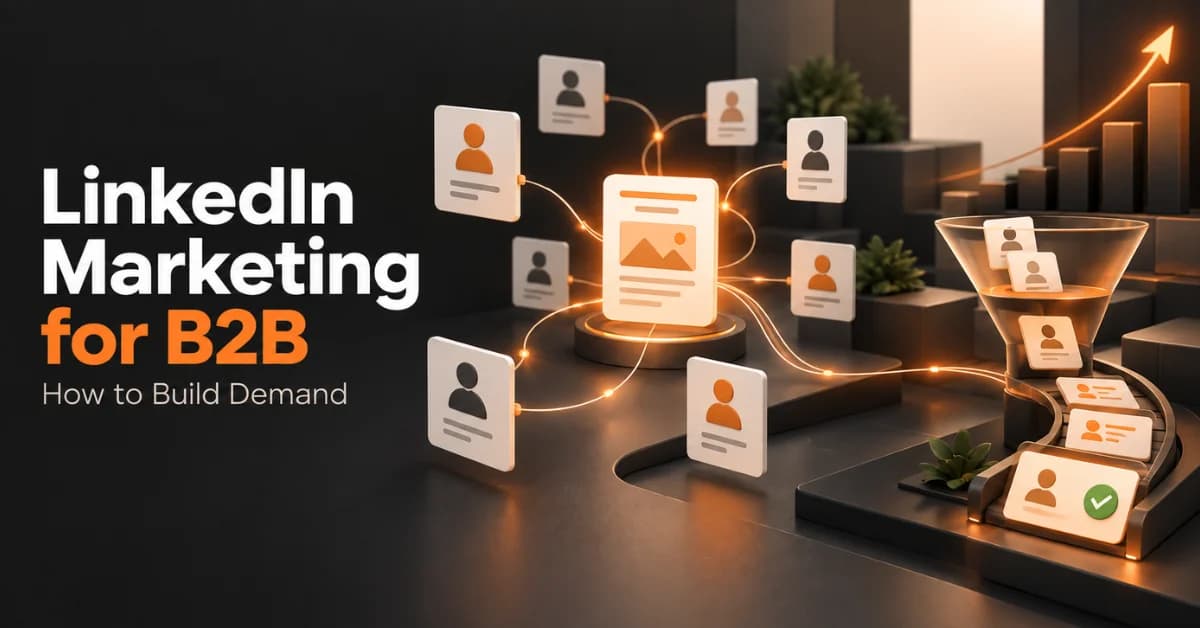
B2B buyers rarely move from seeing a company for the first time to requesting a sales call immediately. They research problems, compare approaches, evaluate expertise, and often involve several people before making a decision. That makes LinkedIn Marketing for B2B more valuable as a demand-building channel than as a simple source of leads.
A strong LinkedIn presence can help a B2B company become visible before a buyer enters an active buying cycle. Useful content, credible expertise, founder-led communication, and consistent engagement can create familiarity and trust over time. LinkedIn itself describes B2B marketing as a process centered on education, relationship-building, and consensus across buying groups.
What Is LinkedIn Marketing for B2B?
LinkedIn Marketing for B2B is the use of LinkedIn content, professional networking, thought leadership, company pages, personal profiles, advertising, and audience targeting to build awareness and relationships with business buyers. Unlike consumer marketing, B2B marketing often involves longer buying journeys and multiple decision-makers. A potential customer may interact with several pieces of content before contacting a provider.
This is why an effective LinkedIn marketing strategy should support the entire buyer journey rather than focus only on immediate conversions.
Why LinkedIn Matters for B2B Demand Generation
LinkedIn combines professional information such as job function, seniority, industry, and location with a business-focused environment. These characteristics make it particularly useful for reaching specific B2B audiences.
For example, a cybersecurity company selling to financial institutions could create content around:
Common security risks
Compliance challenges
Cybersecurity planning
Industry trends
Customer lessons
Practical security frameworks
The company does not need to promote its service in every post. By consistently addressing relevant problems, it can build familiarity before a prospect becomes sales-ready.
LinkedIn Marketing for B2B vs. Traditional Lead Generation
Demand generation and lead generation are connected, but they are not identical. Demand generation creates awareness, interest, and preference around a problem or solution. Lead generation focuses on identifying people who have taken an action that indicates potential interest.
A practical B2B funnel can look like this:
Awareness: A prospect discovers your insight.
Interest: They follow your company or founder.
Consideration: They read your articles or case studies.
Intent: They visit your website or request information.
Lead: They provide contact information.
Opportunity: Sales identifies a genuine business need.
This distinction matters because a demand-generation campaign can influence future pipeline even when it does not immediately produce a form submission.
How to Build a B2B LinkedIn Strategy
A successful B2B LinkedIn strategy starts with the audience, not the posting schedule. Before creating content, define who you want to reach, what problems they face, and what information they need before they can confidently evaluate your solution.
Define Your Ideal B2B Customer
Start with an ideal customer profile (ICP).
Consider:
Industry
Company size
Location
Job function
Seniority
Business challenges
Buying authority
Common objections
Buying triggers
For example, a B2B SaaS company targeting growing businesses might focus on operations leaders who struggle with manual workflows, fragmented systems, and inefficient reporting.
That information should shape the company's content themes.
Identify the Problems Your Buyers Actually Face
Your LinkedIn content becomes more relevant when it reflects real customer problems.
Instead of repeatedly saying, “Our platform improves productivity,” discuss the underlying issue:
Why do growing teams lose productivity when processes remain dependent on spreadsheets and manual approvals?
That shift turns promotional messaging into useful educational content.
Your research can come from:
Sales conversations
Customer questions
Support tickets
Industry discussions
Search queries
Competitor content
LinkedIn comments
Customer interviews
LinkedIn also recommends using audience and buyer insights to understand the challenges and interests that should shape thought leadership.
Create Clear LinkedIn Content Pillars
Choose three to five recurring themes rather than posting random topics.
For example:
Industry insights
Customer problems
Practical education
Founder expertise
Case studies and results
These pillars make content creation more consistent while keeping the brand focused.
Build a LinkedIn Content Strategy That Creates Demand
A strong LinkedIn content strategy should help potential buyers understand their problems and evaluate possible solutions. Think beyond promotional posts. Your content should answer questions prospects are asking before they ever contact your business.
Use Content for Different Buyer Stages
At the awareness stage, publish:
Industry trends
Problem-focused posts
Educational insights
Original observations
Common mistakes
At the consideration stage, publish:
Frameworks
How-to content
Case studies
Comparisons
Expert analysis
At the decision stage, publish:
Customer outcomes
Implementation advice
FAQs
Objection-handling content
Product or service explanations
This creates a connected content journey instead of a collection of unrelated posts.
What Should B2B Companies Post on LinkedIn?
Good B2B content does not have to be complicated.
Consider sharing:
A lesson from a customer project
An industry misconception
A short strategic framework
A common buyer mistake
A founder's perspective
A breakdown of a market change
A practical checklist
Original research
A case-study lesson
Answers to recurring customer questions
LinkedIn's own thought-leadership guidance emphasizes originality, authenticity, customer problems, and useful perspectives rather than constant promotion.
How Founder LinkedIn Builds B2B Demand
Founder LinkedIn can become an important part of a B2B marketing strategy because buyers often want to understand the people behind a business. A company page can communicate what the organization does. A founder profile can communicate why the company thinks the way it does.
That distinction can make content feel more personal and credible.
Founder LinkedIn vs. Company Page
A founder profile can focus on:
Personal expertise
Industry opinions
Business lessons
Customer observations
Leadership perspectives
Stories and experiences
A company page can focus more on:
Company announcements
Resources
Services
Customer stories
Events
Hiring
Brand information
The strongest approach often combines both.
In 2026, LinkedIn has highlighted the growing importance of human voices and creator-style thought leadership in B2B, noting that buyers increasingly respond to trusted individuals rather than corporate messages alone.
What Should Founders Post on LinkedIn?
A founder does not need to become a full-time content creator.
A simple approach is to turn real business experience into useful insights.
For example:
“We noticed that many growing companies invest in more software when their actual problem is unclear processes. Here are three signs that the process—not the technology—is the bottleneck.”
This type of post demonstrates experience without turning the content into an advertisement.
LinkedIn Lead Generation: Turning Attention Into Opportunities
LinkedIn lead generation works best when it builds on relevance and trust. If every interaction immediately becomes a sales pitch, prospects may disengage. Instead, create a natural path from useful content to deeper resources and eventually to a sales conversation.
Organic LinkedIn Lead Generation
Organic methods include:
Educational content
Founder-led posts
Industry conversations
Relevant networking
Direct messages
Website content
Lead magnets
Newsletters
Webinars
Case studies
The important principle is quality over quantity.
A B2B company may gain more value from ten highly relevant conversations than from hundreds of low-intent contacts.
LinkedIn Lead Generation Ads
Paid campaigns can extend reach to specific professional audiences.
Businesses can use LinkedIn advertising for objectives such as:
Brand awareness
Website traffic
Lead generation
Event promotion
Retargeting
Account-based marketing
LinkedIn's lead-generation guidance recommends monitoring conversion data and continuously optimizing campaigns rather than judging success only by engagement.
Paid advertising becomes more effective when the audience, offer, landing page, and follow-up process already make sense.
How to Create LinkedIn Posts That Generate Demand
A useful post does not need to go viral. It needs to be relevant to the people you want to influence.
Use the Problem → Insight → Action Framework
A simple structure is:
Problem: Identify a problem your audience recognizes.
Insight: Explain why the problem happens or provide a perspective they may not have considered.
Action: Give the reader a practical next step.
For example:
Problem: B2B companies often publish consistently but still receive few qualified leads.
Insight: The issue may not be posting frequency. The content may attract other marketers rather than potential buyers.
Action: Review the last 20 posts and classify each one by target buyer, business problem, and buying stage.
This approach gives readers something useful even when they are not ready to buy.
Write for Conversations, Not Just Engagement
Comments can reveal valuable buying signals. When someone asks a detailed question, challenges an assumption, or describes a similar business problem, that conversation may be more commercially useful than a simple reaction. Respond thoughtfully and continue the conversation naturally. Avoid immediately turning every comment into a pitch.
LinkedIn Content Ideas for B2B Companies
If your team struggles to maintain a content calendar, use customer questions as your starting point.
Potential topics include:
Three mistakes companies make when solving a specific problem
A breakdown of an industry trend
A customer problem and how to approach it
Myth vs. reality posts
Lessons from a failed strategy
Lessons from a successful project
Industry predictions
Practical checklists
Expert opinions
Frequently asked buyer questions
Behind-the-scenes decision-making
Case-study insights
Short educational frameworks
For UAE-based B2B companies, content can also address regional business conditions, industry developments, customer expectations, or operational challenges when those topics genuinely matter to the target audience.
A Simple B2B LinkedIn Content Funnel
A practical funnel helps prevent every post from trying to generate a sales call.
Top-of-Funnel LinkedIn Content
Focus on visibility and education.
Use:
Industry trends
Educational insights
Problem awareness
Original opinions
Beginner-friendly explanations
Middle-of-Funnel LinkedIn Content
Help prospects evaluate their options.
Use:
Frameworks
Guides
Case studies
Comparisons
Implementation advice
Expert analysis
Bottom-of-Funnel LinkedIn Content
Help qualified prospects make decisions.
Use:
Customer outcomes
FAQs
Product demonstrations
Implementation details
Objection handling
Service explanations
This full-funnel approach connects brand building with demand generation rather than treating them as separate activities. LinkedIn similarly emphasizes the relationship between thought leadership and demand generation.
How to Measure LinkedIn Marketing for B2B
Measuring LinkedIn marketing only through likes and impressions can create the wrong picture.
Track metrics at different stages.
LinkedIn Metrics That Matter
Awareness metrics
Reach
Impressions
Follower growth
Profile views
Engagement metrics
Comments
Shares
Saves
Engagement rate
Demand metrics
Website visits
Content engagement
Returning visitors
Qualified conversations
Pipeline metrics
Qualified leads
Meetings
Sales opportunities
Pipeline influenced
Revenue generated
The right metric depends on the campaign objective.
A thought-leadership campaign may initially focus on reach and engagement, while a lead-generation campaign should eventually be judged against qualified conversions and pipeline.
Why Engagement Does Not Always Equal Revenue
A post can receive thousands of impressions without reaching a single strong prospect. Another post might receive modest engagement but attract a senior decision-maker from a target account.
For B2B marketing, relevance often matters more than raw volume.
Common B2B LinkedIn Marketing Mistakes
Avoid these common problems:
Posting only promotional content
Measuring success through follower count alone
Ignoring founder profiles
Targeting everyone instead of a defined ICP
Publishing generic AI-generated content
Chasing viral posts
Sending aggressive sales messages
Ignoring comments and conversations
Posting without consistent content pillars
Failing to connect marketing data with sales outcomes
Google's people-first guidance similarly emphasizes original value, real expertise, accuracy, and content created primarily to help people rather than manipulate search rankings.
A Practical 30-Day LinkedIn Marketing Plan for B2B
You do not need to rebuild your entire strategy at once.
Week 1: Research and Positioning
Define your ideal customer
Identify major customer problems
Review competitor content
Interview sales or customer-facing teams
Establish three to five content pillars
Week 2: Create Content
Prepare posts covering:
Educational topics
Customer problems
Industry insights
Founder perspectives
Case studies
Create several variations from the same core insight rather than starting from zero every day.
Week 3: Distribute and Engage
Publish consistently and participate in relevant industry conversations. Respond to comments with useful answers. Connect with people who fit your target audience without turning every connection request into a sales pitch.
Week 4: Measure and Improve
Review:
Which topics generated meaningful conversations?
Which posts attracted your target audience?
Which content drove website visits?
Which interactions created qualified opportunities?
Which formats should you produce more often?
Then use those findings to improve the next month's content plan.
Key Takeaways From LinkedIn Marketing for B2B
Effective LinkedIn Marketing for B2B is not about publishing more content or collecting the largest possible audience. It is about consistently showing the right people that your business understands their problems and can provide useful perspectives. A strong strategy combines customer research, valuable content, founder expertise, thoughtful engagement, lead generation, and measurement.
Most importantly, treat LinkedIn as part of a wider B2B growth system. Connect social content with your website, SEO, email marketing, sales process, and conversion tracking so that awareness can eventually contribute to measurable business growth.
How BrandVexo Digital Solutions Can Support Your B2B Growth
BrandVexo Digital Solutions helps businesses build practical digital growth systems across digital marketing, SEO, web development, AI automation, and business solutions. For B2B companies, that can mean connecting LinkedIn content with a broader strategy rather than treating social media as an isolated channel. Our approach focuses on useful content, clear positioning, stronger digital experiences, and measurable outcomes instead of vanity metrics. If your LinkedIn activity generates attention but does not consistently support your wider marketing and sales process, reviewing the complete customer journey can reveal where the gaps are.
Contact BrandVexo Digital Solutions:
Phone: +971 52 356 5409
Email: info@brandvexo.com
Website: www.brandvexo.com
Frequently Asked Questions
What is LinkedIn Marketing for B2B?
LinkedIn Marketing for B2B uses LinkedIn content, networking, thought leadership, company pages, personal profiles, and advertising to reach business audiences and build awareness, relationships, demand, and opportunities.
How does LinkedIn help B2B companies generate demand?
LinkedIn helps businesses reach professional audiences with educational content, industry insights, and thought leadership. Over time, this can build familiarity and influence buyers before they actively contact a vendor.
What is a good B2B LinkedIn strategy?
A good B2B LinkedIn strategy starts with a defined ideal customer profile, clear positioning, useful content pillars, consistent engagement, appropriate lead-generation tactics, and measurement tied to business outcomes.
How can founders use LinkedIn for B2B marketing?
Founders can share industry insights, business lessons, customer observations, opinions, and practical advice. This humanizes the brand and can help establish the founder as a credible voice within the target market.
How does LinkedIn lead generation work?
LinkedIn lead generation can happen organically through content, networking, conversations, and website resources or through paid campaigns using targeted advertising and lead-generation formats. The strongest approach focuses on qualified prospects rather than simply maximizing lead volume.
What should a B2B company post on LinkedIn?
B2B companies can publish educational content, industry insights, customer lessons, case studies, practical frameworks, expert opinions, FAQs, and problem-focused posts. The content should reflect the needs of the intended buyer.
How often should a B2B company post on LinkedIn?
There is no universal posting frequency that guarantees results. A sustainable schedule with consistently useful content is more valuable than publishing frequently without a clear purpose.
How do you measure B2B LinkedIn marketing success?
Measure performance across the funnel, including reach, engagement, website activity, qualified conversations, leads, meetings, sales opportunities, pipeline influence, and revenue where attribution is available.
Disclaimer: This article provides general information about LinkedIn marketing for B2B businesses and is intended for educational purposes only. Strategies and results may vary depending on your industry, audience, budget, and business goals. Consider reviewing your specific marketing needs with a qualified professional before making strategic decisions.
Free growth plan
Ready to grow your business?
Reading is a start — now let's build it. Tell us where you want to grow and a senior strategist will map the fastest, most profitable way to get there. Free, no obligation.
Discussion
Join the conversation
Be the first to comment. Comments are reviewed before they appear, so yours won't show up instantly — but we read every one.
Leave a comment
Keep reading
All articles
How a Digital Marketing Agency Improves Online Visibility
Digital marketing agency improves online visibility through SEO, content marketing, social media, PPC advertising, and strategies that support business growth.

How to Simplify IT Services for Small Businesses in 2026
IT services for small businesses in 2026 with practical tips on cybersecurity, cloud tools, automation, IT support, and smarter technology cost management.

How to Build a Social Media Content Calendar for Ecommerce
Build a Social Media Content Calendar for ecommerce with practical planning steps, content ideas, scheduling tools, and tips to measure results.