

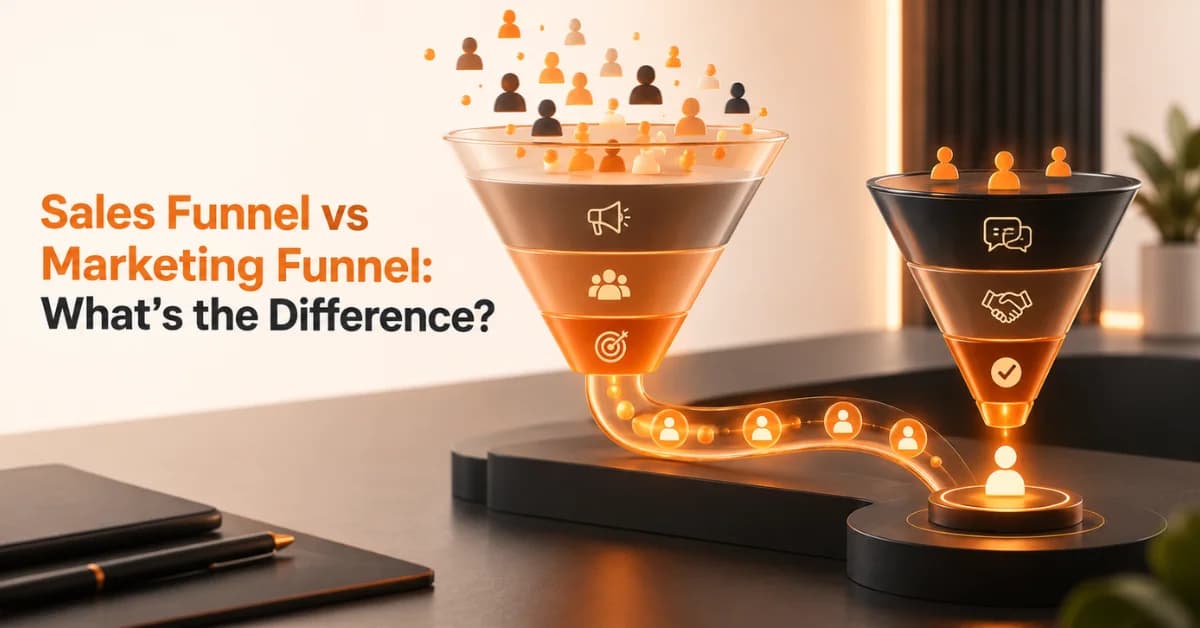
Sales Funnel vs Marketing Funnel: What’s the Difference?
Marketing and sales work toward the same business outcome, but they do not always follow the same process. This is where the difference between a sales funnel vs marketing funnel becomes important. A marketing funnel focuses on attracting the right audience, building interest, educating prospects, and creating demand. A sales funnel focuses more closely on qualified prospects and moves them toward a purchase decision.
Both funnels can overlap, especially when businesses use content marketing, lead generation, CRM systems, email campaigns, and sales automation. Understanding how they connect can help businesses identify where prospects drop off and improve the customer journey.
What Is a Marketing Funnel?
A marketing funnel represents the journey a person takes from first discovering a business to becoming increasingly interested in its products or services. Marketing teams use content, search engine optimization, social media, email marketing, advertising, webinars, and other channels to move potential customers through this journey.
The exact structure varies by business. However, most marketing funnel models include several stages that reflect increasing awareness and buying intent.
What Are the Marketing Funnel Stages?
The most common marketing funnel stages include:
Awareness: A potential customer first discovers a brand or solution.
Interest: The person engages with content or explores the problem further.
Consideration: The prospect compares possible solutions and evaluates options.
Intent: The prospect shows stronger buying signals, such as requesting pricing or a consultation.
Conversion: The prospect completes a desired action, such as purchasing or booking a service.
Not every customer moves through these stages in a perfectly straight line. Someone might discover a business through Google, leave the website, see a social media post weeks later, and then return through a branded search.
What Does Marketing Do at Each Stage?
Marketing activities should match the prospect's level of awareness.
For example:
SEO articles can attract people researching a problem.
Social media content can build awareness and engagement.
Comparison guides can help prospects evaluate solutions.
Case studies can provide evidence during consideration.
Landing pages can encourage visitors to request a consultation.
Email nurturing can keep interested prospects engaged until they are ready to act.
The goal is not simply to generate more traffic. It is to attract relevant people and help them move toward an appropriate next step.
What Is a Sales Funnel?
A sales funnel focuses on turning potential opportunities into customers. It usually begins after a prospect has shown enough interest for a sales process to become relevant. For example, someone might submit a contact form, request a quote, book a demo, or respond positively to a sales representative.
The sales team then determines whether the prospect is a suitable opportunity and guides them toward a purchasing decision.
Common Sales Funnel Stages
A typical sales funnel may include:
Lead identification
Lead qualification
Discovery or needs assessment
Product or service presentation
Proposal or quotation
Negotiation
Decision
Closed deal
The exact stages depend on the business model.
A SaaS company may use free trials and product demos, while a professional services company may rely on consultations, proposals, and negotiations.
How Does a Sales Funnel Work?
The sales funnel becomes more focused as the prospect moves forward. A large number of people may visit a website, but only some become leads. From those leads, only some meet the company's qualification criteria. An even smaller group may become active sales opportunities. This is why businesses should not judge sales performance only by the number of leads generated.
Lead quality, opportunity value, sales cycle length, conversion rates, and revenue also matter.
Sales Funnel vs Sales Pipeline
A sales funnel and sales pipeline are related but not identical. A sales funnel usually describes how prospects progress through stages and where potential customers drop out. A sales pipeline gives sales teams an operational view of active opportunities. It often shows which prospects are at stages such as discovery, proposal, negotiation, or closing.
For example, a CRM may show 20 active opportunities in a sales pipeline, while funnel analysis may show that only 25% of qualified leads typically become customers.
Understanding both views helps businesses identify problems in the sales process.
Sales Funnel vs Marketing Funnel: Key Differences
The easiest way to understand the Sales Funnel vs Marketing Funnel is to compare their purpose, audience, activities, and measurements.
Primary Goal
The marketing funnel focuses on attracting and developing potential customers. Marketing helps people understand a problem, evaluate solutions, and become interested in a particular business or offer.
The sales funnel focuses more directly on converting qualified opportunities into customers.
Main Audience
Marketing usually addresses a broader audience. For example, an SEO article may reach hundreds or thousands of people who are researching a particular problem. Only a portion of those visitors may fit the company's ideal customer profile.
Sales generally works with a narrower group of prospects who have demonstrated stronger buying intent.
Main Activities
Marketing activities can include:
SEO
Content marketing
Social media
Email marketing
Paid advertising
Webinars
Lead magnets
Educational resources
Sales activities can include:
Discovery calls
Lead qualification
Product demonstrations
Consultations
Proposals
Negotiations
Follow-ups
Contract discussions
Main Metrics
Marketing teams may track:
Organic traffic
Engagement
Leads
Conversion rate
Cost per lead
Marketing-qualified leads
Landing-page conversions
Sales teams may track:
Qualified opportunities
Meetings
Proposal rate
Win rate
Average deal value
Sales cycle length
Revenue
The important point is that these metrics answer different questions.
Marketing asks, "Are we attracting and engaging the right people?"
Sales asks, "Are we converting suitable opportunities into customers?"
Typical Ownership
Marketing often manages the earlier stages of the customer journey, while sales manages later-stage opportunities. However, the boundary is not fixed. Modern businesses increasingly connect marketing automation, CRM platforms, lead scoring, analytics, and sales activity so that both teams can work from a shared view of the customer journey.
How Marketing and Sales Funnels Work Together
Marketing and sales funnels should not operate as two disconnected systems. A potential customer may first encounter a company through search, interact with its content, download a resource, and eventually request a consultation.
At that point, sales may take responsibility for qualification and conversion.
A simplified journey looks like this:
Audience → Marketing → Lead → Qualification → Sales → Customer → Retention
The exact handoff point depends on the business.
A company selling low-cost products may allow customers to purchase directly from a marketing campaign. A B2B company selling complex services may require several sales conversations before a prospect becomes a customer.
Where Does the Marketing Funnel End and Sales Funnel Begin?
There is no universal handoff point.
Many businesses use concepts such as:
Marketing-qualified lead (MQL): A lead that meets marketing-defined engagement or qualification criteria.
Sales-qualified lead (SQL): A lead that sales considers suitable for direct sales follow-up.
Lead scoring: A method for assigning values to prospect characteristics or actions.
Sales handoff: The point where responsibility moves from marketing to sales.
Clear definitions can prevent common problems, such as sales receiving unqualified leads or marketing being blamed for opportunities that were never properly followed up.
What Is a Conversion Funnel?
A conversion funnel is a broader way of describing the steps people take before completing a desired action.
That action does not always have to be a purchase.
A conversion could be:
Signing up for a newsletter
Downloading a guide
Completing a contact form
Booking a consultation
Requesting a demo
Starting a free trial
Making a purchase
This makes the conversion funnel useful across websites, marketing campaigns, lead-generation systems, and e-commerce businesses.
How Does a Conversion Funnel Fit Into Marketing and Sales?
Think of the three concepts this way:
Marketing funnel: focuses on attracting, educating, and developing potential customers.
Sales funnel: focuses on qualified opportunities moving toward a purchase.
Conversion funnel: focuses more broadly on the steps users take before completing a defined conversion.
These frameworks can overlap. A single business may use all three when analyzing different parts of its customer journey.
Sales Funnel vs Marketing Funnel Example
Consider a B2B digital marketing agency. A business owner searches Google for information about improving organic traffic. They find an educational article and visit the agency's website. At this point, the visitor is primarily part of the marketing funnel. The visitor later downloads an SEO checklist and subscribes to the agency's email content. After reading several resources, they request a consultation. Now the prospect has demonstrated stronger buying intent.
Marketing may qualify the inquiry before passing it to sales. A sales representative then schedules a discovery call to understand the company's goals, current challenges, budget, and requirements.
The agency may then prepare a proposal.
If the prospect agrees to the scope and pricing, the opportunity moves toward closing.
The journey can therefore look like:
Google search → educational content → lead magnet → consultation request → qualification → discovery call → proposal → negotiation → customer
This example shows why the marketing and sales funnels are connected rather than completely separate.
Which Funnel Should Your Business Use?
Most businesses do not need to choose between a marketing funnel and a sales funnel.
They need to understand where each one fits.
When to Focus More on the Marketing Funnel
A business may need stronger marketing processes when it has:
Low brand awareness
Limited organic traffic
Few inbound leads
A new product or service
A long customer education process
Weak content performance
In these situations, improving visibility, educational content, targeting, and lead generation can help create a stronger flow of potential customers.
When to Focus More on the Sales Funnel
A business may need to examine its sales process when it already receives leads but struggles to convert them.
Potential warning signs include:
Many leads but few qualified opportunities
Slow follow-up
Weak discovery calls
Proposals frequently going unanswered
Long sales cycles
Poor lead qualification
No consistent CRM process
The solution may involve improving qualification, follow-up, sales messaging, or opportunity management rather than generating more leads.
When You Need Both
Businesses with established customer acquisition processes usually need both perspectives. Marketing creates demand and develops prospects. Sales handles qualified opportunities and guides them toward purchase. When both teams share definitions, data, and customer information, businesses can identify problems across the complete journey.
How to Improve Your Marketing and Sales Funnel
Improving a funnel starts with identifying where people leave and why.
Improve the Marketing Funnel
Start by matching content with customer intent. Someone searching for a basic definition needs different content from someone comparing providers.
You can also:
Create content for different funnel stages.
Use clear calls to action.
Improve landing-page relevance.
Strengthen internal linking.
Nurture promising leads through email.
Track lead quality instead of traffic alone.
Test different offers and conversion points.
Improve the Sales Funnel
For sales, focus on process consistency.
Useful improvements include:
Define clear qualification criteria.
Respond quickly to suitable leads.
Use structured discovery questions.
Record opportunities in a CRM.
Schedule systematic follow-ups.
Analyze lost opportunities.
Identify stages with unusually high drop-off.
Review the sales cycle regularly.
Connect Marketing Data With Sales Data
Marketing and sales should agree on what counts as a lead, qualified lead, opportunity, and customer. This creates a shared measurement system. For example, if marketing reports 500 leads but sales considers only 40 of them qualified, the business should investigate lead quality rather than simply celebrating the larger number.
The goal is not to make marketing and sales compete over numbers. It is to understand how each stage contributes to revenue and customer experience.
Common Mistakes Businesses Make With Funnels
Businesses often make funnel management more complicated than necessary.
Common mistakes include:
Treating every website visitor as a sales-ready lead
Using the same message at every stage
Ignoring lead quality
Creating unnecessary funnel stages
Failing to define the marketing-to-sales handoff
Measuring traffic without measuring conversions
Confusing a sales funnel with a sales pipeline
Focusing only on acquiring customers and ignoring retention
A good funnel should help teams understand customer movement, not create extra administrative work.
FAQs
What is the difference between a sales funnel and a marketing funnel?
A marketing funnel focuses on attracting, educating, and nurturing potential customers. A sales funnel focuses more closely on qualified prospects and moves them through activities such as discovery, proposals, negotiation, and closing.
Is a sales funnel part of a marketing funnel?
They can overlap, but they serve different purposes. Marketing generally develops awareness and demand, while sales focuses on qualified opportunities and purchase decisions. The exact relationship depends on the business model.
What are the 5 stages of a marketing funnel?
A commonly used model includes awareness, interest, consideration, intent, and conversion. However, businesses may use different models and stage names depending on their customer journey.
What is the difference between a sales funnel and a sales pipeline?
A sales funnel describes how prospects progress toward conversion and where people may drop out. A sales pipeline usually gives sales teams a practical view of active opportunities and their current stages.
What is a conversion funnel?
A conversion funnel describes the steps users take before completing a desired action. That action could be a purchase, form submission, consultation request, demo booking, signup, or another measurable goal.
Do small businesses need both a marketing and sales funnel?
Many small businesses benefit from understanding both. Marketing helps generate and nurture demand, while sales manages qualified opportunities. The amount of structure needed depends on the business model, sales cycle, and customer journey.
About BrandVexo Digital Solutions
BrandVexo helps businesses build practical digital growth systems across digital marketing, SEO, web development, AI automation, and business solutions. Our approach focuses on connecting digital activity with measurable business outcomes rather than vanity metrics.
If you need help reviewing your marketing funnel, improving lead generation, or creating a clearer conversion journey, our team can help you identify practical opportunities based on your business goals.
Phone: +971 52 356 5409
Email: info@brandvexo.com
Website: www.brandvexo.com
Final Takeaway
The key difference between a Sales Funnel vs Marketing Funnel is their primary focus. The marketing funnel helps attract, educate, and nurture potential customers. The sales funnel focuses on qualified opportunities and moves them toward a purchasing decision. A conversion funnel provides a broader framework for understanding how users complete desired actions, while a sales pipeline helps teams manage active sales opportunities.
For businesses, the most useful approach is usually not to treat these systems as competing processes. Instead, connect them.
Disclaimer: This article provides general information about marketing and sales funnels and should not be considered professional business or marketing advice. Funnel stages, processes, and results may vary depending on your business model, industry, audience, and sales process.
Free growth plan
Ready to grow your business?
Reading is a start — now let's build it. Tell us where you want to grow and a senior strategist will map the fastest, most profitable way to get there. Free, no obligation.
Discussion
Join the conversation
Be the first to comment. Comments are reviewed before they appear, so yours won't show up instantly — but we read every one.
Leave a comment
Keep reading
All articles Growth
Lead Response Time: How Quickly Should You Respond?
Learn how lead response time affects conversions, why speed to lead matters, and how to build faster lead response and follow-up workflows.
 Growth
Lead Nurturing: How to Turn Enquiries Into Customers
Learn how lead nurturing turns enquiries into customers with practical follow-up sequences, email nurturing, sales nurture and conversion strategies.
 Growth
Automated Lead Qualification: How to Qualify Leads Without Losing Good Prospects
Learn how automated lead qualification uses AI lead scoring and smart workflows to prioritize leads, reduce missed opportunities, and keep good prospects visible.