

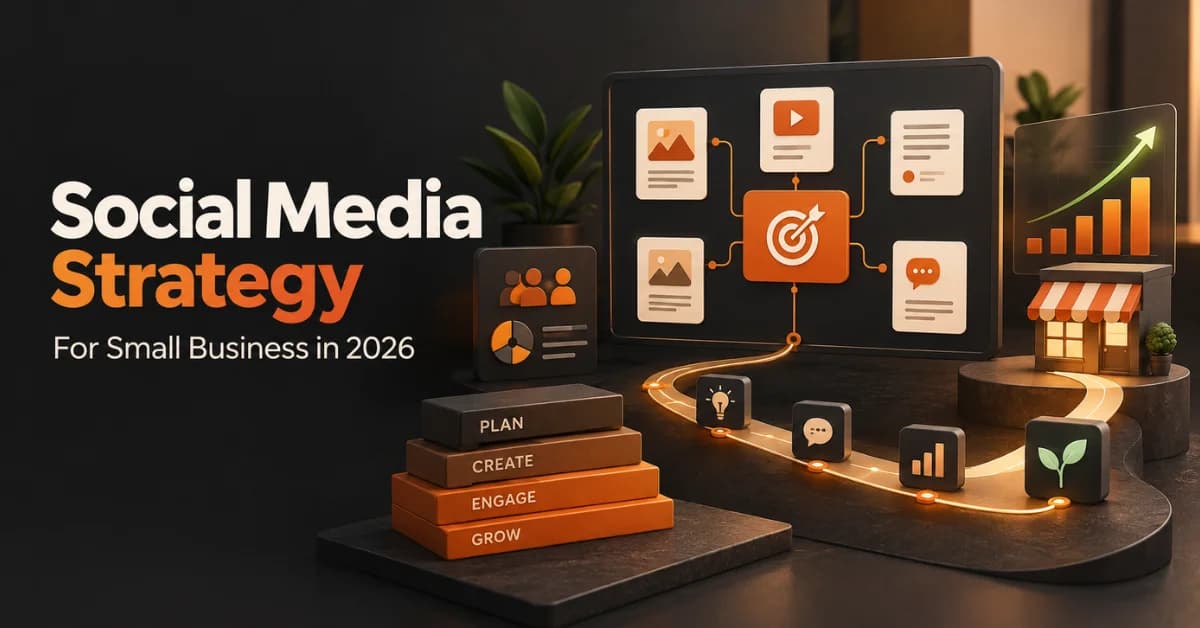
Social Media Strategy for Small Business in 2026
Social media is no longer just a place for businesses to post updates. For small businesses, it can support brand awareness, customer relationships, website traffic, lead generation, and sales when it follows a clear Social Media Strategy. The challenge is that simply creating accounts on Instagram, Facebook, LinkedIn, TikTok, or other platforms does not create results. Small businesses need to know who they want to reach, what they should publish, where they should publish it, and how they will measure success.
In 2026, an effective approach also considers short-form video, social search, useful educational content, community engagement, and responsible use of AI. The goal is not to publish more content. It is to create content that helps the right people take the next step.
What Is a Social Media Strategy?
A Social Media Strategy is a structured approach to using social platforms to achieve specific business objectives. It connects your audience, business goals, platforms, content, engagement activities, and performance measurement.
Instead of asking, “What should we post today?” a strategy asks better questions:
Who are we trying to reach?
What problems can we help solve?
Which platforms does our audience actually use?
What type of content will be useful to them?
What action should each piece of content encourage?
Which results matter to the business?
A strong strategy therefore provides direction before content creation begins.
Social Media Strategy vs. Social Media Plan
These terms are related but not identical. Your Social Media Strategy defines the overall direction. It establishes your goals, audience, positioning, platforms, content approach, and measurement framework. Your social media plan turns that strategy into practical actions. It can include your content calendar, publishing schedule, topics, formats, captions, calls to action, and performance targets.
Think of the strategy as the roadmap and the plan as the route you follow each week.
Why Small Businesses Need a Social Media Strategy in 2026
Small businesses often have limited time, staff, and marketing budgets. That makes strategic focus particularly important. A business that publishes randomly may generate occasional engagement but struggle to turn social activity into meaningful business outcomes.
A focused strategy can help a business:
Build brand awareness
Establish credibility
Reach a specific customer segment
Generate website traffic
Support lead generation
Answer customer questions
Strengthen existing relationships
Showcase expertise
Encourage repeat engagement
The objective should not be to collect followers simply because a larger number looks impressive. A smaller, relevant audience can be more valuable than a large audience that has little interest in the business.
Social Media Is Also Becoming a Discovery Channel
Customers increasingly use digital platforms to find ideas, recommendations, businesses, products, services, and answers. That means your social content should be useful even when someone discovers it without previously knowing your brand.
For example, a Dubai-based consultancy could create a short video answering a common customer question, an Instagram carousel explaining a process, and a LinkedIn post discussing an industry problem. Each piece can introduce the business while providing standalone value.
This also creates opportunities for content to support broader search visibility when the information is useful, clearly structured, and relevant to what people are looking for.
How to Build a Social Media Strategy for a Small Business
A practical Social Media Strategy starts with business objectives rather than platform trends.
1. Set Clear Business Goals
Start by deciding what social media needs to accomplish.
Possible goals include:
Increasing qualified website traffic
Generating enquiries
Building local awareness
Promoting a new service
Increasing product consideration
Improving customer engagement
Supporting repeat purchases
Establishing industry authority
Make each goal measurable where possible.
For example, “increase awareness” is difficult to evaluate on its own. “Increase qualified profile visits by 20% over three months” gives the team something more concrete to monitor.
Your content, platform selection, and metrics should all connect back to these goals.
2. Define Your Target Audience
Good content starts with understanding the people you want to reach.
Identify their needs, problems, questions, buying motivations, objections, and preferred content formats.
You can use information from:
Customer conversations
Sales enquiries
Website analytics
Social comments
Reviews
Search queries
Customer surveys
Frequently asked questions
A small business does not need a complicated audience research system to get started. Even a simple list of the customer's main problems can provide valuable content ideas.
3. Choose the Right Social Media Platforms
Being active on every platform is not necessarily a smart strategy.
Choose platforms based on where your audience spends time and which formats suit your business.
Instagram can work well for visual brands, lifestyle businesses, services, creators, and businesses that can demonstrate their work visually.
LinkedIn can be valuable for B2B companies, consultants, professional services, technology businesses, and industry-focused brands.
TikTok can support discovery through short-form educational, entertaining, demonstrative, or behind-the-scenes content.
Facebook can remain useful for community engagement, local businesses, groups, established audiences, and certain advertising objectives.
YouTube can support educational content, tutorials, demonstrations, reviews, and long-form expertise.
Pinterest can be useful for visually searchable topics such as design, home, lifestyle, planning, products, and inspiration.
The right platform is the one that connects your business with a relevant audience and gives you a practical way to communicate with that audience consistently.
4. Create Your Content Pillars
Content pillars give your social content strategy structure. Instead of creating unrelated posts every day, select several recurring themes that support your business goals.
Useful content pillars include:
Educational content
How-to content
Customer questions
Industry insights
Product or service information
Customer stories
Testimonials and social proof
Behind-the-scenes content
Company updates
Promotional content
For example, a digital marketing company could use four main pillars: SEO education, digital marketing tips, client-focused problems, and practical business growth advice.
This makes content planning faster and creates a more recognizable brand presence.
Build a Social Content Strategy That People Actually Want to See
A strong social content strategy should answer real customer needs rather than simply filling a publishing calendar.
Use Different Content Formats
Different formats serve different purposes.
Consider using:
Short-form videos
Carousels
Static graphics
Stories
Tutorials
Customer testimonials
FAQs
Polls
Interviews
Case studies
Behind-the-scenes content
Do not assume that every topic needs the same format.
A complex explanation may work better as a carousel or video. A quick announcement may need only a concise graphic and caption.
Use Promotional Content Carefully
Businesses need to promote their products and services, but constant selling can make social feeds less useful. Balance promotional posts with content that educates, answers questions, demonstrates expertise, or helps customers make better decisions. The exact ratio should depend on your audience and business model. There is no universal formula that every small business must follow.
Create Content Around Customer Questions
One of the easiest ways to improve content relevance is to use questions customers already ask.
Turn questions such as:
How much does this service cost?
How long does the process take?
What mistakes should I avoid?
Which option is better for my business?
What happens after I purchase?
Do I really need this service?
into educational posts, videos, FAQs, or social media carousels.
This approach helps create content around genuine user needs instead of guessing what might attract attention.
Create a Social Media Plan for Consistent Posting
Once the strategy is clear, create a practical social media plan.
Your plan can include:
Platform
Content topic
Content format
Target audience
Publishing date
Caption
Call to action
Visual requirements
Content owner
Target metric
A simple weekly structure could look like this:
Monday: Educational post
Tuesday: Short-form video
Wednesday: Customer question or FAQ
Thursday: Industry insight
Friday: Case study, testimonial, or promotional content
Weekend: Community-focused story or lighter content
This schedule is only a starting point. Adjust it according to audience behaviour and performance data.
How Often Should a Small Business Post on Social Media?
There is no single posting frequency that guarantees success. A better approach is to choose a schedule your business can maintain without sacrificing quality. Three useful posts that answer real customer questions can be more valuable than seven rushed posts created simply to meet a target.
Consistency means delivering useful content reliably. It does not mean publishing low-value content every day.
Use AI to Improve Small Business Social Media Without Losing Authenticity
AI can make social media workflows more efficient, but it should support human judgment rather than replace it.
Businesses can use AI to help with:
Content idea generation
Caption drafts
Video script outlines
Content repurposing
Content calendar planning
Audience-question analysis
Social post variations
Performance summaries
Topic research
For example, a 1,500-word blog post could become several social content ideas: a short video script, a carousel, an FAQ post, a LinkedIn discussion, and several short educational posts.
However, AI-generated material still needs human review. Check facts, examples, brand voice, originality, and customer relevance before publishing.
Google's current guidance allows AI-assisted content when it provides value, but warns against using automation to produce large amounts of low-value content primarily for search manipulation.
Where Human Input Still Matters
Human involvement remains important for:
Original experiences
Brand personality
Customer insights
Expert opinions
Fact checking
Sensitive topics
Storytelling
Final editorial decisions
AI can increase efficiency. It should not remove the experience and judgment that make business content trustworthy.
How to Measure Social Media Strategy Performance
Followers are only one part of the picture.
Your metrics should reflect your business goals.
Useful metrics include:
Reach
Engagement rate
Shares
Saves
Comments
Profile visits
Website visits
Leads
Conversion rate
Cost per lead
Customer enquiries
Revenue influenced by social activity
For example, if your objective is lead generation, a post with fewer likes but several qualified enquiries may outperform a highly viewed post that generates no business action.
How to Know What Content Is Working
Review performance regularly rather than waiting until the end of the year.
A simple monthly review can ask:
Which topics received the strongest response?
Which formats generated the most useful engagement?
Which posts generated website visits or enquiries?
What questions did customers repeatedly ask?
Which content should be repurposed?
What should be tested next month?
Use these findings to improve your next social media plan.
Common Social Media Mistakes Small Businesses Should Avoid
Many businesses struggle because they focus on activity instead of strategy.
Common mistakes include:
Posting without a clear objective
Joining too many platforms
Copying competitors
Making every post promotional
Ignoring comments and messages
Chasing followers instead of relevant customers
Publishing unedited AI content
Using inconsistent branding
Ignoring analytics
Failing to reuse successful content
A useful rule is simple: if a social activity does not help your audience or contribute to a business objective, reconsider why you are doing it.
A Practical 30-Day Social Media Strategy for Small Business
A 30-day framework can help a small business move from random posting to structured execution.
Week 1 — Research and Setup
Start by:
Defining your primary business objective
Identifying your target audience
Reviewing existing social accounts
Choosing your priority platforms
Establishing three to five content pillars
Also review your existing posts. Look for topics that generated meaningful questions, shares, saves, clicks, or enquiries.
Week 2 — Content Creation
Build your first content batch. Create educational posts, short-form videos, FAQs, customer-focused content, and selected promotional posts. Prepare several pieces at once instead of creating everything immediately before publishing.
This makes consistency easier and gives your team more time to improve quality.
Week 3 — Publish and Engage
Start publishing according to your social media plan. Do more than publish and leave. Respond to comments, answer messages, acknowledge useful feedback, and pay attention to questions that could become future content.
Social media works best when businesses treat it as a communication channel rather than a digital billboard.
Week 4 — Analyse and Improve
Review the month's performance.
Identify your strongest:
Topics
Formats
Hooks
Calls to action
Platforms
Audience responses
Then use these findings to build the next month's content plan.
The goal is continuous improvement rather than finding a perfect strategy on the first attempt.
Social Media Strategy Example for a Small Business
Consider a small UAE consultancy that wants to generate more qualified enquiries. Instead of posting generic promotional messages across every platform, the business could focus on LinkedIn and Instagram.
Its content pillars could include:
Practical business advice
Common customer questions
Industry updates
Client success stories
Service explanations
The business could publish educational LinkedIn posts, short Instagram videos, FAQ carousels, and occasional service-focused content.
Rather than measuring success only through followers, it could track profile visits, website traffic, enquiry forms, qualified leads, and consultation requests.
This creates a clearer connection between social media activity and business outcomes.
How to Improve Your Social Media Strategy Over Time
A successful strategy should evolve.
Audience interests change. Platforms introduce new features. Content formats become more or less effective. Your business goals can also change.
Use a simple improvement cycle:
Plan → Create → Publish → Engage → Measure → Improve
Review the strategy regularly and keep what works.
If educational videos consistently generate meaningful engagement, create more of them. If a certain topic produces little response, change the angle or format before abandoning the subject completely.
The goal is not to follow every social media trend. The goal is to understand what works for your audience and business.
Frequently Asked Questions About Social Media Strategy
What is a Social Media Strategy for a small business?
A Social Media Strategy is a structured approach to using social platforms to achieve business goals. It defines the target audience, platforms, content approach, engagement methods, and performance metrics.
Which social media platform is best for small businesses in 2026?
There is no single best platform for every business. The right choice depends on your audience, industry, content format, resources, and business objectives.
How often should a small business post on social media?
A small business should choose a sustainable publishing schedule that allows it to maintain useful content consistently. Quality, relevance, and audience response matter more than following an arbitrary daily posting target.
What should a small business post on social media?
Useful options include educational content, FAQs, tutorials, customer stories, industry insights, behind-the-scenes content, social proof, and relevant promotional posts.
How can AI help with small business social media?
AI can support research, ideation, caption drafting, content repurposing, video scripting, planning, and performance analysis. Businesses should review AI-assisted content for accuracy, originality, brand voice, and relevance before publishing.
How do you measure whether a social media strategy is working?
Measure results against your business objective. Relevant metrics can include engagement, website traffic, leads, enquiries, conversions, cost per lead, and revenue influenced by social activity.
Final Takeaway
A successful Social Media Strategy does not require a small business to be active everywhere or publish constantly. It requires a clear understanding of the audience, focused platform selection, useful content, consistent execution, genuine engagement, and regular measurement.
In 2026, businesses can also use AI to make content workflows more efficient. However, the strongest social presence still comes from useful information, authentic communication, real customer understanding, and human oversight.
About BrandVexo Digital Solutions
BrandVexo helps businesses build practical digital growth systems across digital marketing, SEO, web development, AI automation, and business solutions. Our approach focuses on measurable business outcomes rather than vanity metrics.
If you need support with social media planning, content strategy, SEO, digital marketing, or broader digital growth, our team can help you build a practical approach around your business goals.
Phone: +971 52 356 5409
Email: info@brandvexo.com
Website: www.brandvexo.com
Disclaimer: This article provides general digital marketing information and strategic guidance. Platform features, algorithms, advertising options, and best practices can change, so businesses should review current platform documentation before making significant marketing decisions.
Free growth plan
Ready to grow your business?
Reading is a start — now let's build it. Tell us where you want to grow and a senior strategist will map the fastest, most profitable way to get there. Free, no obligation.
Discussion
Join the conversation
Be the first to comment. Comments are reviewed before they appear, so yours won't show up instantly — but we read every one.
Leave a comment
Keep reading
All articles Growth
Social Media Marketing for Restaurants: What Works
Learn what works in social media marketing for restaurants, including Instagram, TikTok, local strategy, content ideas, and measurable F&B marketing tactics.
 Growth
Social Media Content Calendar: A Practical System
Create a practical social media content calendar with content planning, scheduling, content pillars, templates, and measurement tips for consistent growth.
 Growth
Short-Form Video Strategy: What Businesses Should Post
Learn what businesses should post with a short-form video strategy, including Reels, TikTok content, video ideas, content pillars, and practical tips.