

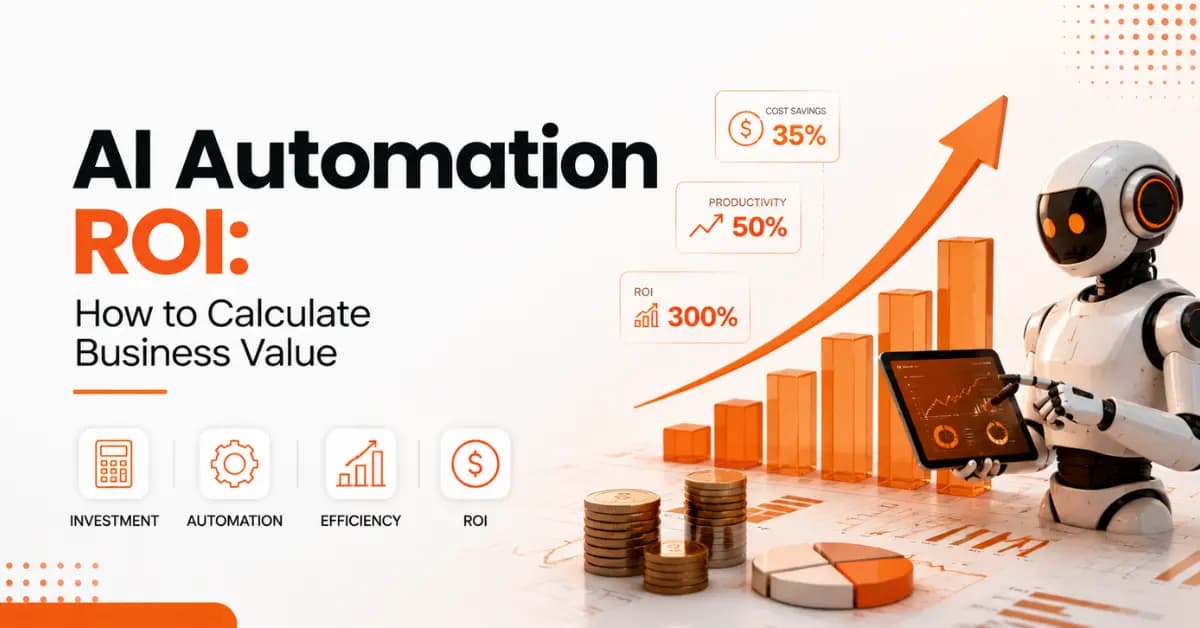
AI Automation ROI: How to Calculate the Business Case
AI automation is no longer just a technology trend. For businesses, the more important question is simple: Will automation actually improve the bottom line? That is where AI Automation ROI becomes important. Instead of investing in AI because competitors are doing it, businesses can evaluate automation based on measurable outcomes such as time saved, operating costs reduced, revenue generated, faster response times, and fewer errors.
This approach is particularly relevant for UAE businesses. The UAE has positioned artificial intelligence as a strategic priority, with its national AI strategy focused on productivity, investment, innovation, and economic value. The UAE's 2026 AI Charter also emphasizes responsible AI use, privacy, transparency, accountability, and human oversight.
For a business considering automation, the goal should not be to automate everything. The goal should be to automate the right processes at the right cost and measure the resulting business impact.
What Is AI Automation ROI?
AI Automation ROI measures the financial return a business receives from an AI-powered automation investment compared with the cost of implementing and operating it.
A simple formula is:
AI Automation ROI = (Financial Benefits − Automation Costs) ÷ Automation Costs × 100
Financial benefits can include more than direct cost savings. They may come from:
Reduced employee hours spent on repetitive tasks
Lower administrative costs
Faster lead response
Increased sales conversions
Fewer manual errors
Reduced outsourcing costs
Improved customer service
Higher employee productivity
Faster business processes
For example, if an automation project costs AED 30,000 and generates AED 50,000 in measurable financial benefits during the evaluation period, the net benefit is AED 20,000.
The important point is to calculate ROI using realistic business data rather than optimistic assumptions.
Why AI Automation ROI Matters for UAE Businesses
Businesses in Dubai and across the UAE operate in highly competitive markets where speed, service quality, and operational efficiency can directly affect growth. Business automation Dubai strategies can help companies reduce repetitive work across sales, marketing, finance, customer service, administration, and reporting. The UAE's broader AI direction also supports the adoption of AI to improve efficiency, productivity, innovation, and economic value.
However, technology adoption alone does not guarantee financial results.
A company could spend thousands of dirhams automating a process that saves only a few hundred dirhams per month. In that situation, the technology may work perfectly while the business case remains weak.
That is why companies should calculate the expected return before implementation.
How to Calculate AI Automation ROI Step by Step
A practical ROI calculation starts with the existing process.
Step 1: Define the Current Process
First, document how the process works today.
Identify:
How many tasks employees complete each month
How many employees participate
Average time spent per task
Monthly task volume
Current software costs
Error rates
Delays and bottlenecks
Revenue opportunities being missed
Do not start with the automation tool. Start with the business problem.
For example, a sales team may spend hours every week copying lead information between email, spreadsheets, and a CRM. That process represents a measurable cost.
Step 2: Calculate the Current Cost
Suppose a company spends 200 employee hours each month on repetitive lead management and reporting.
If the estimated employee cost is AED 50 per hour:
200 hours × AED 50 = AED 10,000 per month
The current process therefore has an estimated labor cost of AED 10,000 per month.
This creates the baseline against which the automation project can be evaluated.
Step 3: Estimate Automation Savings
Next, estimate how much work automation could remove or reduce.
Suppose automation reduces the workload from 200 hours to 70 hours per month.
That means:
200 − 70 = 130 hours saved
At AED 50 per hour:
130 × AED 50 = AED 6,500 monthly productivity value
This does not necessarily mean the company should remove employees. In many cases, the better outcome is to redirect those employees toward sales, strategy, customer relationships, or other higher-value activities.
Step 4: Add Revenue Impact
Cost savings are only one side of the calculation.
AI automation can also influence revenue.
For example, an automated lead workflow could:
Respond to leads faster
Qualify prospects automatically
Send personalized follow-ups
Notify sales representatives
Reduce missed opportunities
Keep CRM information updated
If faster follow-up generates additional qualified opportunities and sales, that revenue should also be included in the business case where it can be measured reliably.
Step 5: Calculate the Payback Period
ROI tells you the return relative to investment, while the payback period tells you how quickly the initial investment can be recovered.
Use:
Payback Period = Initial Automation Investment ÷ Monthly Net Benefit
For example, if implementation costs AED 30,000 and the expected net benefit is AED 5,000 per month:
AED 30,000 ÷ AED 5,000 = 6 months
The estimated payback period would therefore be six months.
AI Automation ROI Example: A Dubai SME
Consider a hypothetical Dubai-based professional services company that receives approximately 1,000 leads each month.
Its sales and operations team currently spends significant time qualifying leads, updating CRM records, sending follow-ups, and preparing reports.
Before Automation
The company spends approximately:
250 hours per month on repetitive tasks
AED 50 per hour in estimated employee cost
AED 12,500 monthly in productivity cost
The company also loses some opportunities because employees cannot respond to every inquiry immediately.
After Automation
The company introduces an AI-powered workflow that:
Lead received → AI qualification → CRM update → personalized response → sales notification → follow-up
The manual workload falls to approximately 80 hours per month.
That represents:
250 − 80 = 170 hours saved
At AED 50 per hour:
170 × AED 50 = AED 8,500 monthly productivity value
If the automation costs AED 3,000 per month, the estimated direct monthly benefit is:
AED 8,500 − AED 3,000 = AED 5,500
This produces a useful starting point for evaluating the investment.
The figures above are illustrative rather than guaranteed results. Actual AI Automation ROI depends on the company's processes, implementation quality, technology costs, employee costs, and revenue impact.
What Costs Should You Include When Calculating AI Automation ROI?
One common mistake is calculating ROI using only the subscription price of an AI tool.
The real automation investment can include several components.
Direct Automation Costs
Consider:
AI software subscriptions
Workflow automation platforms
API usage
Initial development
System integrations
Implementation
Testing
Employee training
Ongoing Automation Costs
You may also need to account for:
Maintenance
Monitoring
Workflow improvements
Data management
Security controls
Human review
Software upgrades
Additional usage as the business scales
For custom AI systems, integration and maintenance can become significant parts of the total cost.
A realistic business case should therefore calculate total cost of ownership, not simply the initial setup fee.
How to Measure AI Automation ROI Beyond Cost Savings
A strong ROI model should track more than money saved.
Productivity ROI
Measure:
Employee hours saved
Tasks completed per employee
Processing time
Number of processes automated
Work completed without manual intervention
Revenue ROI
Track:
Leads generated
Lead response time
Conversion rate
Sales opportunities
Revenue influenced by automation
Customer retention
Quality ROI
Measure:
Error reduction
Data accuracy
Customer satisfaction
Response consistency
Processing accuracy
Strategic ROI
Some benefits are harder to express immediately in monetary terms. Automation can help businesses scale without increasing administrative workload at the same rate. It can also allow employees to spend more time on strategic activities instead of repetitive data entry.
These benefits should not replace financial calculations, but they can strengthen the overall business case.
AI Workflows UAE Businesses Can Use to Improve ROI
AI workflows UAE businesses use should connect automation to a measurable business outcome. Instead of automating one isolated task, companies can connect several steps into a complete workflow.
Lead Management Workflow
Lead → AI qualification → CRM update → personalized response → sales alert
This can reduce manual data entry while helping sales teams prioritize higher-value prospects.
Customer Support Workflow
Customer query → AI classification → knowledge lookup → response → human escalation
The AI can handle routine requests while sending complex or sensitive cases to a human employee.
Finance Workflow
Invoice → data extraction → validation → accounting system → approval → reporting
This can reduce repetitive data processing and improve the consistency of financial workflows.
Marketing Workflow
Content request → research → AI-assisted creation → human review → publishing → performance tracking
The important KPI is not simply the number of pieces produced. Businesses should measure whether the workflow improves productivity, content output, qualified traffic, leads, or revenue.
When Should You Work With an AI Agency Dubai?
Not every business needs a custom AI implementation. For a simple task, an existing automation platform may be sufficient. More complex projects may require integration between CRM systems, websites, databases, communication platforms, and internal software.
An AI agency Dubai can be useful when:
Several business systems need integration
The workflow requires custom logic
Internal teams lack automation expertise
The company needs custom AI functionality
Data security requirements are important
Automation will affect multiple departments
The business needs ongoing monitoring and optimization
Before selecting a provider, ask:
What business problem will the automation solve?
Which KPI will improve?
What is the expected payback period?
What are the implementation costs?
What ongoing costs should we expect?
How will results be measured?
What happens when the AI produces an incorrect result?
Where will human approval remain necessary?
Can the workflow scale with the business?
The best provider is not necessarily the one offering the most advanced AI. It is the one that can connect the technology to a clear business outcome.
Common Mistakes That Make AI Automation ROI Look Better Than It Is
Only Counting Labor Savings
A company may calculate hours saved but ignore implementation costs, software fees, maintenance, and training.
Calculate both benefits and expenses.
Ignoring Implementation Costs
A workflow may appear inexpensive until integration, development, testing, and employee training are added.
Include these costs from the beginning.
Automating the Wrong Process
Automation does not fix a poorly designed process.
If a process is already inefficient, document and improve it before automating it.
Using Unrealistic Productivity Estimates
Avoid assuming that automation will eliminate 100% of manual work.
Use conservative estimates and compare them with actual results after launch.
Not Tracking Results After Implementation
ROI should not end when the automation goes live.
Compare:
Baseline KPI → Post-automation KPI → Financial impact
This gives management a clearer picture of whether the project delivered the expected value.
How to Build an AI Automation Business Case
A simple six-part framework can make automation decisions easier.
1. Problem
Identify the repetitive or inefficient process.
2. Baseline
Calculate what the current process costs in time, money, errors, and missed opportunities.
3. Solution
Define exactly what AI or automation will change.
4. Investment
Calculate setup, software, integration, training, maintenance, and other costs.
5. Expected Benefit
Estimate productivity gains, cost savings, revenue impact, and quality improvements.
6. Measurement
Choose the KPIs that will determine whether the investment succeeded.
For better decision-making, create three scenarios:
Conservative: Lower expected benefits
Expected: Most realistic outcome
Optimistic: Strong performance scenario
This approach reduces the risk of approving a project based on overly optimistic assumptions.
AI Automation ROI: Key Metrics to Track
Businesses should select KPIs based on the process being automated.
Useful metrics include:
AI Automation ROI: Overall financial return
Monthly cost savings: Direct recurring savings
Hours saved: Productivity improvement
Revenue generated: Additional measurable revenue
Conversion rate: Sales effectiveness
Cost per lead: Marketing efficiency
Response time: Customer or sales speed
Error rate: Quality improvement
Employee productivity: Output per employee
Customer satisfaction: Service impact
Payback period: Time required to recover investment
Automation adoption rate: Actual use of the system
Tracking these metrics gives business leaders evidence rather than assumptions.
FAQ
What is AI Automation ROI?
AI Automation ROI measures the financial return generated by an AI automation investment compared with the total cost of implementing and operating the automation.
How do you calculate AI Automation ROI?
Use the basic formula:
AI Automation ROI = (Financial Benefits − Automation Costs) ÷ Automation Costs × 100
Include measurable cost savings, productivity gains, and relevant revenue impact while accounting for implementation and ongoing costs.
How long does AI automation take to pay for itself?
There is no universal payback period. It depends on the initial investment, monthly savings, revenue impact, and operating costs. Businesses should calculate payback using their own financial data.
Is AI automation expensive for small businesses?
Not necessarily. Small businesses can start with SaaS-based AI tools and simple workflows before investing in complex custom solutions. The right starting point is a process where automation can produce measurable value.
What business processes should companies automate first?
Start with repetitive, high-volume, rule-based processes that consume significant employee time and have measurable outcomes. Examples include lead qualification, CRM updates, customer support, reporting, invoice processing, and data entry.
How can Dubai businesses use AI automation?
Dubai businesses can use AI automation across sales, customer service, marketing, finance, HR, reporting, administration, and operational workflows. The best use case depends on the company's processes and measurable business goals.
How BrandVexo Can Help With AI Automation
BrandVexo helps businesses explore practical digital and AI solutions designed around real business objectives rather than technology for its own sake. From AI automation and workflow optimization to digital marketing, SEO, web development, and business solutions, the focus is on creating systems that can support productivity, customer engagement, and scalable growth.
If your business is considering automation, start by identifying the process that consumes the most repetitive time. Once the current cost and expected benefit are clear, you can make a more informed decision about whether automation makes financial sense.
BrandVexo Digital Solutions
📞 +971 52 356 5409
📧 info@brandvexo.com
🌐 www.brandvexo.com
Final Takeaway
AI automation can create significant value, but the technology itself is not the ROI. The return comes from solving a valuable business problem efficiently. Before investing, calculate what the existing process costs, estimate realistic automation benefits, include implementation and ongoing expenses, and establish KPIs for measuring actual performance. For UAE businesses exploring business automation Dubai, AI workflows, or custom AI solutions, the best starting point is usually a high-volume, repetitive process where the cost of the current workflow is easy to measure.
Disclaimer: This article provides general educational information about AI automation and ROI calculations. Examples and financial figures are illustrative and should not be treated as guaranteed business results. Actual ROI depends on implementation costs, business processes, technology, and measurable outcomes.
Free growth plan
Ready to grow your business?
Reading is a start — now let's build it. Tell us where you want to grow and a senior strategist will map the fastest, most profitable way to get there. Free, no obligation.
Discussion
Join the conversation
Be the first to comment. Comments are reviewed before they appear, so yours won't show up instantly — but we read every one.
Leave a comment
Keep reading
All articles Automation
AI Automation Dubai: Use Cases, Costs and Providers
Discover AI automation Dubai, including use cases, costs, AI workflows, implementation tips, and how to choose the right AI automation provider.
 Automation
n8n vs Make vs Zapier: Which Automation Tool Wins?
Compare n8n vs Make vs Zapier for pricing, features, AI automation, integrations, scalability, and business use cases. Find the right tool for you.
 Automation
CRM Automation: 12 Workflows That Save Sales Time
Discover 12 CRM automation workflows that save sales time, improve lead follow-up, and connect WhatsApp, chatbots, nurturing, and pipeline tasks.