

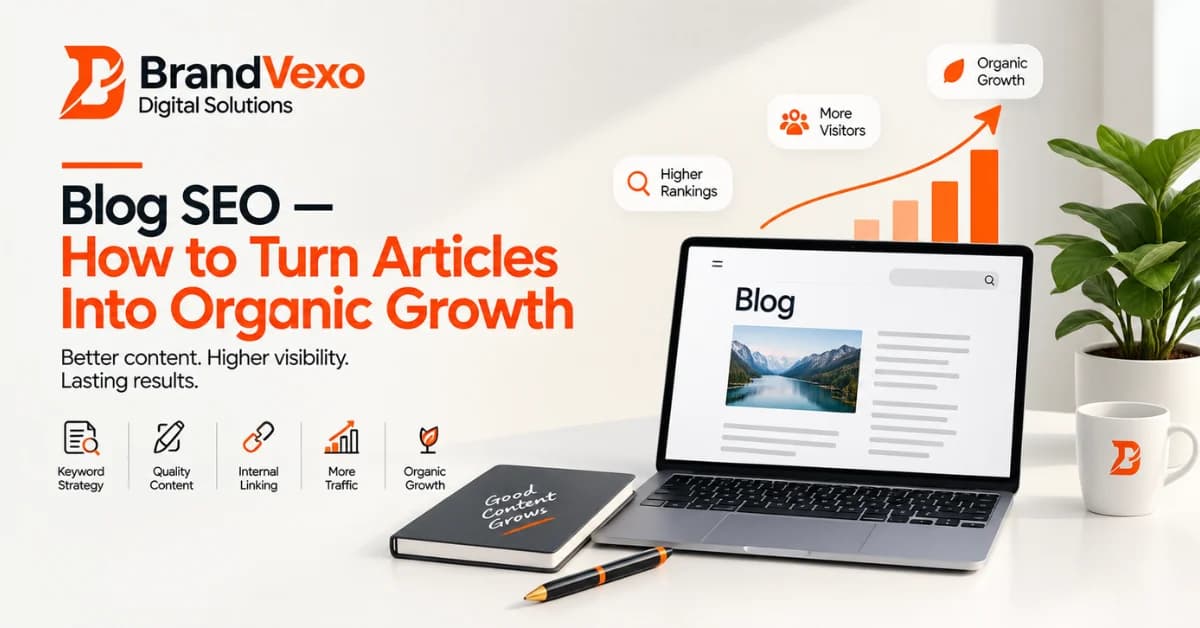
Blog SEO: How to Turn Articles Into Organic Growth
Publishing blog posts consistently does not automatically create organic growth. A website can publish dozens of articles and still struggle to attract qualified visitors if those articles do not match search intent, answer real questions, or connect with the rest of the website. Blog SEO turns individual articles into useful search assets. It combines topic research, search intent, content quality, on-page optimization, internal linking, technical accessibility, measurement, and ongoing improvement. Google’s current guidance emphasizes helpful, reliable, people-first content rather than content created primarily to manipulate rankings.
For businesses, the goal is not simply to get more pageviews. A strong SEO blogging strategy should attract the right audience, answer their questions, build trust, and guide relevant visitors toward the next useful step.
What Is Blog SEO and Why Does It Matter?
Blog SEO is the process of creating, structuring, optimizing, and maintaining blog content so that search engines can understand it and people can find useful answers through organic search. Effective Blog SEO includes more than adding a keyword to a title. It involves understanding what people want, producing genuinely useful information, organizing the page clearly, connecting related content, and monitoring how the article performs.
Google recommends using words that people actually search for in important page elements while keeping the content helpful and reliable.
What Blog SEO Actually Includes
A practical Blog SEO process can include:
Search intent analysis
Keyword and topic research
Content planning
Helpful content creation
H1, H2, and H3 optimization
Title and meta description optimization
Internal linking
Relevant external references
Image optimization
Technical accessibility
Content measurement
Content updates and refreshes
These elements work together. Optimizing one heading will not compensate for an article that fails to answer the searcher's actual question.
How SEO Blogging Supports Long-Term Organic Growth
Think of a blog post as one part of a larger journey:
Useful article → Search visibility → Relevant visitors → Trust → Website engagement → Business action
For example, a company selling ecommerce services might publish an article about improving product page SEO. That article can answer an informational question, link to related ecommerce guides, and eventually introduce a relevant service page.
The article therefore becomes more than a traffic source. It becomes part of the website's content ecosystem.
Start With Search Intent, Not Just Keywords
One of the biggest mistakes in SEO blogging is choosing a keyword first and writing whatever information can be placed around it.
A better approach starts with the searcher's problem.
Identify What the Searcher Actually Wants
Search queries can have different purposes. A person searching for “what is technical SEO” probably wants an explanation. Someone searching for “technical SEO agency” may be evaluating providers.
Before writing, ask:
What does the searcher need to accomplish after reading this page?
Look at the type of results appearing for the query and identify the common format. Are they guides, comparisons, tutorials, definitions, product pages, or service pages?
Your content should satisfy the underlying need rather than simply repeat the search phrase.
Match the Article Format to the Query
Different searches can require different formats.
For example:
How-to query: Step-by-step guide
Definition query: Clear explanation with examples
Comparison query: Detailed comparison
Problem query: Troubleshooting guide
Planning query: Checklist or framework
Commercial investigation: Comparison, buyer's guide, or solution-focused content
This approach helps blog optimization start with usefulness instead of keyword placement.
Choose Topics That Can Generate Organic Blog Traffic
Not every topic deserves an article. A topic might have search volume but little relevance to your audience. Another topic might have modest search demand but attract highly qualified visitors.
Build Topics Around Real Customer Problems
Start with questions your audience actually asks.
Useful sources include:
Sales conversations
Customer support questions
Website FAQs
Search suggestions
Existing analytics data
Industry discussions
Competitor content
Product or service objections
Suppose a digital agency provides ecommerce services. Instead of publishing generic posts about “digital marketing,” it could build content around specific problems such as product page optimization, abandoned carts, ecommerce SEO, conversion optimization, and Shopify SEO.
These topics have a clearer relationship with the problems potential customers want to solve.
Use Topic Clusters Instead of Random Blog Posts
A strong content strategy connects related articles.
For example:
Pillar topic: Ecommerce SEO
Supporting articles could include:
Product Page SEO
Category Page SEO
Shopify SEO
Ecommerce Keyword Research
Technical SEO for Ecommerce
Ecommerce Content Strategy
Internal links can connect these pages and help users move between related resources.
This creates a stronger content SEO structure than publishing unrelated articles every week.
Create Helpful Content That Deserves Attention
Good SEO content should provide value even if the visitor never becomes a customer. Google's guidance encourages original, substantial, reliable content that gives readers a satisfying experience. It also recommends considering whether content demonstrates first-hand expertise and whether it adds meaningful value beyond what is already available.
Answer the Main Question Early
Avoid making readers scroll through several paragraphs of generic background before reaching the answer.
A strong introduction should quickly establish:
What the topic means
Why it matters
What the reader will learn
What practical problem the article will solve
Then expand the explanation with examples and supporting details.
Add Original Experience, Examples, and Evidence
Generic summaries are easy to reproduce.
Useful content adds something more:
Original examples
Practical workflows
First-hand observations
Relevant data
Expert explanations
Screenshots where appropriate
Industry-specific scenarios
Clear recommendations based on evidence
For example, instead of simply saying “use internal links,” explain how an ecommerce website could connect a broad SEO guide with product-page and category-page optimization articles.
That makes the information more actionable.
Cover the Topic Without Adding Filler
Do not increase an article's length simply to hit a word-count target. Google explicitly states that there is no preferred word count.
A 1,500-word article should contain 1,500 words because the topic requires useful explanation—not because an arbitrary length is supposedly a ranking requirement.
Apply On-Page Blog Optimization Before Publishing
Once the content is useful, make it easy for both readers and search engines to understand.
Optimize the Title and H1
Your title should accurately communicate what the article provides.
A strong title should:
Clearly describe the topic
Reflect search intent
Include the main topic naturally
Give readers a reason to click
Avoid exaggerated promises
Keep the H1 clear and closely aligned with the page's purpose.
Structure Content With H2 and H3 Headings
Good headings create a logical hierarchy.
Use:
H1 → Main article topic
H2 → Major sections
H3 → Supporting questions or subsections
This makes long articles easier to scan and helps readers find the information they need.
Optimize URLs, Meta Titles, and Meta Descriptions
Keep the URL concise and descriptive. Your meta title should accurately summarize the page, while the meta description should explain the benefit of visiting it. Avoid stuffing several variations of the same keyword into these fields.
Optimize Images
Images can improve comprehension when they add genuine value.
For better blog optimization:
Use descriptive image file names
Write useful alt text
Compress large images
Choose relevant visuals
Avoid images that exist only to fill space
SEO should support the overall page experience rather than distract from the content.
Build a Strong Internal Linking Strategy
Internal linking is one of the most useful ways to connect individual articles into a broader content system.
Link From New Articles to Relevant Existing Pages
When publishing a new article, look for older pages that provide useful context.
For example, an article about ecommerce conversion optimization might naturally link to:
Product page SEO
Ecommerce SEO
Abandoned cart optimization
Landing page optimization
The link should help the reader continue their research.
Use Descriptive Anchor Text
Use anchor text that gives the reader an idea of what they will find after clicking. Instead of repeatedly using generic text such as “click here,” use descriptive wording when it fits naturally.
Link Blog Content to Commercial Pages
Blog content can also connect informational searches with relevant business pages.
A logical path might look like:
Educational article → Related guide → Relevant service → Contact or conversion
The objective is not to force a sales message into every article. It is to make the next useful step easy to find.
Make Content SEO Work Beyond the Article
Content performance also depends on the website environment surrounding the article.
Improve the Article's Technical Accessibility
Search engines need to be able to access, crawl, and understand your content.
Review:
Mobile usability
Crawlability
Indexability
HTTPS
Page performance
Canonicalization where relevant
Internal links
Google's Search Essentials specifically highlights crawlable links and technical accessibility as foundational SEO practices.
Connect Blog Content With the Rest of the Website
Your blog should not operate as an isolated section.
Connect relevant articles with:
Service pages
Product pages
Category pages
Resource pages
Case studies
Other supporting guides
This gives users a clearer path through the website and creates a more organized content structure.
Promote Your Articles to Build Initial Visibility
Publishing an article does not mean the work ends.
Relevant promotion can help your existing audience find the content and can introduce the article to people who may benefit from it.
Use Relevant Distribution Channels
Depending on the audience, consider:
Email newsletters
LinkedIn
Social media
Industry communities
Professional networks
Relevant partnerships
Google also recommends telling people about your site and participating in relevant communities where you can appropriately share useful information.
Promotion should remain useful and relevant. Avoid turning distribution into repetitive promotional messaging.
Turn One Article Into Multiple Content Assets
A detailed article can support several other formats.
For example:
One blog article →
LinkedIn post
Newsletter
Short social posts
Video topic
FAQ content
Infographic
Internal sales resource
This allows businesses to gain more value from the research that went into the original article.
Measure Whether Your Blog Is Actually Growing
Traffic alone does not tell you whether your content strategy works.
Track the Right SEO Metrics
Monitor metrics such as:
Organic clicks
Search impressions
Search queries
Average position
Organic sessions
Engagement
Leads
Conversions
Assisted conversions
Google Search Console can help website owners understand how pages perform in Google Search.
Find Pages With High Impressions but Low Clicks
A page receiving many impressions but relatively few clicks can provide an optimization opportunity.
Review:
Page title
Meta description
Search intent
Content relevance
Whether the introduction matches the query
Do not change these elements simply to manipulate clicks. Make changes that create a more accurate and useful search result.
Find Pages That Get Traffic but No Conversions
High traffic does not automatically mean business value.
If an article attracts visitors but produces no meaningful actions, examine:
Whether the traffic matches your audience
Search intent
Internal links
Calls to action
Relevance of the linked offer
User journey
The goal of organic blog traffic should be relevant visibility that supports meaningful outcomes.
Refresh Existing Articles for More Organic Growth
One of the biggest opportunities in content SEO is often already sitting on your website. Old articles can contain valuable research, backlinks, internal links, and existing search visibility.
When Should You Update an Old Blog Post?
Consider reviewing an article when:
Information has changed
Organic clicks have declined
Rankings have dropped
Competitors provide better coverage
Search intent has changed
Statistics are outdated
Examples no longer reflect the market
What Should You Update?
Depending on the page, you may improve:
Facts and statistics
Examples
Headings
Search intent alignment
Internal links
External references
FAQs
Images
Meta information
Improve Instead of Simply Changing the Date
Changing a publication date without substantially improving the content does not make an article meaningfully fresher.
A proper content refresh should add useful information, correct outdated details, improve clarity, or better satisfy the searcher's needs. Google's people-first guidance specifically warns against changing dates merely to make pages appear fresh.
Common Blog SEO Mistakes That Limit Organic Growth
Avoid these common problems:
Writing for keywords instead of readers
Ignoring search intent
Publishing thin or repetitive articles
Overusing exact-match keywords
Creating multiple articles around the same search intent
Neglecting internal links
Using vague titles
Ignoring older content
Measuring only rankings
Publishing without reviewing performance
Adding unnecessary paragraphs to reach a word count
Creating content solely because a topic appears trendy
Effective SEO blogging requires a balance between search visibility and genuine usefulness.
A Practical Blog SEO Workflow You Can Repeat
A repeatable process makes content production more consistent.
Step 1 — Research
Identify:
Audience problem
Search intent
Primary keyword
Related topics
Competitor gaps
Existing content on your website
Step 2 — Plan
Create:
Search-focused title
H2/H3 structure
Content angle
Examples
Internal-link opportunities
Relevant FAQs
Step 3 — Write
Focus on:
Clear answers
Original value
Simple language
Practical examples
Natural keyword usage
Step 4 — Optimize
Review:
H1
Title tag
Meta description
URL
Headings
Images
Internal links
External references
Step 5 — Publish and Promote
Make the article available to your audience through relevant channels.
Step 6 — Measure and Improve
Use performance data to identify opportunities for updates, stronger internal links, improved search alignment, and better user journeys.
Blog SEO Checklist Before You Publish
Use this quick checklist before publishing an article:
Does the article satisfy the main search intent?
Is the primary keyword used naturally?
Does the introduction explain the topic clearly?
Is the title accurate and useful?
Are H2 and H3 headings logically structured?
Does the article add original value?
Are secondary keywords naturally incorporated?
Are relevant internal links included?
Are external sources trustworthy and relevant?
Are images optimized?
Is the URL concise?
Is the meta description accurate?
Does the article provide a useful next step?
Can the reader act on the information?
FAQs
What is Blog SEO?
Blog SEO is the process of creating and optimizing blog content so search engines can understand it and users can find useful answers through organic search. It includes search intent, keyword research, content structure, on-page optimization, internal linking, technical accessibility, and ongoing content improvement.
How does SEO blogging increase organic traffic?
SEO blogging can increase organic visibility by creating useful content that matches the questions and problems people search for. When articles satisfy search intent and provide strong value, they can attract relevant visitors through organic search. However, no particular ranking or traffic result is guaranteed.
How often should you publish SEO blog posts?
There is no universal publishing frequency that guarantees better results. A sustainable schedule that allows you to create useful, accurate, well-researched content is generally more valuable than publishing large quantities of low-value articles.
How do I optimize an existing blog post?
Start by reviewing its search performance, search intent, accuracy, competitors, internal links, and content gaps. Then update outdated information, improve weak sections, add useful examples, strengthen internal links, and improve the page's overall usefulness.
What is the difference between content SEO and Blog SEO?
Content SEO is the broader practice of optimizing content for search visibility and user needs across a website. Blog SEO focuses specifically on blog articles and the systems used to research, create, optimize, organize, measure, and refresh those articles.
How long does it take for a blog post to generate organic traffic?
There is no fixed timeframe. Results depend on factors such as the website's existing authority, competition, topic demand, technical accessibility, content quality, search intent, and how the content performs after publication. Treat organic growth as an ongoing process rather than a guaranteed short-term result.
Turn Blog Content Into a Sustainable Organic Growth System
Blog SEO works best when you treat every article as part of a larger system. Instead of publishing content simply because a keyword has search volume, start with a real audience problem and create the most useful answer you can. Then connect that article to relevant pages, make the experience easy to navigate, monitor its performance, and improve it when the data or topic changes.
Google's current guidance for both traditional and AI-powered Search continues to emphasize helpful, original, people-first content and strong foundational SEO rather than shortcuts or “AI-search hacks.”
For businesses, the real opportunity is to turn individual articles into a connected content system that attracts relevant organic blog traffic, builds trust, and supports measurable business goals.
How BrandVexo Can Help!
BrandVexo helps businesses build practical digital growth systems across digital marketing, SEO, web development, AI automation, and business solutions. We focus on measurable outcomes rather than vanity metrics, helping businesses connect their digital activities with real commercial goals. Our approach combines strategy, content, technology, and optimization to create sustainable growth systems. From SEO and content strategy to web development and AI automation, we help businesses solve practical digital challenges.
Contact BrandVexo Digital Solutions:
Phone: +971 52 356 5409
Email: info@brandvexo.com
Website: www.brandvexo.com
Disclaimer: SEO results vary by website, industry, competition, content quality, and other factors. The strategies discussed in this article provide general SEO guidance and do not guarantee specific rankings, traffic levels, or conversions.
Free growth plan
Ready to grow your business?
Reading is a start — now let's build it. Tell us where you want to grow and a senior strategist will map the fastest, most profitable way to get there. Free, no obligation.
Discussion
Join the conversation
Be the first to comment. Comments are reviewed before they appear, so yours won't show up instantly — but we read every one.
Leave a comment
Keep reading
All articles Growth
Content Audit Checklist: What to Update, Merge or Delete
Use this Content Audit Checklist to find outdated, duplicate, and low-value pages, then decide what to update, merge, redirect, or delete.
 Growth
SEO Content Brief: How to Create One That Ranks
Learn how to create an SEO content brief with search intent, keyword research, SERP analysis, content gaps, structure, and a practical template.
 Growth
Content Marketing Strategy: Build Traffic That Converts
Build a Content Marketing Strategy that attracts the right audience, guides visitors through the content funnel, and turns traffic into qualified leads.