

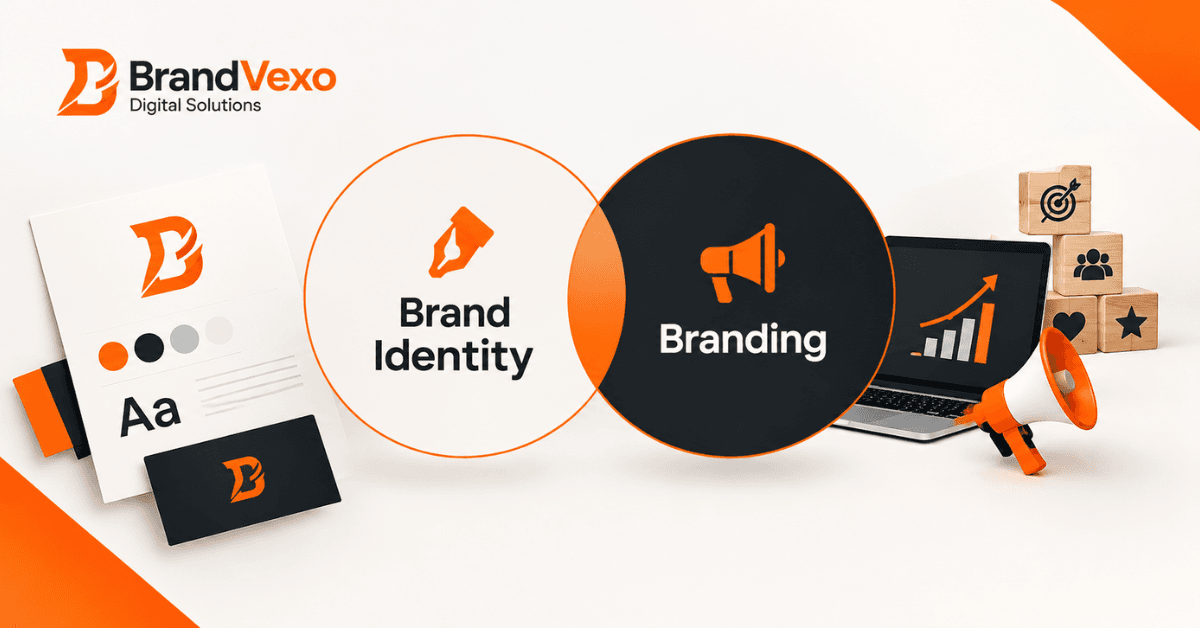
Brand Identity vs Branding: What's the Difference?
Many businesses use brand identity and branding as if they mean the same thing. They are closely connected, but they are not identical. Understanding the difference can help businesses make better decisions about their logo, visual identity, messaging, customer experience, and marketing.
What Is Brand Identity?
Brand identity is the set of visual and symbolic elements that a business uses to present itself consistently. It gives a company a recognizable appearance and helps customers identify it across different touchpoints. A strong identity makes the business look and sound consistent whether someone visits its website, sees an advertisement, opens an email, or views a social media post.
Key Elements of Brand Identity
A typical brand identity can include:
Brand name
Logo
Color palette
Typography
Photography style
Illustrations and graphics
Icons
Brand voice
Messaging style
Packaging design
Brand guidelines
These elements should work together rather than appear as unrelated design choices.
For example, a professional consulting company might use a restrained color palette, clean typography, structured layouts, and a confident communication style. A children's education brand might use a completely different visual and verbal approach.
The goal is not simply to make a business look attractive. The identity should help communicate its personality, positioning, and intended market.
What Does Brand Identity Do?
A well-defined identity can help a business:
Build recognition
Maintain visual consistency
Communicate personality
Differentiate its presentation
Create a more predictable brand experience
Give employees and designers clear creative direction
Brand identity therefore provides the practical tools a business uses to express itself.
What Is Branding?
Branding is the broader process of building, communicating, and managing a brand. It includes the decisions that shape how a business presents its value and how people come to understand and remember it. Branding can involve strategy, positioning, messaging, identity, marketing, content, customer interactions, and reputation.
The AMA describes brand marketing as an approach used to establish a distinctive identity, values, and perceptions that differentiate a company in its market.
What Does Branding Include?
Depending on the business, branding may involve:
Audience research
Brand positioning
Competitive differentiation
Brand strategy
Brand messaging
Brand identity
Content strategy
Marketing communication
Customer experience
Brand management
Reputation management
This is why branding cannot be reduced to designing a logo.
A company may have a polished logo and attractive website but still have an unclear brand if its positioning, messaging, content, and customer experience send conflicting signals.
Branding Is More Than a Logo
One of the most common misunderstandings in marketing is treating a logo as the entire brand. A logo helps identify a business visually. However, customers also form opinions based on what the company says, how it behaves, what it delivers, and how consistently it communicates.
That makes the logo vs brand distinction important.
A logo is an asset.
A brand is the broader identity, meaning, positioning, experience, and associations connected to the business.
Brand Identity vs Branding: Key Differences
The easiest way to understand Brand Identity vs Branding is to look at their roles.
Aspect | Brand Identity | Branding |
|---|---|---|
Meaning | The elements used to represent a business | The broader process of building and managing the brand |
Scope | More specific | Much broader |
Main focus | How the business presents itself | How the business is positioned and experienced |
Includes | Logo, colors, typography, visuals, voice | Strategy, positioning, identity, messaging, marketing, experience |
Timeframe | Created and documented | Continues as the business operates |
Purpose | Create recognizable and consistent expression | Shape communication, perception, and market position |
Brand identity is therefore part of branding, rather than an alternative to it.
Think of it this way:
Branding is the overall system and process. Brand identity is one of the main tools used to express that system.
Branding vs Visual Identity: Are They the Same?
The terms branding vs visual identity are also often confused. Visual identity focuses specifically on the visual side of a brand. It determines how the business looks across different platforms and materials.
Branding has a much wider scope.
Visual Identity Usually Includes
Logo
Brand colors
Fonts
Photography
Illustrations
Icons
Graphic patterns
Layout styles
Visual guidelines
Visual identity helps customers recognize a business visually.
Branding, meanwhile, can include the reason behind those design decisions, the business's positioning, messaging, customer experience, content, and marketing strategy.
A useful hierarchy is:
Branding → Brand Identity → Visual Identity → Individual Visual Assets
This distinction matters because changing a logo alone does not necessarily constitute a complete rebrand.
Logo vs Brand: Why They Are Not the Same
The logo vs brand distinction becomes easier when you think about what customers actually experience. A logo is a visual identifier. It can help people recognize a company, but it does not communicate everything about that company by itself.
Consider a restaurant.
Customers may recognize its logo, but their perception of the business can also come from:
Food quality
Service
Menu design
Packaging
Restaurant atmosphere
Website
Social media
Pricing
Customer reviews
Staff interactions
All of these experiences contribute to how people understand the business.
This is why a logo can support a brand without being the brand itself.
What Is a Brand System?
A brand system is the practical framework that helps a business apply its identity consistently. Instead of keeping individual brand assets in isolation, a brand system explains how those assets work together.
What Can a Brand System Include?
A brand system may contain:
Primary and secondary logos
Logo usage rules
Color specifications
Typography hierarchy
Photography direction
Illustration style
Iconography
Layout principles
Brand voice
Messaging guidelines
Social media templates
Website design principles
Presentation templates
Brand usage rules
A brand system becomes particularly useful when a business grows.
For example, a small company may initially have one designer creating everything. As the business expands, different employees, agencies, freelancers, and marketing teams may produce content. Without clear guidelines, consistency can quickly disappear.
A brand system gives everyone a shared framework.
How Brand Identity and Branding Work Together
Brand identity and branding work best when they support the same strategic direction. Consider a Dubai-based consulting company entering a competitive market.
First, the company may define:
Its target audience
Its market position
Its core value proposition
Its brand personality
Its communication style
These decisions form part of the broader branding strategy.
The company can then develop its identity through:
Logo
Colors
Typography
Website design
Social media templates
Business documents
Presentation designs
Branding continues after those assets are created.
The company must consistently apply its positioning and messaging through its website, sales communication, advertising, social media, content, and customer interactions.
This example shows the difference clearly: brand identity gives the business a consistent expression, while branding continues through the way the business communicates and operates.
When Does a Business Need Brand Identity or Branding?
The right priority can change depending on the business stage.
Startups
A startup usually needs a clear foundation before producing large volumes of marketing content.
That foundation can include:
Target audience
Positioning
Brand personality
Core messaging
Visual identity
Basic brand guidelines
This prevents the business from changing its presentation every few weeks.
Growing Businesses
A growing company may already have an identity but struggle with consistency. At this stage, it may need a stronger brand system, clearer messaging, and better guidelines for different teams and platforms.
Businesses Considering a Rebrand
A rebrand should involve more than changing colors or replacing a logo.
A business should first review:
Current market positioning
Existing customer perception
Brand strengths and weaknesses
Competitor differentiation
Messaging
Visual identity
Customer experience
The business can then determine which elements need to change and which should remain.
Common Branding and Brand Identity Mistakes
Businesses often make branding decisions based on appearance alone.
Common mistakes include:
Treating the logo as the entire brand
Designing before defining positioning
Using different colors across platforms
Changing fonts repeatedly
Ignoring brand voice
Creating marketing assets without guidelines
Copying competitors too closely
Focusing only on visual appearance
Treating branding as a one-time project
Changing identity without considering customer experience
The solution is not necessarily more design work.
Businesses should first establish what they want to communicate, who they want to reach, and how they want to be differentiated. The visual identity can then support those decisions.
How to Build a Strong Brand System Step by Step
A practical branding process can start with six steps.
1. Define Your Audience
Identify who your business serves and what matters to those customers. Consider their needs, expectations, problems, buying behavior, and preferred communication channels.
2. Establish Your Positioning
Clarify:
Who you serve
What you offer
What makes your business different
What value you provide
Why customers should consider you
Clear positioning gives the rest of your branding direction.
3. Define Your Brand Personality and Voice
Decide how your business should communicate. For example, a financial services company may use a precise and professional tone, while a lifestyle brand may use a more conversational style. Consistency matters more than using complicated language.
4. Build the Visual Identity
Develop the visual elements that represent the strategic direction.
This can include:
Logo
Colors
Typography
Photography
Graphics
Supporting visual elements
The goal is to create a system rather than a collection of unrelated designs.
5. Document the Brand System
Create practical guidelines that explain how the brand should be used.
Document logo rules, colors, typography, imagery, tone, messaging, and other important standards.
6. Apply It Consistently
Use the system across:
Website
Social media
Advertising
Email
Presentations
Packaging
Sales materials
Customer communications
Consistency helps customers recognize the business across different touchpoints.
Brand Identity vs Branding: A Simple Way to Remember the Difference
If you only remember one distinction, use this:
Brand identity is what your business creates to express itself. Branding is the broader process of building and managing how the business is positioned, communicated, and experienced.
A few simple rules make the difference easier to remember:
Logo ≠ brand
Visual identity ≠ entire branding strategy
Brand identity ≠ entire customer experience
Brand system = framework for consistent execution
Branding = broader strategic and ongoing process
When these elements work together, a business can create a more consistent and recognizable presence.
Frequently Asked Questions
Is brand identity the same as branding?
No. Brand identity refers to the elements a business creates to represent itself, such as its logo, colors, typography, and visual style. Branding is broader and includes strategy, positioning, messaging, communication, customer experience, and brand management.
What is the difference between branding and visual identity?
Visual identity focuses mainly on how a brand looks, including its logo, colors, typography, imagery, and graphic style. Branding covers a broader range of strategic and communication activities that shape how a business is presented and experienced.
Is a logo part of brand identity?
Yes. A logo is generally one component of a brand identity. It provides a recognizable visual identifier, but it does not represent every aspect of the brand.
What is the difference between a logo and a brand?
A logo is a visual asset used to identify a business. A brand is broader and can include its positioning, identity, messaging, customer experience, reputation, and the associations people develop around the business.
What is included in a brand system?
A brand system can include logos, color specifications, typography, imagery, graphic elements, brand voice, messaging guidelines, templates, and rules for applying the identity consistently across different channels.
Do small businesses need branding?
Small businesses can benefit from having clear positioning, consistent messaging, and a recognizable identity. The scope does not need to be complicated. A practical brand foundation can provide direction as the business grows.
Can a business change its brand identity?
Yes. Businesses may update their identity when their market, audience, positioning, services, or overall direction changes. However, identity changes should consider existing customer recognition and the broader brand strategy.
About BrandVexo Digital Solutions
BrandVexo helps businesses build practical digital growth systems across digital marketing, SEO, web development, AI automation, and business solutions. A strong digital presence works best when branding, messaging, website experience, and marketing activities support the same business goals. If your current brand identity feels inconsistent or no longer reflects your business, reviewing your positioning, messaging, visual identity, and digital touchpoints can be a useful starting point.
Phone: +971 52 356 5409
Email: info@brandvexo.com
Website: www.brandvexo.com
Conclusion
Understanding Brand Identity vs Branding helps businesses avoid treating branding as simply a logo or design project. Brand identity gives a business the visual and verbal tools it uses to represent itself. Branding is the broader process that connects those tools with positioning, messaging, marketing, customer experience, and ongoing brand management.
The distinction is especially useful when building a new business, expanding into new markets, creating a brand system, or considering a rebrand.
Disclaimer: This article provides general information about brand identity and branding and is intended for educational purposes only. Branding needs can vary based on your business, audience, industry, and goals.
Free growth plan
Ready to grow your business?
Reading is a start — now let's build it. Tell us where you want to grow and a senior strategist will map the fastest, most profitable way to get there. Free, no obligation.
Discussion
Join the conversation
Be the first to comment. Comments are reviewed before they appear, so yours won't show up instantly — but we read every one.
Leave a comment
Keep reading
All articles Branding
Brand Positioning: How to Stand Out in a Crowded Market
Learn how brand positioning helps businesses stand out, build brand differentiation, define a clear value proposition, and create a focused positioning strategy.
 Branding
Brand Strategy for Small Business: A Practical Guide
Build a strong brand strategy for small business with practical tips on brand positioning, messaging, identity, consistency, and customer growth.
 Branding
One brand, said the same way, everywhere.
Consistency is what makes a small brand look inevitable. Why a brand is a system — not a logo — and how that system earns a premium.