

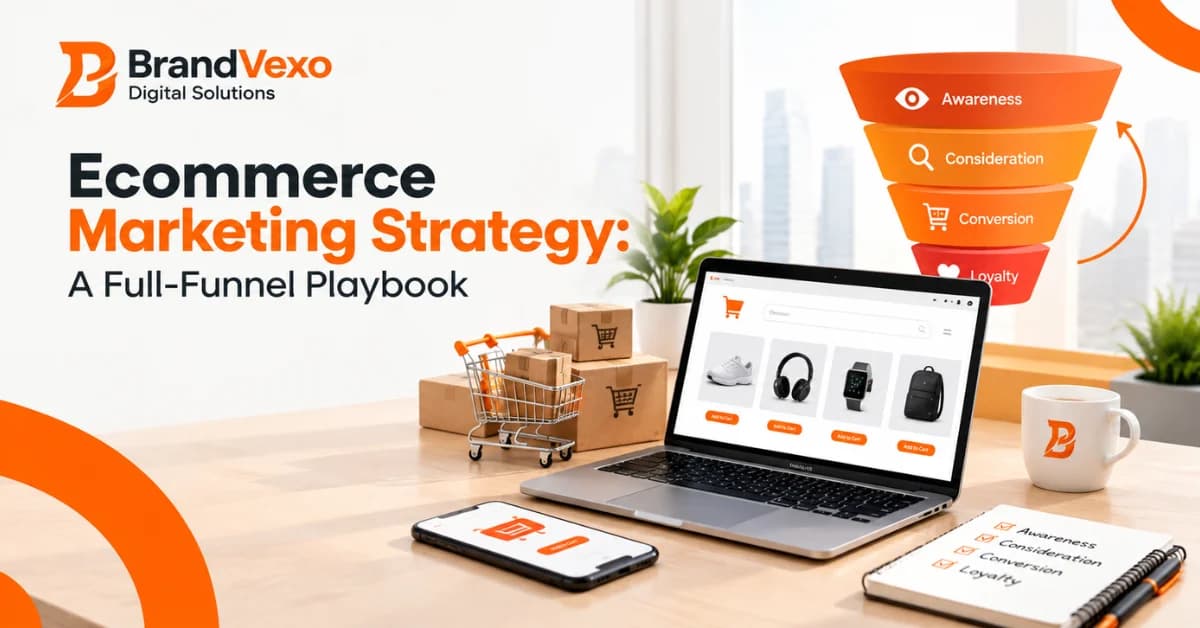
Ecommerce Marketing Strategy: A Full-Funnel Playbook
An effective Ecommerce Marketing Strategy does more than bring visitors to an online store. It connects search, social media, paid advertising, content, product pages, conversion optimization, and customer retention into one customer journey.
Many ecommerce businesses generate traffic but struggle to turn that traffic into profitable customers. Others acquire customers successfully but fail to encourage repeat purchases. A full-funnel approach addresses both problems by considering what customers need before, during, and after a purchase.
What Is an Ecommerce Marketing Strategy?
An ecommerce marketing strategy is a structured plan for attracting potential customers, helping them evaluate products, converting them into buyers, and encouraging repeat purchases.
It combines several activities, including:
Ecommerce SEO
Paid search and shopping campaigns
Social media marketing
Content marketing
Email and SMS marketing
Retargeting
Conversion rate optimization
Customer retention
Analytics and performance measurement
The goal is not to use every available channel. Instead, businesses should select channels that match their customers, products, buying cycle, and budget.
For example, an online skincare store might use Google Search to capture high-intent shoppers, Instagram content to build awareness, product reviews to increase trust, retargeting to reconnect with visitors, and email campaigns to encourage repeat purchases.
Why a Full-Funnel Ecommerce Marketing Strategy Matters
Customers rarely move directly from seeing a brand to completing an order. They may discover a product through social media, search for alternatives on Google, read reviews, compare prices, visit the website several times, and then purchase.
A full-funnel ecommerce strategy accounts for these different stages.
The Four Stages of the Ecommerce Funnel
Awareness: Introduce the brand and products to relevant potential customers.
Consideration: Give shoppers information that helps them compare and evaluate products.
Conversion: Remove friction and make purchasing simple.
Retention: Turn existing customers into repeat buyers through useful communication and better experiences.
This approach connects the customer journey instead of treating SEO, advertising, social media, and email as completely separate activities.
How to Build an Ecommerce Marketing Strategy Step by Step
1. Define Your Target Ecommerce Customer
Start by understanding exactly who you want to attract.
A useful customer profile should consider:
Age and location
Product needs
Common pain points
Purchase motivations
Budget
Buying frequency
Preferred channels
Objections before purchasing
Do not define your audience only by demographics. Behavioral information can be more useful.
For example, a premium fitness equipment store may target people who actively research home workouts, compare equipment specifications, and value durability. That insight can influence both content and advertising.
A clear customer persona helps you create relevant messaging instead of trying to appeal to everyone.
2. Set Clear Ecommerce Marketing Goals
Your marketing goals should connect directly to business outcomes.
Common ecommerce goals include:
Increasing qualified website traffic
Improving conversion rate
Reducing customer acquisition cost
Increasing average order value
Increasing repeat purchases
Improving customer lifetime value
Growing profitable revenue
This is where ecommerce growth becomes more than simply increasing website visitors.
A store could double its traffic and still struggle if visitors do not convert. Conversely, improving product pages and checkout performance can increase revenue without doubling traffic.
3. Choose the Right Ecommerce Marketing Channels
There is no universal channel mix for every online store.
Depending on your audience and products, your strategy may include:
SEO
Google Search
Google Shopping
Meta advertising
Social media
Content marketing
Email marketing
SMS marketing
Influencer marketing
Affiliate marketing
Retargeting
Marketplace marketing
The right combination depends on where your customers already search, compare, and make purchasing decisions.
A new ecommerce business with limited resources may need to focus on a few high-impact channels instead of spreading its budget across ten platforms.
Top Online Store Marketing Channels That Drive Growth
Online store marketing works best when every channel has a defined role within the customer journey.
Ecommerce SEO for Sustainable Organic Traffic
SEO can help ecommerce stores attract people who are already searching for relevant products and information.
Important areas include:
Product page optimization
Category page optimization
Search intent
Internal linking
Product descriptions
Buying guides
Image optimization
Technical SEO
Structured data
Product pages deserve particular attention because they can target transactional searches closer to the buying decision.
Google's documentation explains that Product structured data can help eligible pages provide information such as price, availability, reviews, and product details to Search. Merchant listing experiences can also use product information such as price, shipping, and return details.
However, structured data should support useful on-page information rather than replace it.
Your product pages should clearly explain what the product does, who it is for, its benefits, specifications, pricing, delivery information, and return conditions.
Paid Advertising for Faster Customer Acquisition
Paid advertising can help ecommerce businesses reach high-intent customers more quickly.
Common options include:
Google Search Ads
Google Shopping
Meta Ads
Retargeting campaigns
Product-focused social campaigns
The objective should not simply be to generate clicks.
Businesses should monitor metrics such as:
Customer acquisition cost
Conversion rate
Return on ad spend
Average order value
Revenue
Customer lifetime value
For customer acquisition ecommerce, profitability matters as much as traffic volume.
For example, a campaign generating 1,000 visitors may appear successful. But if those visitors rarely purchase, the business may be paying for traffic without generating sufficient revenue.
Social Media and Influencer Marketing
Social platforms can help ecommerce brands demonstrate products, answer common questions, and build trust.
Useful formats include:
Product demonstrations
Short-form videos
Customer testimonials
User-generated content
Before-and-after demonstrations where appropriate
Product comparisons
Creator partnerships
Behind-the-scenes content
The objective should be connected to the funnel.
Awareness content may introduce a problem and product. Consideration content can answer objections. Conversion-focused content can highlight benefits, reviews, pricing, or an offer.
How to Optimize Each Stage of the Ecommerce Funnel
Top of Funnel: Build Product Awareness
At the awareness stage, customers may not know your brand or may not have decided what product they need.
Useful tactics include:
SEO content
Educational articles
Social media videos
Influencer content
Discovery advertising
Helpful product education
The focus should be on reaching relevant audiences rather than generating the largest possible reach.
Middle of Funnel: Build Trust and Consideration
Customers in the consideration stage need reasons to believe that your product fits their needs.
Support their decision with:
Customer reviews
Product comparisons
FAQs
Demonstration videos
Buying guides
Testimonials
Detailed specifications
Retargeting campaigns
This stage is particularly important for products that require research before purchase.
Bottom of Funnel: Convert High-Intent Shoppers
When someone is ready to purchase, unnecessary friction can stop the sale.
Improve the buying experience with:
Clear product benefits
High-quality product images
Transparent pricing
Visible delivery information
Clear return policies
Multiple payment options
Strong calls to action
Customer reviews
Simple checkout
Do not make customers search for information that could affect their purchasing decision.
Post-Purchase: Turn Buyers Into Repeat Customers
The relationship should not end after payment.
A post-purchase strategy can include:
Order confirmation
Delivery updates
Product education
Review requests
Cross-selling
Upselling
Loyalty offers
Replenishment reminders
Win-back campaigns
Retention can improve ecommerce growth because the business does not need to acquire a completely new customer for every sale.
Conversion Rate Optimization for Ecommerce
Increasing traffic is only one way to grow an online store. Improving the percentage of visitors who purchase can also create significant gains.
Key Ecommerce Conversion Elements
Review your store for:
Mobile usability
Page speed
Product photography
Product descriptions
Customer reviews
Pricing clarity
Shipping information
Return policies
Trust signals
Navigation
Checkout simplicity
Google's page experience guidance emphasizes factors such as mobile usability, secure pages, Core Web Vitals, and avoiding intrusive experiences as part of creating a good overall experience.
A/B Testing Ideas for Online Stores
Instead of making major changes based on assumptions, test specific elements such as:
Product page headlines
CTA placement
Product images
Promotional messaging
Checkout layout
Shipping messages
Product recommendations
Test one meaningful variable at a time where possible, then evaluate the results using sufficient data.
Ecommerce Email Marketing and Customer Retention
Email marketing gives ecommerce businesses a direct way to communicate with customers and prospects.
Useful automated flows include:
Welcome emails
Abandoned-cart emails
Browse-abandonment emails
Order confirmations
Post-purchase emails
Review requests
Cross-sell campaigns
Replenishment reminders
Win-back campaigns
Personalization can make these messages more useful. For example, a customer who purchased a particular skincare product may receive relevant usage information or a replenishment reminder instead of a generic promotional email.
How to Measure Ecommerce Marketing Performance
A good ecommerce marketing strategy needs reliable measurement.
Track metrics according to funnel stage.
Funnel Stage | Useful Metrics |
|---|---|
Awareness | Reach, impressions, organic traffic |
Consideration | Product views, engagement, email sign-ups |
Conversion | Conversion rate, revenue, CAC, ROAS |
Retention | Repeat purchase rate, LTV, retention rate |
Your analytics setup should also track important ecommerce actions.
Google Analytics supports ecommerce events such as add_to_cart and purchase, with parameters that can provide information about products, quantities, values, currency, and transactions.
This data helps businesses identify where shoppers leave the funnel.
For example:
High product views + low add-to-cart rate: Review product positioning, pricing, images, or trust signals.
High add-to-cart rate + low purchase rate: Investigate checkout, shipping costs, payment options, or unexpected fees.
Strong first purchases + weak repeat purchases: Review the retention and post-purchase strategy.
Ecommerce Marketing Strategy Example
Consider a hypothetical UAE-based skincare ecommerce store.
The business could build a full-funnel strategy like this:
Awareness: Publish helpful skincare content and create short-form social videos addressing common customer problems.
Consideration: Optimize category and product pages with detailed descriptions, ingredients, usage instructions, reviews, and FAQs.
Conversion: Use Google Shopping and high-intent search campaigns to reach shoppers actively looking for relevant products.
Retargeting: Show relevant products to visitors who viewed products but did not purchase.
Retention: Send post-purchase education, review requests, replenishment reminders, and relevant product recommendations.
The important point is that each activity supports another stage of the customer journey.
Common Ecommerce Marketing Mistakes to Avoid
Many online stores make their strategy more complicated than necessary.
Avoid these common mistakes:
Focusing only on paid advertising
Targeting an overly broad audience
Ignoring mobile shoppers
Sending paid traffic to weak product pages
Tracking clicks instead of business outcomes
Ignoring existing customers
Using identical messaging at every funnel stage
Launching too many channels without enough data
Making checkout unnecessarily complicated
Creating content without understanding search intent
A smaller number of well-managed channels can be more useful than a large number of poorly optimized campaigns.
How to Create an Ecommerce Marketing Strategy on a Limited Budget
A limited budget does not mean marketing should stop. It means prioritization becomes more important.
Start with the areas closest to revenue.
Prioritize High-Impact Activities
A practical sequence is:
Fix major website and conversion issues.
Optimize product and category pages.
Improve technical and ecommerce SEO.
Create useful content around customer questions.
Launch targeted paid campaigns.
Build email capture and automated flows.
Retarget qualified website visitors.
Expand into additional channels after collecting enough performance data.
This approach can help small businesses avoid spending money across too many platforms before understanding what actually works.
Ecommerce Marketing Strategy Checklist
Use this checklist when reviewing your current strategy:
Define your target customer
Set measurable marketing goals
Map the customer journey
Optimize product pages
Improve category pages
Build an ecommerce SEO strategy
Select relevant advertising channels
Create retargeting campaigns
Set up email automation
Improve checkout
Track customer acquisition cost
Monitor conversion rate
Measure repeat purchases
Test and improve continuously
How BrandVexo Can Help!
BrandVexo Digital Solutions helps businesses build practical digital growth systems across digital marketing, SEO, web development, AI automation, and business solutions. Our approach focuses on useful strategies and measurable business outcomes rather than vanity metrics.
Phone: +971 52 356 5409
Email: info@brandvexo.com
Website: www.brandvexo.com
If your ecommerce business needs a clearer customer journey, stronger online visibility, or a more structured digital marketing system, reviewing your current funnel is a practical place to start.
FAQ
What is an ecommerce marketing strategy?
An ecommerce marketing strategy is a plan for attracting potential customers, building product awareness, converting website visitors into buyers, and encouraging repeat purchases. It can combine SEO, paid advertising, social media, content, email, conversion optimization, and retention activities.
What are the best ecommerce marketing channels?
The best channels depend on the product, audience, buying cycle, budget, and customer behavior. Common options include SEO, Google Shopping, paid search, social media, email marketing, influencer marketing, content marketing, and retargeting.
How can I increase ecommerce sales?
Start by identifying where customers leave your funnel. Improve qualified traffic through SEO and advertising, strengthen product pages, simplify checkout, add trust signals, and build retention campaigns that encourage repeat purchases.
How can I reduce ecommerce customer acquisition costs?
Improve targeting, landing pages, product pages, conversion rates, and campaign efficiency. Retarget qualified visitors and increase customer lifetime value so the business can generate more revenue from acquired customers.
What is the difference between ecommerce marketing and online store marketing?
Ecommerce marketing covers the broader strategy for selling products online, including acquisition, conversion, retention, and customer experience. Online store marketing often refers more specifically to the activities used to promote and generate sales for a particular online store.
How long does an ecommerce marketing strategy take to work?
The timeframe depends on the channel and starting point. Paid campaigns can generate traffic quickly, while SEO, content, brand visibility, and retention programs generally require ongoing work and accumulated data. Businesses should evaluate performance according to the expected timeline of each channel rather than expecting every tactic to produce immediate results.
Final Thoughts
A successful Ecommerce Marketing Strategy is not simply a collection of advertisements, social posts, and blog articles. It is a connected system that moves customers from awareness to consideration, conversion, and eventually repeat purchase.
Start by understanding your audience and setting measurable goals. Then choose the channels that match customer behavior, optimize the buying experience, and measure performance across the entire funnel.
Disclaimer: This article provides general digital marketing information and should not be treated as a guarantee of specific ecommerce results. Marketing performance varies based on the business model, audience, product, market, budget, competition, and execution.
Free growth plan
Ready to grow your business?
Reading is a start — now let's build it. Tell us where you want to grow and a senior strategist will map the fastest, most profitable way to get there. Free, no obligation.
Discussion
Join the conversation
Be the first to comment. Comments are reviewed before they appear, so yours won't show up instantly — but we read every one.
Leave a comment
Keep reading
All articles Branding
Shopify SEO: How to Rank Products and Collections
Learn Shopify SEO strategies to optimize product pages, collection pages, technical SEO, internal links, and content for stronger organic visibility.
 Branding
Branding Cost Dubai: What Businesses Should Expect
Branding Cost Dubai explained with 2026 price ranges, logo design costs, brand identity packages, agency fees, hidden costs and budgeting tips.
 Branding
Brand Guidelines: What to Include and Why They Matter
Learn what Brand Guidelines include, from logos and colors to typography and brand voice, and how they help businesses maintain consistent branding.