

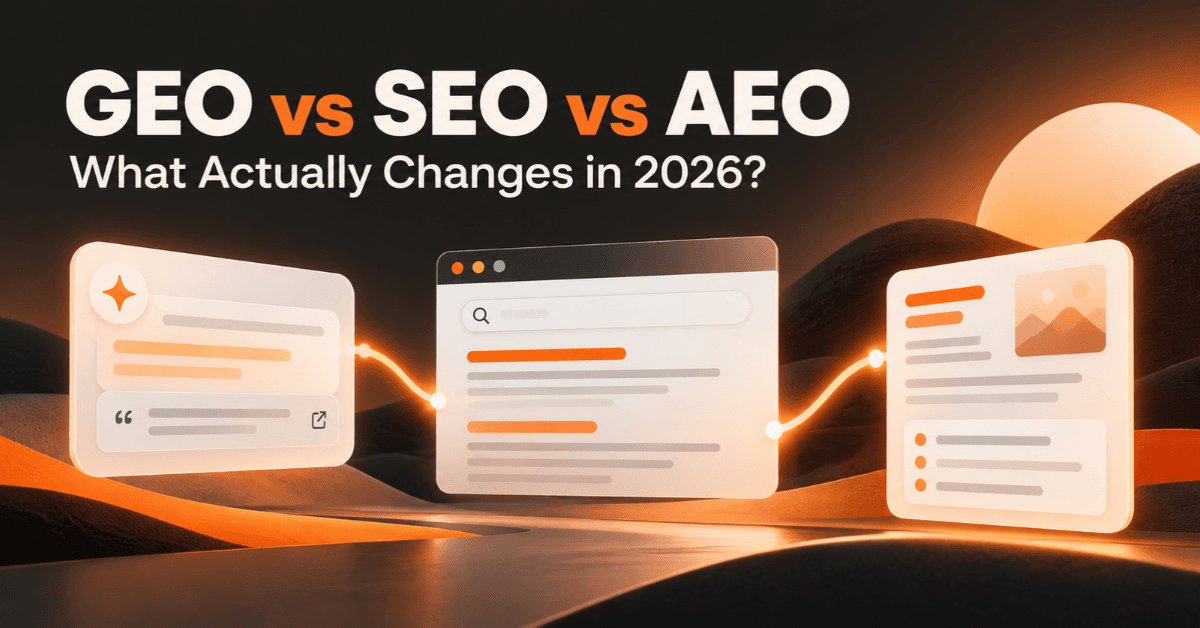
GEO vs SEO vs AEO: What Actually Changes in 2026?
Search is changing. People still use Google to find websites, products, services, and information, but they are also asking AI-powered tools to explain topics, compare options, summarize research, and recommend solutions. That shift has created new terms such as generative engine optimization (GEO), answer engine optimization (AEO), and AI SEO. But the terminology can make the situation seem more complicated than it is.
The important question is not whether businesses should abandon SEO. It is how traditional SEO works alongside answer-focused and generative search experiences.
SEO vs AEO vs GEO: What Do These Terms Actually Mean?
SEO, AEO, and GEO describe closely related approaches to improving how people and search systems find and understand information. Their emphasis differs, but they share many fundamentals.
What Is SEO?
Search engine optimization (SEO) is the practice of helping search engines understand your website and helping users discover relevant pages through organic search.
Traditional SEO includes areas such as:
Search intent research
Keyword targeting
Technical SEO
Crawling and indexing
Internal linking
Content optimization
Page experience
Authority and reputation
Relevant external references
Google describes SEO as helping search engines understand content and helping users find a website through search. Its guidance also emphasizes that SEO works best when it supports useful, people-first content.
What Is Answer Engine Optimization (AEO)?
Answer engine optimization (AEO) focuses on making information easy for answer-focused systems to understand and present when someone asks a specific question.
AEO commonly emphasizes:
Direct answers
Question-based headings
Concise definitions
Clear explanations
Structured information
FAQs
Easily extractable facts
For example, instead of only targeting the keyword "GEO," an AEO-focused page might directly answer:
What is generative engine optimization?
The answer should appear clearly before the page expands into deeper context.
AEO is therefore closely connected to search intent and content structure.
What Is Generative Engine Optimization (GEO)?
Generative engine optimization (GEO) generally refers to optimizing content and a brand's wider online presence for generative AI search experiences. Instead of focusing only on whether a page appears as a traditional blue-link result, GEO considers whether useful information from a business or publisher can be represented, referenced, or cited in an AI-generated response.
The terminology is not completely standardized across the industry. Some practitioners use GEO and AEO almost interchangeably, while others use GEO to emphasize the generative process and AEO to emphasize the answer.
What Is AI SEO?
AI SEO is a broader term that can describe SEO practices adapted to AI-powered search and discovery.
It can include:
Traditional SEO
AEO
GEO
Semantic search optimization
Entity optimization
Content authority
Optimization for AI-assisted search experiences
The practical takeaway is simple: businesses do not need three completely separate websites or three unrelated content strategies.
GEO vs SEO vs AEO: The Key Differences
The easiest way to understand the three approaches is to look at the primary outcome each one emphasizes.
Factor | SEO | AEO | GEO |
|---|---|---|---|
Main focus | Organic search visibility | Clear answers | Visibility in generative responses |
Primary environment | Search engines | Answer-focused experiences | Generative AI experiences |
Main target | Web pages | Specific answers | Useful sources and brand information |
Content emphasis | Relevance and quality | Clarity and extractability | Authority, context and relevance |
Typical user behavior | Search and click | Ask and receive an answer | Ask, compare and explore |
Important signals | Technical SEO, relevance, quality, links | Clear structure and direct answers | Source credibility, topical depth and useful information |
Common measurements | Rankings, impressions, traffic, conversions | Answer visibility and query coverage | Mentions, citations, AI referral traffic and conversions |
These categories overlap. A well-optimized page can support traditional search, answer experiences, and generative search simultaneously.
Google's current guidance is particularly important here: it states that the existing SEO fundamentals remain relevant for AI Overviews and AI Mode. Google also says there are no additional technical requirements or special schema required specifically to appear in those AI features.
What Actually Changes in 2026?
The biggest change is not that SEO has disappeared. The change is that the search experience now includes more ways for users to consume information.
Search Is Becoming More Answer-Driven
A traditional search journey might look like this:
Search query → search results → website → answer
An AI-assisted journey may look more like:
Question → AI-generated response → supporting sources → deeper exploration
Google's AI Overviews and AI Mode are designed to help users handle more complex questions, with AI Mode supporting exploration and comparisons. Google also explains that these systems can use multiple related searches to develop a response.
This means businesses should not write content only around isolated keywords.
They should answer the broader questions their audience actually has.
From Ranking for Keywords to Becoming a Useful Source
Keyword rankings still matter, but they are only one part of modern search visibility.
Consider a business publishing an article about ecommerce SEO.
A traditional SEO strategy may focus on ranking for:
"ecommerce SEO strategy"
A broader 2026 content strategy can also address:
What is ecommerce SEO?
How does ecommerce SEO work?
What should an ecommerce SEO strategy include?
How can product pages rank?
How does technical SEO affect ecommerce?
How can businesses improve organic conversions?
The result is content with greater contextual depth.
That matters because modern search experiences increasingly need to understand relationships between concepts rather than simply match individual words.
Search Intent Matters More Than Exact-Match Keywords
A page can mention a keyword dozens of times and still fail to satisfy the user.
For example, someone searching "AI SEO for small business" may actually want to know:
What AI SEO means
Whether traditional SEO still matters
How to structure content
How to measure results
What tools are useful
What mistakes to avoid
Strong content addresses the underlying intent rather than repeating the exact phrase.
Google's people-first guidance specifically encourages creators to produce comprehensive, original, useful information instead of creating content primarily to attract search traffic.
Content Structure Matters More
Clear structure helps both people and machines understand a page.
A strong article can use:
Descriptive H2 and H3 headings
Short paragraphs
Direct answers
Bullet points
Definitions
Examples
Supporting evidence
Relevant internal links
Clear terminology
The goal is not to make content artificially "AI-friendly."
The goal is to make the information easy to understand, verify, navigate, and use.
How GEO, SEO, and AEO Work Together
The biggest mistake is treating SEO, AEO, and GEO as competing strategies.
They can work as layers of one content system.
SEO Builds the Foundation
SEO helps make content discoverable and understandable.
A strong foundation includes:
Crawlable pages
Appropriate indexing
Logical website architecture
Internal links
Search-intent alignment
Useful content
Good page experience
Clear titles and headings
Google confirms that these foundational SEO practices remain relevant for its AI search features.
AEO Makes Information Easy to Answer
AEO adds a strong focus on questions and direct responses.
For example:
Question: What is GEO?
Direct answer: GEO, or generative engine optimization, refers to practices intended to improve how useful and authoritative content is represented in generative AI search experiences.
Then the article can provide deeper explanation, examples, limitations, and related concepts.
GEO Adds Context and Authority
GEO focuses on the wider information environment surrounding a brand or topic.
Useful GEO-oriented practices include:
Publishing original research
Demonstrating subject expertise
Maintaining accurate information
Building topical depth
Strengthening brand/entity consistency
Earning credible third-party references
Providing useful, specific explanations
Google's E-E-A-T guidance emphasizes experience, expertise, authoritativeness, and trustworthiness, while noting that E-E-A-T itself is not a single ranking factor.
How to Optimize Content for SEO, AEO, and GEO in 2026
A practical strategy does not require completely separate content for every search environment.
1. Start With Search Intent
Before writing, identify what the user is actually trying to accomplish.
For example, the query "GEO vs SEO vs AEO" suggests comparison intent.
The reader probably wants:
Definitions
Differences
Similarities
Practical applications
2026 changes
Measurement methods
Implementation guidance
Build the article around those needs.
2. Answer the Main Question Early
Do not force readers through 1,000 words before giving them the basic answer.
Start with a concise explanation, then expand.
This improves usability and gives the page a clear information hierarchy.
3. Build Topic Depth Instead of Repeating Keywords
Use related concepts naturally.
For an AI SEO article, relevant terminology could include:
AI search
Generative AI
Search intent
Semantic search
Search visibility
AI-generated answers
Content authority
Entity optimization
Organic search
Topical relevance
These terms should appear because they help explain the subject, not because they create an artificial keyword count.
4. Add Original Information and Experience
Generic summaries are easy to produce.
Useful expertise is harder to replicate.
Where appropriate, strengthen content with:
Original examples
First-hand observations
Data
Expert commentary
Case studies
Screenshots
Practical workflows
Industry-specific analysis
Google's guidance asks whether content provides original information, research, analysis, or substantial value beyond simply rewriting other sources.
5. Make Important Facts Easy to Verify
Trust matters.
When publishing factual claims:
Use credible sources
Attribute research
Check statistics
Update time-sensitive information
Avoid unsupported claims
Distinguish facts from opinions
This becomes especially important when content discusses technology that changes quickly.
6. Strengthen Internal Linking
Create topical relationships between related pages.
For example, a BrandVexo content cluster could connect:
AI SEO
→ GEO
→ AEO
→ AI content
→ Blog SEO
→ Content strategy
→ SEO strategy for small businesses
→ B2B content marketing
Internal links help readers navigate related topics and help search engines understand website structure.
7. Use Structured Data Correctly
Structured data can help Google understand eligible content and may support certain search appearances.
However, it should accurately represent visible page content.
Google states that structured data does not guarantee a rich result, and misleading or irrelevant markup can cause eligibility problems.
Also, businesses should not assume that special "AI schema" is required. Google's AI search documentation explicitly says there is no special schema required for AI Overviews or AI Mode.
GEO vs SEO vs AEO: A Practical Example
Imagine a UAE digital marketing agency creates a page targeting:
"AI SEO strategy for small businesses."
The three approaches could influence the same page in different ways.
SEO Approach
The agency could:
Match the page to search intent
Optimize the title and headings
Improve internal linking
Ensure the page is crawlable
Cover the topic comprehensively
AEO Approach
The agency could add direct answers to questions such as:
What is AI SEO?
How does AI SEO work?
Is AI SEO replacing traditional SEO?
How can a small business start?
Each answer should be clear and useful without unnecessary repetition.
GEO Approach
The agency could strengthen the page with:
Original examples
Expert explanations
Supporting sources
Relevant industry context
Clear definitions
Practical recommendations
Consistent information about the business
The same page can therefore serve several discovery experiences without creating separate versions for each acronym.
What Metrics Should You Track in 2026?
Measurement is also changing.
Traditional SEO Metrics
Track:
Organic traffic
Search impressions
Click-through rate
Rankings
Indexed pages
Organic conversions
Landing-page performance
Google says AI Overviews and AI Mode traffic is included within the overall Web search reporting in Search Console.
AEO Metrics
Depending on the platform and available reporting, businesses can monitor:
Question/query coverage
Search impressions
Answer visibility
Featured-answer appearances where measurable
Organic clicks
Engagement after the search visit
Not every answer engine provides the same level of reporting, so measurement should remain platform-specific.
GEO Metrics
Potential indicators include:
AI-generated mentions
Citations
AI referral sessions
Brand visibility in relevant AI answers
Assisted conversions
Leads influenced by AI discovery
GEO measurement remains less standardized than traditional SEO measurement. Businesses should avoid treating third-party AI visibility scores as universal ranking metrics.
Common GEO, SEO, and AEO Mistakes to Avoid
Avoid these common problems:
Treating GEO as a replacement for SEO
Repeating keywords unnaturally
Writing generic AI-generated articles without meaningful review
Creating content solely because a topic is trending
Publishing unsupported statistics
Producing dozens of thin pages around similar queries
Ignoring technical SEO
Assuming structured data guarantees visibility
Treating AI citations as guaranteed
Measuring success only through rankings
Writing for machines instead of people
Google's current guidance specifically warns against search-engine-first content, mass-produced content, excessive automation without added value, and pages that mainly summarize other sources without meaningful original contribution.
Does GEO Replace SEO in 2026?
No.
SEO remains the foundation for making websites discoverable, crawlable, understandable, and useful in search.
Google's guidance for AI Overviews and AI Mode states that existing SEO best practices continue to apply and that there are no additional technical requirements for appearing as a supporting link in those features.
A practical way to think about the relationship is:
SEO = search foundation
AEO = answer-focused structure
GEO = generative-search visibility and source context
These concepts overlap, and the terminology used by different practitioners is not completely consistent.
Which Approach Should Your Business Use?
Rather than choosing only one, evaluate your current situation.
Focus on SEO When:
Your website has indexing or technical issues.
Organic visibility is weak.
Pages do not match search intent.
Your site lacks useful topic coverage.
You need a stronger organic search foundation.
Add AEO When:
Customers frequently ask questions.
Your industry involves research and education.
Users need quick definitions or explanations.
Your content can answer specific queries clearly.
Expand Into GEO When:
Customers increasingly use AI-powered discovery.
Your industry depends heavily on expertise and trust.
Your brand needs stronger topical authority.
You want your information to be accurately represented across emerging search experiences.
The important point is that these are not mutually exclusive strategies.
The 2026 Search Strategy: One Content System, Multiple Search Experiences
A practical modern workflow can follow eight steps:
Research: Understand your audience, questions, entities, and search intent.
Create: Publish original, useful information.
Optimize: Apply technical and on-page SEO fundamentals.
Structure: Organize information around clear questions and topics.
Support: Use reliable evidence and credible references.
Connect: Build internal links and related topic clusters.
Measure: Track organic, answer-focused, and AI-related visibility where data is available.
Improve: Update content when information, user needs, or search experiences change.
This approach keeps the focus on the user rather than on trying to manipulate an individual search feature.
FAQs
What is the difference between GEO and SEO?
SEO focuses broadly on improving visibility and discoverability in search engines. GEO generally focuses on how content and brand information can appear or be represented in generative AI experiences. The two share many fundamentals, including useful content, accessibility, relevance, and authority.
What is the difference between AEO and GEO?
AEO generally emphasizes providing clear answers to specific questions, while GEO emphasizes visibility within generative AI responses. In practice, the terminology overlaps significantly, and many practitioners use the terms differently.
Is GEO replacing SEO in 2026?
No. Google's own guidance states that existing SEO best practices remain relevant for AI Overviews and AI Mode. AI search adds new discovery experiences, but it does not remove the need for technically sound, useful, people-first web content.
What is generative engine optimization?
Generative engine optimization is a commonly used term for improving the likelihood that useful, authoritative information about a topic or brand is represented in generative AI search experiences.
What is answer engine optimization?
Answer engine optimization focuses on structuring information so answer-focused systems can understand and provide clear responses to user questions.
Is AI SEO the same as GEO?
Not necessarily. AI SEO is often used as a broader term covering SEO practices for AI-powered search, while GEO specifically refers to generative engine optimization. Industry terminology is still evolving.
How can businesses optimize content for AI search?
Start with strong SEO fundamentals, satisfy search intent, provide direct answers, demonstrate real expertise, publish original information, use reliable sources, maintain accurate business information, and organize content clearly.
Does Google require special GEO or AI schema?
Google says there are no additional technical requirements or special schema needed to appear in AI Overviews or AI Mode. Standard SEO fundamentals and accurate structured data remain important where applicable.
How do you measure GEO performance?
Measurement can include AI citations, brand mentions, AI referral traffic, conversions influenced by AI discovery, and visibility across relevant generative platforms. However, reporting capabilities vary between platforms, so businesses should avoid relying on a single universal GEO score.
Do businesses still need traditional SEO in 2026?
Yes. Search engines still need to discover, crawl, understand, and evaluate web content. Google's current documentation continues to recommend foundational SEO practices for AI-powered Search experiences.
Conclusion
The biggest change in 2026 is not the disappearance of SEO. It is the expansion of search.
SEO remains the foundation for organic search visibility.
AEO emphasizes clear, direct answers to user questions.
GEO focuses on how useful information can be represented within generative search experiences.
And AI SEO provides a broader way to think about optimizing content as search becomes more conversational, contextual, and AI-assisted.
For businesses, the practical answer is to build one strong content system that serves people first and works across different discovery experiences. Create useful information, demonstrate genuine expertise, organize it clearly, support important claims, and keep your website technically accessible.
That approach is more durable than chasing every new search acronym.
How BrandVexo Can Help!
BrandVexo Digital Solutions helps businesses build practical digital growth systems across digital marketing, SEO, web development, AI automation, and business solutions. Our approach focuses on solving audience problems and creating measurable business outcomes rather than chasing vanity metrics. We also support businesses with social media management, content strategy, personal branding, and digital growth solutions.
Contact BrandVexo:
Phone: +971 52 356 5409
Email: info@brandvexo.com
Website: www.brandvexo.com
Disclaimer: Search platforms and AI systems continue to evolve, so specific features, terminology, and measurement capabilities may change. This article provides general digital marketing information and should be reviewed against current platform documentation when making strategic decisions.
Free growth plan
Ready to grow your business?
Reading is a start — now let's build it. Tell us where you want to grow and a senior strategist will map the fastest, most profitable way to get there. Free, no obligation.
Discussion
Join the conversation
Be the first to comment. Comments are reviewed before they appear, so yours won't show up instantly — but we read every one.
Leave a comment
Keep reading
All articles Growth
AI Search Optimization: How to Get Cited in AI Answers
Learn how AI Search Optimization improves AI visibility, supports LLM citations, and helps businesses create content for modern generative search.
 Growth
UAE Market Entry Digital Strategy: A Growth Playbook
Build a UAE market entry digital strategy with practical guidance on research, SEO, go-to-market planning, content, channels, and growth.
 Growth
Growth Agency vs Specialist Agencies: Which Model Wins?
Compare Growth Agency vs Specialist Agencies, including costs, expertise, strategy, and scalability, to choose the right marketing model for your business.