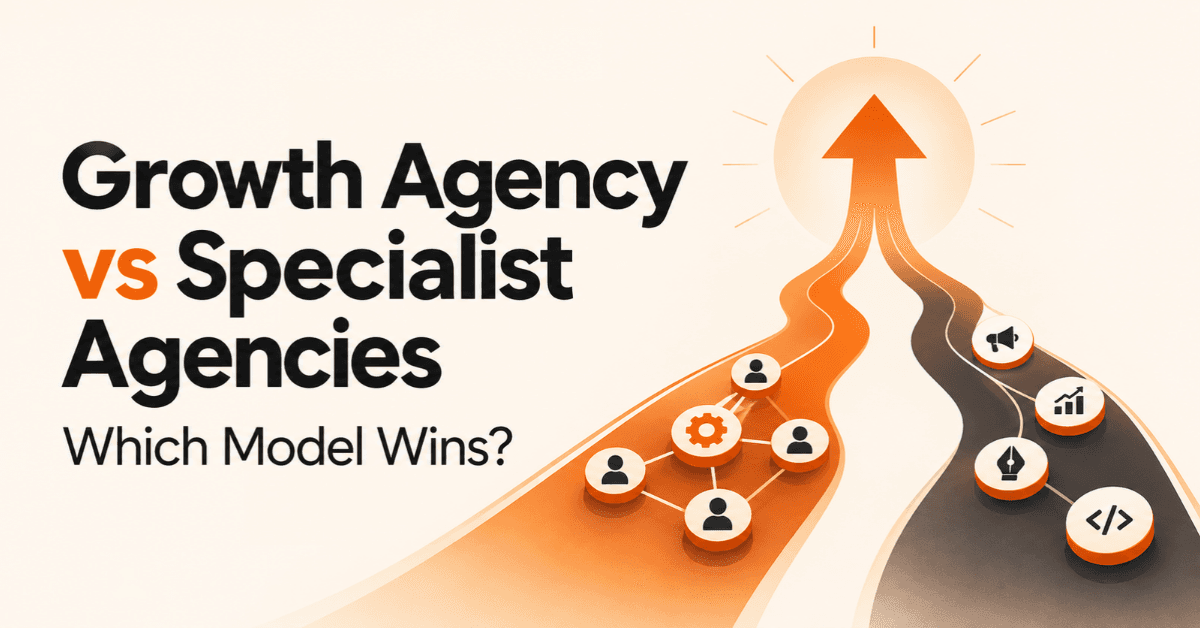
Growth Agency vs Specialist Agencies: Which Model Wins?
Choosing the right marketing partner can become difficult when a business needs more than one service. Should you work with a growth agency that manages several marketing functions, or hire specialist agencies that focus deeply on individual areas such as SEO, PPC, web development, or social media?
The answer depends on what your business actually needs. A growth agency can provide broader coordination across multiple channels, while a specialist agency can bring focused expertise to a specific challenge. Some businesses may also benefit from combining both models.
Understanding the difference between a Growth Agency vs Specialist Agencies can help you make a more informed decision based on your goals, internal resources, budget, and marketing complexity.
What Is a Growth Agency?
A growth agency works across multiple marketing and business-growth functions with a focus on measurable outcomes. Instead of treating SEO, advertising, content, websites, and conversion optimization as completely separate activities, the agency connects them through a broader growth strategy.
A growth agency may act as a growth partner, helping a business identify opportunities, prioritize marketing activities, track performance, and adjust campaigns as results develop.
What Does a Growth Agency Typically Handle?
Depending on the agency, its services may include:
Business and marketing strategy
Search engine optimization
Paid advertising
Content marketing
Social media marketing
Website development
Landing-page optimization
Conversion rate optimization
Lead generation
Analytics and reporting
Marketing automation
Customer acquisition and retention
The important point is that having many services does not automatically make an agency a growth agency. The stronger model connects those services to business objectives and measurable outcomes.
What Is a Specialist Agency?
A specialist agency concentrates on one marketing discipline or a narrow group of related services. Its team develops deeper expertise in a particular area rather than covering a broad range of marketing functions.
For example, a business may hire an SEO agency specifically to improve organic search visibility or a PPC agency to manage paid search campaigns.
Examples of Specialist Agencies
Common specialist agency models include:
SEO agencies
PPC and paid media agencies
Social media agencies
Web development agencies
Branding agencies
Content marketing agencies
Email marketing agencies
Conversion optimization agencies
Performance marketing agencies
This model can work well when a business already has a broader strategy and needs specialized expertise to solve a particular problem.
Growth Agency vs Specialist Agencies: Key Differences
The main difference between the two models comes down to breadth versus depth.
A growth agency typically coordinates several marketing functions under one strategic direction. A specialist agency concentrates resources on a specific discipline.
Neither model automatically fits every business. The right choice depends on the problem you need to solve.
Breadth of Services
A growth agency can manage several connected activities. For example, an ecommerce company might use SEO to attract organic traffic, paid advertising to generate immediate demand, content to educate customers, and conversion optimization to improve sales.
A specialist agency normally focuses on one part of that system. An SEO agency, for example, may concentrate primarily on technical SEO, content optimization, authority building, and organic search performance.
Depth of Expertise
Specialist agencies can provide highly focused expertise in their chosen field. This can become particularly useful when a business has a technical or complex problem that requires dedicated knowledge.
A growth agency needs broader capabilities because it must understand how different marketing functions interact. Its value often comes from connecting those disciplines rather than going as deep into every technical area as a specialist can.
Strategic Coordination
Coordination becomes an important consideration when several marketing channels operate simultaneously.
With one growth partner, the business can potentially establish a unified strategy across SEO, advertising, content, web development, and conversion optimization.
With multiple specialists, the business may need someone internally to coordinate priorities, timelines, messaging, reporting, and channel strategy.
Communication and Project Management
Working with one agency can simplify communication because the business has fewer external relationships to manage.
Working with several specialist agencies can provide access to highly focused expertise, but it may also require more coordination. Businesses should consider whether their internal team has enough time and experience to manage that structure effectively.
Reporting and Accountability
The reporting structure can also differ.
Rather than focusing only on activities such as posts published, keywords targeted, or ads launched, businesses should connect agency work with meaningful outcomes such as:
Qualified leads
Conversion rates
Customer acquisition cost
Revenue
Marketing ROI
Customer lifetime value
Organic growth
Paid campaign efficiency
The goal should be to understand how marketing activity contributes to business performance.
Full Service Agency vs Specialist: What Is the Real Difference?
The full service agency vs specialist comparison can be confusing because businesses sometimes use terms such as full-service, 360-degree, growth, and digital agency interchangeably.
A full-service agency generally offers a broad range of marketing services. A specialist agency focuses on a narrower discipline. A growth agency may also offer multiple services, but its positioning typically centers on connecting marketing activities with measurable growth objectives.
Full-Service Agency
A full-service marketing agency may provide several services under one organization, such as:
SEO
Paid advertising
Social media
Content
Web design
Branding
Email marketing
The main attraction is convenience and centralized management.
Specialist Agency
A specialist agency builds its capabilities around a particular discipline.
For example, an SEO specialist may spend most of its resources on search visibility, technical optimization, content strategy, and organic performance.
This depth can be useful when the business has a specific challenge that requires dedicated expertise.
Growth Agency
A growth agency focuses on how different activities work together.
For example, increasing website traffic does not necessarily create business growth if visitors do not convert. A growth-oriented approach may therefore connect SEO, paid traffic, landing pages, analytics, and conversion optimization.
This is why businesses should evaluate an agency based on its actual strategy and processes rather than choosing one simply because it uses the label "growth" or "full service."
When Does a Growth Agency Make Sense?
A growth agency can be practical when your marketing strategy involves several connected channels.
You Need Multiple Marketing Channels
A business running SEO, paid advertising, content marketing, social media, and conversion optimization may benefit from stronger coordination.
For example, an ecommerce company could use SEO to build long-term visibility while paid campaigns generate immediate traffic. Its website and product pages then need to convert that traffic into customers.
Managing these activities through one strategic framework can reduce disconnected decision-making.
You Want One Strategic Direction
Businesses often struggle when every channel operates independently. A growth partner can help establish common priorities, KPIs, messaging, and reporting across different marketing activities.
This can make it easier to understand which activities support acquisition, conversion, and retention.
Your Internal Team Is Small
A small internal marketing team may not have specialists in every discipline. Instead of hiring several full-time employees immediately, the business may use an external growth agency to supplement its capabilities.
This can provide access to broader skills while allowing the internal team to focus on core business responsibilities.
You Are Scaling Your Marketing
As marketing becomes more complex, businesses often need stronger processes. A growth agency can potentially support coordination across campaigns, content, website improvements, analytics, and acquisition channels.
The important factor is not the number of services available. It is whether those services work together around clearly defined business goals.
When Does a Specialist Agency Make More Sense?
A specialist agency can be useful when you already know exactly what needs improvement.
You Have One Clear Marketing Problem
Consider a business experiencing a major technical SEO issue after a website migration. It may not need a broad growth program. It may need a specialist with deep technical SEO experience. The same principle applies to other focused projects such as PPC account restructuring, website development, or conversion optimization.
You Need Advanced Technical Expertise
Some projects require specialized knowledge. For example, a complex SEO migration, large-scale ecommerce development project, or advanced conversion audit may benefit from a team that spends most of its time working in that discipline.
You Already Have an Internal Strategy
Businesses with experienced marketing leaders may already have their overall strategy, messaging, and reporting systems in place.
In that situation, a specialist can fill a specific capability gap without taking responsibility for the entire marketing function.
You Need a Short-Term Project
Specialists can also work well for defined projects, such as:
Website migration
SEO audit
PPC restructuring
Brand identity development
Technical conversion audit
Analytics implementation
The business can bring in the required expertise without changing its entire agency model.
Growth Agency vs Specialist Agencies: Which Model Fits Your Business?
Instead of asking which model is universally better, start by examining your business situation.
Choose Based on Your Business Stage
A startup may have limited resources and a small internal team. It may need focused expertise around a clearly defined priority. A growing business may have several active channels and need stronger coordination between them. An established company may have an internal marketing department and use external specialists for highly technical or specialized projects.
The appropriate agency model can therefore change as the business develops.
Choose Based on Your Marketing Goals
Your objective should influence your agency choice.
For example:
Brand awareness: branding, content, social media, and media expertise may matter.
Lead generation: SEO, paid advertising, landing pages, and conversion optimization may need to work together.
Ecommerce growth: acquisition, product-page optimization, CRO, analytics, and retention can become interconnected.
SEO growth: a specialist SEO agency may be appropriate when organic search is the primary challenge.
Website improvement: a web development or CRO specialist may provide focused expertise.
Choose Based on Internal Resources
Ask yourself:
Do we have an experienced marketing team?
Who will coordinate multiple agencies?
Do we understand the technical work involved?
How much strategic support do we need?
Can we manage several reporting systems?
Do we need one central point of contact?
These questions often reveal whether breadth or specialization is more practical.
Can Businesses Use a Growth Agency and Specialist Agencies Together?
Yes. Businesses do not always have to choose one model exclusively. A hybrid agency model can combine broader strategic coordination with specialized expertise.
For example, a UAE ecommerce business might work with a growth partner for its overall acquisition strategy, analytics, content direction, and campaign coordination. It could then bring in a specialist SEO team for a complex technical migration or a specialist development team for a major website rebuild.
In this structure, the growth partner can help maintain strategic direction while specialists handle projects that require deeper technical expertise.
The key is to define ownership clearly.
Who controls the strategy? Who owns reporting? Which agency manages each channel? How will teams share data? What happens when two agencies recommend different priorities?
Clear answers to these questions can prevent duplicated work and conflicting strategies.
How to Compare Agencies Before You Hire One
The agency selection process should go beyond comparing service lists and monthly fees.
Evaluate Their Strategy
Ask prospective agencies:
Do you understand our business model?
How would you identify growth opportunities?
Which KPIs would you prioritize?
How would different marketing channels work together?
How would you measure success?
A good strategy should connect marketing activities to business objectives.
Evaluate Their Expertise
Review:
Relevant experience
Team capabilities
Processes
Technical knowledge
Industry familiarity
Previous work that is relevant to your goals
Do not assume that a long list of services means an agency has equal expertise in every area.
Evaluate Their Reporting
Ask what the agency reports and how often. Useful reporting should help you understand what happened, why it happened, and what the team plans to do next. Depending on the business, relevant metrics may include qualified leads, conversion rate, acquisition cost, revenue, organic traffic, paid performance, and retention.
Evaluate Communication
Consider:
Who will manage the relationship?
How often will you meet?
Who approves campaigns?
Who owns strategy?
How quickly does the agency respond?
How will internal and external teams collaborate?
Strong communication becomes especially important when multiple agencies are involved.
Common Mistakes When Choosing an Agency Model
Businesses can make poor agency decisions even when they hire technically capable teams.
Common mistakes include:
Choosing based only on price
Assuming more services automatically mean better results
Hiring a specialist without a clear overall strategy
Hiring a full-service agency without checking actual expertise
Focusing heavily on vanity metrics
Failing to define KPIs
Ignoring communication requirements
Hiring an agency before identifying the real business problem
Treating an agency only as a vendor instead of establishing clear strategic responsibilities
The best starting point is usually the business problem, not the agency package.
How to Measure Whether Your Agency Is Actually Driving Growth
Agency performance should connect to meaningful business outcomes.
Track Business Metrics
Depending on your business model, consider monitoring:
Qualified leads
Conversion rate
Customer acquisition cost
Revenue
Customer lifetime value
Marketing ROI
Retention
Organic visibility
Paid campaign efficiency
Not every business needs every metric. Select the indicators that reflect your actual commercial objectives.
Connect Marketing Activities to Outcomes
A useful question is:
"What changed in the business because of this work?"
For example, instead of only reporting that a campaign generated more website traffic, examine whether that traffic produced qualified leads, sales, or another meaningful outcome.
This approach creates better conversations between businesses and agencies because it moves reporting beyond activity counts.
Growth Agency vs Specialist Agencies: A Practical Decision Framework
Use the following framework before choosing an agency model.
A Growth Agency May Fit When:
You need several marketing channels managed together
You want one strategic point of contact
Your business needs broader growth planning
Your internal team has limited capacity
You want centralized reporting
Your marketing channels influence each other
A Specialist Agency May Fit When:
You have a clearly defined technical need
You need deep expertise in one channel
Your internal team already owns the overall strategy
You have a specific project to complete
You need specialized execution
A Hybrid Model May Fit When:
You need strategic coordination and specialist expertise
Your marketing ecosystem is complex
Your internal team can manage agency relationships
Different projects require different technical capabilities
You want a central growth strategy while retaining access to niche specialists
The goal is to match the agency structure to the work rather than selecting an agency model simply because it is popular.
FAQs
What is the difference between a growth agency and a specialist agency?
A growth agency generally works across multiple connected marketing functions with an emphasis on broader business growth. A specialist agency concentrates on a particular discipline, such as SEO, PPC, web development, or conversion optimization.
Is a growth agency the same as a full-service agency?
Not necessarily. A full-service agency typically emphasizes a broad range of services, while a growth agency may place greater emphasis on connecting those services to measurable growth objectives. The actual processes and strategy matter more than the label.
When should a business hire a specialist agency?
A specialist can make sense when a business has a clearly defined problem that requires deep expertise. Examples include technical SEO, PPC optimization, website development, conversion optimization, or a specialized branding project.
Can a growth agency work with specialist agencies?
Yes. A business can use a hybrid structure in which a growth agency manages broader strategy while specialists handle specific technical or niche projects. Clear responsibilities, communication, reporting, and ownership are important in this setup.
How do I choose the right agency model?
Start with your business objectives, marketing challenges, internal capabilities, budget, and required expertise. Then decide whether you need broad strategic coordination, focused specialization, or a combination of both.
What should I look for in a growth partner?
Look for strategic thinking, relevant expertise, transparent communication, measurable KPIs, clear reporting, and an understanding of your business model. A strong growth partner should be able to explain how marketing activity connects to commercial objectives.
How BrandVexo Can Help!
BrandVexo Digital Solutions helps businesses build practical digital growth systems across digital marketing, SEO, web development, AI automation, and business solutions. Our approach focuses on measurable commercial outcomes rather than vanity metrics, helping businesses connect their digital activities with clear business objectives.
We can support businesses with growth strategy, SEO, digital marketing, website development, AI automation, social media management, content strategy, and personal or business branding. If you are assessing whether you need a broader growth partner, specialist support, or a combination of both, our team can help you review your current digital setup and identify practical next steps.
Phone: +971 52 356 5409
Email: info@brandvexo.com
Website: www.brandvexo.com
Conclusion
The Growth Agency vs Specialist Agencies decision does not have one universal answer. A growth agency can make sense when a business needs multiple marketing functions connected through one strategy, while a specialist agency can be valuable when a business needs deep expertise in a particular discipline.
The right agency model depends on your business stage, goals, internal resources, marketing complexity, and specific challenges.
Disclaimer: This article provides general information about growth agencies, specialist agencies, and different agency models for educational purposes. Agency suitability, pricing, services, and results vary based on each business’s goals, resources, industry, and requirements.
Free growth plan
Ready to grow your business?
Reading is a start — now let's build it. Tell us where you want to grow and a senior strategist will map the fastest, most profitable way to get there. Free, no obligation.
Discussion
Join the conversation
Be the first to comment. Comments are reviewed before they appear, so yours won't show up instantly — but we read every one.
Leave a comment
Keep reading
All articles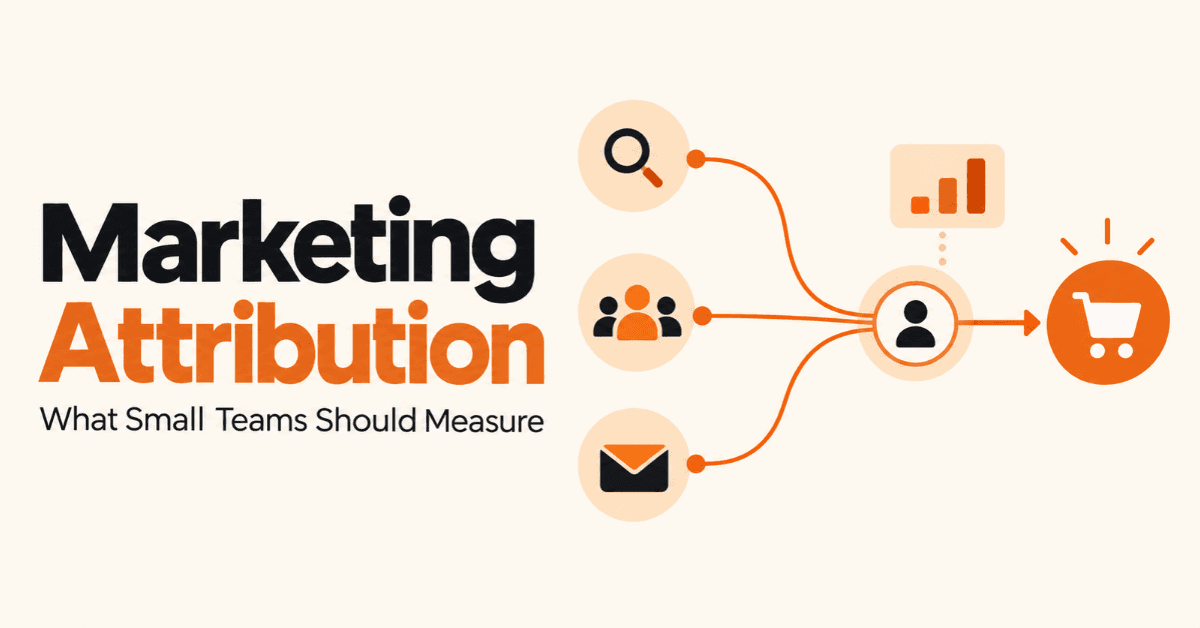 Growth
Marketing Attribution: What Small Teams Should Measure
Marketing Attribution helps small teams measure channels, conversions, CRM data, and marketing ROI to make smarter, data-driven marketing decisions.
 Growth
CAC vs LTV: How to Build a Healthier Growth Model
CAC vs LTV explained with formulas, examples, unit economics, growth metrics, and practical strategies to build a healthier, more sustainable growth model.
 Growth
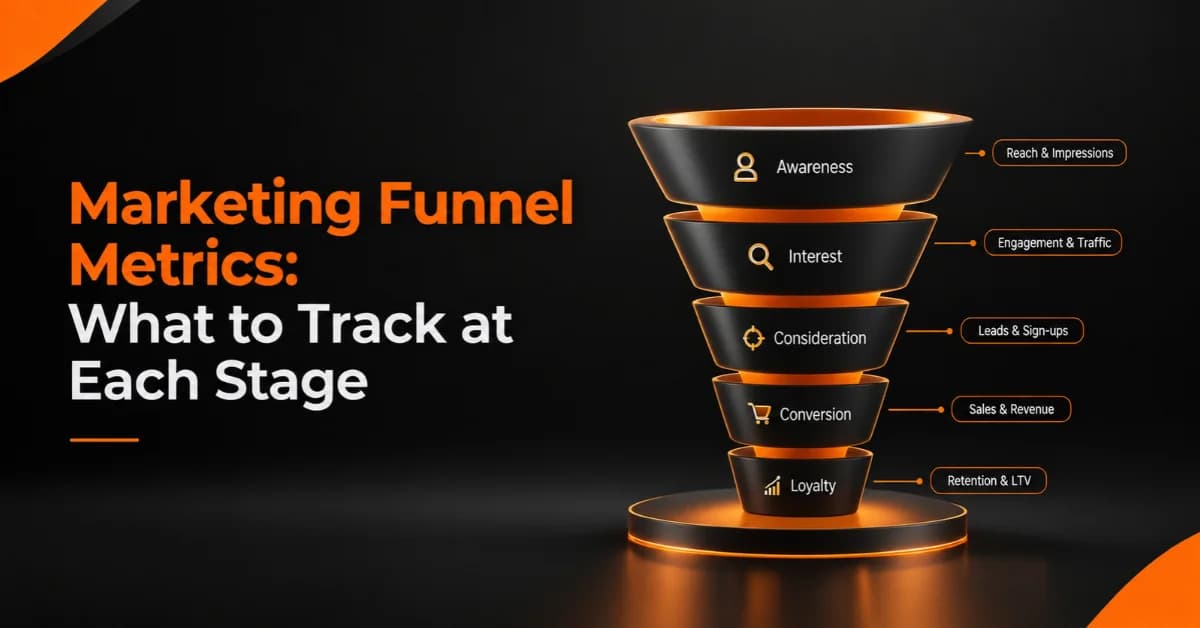
Marketing Funnel Metrics: What to Track at Each Stage
Learn which marketing funnel metrics to track at awareness, consideration, conversion, and retention stages, with formulas, examples, and KPI tips.