

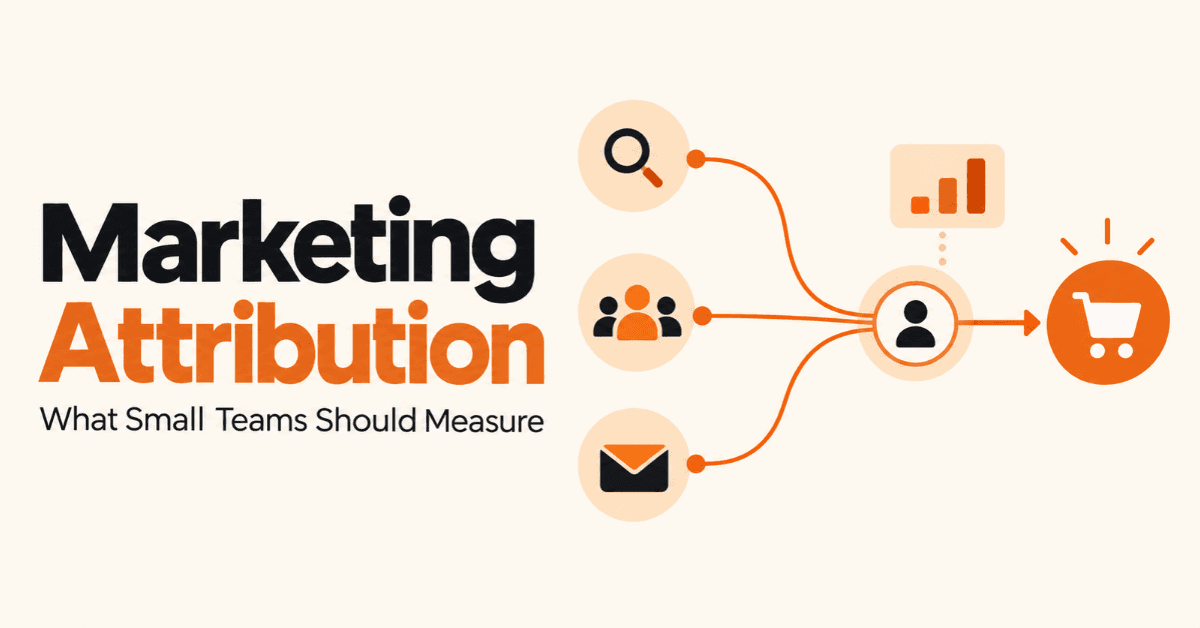
Marketing Attribution: What Small Teams Should Measure
Small marketing teams often know how much traffic they generate, how many leads they receive, and how much they spend on campaigns. The harder question is: which marketing activities actually contribute to conversions and revenue? That is where Marketing Attribution becomes useful. Attribution helps businesses understand the marketing touchpoints that appear along a customer's path to an important action, such as submitting a form, booking a consultation, starting a trial, or making a purchase.
For a small team, however, attribution does not need to become a complicated analytics project. The goal is to connect marketing channels with meaningful business outcomes and use that information to make better decisions.
What Is Marketing Attribution?
Marketing Attribution is the process of assigning credit to marketing touchpoints that contribute to a customer's journey toward a conversion or other important action.
Consider a potential customer who discovers a business through Google Search. They later visit the website through an organic result, subscribe to an email list, click a remarketing advertisement, and eventually contact the sales team.
Which channel generated the customer?
The answer may not be as simple as choosing the last interaction. Attribution helps teams examine the different touchpoints involved in the journey. Google describes attribution as assigning credit for important actions to different ads, clicks, and other factors along the customer's path.
A Simple Marketing Attribution Example
Imagine a small UAE-based consultancy receives a new client through this journey:
Google Search → Website → Blog Article → Email → Consultation Form → Sales Call → Customer
Looking only at the final form submission could make the team believe the website created the customer by itself.
A broader attribution view shows that search visibility, content, email nurturing, and the website all played different roles in the journey.
That distinction matters because the purpose of attribution is not simply to give one channel all the credit. It is to understand how marketing activities work together.
Why Marketing Attribution Matters for Small Teams
Large companies may have dedicated analytics teams, data engineers, and sophisticated reporting systems. Small businesses usually do not have that luxury.
That makes simple, reliable measurement even more important.
Marketing Attribution can help small teams answer practical questions such as:
Which channels generate qualified leads?
Which campaigns produce actual opportunities?
Which channels attract traffic but rarely convert?
How much does it cost to acquire a customer?
Which marketing activities assist conversions?
How long does a typical customer journey take?
Where do prospects leave the sales funnel?
Google Analytics attribution reports are designed to help businesses understand how different marketing efforts work together and how different attribution models can change the credit assigned to channels.
Attribution Is Not About Finding One Winning Channel
A common mistake is to treat attribution as a competition between channels.
For example, SEO might introduce a prospect, paid search might capture their return visit, email might nurture the relationship, and a sales call might close the deal.
Each activity can serve a different role.
The better question is not simply, "Which channel won?"
Instead, ask:
"What role did each channel play in moving this prospect toward becoming a customer?"
That mindset creates more useful marketing reporting.
The 5 Marketing Attribution Metrics Small Teams Should Measure
Small teams do not need dozens of dashboards. Start with a focused group of metrics that connect marketing activity with business outcomes.
1. Leads and Qualified Leads by Channel
Start by measuring how many leads each channel generates.
Track sources such as:
Organic search
Paid search
Social media
Email
Referral traffic
Direct traffic
Content marketing
Offline campaigns
Then go one step further and separate total leads from qualified leads.
A channel that produces 200 low-quality leads may be less useful to the business than a channel producing 50 prospects who are genuinely interested in the service.
2. Conversion Rate by Channel
Conversion rate shows how effectively traffic or leads move toward a desired action.
Depending on the business, this could include:
Website form submissions
Consultation requests
Demo bookings
Trial registrations
Purchases
Qualified opportunities
This is where channel attribution becomes useful. Instead of measuring traffic alone, teams can compare how different acquisition sources contribute to meaningful actions.
Google Analytics uses traffic-source dimensions such as source, medium, and campaign to help businesses understand where users come from and how marketing efforts contribute to outcomes.
3. Customer Acquisition Cost
Customer Acquisition Cost, or CAC, helps teams understand the cost associated with acquiring customers.
A simple formula is:
CAC = Total Sales and Marketing Costs ÷ New Customers Acquired
For example, if a business spends $5,000 on sales and marketing and acquires 25 new customers:
$5,000 ÷ 25 = $200 CAC
Teams can then compare acquisition costs across channels.
However, CAC should not be evaluated alone. A channel with a higher acquisition cost may still make sense if it produces higher-value customers.
4. Revenue and Marketing ROI
Traffic and leads are useful, but revenue provides a stronger connection to business performance.
Marketing ROI = (Marketing Revenue − Marketing Cost) ÷ Marketing Cost × 100
Suppose a campaign costs $2,000 and generates $6,000 in attributable revenue:
($6,000 − $2,000) ÷ $2,000 × 100 = 200%
This calculation can help teams evaluate marketing ROI, but attribution data should not be treated as perfect proof that a particular channel independently caused every dollar of revenue.
Attribution is a measurement framework. It helps teams understand contribution based on the available data.
5. Customer Journey and Assisted Conversions
Customers often interact with several channels before converting.
For example:
Social Media → Organic Search → Email → Website → Conversion
A last-click report may emphasize the final interaction, while a broader customer journey analysis can show the sequence of interactions.
This helps small teams understand assisted touchpoints and identify channels that contribute earlier in the decision-making process.
Choosing the Right Attribution Model for a Small Business
An attribution model is a rule or data-driven approach that determines how credit is assigned to touchpoints along a customer's path to an important action.
The right model depends on the business, customer journey, available data, and reporting objective.
Data-Driven Attribution
Data-driven attribution uses available data to determine how different interactions contribute to key events. Google Analytics currently uses data-driven attribution in its attribution reporting for paid and organic channels, while also providing last-click options in relevant reports.
For teams using Google Analytics, this can provide a more flexible view of multi-touch customer journeys than simply assigning all credit to the final interaction.
Last-Click Attribution
Last-click attribution assigns the credit to the last eligible marketing interaction before the conversion.
It is straightforward and easy to communicate.
However, it can overlook earlier interactions that helped create awareness or consideration.
What About First-Click, Linear, and Other Older Models?
You may still see first-click, linear, time-decay, or position-based attribution discussed in older marketing articles. However, Google has retired these models from its current Google Analytics attribution reporting. Google states that first-click, linear, time-decay, and position-based models are no longer available in Google Analytics attribution reporting as of November 2023.
That makes it important to check whether an attribution guide reflects the current analytics environment before using its recommendations.
How Channel Attribution Helps Small Teams Spend Smarter
Channel attribution connects marketing channels with the conversions and outcomes they appear to influence.
A small business might use:
SEO for long-term organic discovery
Google Ads for capturing active demand
Social media for awareness
Email for nurturing prospects
Content marketing for education
Referrals for trust-based acquisition
These channels do not necessarily perform the same job.
For example, a blog post may introduce a prospect who does not convert for several weeks. Later, the prospect may click a paid advertisement and complete a form.
If the team only reviews the final interaction, it may underestimate the role of the earlier content.
Attribution helps teams examine these paths instead of relying on a single surface-level metric.
CRM Attribution: Connecting Marketing to Revenue
Website analytics can show where visitors come from, but CRM attribution can help connect marketing activity with leads, opportunities, customers, and revenue.
This connection becomes particularly important for businesses with longer sales cycles.
What CRM Attribution Can Connect
A small team can start by recording:
Original lead source
Latest lead source
Campaign
Landing page
Conversion date
Sales stage
Opportunity value
Deal status
Customer status
The goal is to move from:
"We generated 100 leads."
to:
"These sources generated qualified opportunities, and these opportunities produced customers and revenue."
That is a much more useful conversation between marketing and sales.
Keep CRM Data Consistent
Poor data can weaken even a sophisticated attribution system. Use consistent campaign names, source fields, UTM parameters, and lead-status definitions. Google identifies source, medium, and campaign as important traffic-source dimensions for understanding acquisition and attribution.
A Simple Marketing Attribution Framework for Small Teams
Small teams can build a practical system without creating an overly complex reporting structure.
Step 1: Define the Conversion
Decide what matters most to the business.
This might be:
Lead submission
Consultation booking
Demo request
Trial
Purchase
Qualified sales opportunity
Step 2: Track the Source
Use consistent tracking for campaigns and acquisition sources. UTM parameters can help identify campaign, source, and medium information.
Step 3: Connect Marketing Data With the CRM
Make sure marketing leads can be connected to sales opportunities and closed customers.
Step 4: Select a Practical Attribution Model
Use an attribution model that fits the available data and the business question. Do not change the reporting methodology every week.
Step 5: Review the Numbers Regularly
A simple reporting sequence can look like this:
Channel → Leads → Qualified Leads → Opportunities → Customers → Revenue
Step 6: Turn Insights Into Tests
Attribution should lead to action. If one channel generates strong leads but has a weak landing-page conversion rate, test the landing page. If another channel generates traffic but few qualified leads, review targeting and messaging.
The objective is improvement, not simply a more complicated dashboard.
Common Marketing Attribution Mistakes Small Teams Should Avoid
Relying Only on Last-Click Data
Last-click reporting can be useful, but it may hide earlier interactions that contributed to the customer journey.
Measuring Traffic Instead of Business Outcomes
High traffic does not automatically mean high-quality leads or revenue. Always connect traffic data with conversions and, where possible, CRM outcomes.
Ignoring Offline Conversions
Phone calls, sales meetings, referrals, and in-person interactions may not appear clearly in standard website analytics.
Record these interactions where practical.
Using Too Many Attribution Models
Switching methodologies frequently can make historical comparisons confusing.
Choose a consistent approach and document it.
Ignoring Tracking Limitations
Attribution is not perfect.
Privacy controls, consent settings, cross-device journeys, technical limitations, and incomplete tracking can affect the data. Google also uses modeled key events when some online actions cannot be directly observed.
Treat attribution results as useful evidence for decision-making, not as an exact reconstruction of every customer's behavior.
What a Small Team Attribution Dashboard Should Include
A useful dashboard can remain relatively simple.
Track:
Marketing spend
Leads by channel
Qualified leads
Conversion rate
Customer acquisition cost
Opportunities
Revenue
Marketing ROI
Assisted conversions
Sales cycle length
Keep the Dashboard Simple
Every major metric should help answer a business question. If a number does not influence a marketing, sales, or customer-acquisition decision, it may not need to sit on the main dashboard.
A focused dashboard is usually easier for a small team to maintain and act on.
Marketing Attribution Example for a Small Business
Consider a small UAE-based professional services company. The company receives prospects through Google Search, social media, email, and referrals.
One customer journey looks like this:
Google Search → Service Page → Email Signup → Email Nurturing → Consultation Request → Sales Call → Customer
The marketing team records the original source, campaign information, conversion event, CRM opportunity, and final revenue.
Over several months, the team may notice that organic search introduces many prospects, email supports repeat engagement, and sales activity plays an important role in closing opportunities.
The insight is more useful than simply saying that one channel "won."
The team can then test content, landing pages, campaigns, and nurturing sequences based on the role each touchpoint plays.
How to Improve Marketing ROI With Better Attribution
Better attribution can help small teams make more informed marketing decisions.
Instead of asking only how many clicks a campaign received, teams can investigate:
Did it generate qualified leads?
Did those leads become opportunities?
Did opportunities become customers?
What was the acquisition cost?
What revenue was associated with those customers?
Did other channels contribute to the journey?
This can make marketing ROI analysis more meaningful.
However, attribution should support experimentation rather than replace it. A channel that appears strong in one reporting period may perform differently as campaigns, audiences, offers, and market conditions change.
Use attribution insights to identify what deserves further testing.
How BrandVexo Can Help!
BrandVexo helps businesses build practical digital growth systems across digital marketing, SEO, web development, AI automation, and business solutions. Our approach focuses on measurable business outcomes rather than vanity metrics, helping businesses turn marketing activity into clearer opportunities for growth.
If your team needs help connecting SEO, digital marketing, content, automation, and measurable business outcomes, we can help review your current marketing process and identify practical opportunities to improve tracking and performance.
Phone: +971 52 356 5409
Email: info@brandvexo.com
Website: www.brandvexo.com
FAQs
What is Marketing Attribution?
Marketing Attribution is the process of assigning credit to marketing touchpoints that contribute to a customer's path toward a conversion or other important action.
What is the best attribution model for a small business?
There is no universal model that fits every small business. The appropriate approach depends on the customer journey, sales cycle, conversion volume, data quality, and reporting objective. Current Google Analytics attribution reporting includes data-driven and last-click approaches rather than several older models that have been retired.
What is channel attribution?
Channel attribution examines how different marketing channels contribute to conversions or other meaningful business outcomes. It can help teams compare sources such as organic search, paid advertising, email, social media, and referrals.
How does CRM attribution work?
CRM attribution connects marketing-source information with leads, opportunities, customers, and revenue inside a CRM system. It helps businesses understand what happens after a marketing interaction creates a lead.
How can a small business measure marketing ROI?
A simple approach is to compare marketing revenue with marketing costs using the formula: (Marketing Revenue − Marketing Cost) ÷ Marketing Cost × 100. Teams should also consider attribution limitations when interpreting the result.
Is last-click attribution still useful?
Yes, last-click can provide a simple view of the final eligible marketing interaction before a conversion. However, it does not show the full contribution of earlier touchpoints.
Do small businesses need advanced attribution software?
Not necessarily. Many small teams can begin with consistent campaign tracking, website analytics, CRM data, and a small set of meaningful metrics. More advanced systems can be considered when the business has enough complexity and data to justify them.
Final Takeaway
Marketing Attribution does not need to become an overwhelming analytics project. For a small team, the most useful starting point is simple: define meaningful conversions, track marketing sources consistently, connect leads with CRM outcomes, measure revenue, and use an appropriate attribution model.
Focus on the journey from channel → lead → opportunity → customer → revenue.
The goal is not to create a perfect picture of every customer interaction. The goal is to produce reliable enough insight to make better marketing decisions.
Disclaimer: Marketing attribution results depend on tracking setup, data quality, privacy settings, platform limitations, and the attribution methodology used. Attribution should be treated as a decision-support tool rather than a perfect measurement of causation.
Free growth plan
Ready to grow your business?
Reading is a start — now let's build it. Tell us where you want to grow and a senior strategist will map the fastest, most profitable way to get there. Free, no obligation.
Discussion
Join the conversation
Be the first to comment. Comments are reviewed before they appear, so yours won't show up instantly — but we read every one.
Leave a comment
Keep reading
All articles Growth
Growth Agency vs Specialist Agencies: Which Model Wins?
Compare Growth Agency vs Specialist Agencies, including costs, expertise, strategy, and scalability, to choose the right marketing model for your business.
 Growth
CAC vs LTV: How to Build a Healthier Growth Model
CAC vs LTV explained with formulas, examples, unit economics, growth metrics, and practical strategies to build a healthier, more sustainable growth model.
 Growth
Marketing Funnel Metrics: What to Track at Each Stage
Learn which marketing funnel metrics to track at awareness, consideration, conversion, and retention stages, with formulas, examples, and KPI tips.