

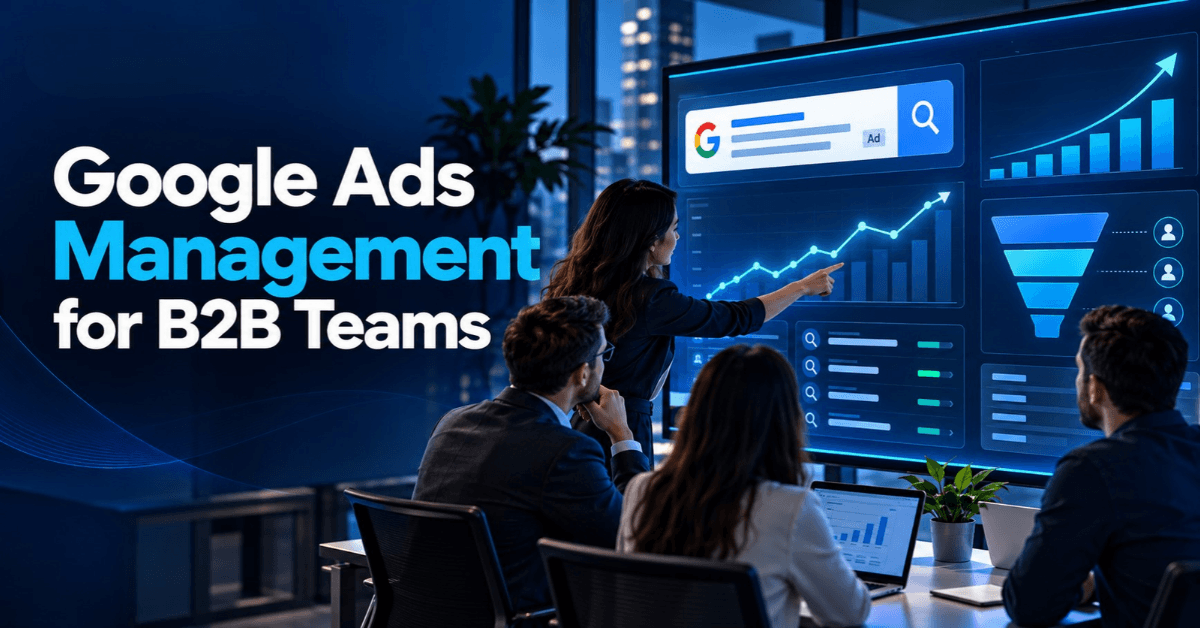
Google Ads Management for B2B Teams | BrandVexo
B2B companies need more than website traffic to grow. They need qualified leads, meaningful sales conversations, and opportunities that turn into revenue. Google Ads Management helps B2B teams reach potential customers when they search for specific services, compare solutions, or look for a provider to solve a business problem. However, B2B advertising comes with unique challenges. Sales cycles can last weeks or months, several decision-makers may influence a purchase, and a high number of leads does not always translate into more sales. A successful campaign must connect keyword targeting, relevant ads, effective landing pages, and accurate conversion tracking.
What Is Google Ads Management for B2B Teams?
Google Ads Management involves planning, launching, monitoring, and improving paid advertising campaigns to achieve specific business goals. For B2B companies, these goals often include generating qualified enquiries, booking sales meetings, attracting business buyers, and creating sales opportunities.
Unlike many consumer campaigns, B2B PPC advertising often focuses on a smaller audience with specific business needs and higher potential contract values.
How B2B PPC Advertising Works
A well-managed B2B Google Ads campaign typically includes:
Keyword research: Identify the terms potential buyers use when searching for solutions.
Campaign structure: Organize campaigns around services, industries, and buyer intent.
Ad creation: Write relevant messages that explain the value of the offer.
Landing page optimization: Help visitors understand the solution and take the next step.
Conversion tracking: Measure meaningful actions, including qualified enquiries and sales opportunities.
Ongoing optimization: Review search terms, bidding, budgets, and lead quality.
For example, a UAE-based IT consultancy could target businesses searching for managed IT support, cloud migration services, or cybersecurity consulting. Each campaign should direct users to a relevant service page rather than a generic homepage.
B2B vs. B2C Google Ads Campaigns
B2B campaigns often involve longer buying journeys, multiple stakeholders, and more detailed evaluation. B2C campaigns may generate purchases immediately, while B2B campaigns frequently begin with a consultation, product demonstration, or sales meeting.
This difference makes lead qualification and pipeline measurement essential parts of B2B Google Ads management.
Why Standard PPC Campaigns Fail to Generate Quality B2B Leads
A campaign can generate clicks and form submissions without producing valuable sales opportunities. This usually happens when the advertising strategy focuses on traffic instead of buyer intent and commercial outcomes.
Common mistakes include:
Targeting broad keywords: General searches may attract students, job seekers, or people looking for free resources rather than business buyers.
Optimizing for cheap leads: A low cost per lead does not guarantee that prospects fit the ideal customer profile.
Using generic landing pages: Visitors may leave if the page does not address their specific business needs.
Ignoring negative keywords: Irrelevant search terms can consume budget without generating useful enquiries.
Disconnecting marketing from sales: Without CRM data, marketers may struggle to identify which campaigns generate qualified opportunities.
B2B teams should evaluate both lead volume and lead quality. A campaign producing fewer qualified prospects may create more revenue than one generating many irrelevant enquiries.
How to Build a Google Ads Strategy for B2B Companies
A strong Google Ads strategy for B2B companies begins with clear business goals and a practical understanding of the target audience. Follow these steps to build campaigns around commercial intent.
1. Define Your Ideal Customer Profile
Start by identifying the businesses most likely to benefit from your product or service.
Consider:
Industry and business type
Company size and location
Common operational challenges
Budget and purchasing capacity
Decision-makers involved in buying
Business problems your solution addresses
For example, a cloud services provider may focus on mid-sized businesses that need infrastructure support but lack a large internal IT team.
This approach helps marketers create more relevant campaigns and prioritize searches associated with genuine business needs.
2. Research High-Intent B2B Keywords
Keyword research helps identify what potential customers want when they search.
Prioritize keywords that demonstrate a clear interest in purchasing a solution, requesting a quote, or comparing providers.
Examples include:
Managed IT services for businesses
B2B cybersecurity consulting
Enterprise CRM implementation services
Cloud migration company
Business software implementation consultant
Separate keywords by intent, such as service searches, pricing searches, comparison searches, and problem-focused searches.
Use the Google Ads Keyword Planner and search-term reports to evaluate keyword ideas and identify irrelevant queries. Search volume, competition, and cost estimates should guide decisions, but the final choice should reflect business relevance.
3. Structure Campaigns Around Buyer Intent
Avoid placing every service and keyword into one campaign. Organize campaigns so that ads, keywords, and landing pages remain closely connected.
For example, a B2B technology company could create separate campaigns for managed IT services, cybersecurity, and cloud consulting.
This structure makes it easier to compare performance, manage budgets, and understand which services attract qualified leads.
4. Create Relevant Ads and Landing Pages
Your ads should explain what you offer and why it matters to the target business. Use clear headlines, relevant service descriptions, and a specific call to action. Avoid vague claims that do not explain the value of your solution. The landing page should support the promise made in the ad. Include a clear service explanation, relevant benefits, proof points you can substantiate, and a straightforward enquiry process.
Depending on the sales process, useful calls to action may include requesting a consultation, booking a demonstration, or asking for a proposal.
5. Use Negative Keywords and Budget Controls
Review search-term reports regularly to identify searches that do not match your target audience. Depending on your business model, you may exclude terms related to jobs, free downloads, training, or unrelated consumer products.
Set budgets according to campaign priorities and business objectives. Avoid increasing spending simply because a campaign generates more clicks. First assess lead quality, conversion tracking, and the cost of creating genuine sales opportunities.
How Do You Optimize Google Ads for B2B Pipeline?
To optimize Google Ads for B2B pipeline, connect advertising activity with the stages prospects move through before becoming customers. Instead of measuring only form submissions, track which campaigns generate qualified leads, sales opportunities, and closed deals.
This approach gives marketing and sales teams a clearer view of advertising performance.
CRM Integration and Offline Conversion Tracking
A customer relationship management (CRM) platform such as HubSpot or Salesforce can help B2B teams track leads as they progress through the sales process.
A practical measurement process includes:
Record relevant lead information when a prospect submits an enquiry.
Connect campaign data with the appropriate CRM record.
Track meaningful milestones, such as qualified leads, booked meetings, and closed sales.
Where supported and properly configured, import eligible offline conversion events into Google Ads.
Use reliable conversion data to evaluate campaigns and inform bidding decisions.
Offline conversion tracking is especially useful when customers complete purchases after phone calls, consultations, or extended negotiations.
Teams should also establish clear definitions for Marketing Qualified Leads (MQLs) and Sales Qualified Leads (SQLs). Marketing and sales departments need to agree on what makes a lead worth pursuing.
Accurate tracking, appropriate consent, and careful handling of customer data are essential throughout the process.
What Is a Good Cost per Lead for B2B Google Ads?
There is no universal cost per lead (CPL) that works for every B2B business. A reasonable target depends on the industry, competition, average contract value, sales conversion rates, profit margins, and customer acquisition goals.
A low CPL may be attractive, but it becomes less useful if most leads fail to qualify.
How to Calculate a Target Cost per Lead
Businesses can estimate an acceptable CPL by working backward from their target customer acquisition cost.
Consider this illustrative example:
A B2B service provider can afford to spend $1,000 to acquire a new customer. If 10% of its qualified leads become paying customers, the maximum acquisition cost implied by that conversion rate is approximately $100 per qualified lead.
The calculation is:
Target cost per qualified lead = Target customer acquisition cost × Lead-to-customer conversion rate
In this example:
$1,000 × 10% = $100 per qualified lead.
This is a simplified model. The business should also account for gross margins, sales expenses, refunds where relevant, and other acquisition costs.
It is important to distinguish between cost per raw lead and cost per qualified lead. If only a small percentage of enquiries fit the ideal customer profile, the actual cost of acquiring a customer may be much higher than the initial CPL suggests.
Which Bidding Strategy Works Best for B2B Google Ads?
The right Google Ads bidding strategy depends on the campaign objective, conversion data, budget, and reliability of the tracking setup.
Common options include:
Maximize Conversions: Aims to generate as many recorded conversions as possible within the available budget.
Target CPA: Aims to achieve conversions around a specified average cost per acquisition.
Maximize Conversion Value: Focuses on generating the highest total value from recorded conversions within the budget.
Target ROAS: Aims to achieve a specified return on advertising spend when conversion values can be measured meaningfully.
For a B2B company, the most suitable approach depends on what Google Ads can reliably measure. Optimizing for every form submission may encourage volume without improving lead quality.
Where sufficient reliable data is available, tracking qualified leads or assigning meaningful values to sales milestones can help align bidding with business objectives.
Teams should avoid setting aggressive targets before collecting enough relevant data. They should also review campaign performance after significant changes rather than making frequent adjustments based on short-term fluctuations.
How Should B2B Teams Measure Google Ads Performance?
Effective B2B PPC management measures progress from the first click to the final sale. The right metrics help teams understand where campaigns perform well and where potential customers drop out of the sales process.
Important metrics include:
Click-through rate (CTR): Shows how often people click after seeing an ad.
Landing page conversion rate: Measures the percentage of visitors who complete a desired action.
Cost per lead (CPL): Measures advertising cost per recorded lead.
Cost per qualified lead: Measures the cost of generating leads that meet agreed qualification criteria.
Cost per acquisition (CPA): Measures the cost of acquiring a customer or another defined conversion, depending on the reporting setup.
MQL-to-SQL conversion rate: Shows how often marketing-qualified leads become sales-qualified leads.
Pipeline value: Estimates the value of sales opportunities associated with marketing activity.
Return on ad spend (ROAS): Compares attributed revenue or conversion value with advertising spend.
Why Quality Score and Landing Page Relevance Matter
Google Ads Quality Score is a diagnostic measure based on expected click-through rate, ad relevance, and landing page experience.
Improving these areas can help advertisers understand how closely their ads match search intent. Relevant keywords, clear ad copy, and useful landing pages support a better user experience.
However, Quality Score should not be treated as the main measure of business success. Qualified leads, acquisition costs, pipeline contribution, and revenue provide a more direct view of commercial performance.
How Long Does It Take to See ROI from B2B Paid Search?
The time required to see a return on investment from B2B paid search varies by industry, competition, budget, sales cycle, and conversion volume. Some campaigns may generate relevant enquiries quickly, while meaningful revenue results may take longer to measure.
A practical approach is to evaluate performance in stages:
Initial stage: Verify conversion tracking, keyword relevance, and landing page functionality.
Optimization stage: Review search terms, lead quality, bidding, and landing page performance.
Pipeline stage: Monitor qualified opportunities and sales progression.
Revenue stage: Compare advertising costs with closed business and acquisition economics.
B2B teams should avoid judging a campaign entirely by its first few leads. They should also avoid continuing campaigns indefinitely without evidence of progress. Set review periods, define success criteria, and use reliable data to guide decisions.
Should You Manage B2B Google Ads In-House or Hire an Agency?
The decision depends on internal expertise, available time, campaign complexity, and the quality of existing measurement systems.
When In-House Management Makes Sense
In-house management may work well when a company has experienced marketers, access to reliable analytics, and enough time to review campaign performance consistently.
It also allows marketing and sales teams to collaborate closely on audience insights, lead qualification, and business priorities.
When B2B PPC Management Services May Help
External support may be useful when a company needs specialist campaign expertise, advanced conversion tracking, structured testing, or help managing multiple campaigns.
A suitable provider should explain its measurement approach, reporting process, optimization priorities, and limitations. Ask how it evaluates qualified leads and sales pipeline outcomes rather than focusing only on clicks and impressions.
Whichever model you choose, establish clear goals and maintain access to your advertising account and performance data.
FAQs
Is Google Ads effective for B2B lead generation?
Yes. Google Ads can help B2B companies reach people actively searching for relevant business solutions. Results depend on keyword intent, targeting, offer relevance, landing page quality, and lead qualification.
What is a good B2B Google Ads conversion rate?
There is no single conversion rate that suits every B2B campaign. Performance varies by industry, offer, keyword intent, landing page, and conversion definition. Compare results with your own historical data and qualified lead outcomes.
How much should a B2B company spend on Google Ads?
Start with a budget that supports meaningful testing while remaining affordable for the business. Consider keyword costs, expected lead volume, sales conversion rates, and the maximum acquisition cost your company can sustain.
Can Google Ads generate leads for high-ticket B2B services?
Yes. High-ticket B2B campaigns can target searches for specialist services, enterprise solutions, and business consultations. Because buying decisions often take longer, teams should measure qualified opportunities and closed revenue alongside initial enquiries.
How can B2B teams track offline conversions in Google Ads?
Businesses can connect CRM or sales data with Google Ads through supported offline conversion measurement methods. Correct configuration, eligible conversion data, and appropriate consent practices are necessary for reliable reporting.
Build a More Effective B2B Google Ads Strategy With BrandVexo
Effective Google Ads Management connects buyer intent, relevant campaigns, qualified leads, and measurable business outcomes. By improving keyword targeting, aligning marketing with sales, and tracking pipeline performance, B2B teams can make more informed advertising decisions.
BrandVexo helps businesses strengthen their digital marketing strategy through practical, performance-focused solutions. Review your current campaigns, identify gaps in lead quality and conversion tracking, and prioritize improvements that align with your business goals. Contact BrandVexo to discuss your digital marketing priorities and identify practical opportunities to improve your B2B advertising performance.
+971 52 356 5409
Disclaimer: This article provides general information about Google Ads management and B2B advertising strategies. Campaign results, advertising costs, and conversion rates vary by industry, competition, tracking quality, and business objectives. Always review current Google Ads documentation and your own campaign data before making significant budget or bidding decisions.
Free growth plan
Ready to grow your business?
Reading is a start — now let's build it. Tell us where you want to grow and a senior strategist will map the fastest, most profitable way to get there. Free, no obligation.
Discussion
Join the conversation
Be the first to comment. Comments are reviewed before they appear, so yours won't show up instantly — but we read every one.
Leave a comment
Keep reading
All articles Growth
Managed IT Services for Small Businesses: A Guide
Explore IT services for small businesses, including managed IT support, cybersecurity, cloud management, backups, costs, and provider selection tips.
 Growth
Core Web Vitals for Business Websites: Guide for Consultants
How Core Web Vitals affect consulting websites, SEO and B2B leads. Explore LCP, INP, CLS, testing tools and practical performance fixes.
 Growth
Digital Growth Audit for Service Firms: A Practical Guide
How digital growth audit helps service firms assess SEO, website performance, lead generation and marketing metrics to identify practical growth opportunities.