

How Dubai Businesses Can Build a 90-Day Growth Strategy
A business can have a good product, a capable team and a marketing budget, yet still struggle to grow. The website brings visitors but few enquiries. Sales conversations begin without context. Campaigns generate activity, but the owner cannot tell which investment is producing customers. In a competitive market such as Dubai, these gaps can quietly consume time and cash.
A practical growth strategy Dubai businesses can use does not begin with adding more channels or increasing spend. It begins by identifying the business constraint, choosing a measurable commercial goal and organising the next 90 days around the work most likely to remove that constraint.
Introduction
A 90-day period is long enough to diagnose a business, implement meaningful improvements and gather early performance evidence. It is also short enough to keep priorities focused. It cannot guarantee a particular revenue result, and it should not be treated as a magic formula. It is a management framework for making decisions, assigning responsibility and learning quickly.
For Dubai SMEs and founders, the right plan will depend on the business model, customer location, sales cycle, capacity, competition and available budget. A B2B consultancy selling across the UAE will need a different acquisition system from a restaurant serving one neighbourhood or an online retailer shipping throughout the Emirates.
This growth strategy Dubai guide explains how to build a 90-day roadmap, what to prioritise in each month, which numbers to monitor and when outside support may be useful. The goal is a plan your team can execute, not a document that sits untouched after the first meeting.
1. Start With a Clear Business Outcome
Before choosing channels, define what growth means for the next quarter. “Get more customers” is too broad to guide decisions. Choose one primary outcome that matters commercially and a small number of supporting measures.
For one business, the priority may be more qualified enquiries. For another, it may be improving proposal conversion, increasing repeat purchases or shortening the time between enquiry and consultation. A growth strategy Dubai company leaders can use should connect marketing activity to an outcome the business can serve.
Write the goal in a measurable format: increase qualified consultation requests, improve lead-to-sale conversion or generate additional recurring revenue. Set a target only after checking historical performance, sales capacity and delivery margins. If data is incomplete, use the first two weeks to establish a baseline rather than inventing a target.
Separate the primary result from supporting indicators. Website visits, social engagement and advertising clicks help diagnose performance, but they are not substitutes for sales, margin or qualified demand.
Use this short sequence to define the target:
Choose one commercial result, such as qualified opportunities, new customers or recurring revenue.
Record the current baseline and the period it covers.
Check gross margin, delivery capacity and the sales cycle before setting a target.
Assign one person to own the result and the weekly review.
2. Audit the Business Before You Spend More
A useful growth audit checks whether the offer, pricing, customer experience, sales process and delivery capacity can support the growth being requested. Review which customer types are profitable, stay longer, refer others or buy repeatedly. Compare them by service, location, company size, acquisition source and sales cycle. Then follow recent enquiries from first contact to sale. Note where people wait, repeat information, receive unclear answers or disappear. A weak handoff can waste demand the marketing team has already paid to create.
Your audit should cover these areas:
Offer and positioning: Is the service easy to understand, relevant to a defined customer and meaningfully different from alternatives?
Acquisition: Which sources currently produce genuine enquiries, not just traffic or reactions?
Conversion: Do landing pages, forms, calls and sales conversations make the next step clear?
Retention and delivery: Can the team fulfil new work consistently and encourage suitable repeat business?
Measurement: Can you connect campaign sources with qualified leads, sales and revenue?
Use CRM records, invoices, sales notes, analytics, campaign reports and customer feedback. If records are incomplete, mark the gaps. Improving data collection may be the first task. The UAE Government's SME overview also outlines public programmes and support available to SMEs.
3. Choose the Customer and Offer You Will Prioritise
Trying to reach every business or resident in Dubai usually makes a small budget less effective. Define a priority audience your team can recognise. For B2B, specify the industry, company size, decision-maker, problem and buying trigger. For local consumer services, consider service area, urgency, price sensitivity and how people choose a provider. Dubai is not one uniform audience. Choose one commercially viable offer that operations can deliver, such as a core service, package or consultation.
A focused growth strategy Dubai SMEs can execute should also state what the business will not prioritise during the quarter. This does not mean ignoring all other customers. It means concentrating budget, content and sales attention on the opportunity with the strongest current evidence.
4. Build a Local Acquisition System for Dubai
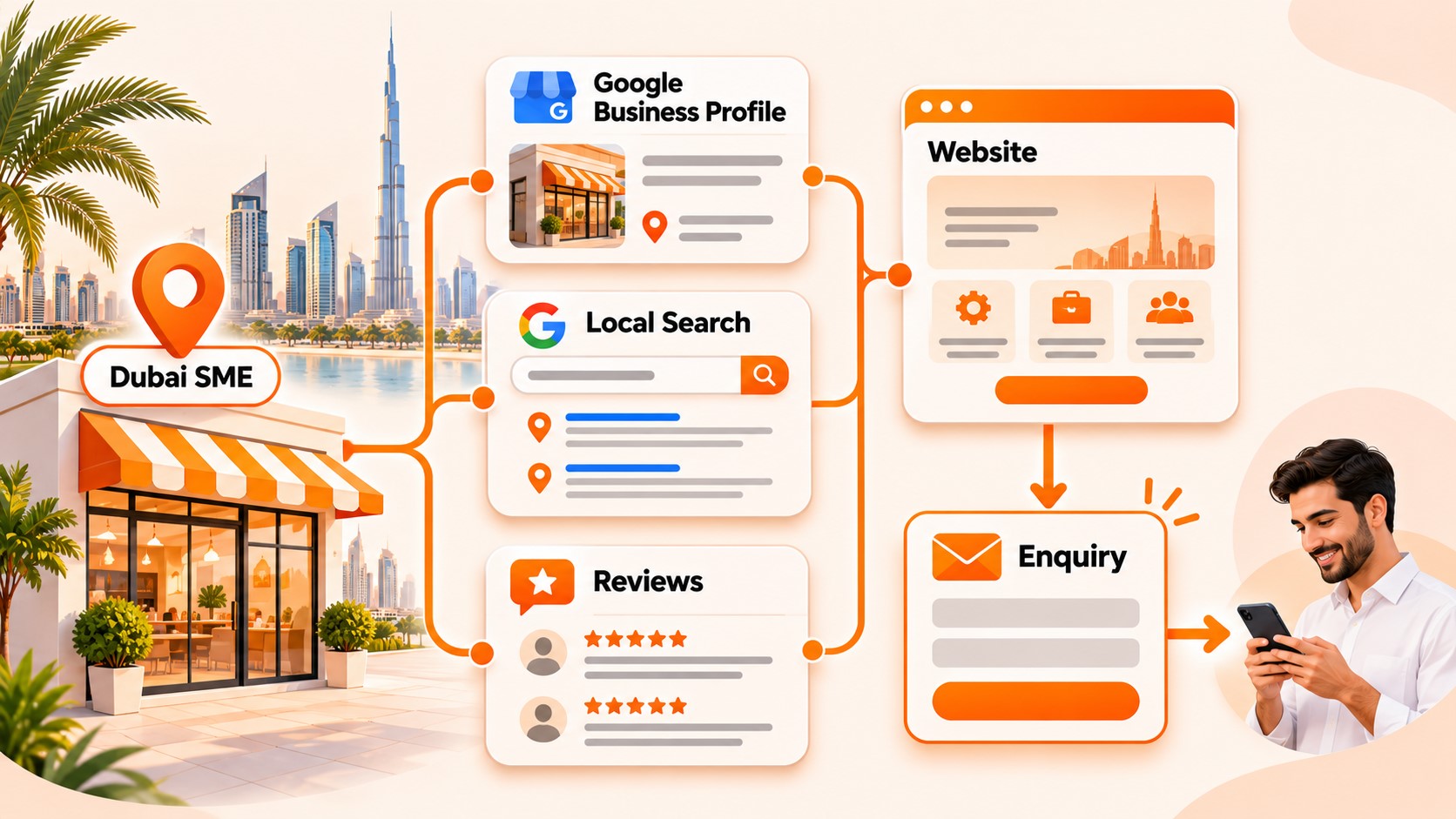
A growth strategy Dubai service businesses use should account for local visibility when customers search for a nearby provider or verify that a business is credible. Keep your business name, address or service area, phone number, opening hours and service descriptions accurate and consistent across your website and profiles.
For eligible businesses that serve customers in person or within defined service areas, maintain a complete and verified Google Business Profile. Add accurate categories, services, photos and contact details. Ask genuine customers for honest reviews and respond professionally to feedback. Google's guidance on improving local ranking explains that local results are influenced by relevance, distance and prominence, and that complete information can help customers understand a business. These factors are not a promise of a particular ranking.
Build local relevance without creating thin pages for every neighbourhood. Explain where you genuinely operate and which services are available. If you serve several Emirates, distinguish service coverage clearly. Local search is only one route to demand; referrals, partnerships, paid search, social campaigns, email, events and outbound sales may also fit. Choose based on customer behaviour and economics.
For businesses that need stronger local visibility, consider a focused SEO and Local SEO programme as one part of the wider plan. Search visibility works best when the pages people land on answer their questions and make it easy to enquire.
5. Improve the Website and Conversion Journey
More visitors will not solve a weak conversion path. Review key pages and make sure customers can quickly understand the service, its value, proof and next step. Test on mobile and desktop. Forms should request only necessary details, contact links should work and the advert's promise should match its landing page. Use real customer questions about price, timing, process and service coverage to improve content. Publish only genuine proof and avoid unsupported guarantees.
If the website is difficult to update, slow or confusing, it may need more than small copy changes. Website development should address structure, performance, mobile usability and enquiry paths together. The decision should follow the audit, not precede it.
6. Make Lead Handling Part of the Growth Plan
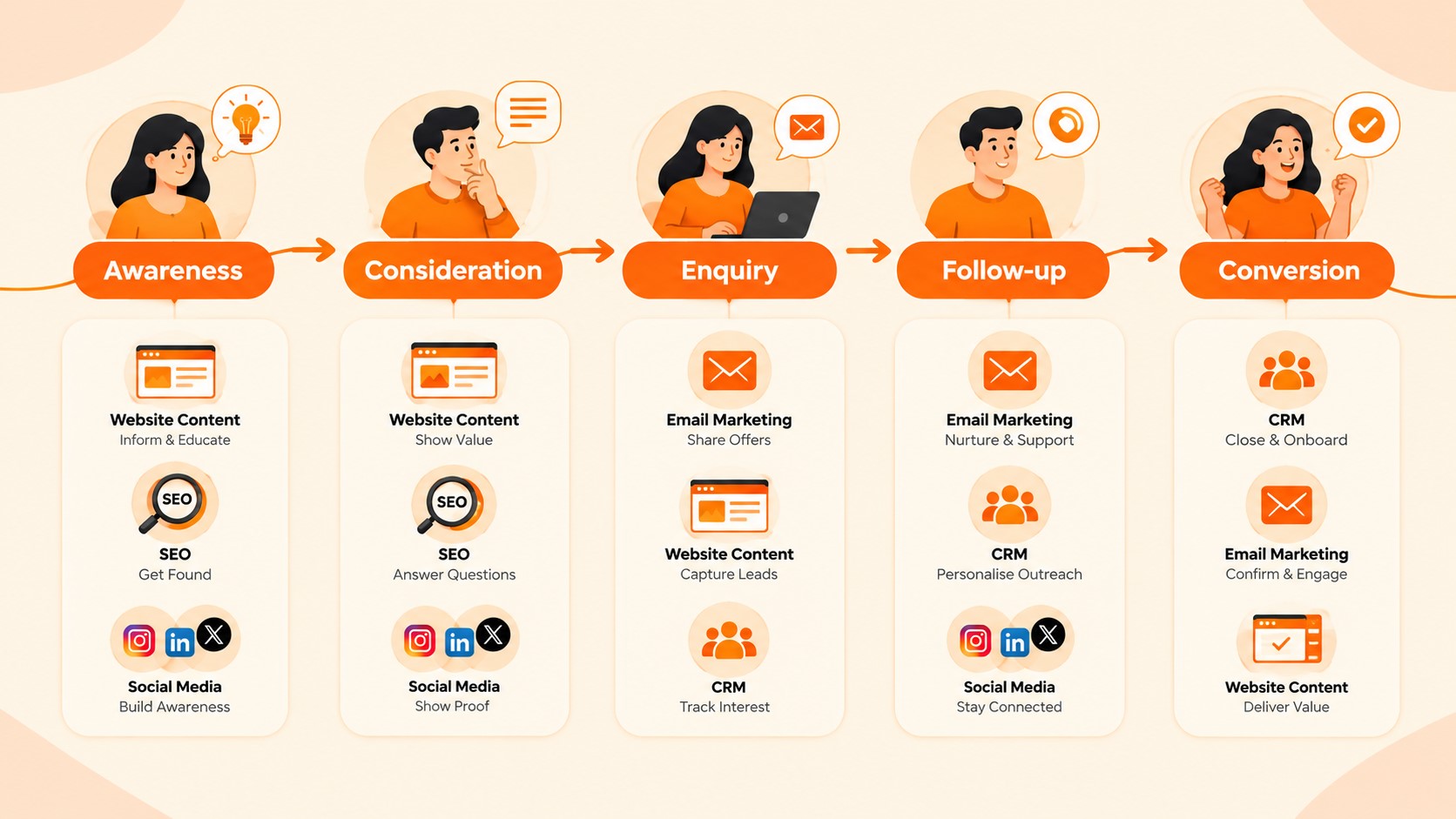
Every enquiry needs an owner and a next step. Record leads from forms, calls, WhatsApp and email in one agreed process. Track source, service interest, status, owner and next action. Keep access limited, collect only necessary information and follow applicable privacy requirements. Automation can support acknowledgements, routing, reminders and booking, but test workflows and retain human judgement for complex conversations. AI automation for lead handling may help when manual follow-up is a recurring bottleneck.
7. Turn the 90 Days Into Three Focused Phases
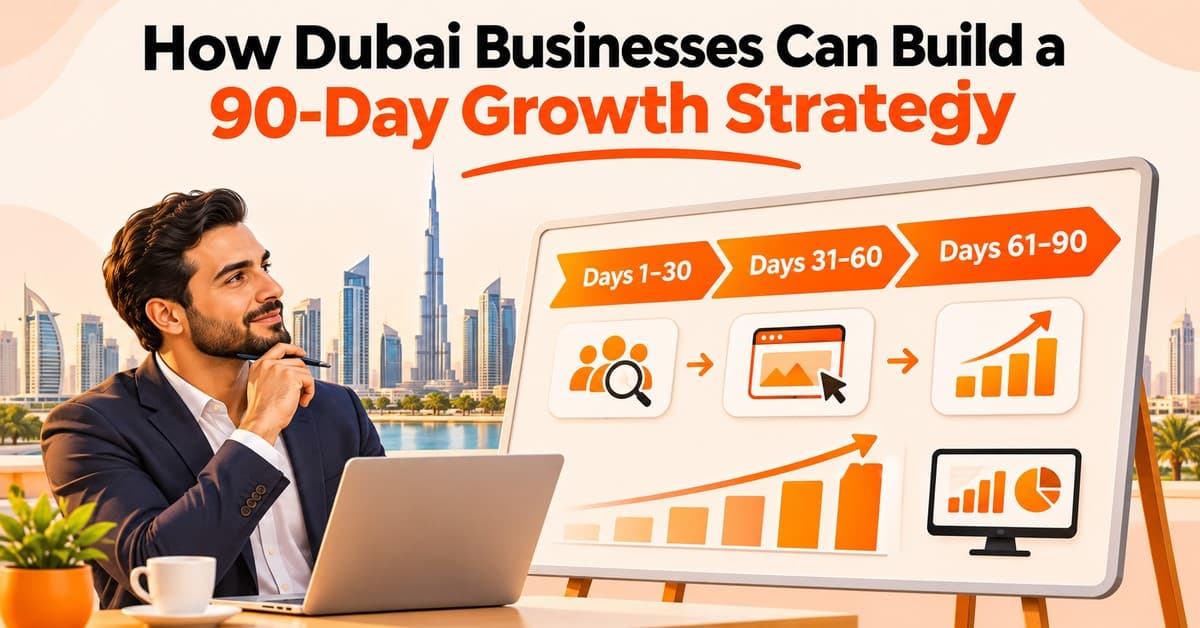
A growth strategy Dubai founders can manage should move from diagnosis to implementation and then optimisation. The sequence below is a starting framework. Adjust the pace to the complexity of the business, the length of its sales cycle and the time needed to make operational changes.
Days 1–30: Diagnose and prepare. Confirm the commercial goal, review customer and sales data, audit the acquisition journey and choose the priority audience and offer. Fix basic tracking and make sure the team can identify a qualified enquiry. Review the website, local profiles, key landing pages and lead response process. At the end of this phase, the business should have a written baseline, a clear priority and an agreed owner for each major action.
Days 31–60: Implement and test. Launch the highest-priority improvements. This may include updating a service page, improving local search information, testing a focused paid campaign, building a referral partnership or introducing a structured follow-up sequence. Avoid changing every channel at once. Keep a record of what changed, when it changed and what result you expected. Give each test enough time and relevant volume to produce interpretable evidence.
Days 61–90: Evaluate and scale selectively. Compare results with the baseline and the original business goal. Identify which audience, offer, channel and conversion improvements are producing qualified demand and profitable sales. Fix weak points before increasing spend. Document what worked, what did not and what remains uncertain. Use those findings to set the next quarter's priorities.
Protect focus. A new idea should not displace an active test unless evidence or a real business constraint justifies the change. This discipline is central to a growth strategy Dubai founders can execute.
8. Set a Weekly Scorecard and Make Decisions
A growth strategy Dubai SMEs can measure needs a short review rhythm. Weekly, review changes, evidence, blockers and next actions. Monthly, assess sales quality, margins, capacity and retention.
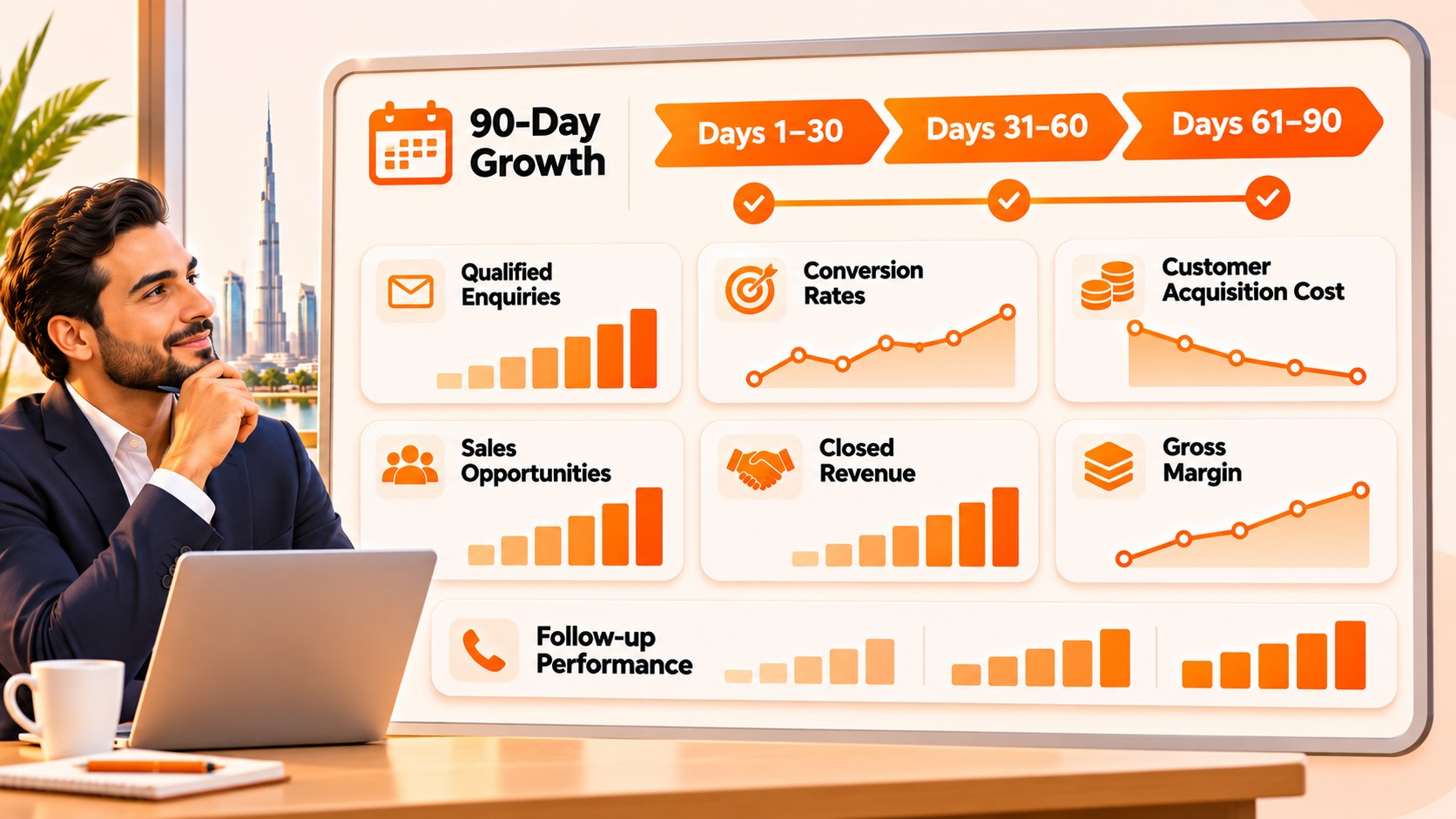
Choose a small dashboard that links acquisition to outcomes. Depending on the business model, it may include:
Qualified enquiries by source and service
Enquiry-to-meeting and meeting-to-sale conversion rates
Cost per qualified enquiry and customer acquisition cost
Proposal value, closed revenue and gross margin
First-response time, follow-up completion and lost-lead reasons
Repeat purchase, renewal or referral activity where relevant
Define each metric consistently. For example, decide what qualifies as a lead before comparing channel performance. Distinguish a form submission from a sales-qualified opportunity. Google Analytics lets businesses mark important interactions as key events and analyse the channels associated with those actions. Its key events guidance explains how these events are used in reporting. The tracking setup must reflect real business events, and analytics should be reviewed alongside CRM and sales records.
Attribution is not perfect proof that one channel caused a sale. Customers may encounter several touchpoints, and offline conversations may be missing. Use tracking as decision support and compare it with sales conversations and revenue records.
9. Allocate Budget Around Priorities and Capacity
A growth strategy Dubai businesses can fund must fit the business. There is no single marketing budget for every Dubai SME. The right amount depends on margins, cash flow, customer value, sales cycle and delivery capacity. Separate one-off foundations, such as website or analytics improvements, from ongoing advertising, content, software and staff costs. Calculate affordable acquisition cost using gross profit or contribution margin, not revenue alone. Keep a testing reserve and do not scale merely because clicks are inexpensive.
10. Common Mistakes That Weaken a 90-Day Plan
A plan can fail when it is built around activity rather than decisions. Avoid targets that ignore capacity, too many channels at once, vanity metrics, slow lead response, constant campaign changes and scaling before tracking or delivery is reliable.
A growth strategy Dubai-based founders can review weekly should name the owner of each action. The answer is not to make the plan more complicated. It is to make ownership clearer, keep the measures consistent and resolve the biggest constraint first.
Conclusion
A practical growth strategy Dubai businesses can use over 90 days starts with a measurable commercial outcome, an honest audit and a focused customer and offer. A growth strategy Dubai owners can review should make each phase measurable. The first month establishes the baseline and fixes the foundations, the second puts priority improvements into action, and the third uses evidence to decide what deserves more investment. Local visibility, a conversion-ready website, reliable lead handling and clear measurement should work as one system. There is no guaranteed result or universal channel mix, but a disciplined plan gives founders and SME teams a clearer way to use their time, budget and capacity. Start with the constraint that is holding the business back, assign an owner and review progress every week.
Ready to build a focused 90-day plan for your business? BrandVexo can review your current channels, website, lead process and reporting, then help identify practical priorities for the next quarter. Explore BrandVexo Growth Strategy or request a free growth call to discuss your goals.
Frequently Asked Questions
1. What is a 90-day growth strategy?
A 90-day growth strategy defines a commercial goal, main constraint, priorities and measures for three months. It moves through diagnosis, implementation and evaluation, adjusted to the sales cycle and available resources.
2. Is a 90-day growth plan suitable for a small business in Dubai?
Yes. A small business can focus on one customer segment, one offer, a few acquisition channels and a simple lead-tracking process. Enterprise software is not essential.
3. Which marketing channels should a Dubai SME use?
Choose channels based on customer behaviour. Local services may use local search, reviews, referrals and paid search. B2B firms may prioritise relationships, useful content, LinkedIn and direct outreach. Measure qualified leads and sales, not popularity.
4. How much should a Dubai business spend on growth?
There is no universal amount. Consider margin, cash flow, customer value and delivery capacity. Start with an affordable test budget and increase investment only when results and operations support it.
5. What should a business measure during the first 90 days?
Track qualified enquiries, conversion rates, acquisition cost, sales opportunities, revenue, margin and follow-up. Use channel metrics to explain commercial results.
6. When should a business hire a growth strategy agency?
Outside support may help when a business lacks time or expertise to audit channels, connect marketing and sales, improve conversion or measure results. Ask agencies for clear deliverables, ownership, reporting definitions and timelines.
Free growth plan
Ready to grow your business?
Reading is a start — now let's build it. Tell us where you want to grow and a senior strategist will map the fastest, most profitable way to get there. Free, no obligation.
Discussion
Join the conversation
Be the first to comment. Comments are reviewed before they appear, so yours won't show up instantly — but we read every one.
Leave a comment
Keep reading
All articles
Social Media Reporting: 10 Metrics That Matter to Business Owners
Understand social media reporting metrics that matter to business owners. Track engagement, reach, leads, conversions and ROI to improve results.
CAC vs LTV: The Metrics Every Growing Business Should Understand