

CAC vs LTV: The Metrics Every Growing Business Should Understand
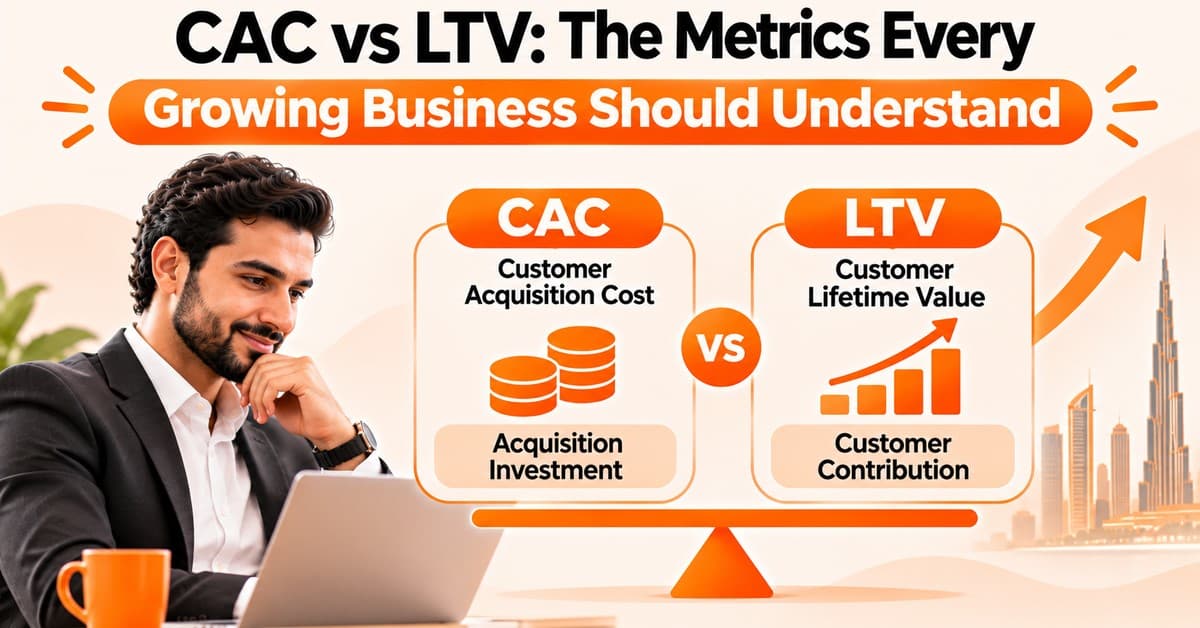
A business can add customers every month and still lose money on growth. It may spend heavily on advertising, sales salaries, discounts, and onboarding while customers leave before they generate enough value to cover those costs. The customer count looks healthy, but the economics underneath may be weak.
That is why CAC vs LTV matters. Customer acquisition cost shows what a business invests to win a customer. Lifetime value estimates the value that customer contributes over the relationship. Together, they help founders understand whether customer acquisition can support sustainable growth, how quickly acquisition costs are recovered, and where the business model needs attention.
Introduction
Customer acquisition cost (CAC) and customer lifetime value (LTV) are two connected measures used to understand unit economics. CAC estimates the cost of acquiring a new paying customer. LTV estimates the economic value generated by that customer over time. Comparing them helps a business assess whether its acquisition model is viable. A clear CAC vs LTV comparison also gives finance and marketing teams a shared way to discuss growth efficiency. This guide uses CAC vs LTV to explain the relationship without treating one ratio as a complete financial diagnosis.
However, the calculation is only useful when the definitions are consistent. A revenue-based LTV compared with a fully loaded CAC can create a misleading picture. A blended average can hide an unprofitable channel. And a commonly quoted ratio should never replace an understanding of cash flow, gross margin, retention, and payback.
This guide explains the calculations, gives practical examples, and shows how to use CAC vs LTV to make better decisions across marketing, sales, finance, and customer success.
1. What CAC and LTV Actually Measure
Customer acquisition cost is the average cost required to acquire one new customer during a defined period. It includes the relevant expenses involved in turning prospects into paying customers. Depending on the business, this can include advertising, sales and marketing salaries, commissions, agency fees, creative production, events, software, and acquisition-related tools.
The key is to decide which costs belong in the calculation and apply the same rule each time. Stripe's guide to calculating CAC explains why businesses should include acquisition-related sales and marketing expenses, match costs to the right period, and count paying customers rather than unconverted leads.
Customer lifetime value estimates the value a customer generates over the relationship with the business. There are several ways to calculate it. A simple revenue-based model estimates the total sales expected from a customer. A more useful model for unit economics estimates gross profit or contribution after direct costs required to serve that customer.
The difference matters. Revenue is not the same as profit. If a customer spends $1,000 but the business spends $600 delivering the product or service, the business has not earned $1,000 in contribution. Comparing gross-profit LTV with CAC gives a more realistic view of acquisition economics.
2. How to Calculate Customer Acquisition Cost
The basic CAC formula is:
CAC = Total acquisition costs ÷ Number of new customers acquired
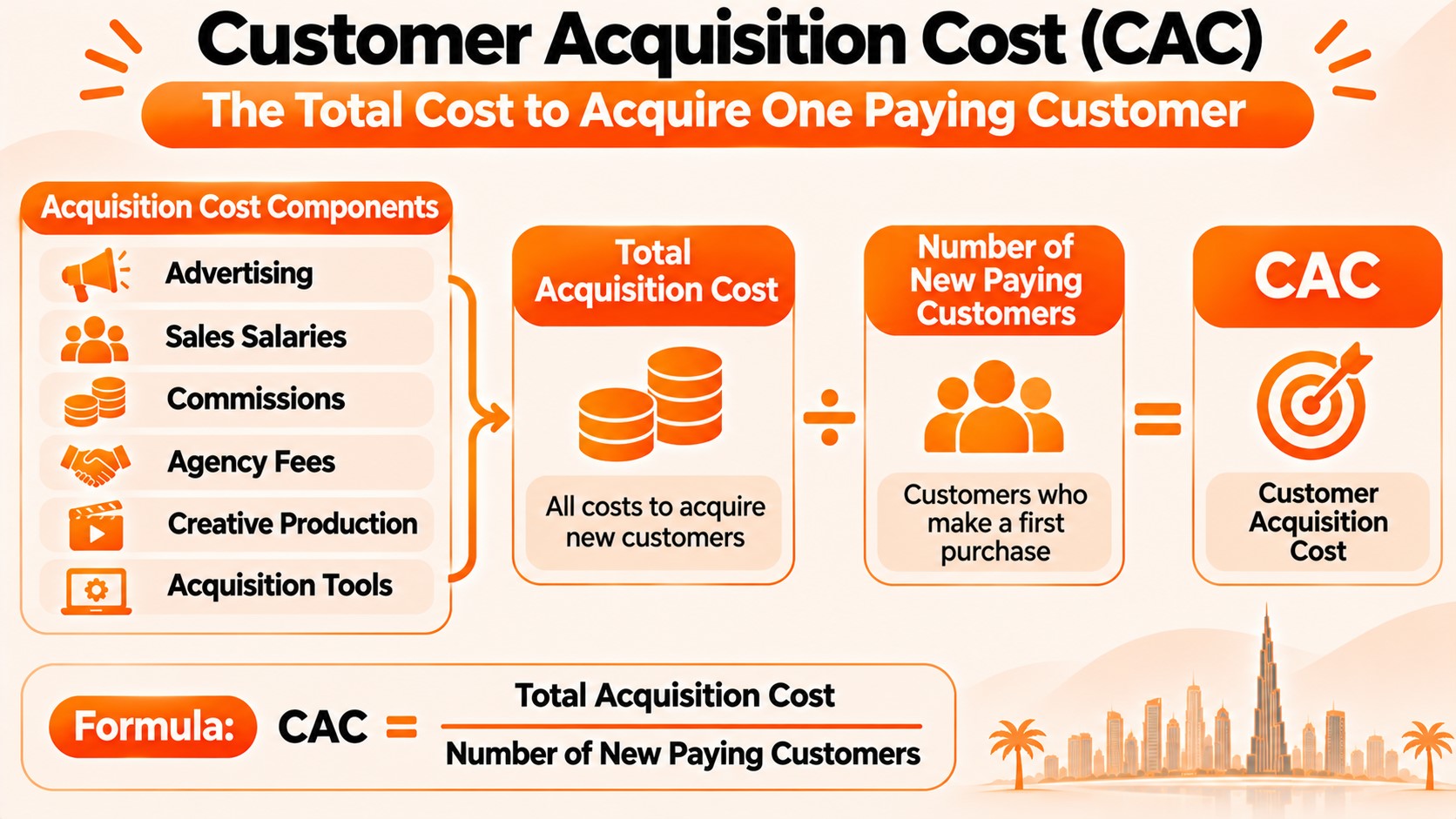
Calculate it consistently:
Add the acquisition-related sales and marketing costs for the chosen period.
Count the new paying customers acquired from the relevant cohort.
Divide the costs by those customers and document any timing adjustments.
For example, assume a company spends $30,000 on acquisition during a quarter and wins 150 new paying customers. Its CAC is $200.
The calculation becomes less useful if the business only includes advertising spend. Suppose the same company spends $20,000 on ads, $5,000 on sales commissions, and $5,000 on acquisition-related staff, agency, and software costs. If all those expenses relate to acquiring the 150 customers, the more complete CAC is still $200. Looking only at ads would produce a lower figure and understate the true cost.
Choose a period that fits the sales cycle. A business with a long B2B buying process may spend in one quarter and close customers in the next. Matching the wrong spending period with the wrong customer group can distort the result. Use cohorts or a consistent lag where possible, and document how costs are allocated.
It can also help to calculate CAC by channel, segment, and acquisition motion. Paid search, referrals, organic search, outbound sales, and partnerships may produce customers with very different costs and retention patterns. A single blended CAC is useful for an overview, but it should not be the only number used to allocate budget. A channel-level CAC vs LTV review can show which sources attract customers who stay and buy again.
3. How to Calculate Customer Lifetime Value
A simple revenue-based LTV formula for a repeat-purchase business is:
Revenue LTV = Average order value × Purchase frequency × Customer lifespan
Suppose a customer spends an average of $100 per order, buys four times per year, and remains active for three years. Estimated revenue LTV is $1,200.
For comparing customer value with acquisition cost, a gross-profit-based estimate is usually more informative:
Gross-profit LTV = Average revenue per period × Gross margin × Expected customer lifespan
For the same example, assume the gross margin is 60%. Estimated gross-profit LTV is $720, before overhead and other costs not included in gross margin.
For subscription businesses with stable recurring revenue and churn, a simplified estimate may be:
LTV = Average monthly revenue per customer × Gross margin ÷ Monthly customer churn rate
This is an estimate, not a guarantee. It assumes the churn rate and margin remain reasonably stable. It can be unreliable for new businesses, seasonal products, changing pricing, or customer groups with very different retention behaviour.
Use actual customer history wherever possible. Segment by product, plan, customer type, or acquisition source. If the business has limited history, label the lifespan assumption and update it as more cohorts mature. This makes CAC vs LTV more useful than relying on optimistic lifetime assumptions.
4. Understand the LTV to CAC Ratio
The LTV to CAC ratio compares the estimated value of a customer with the cost of acquiring that customer.
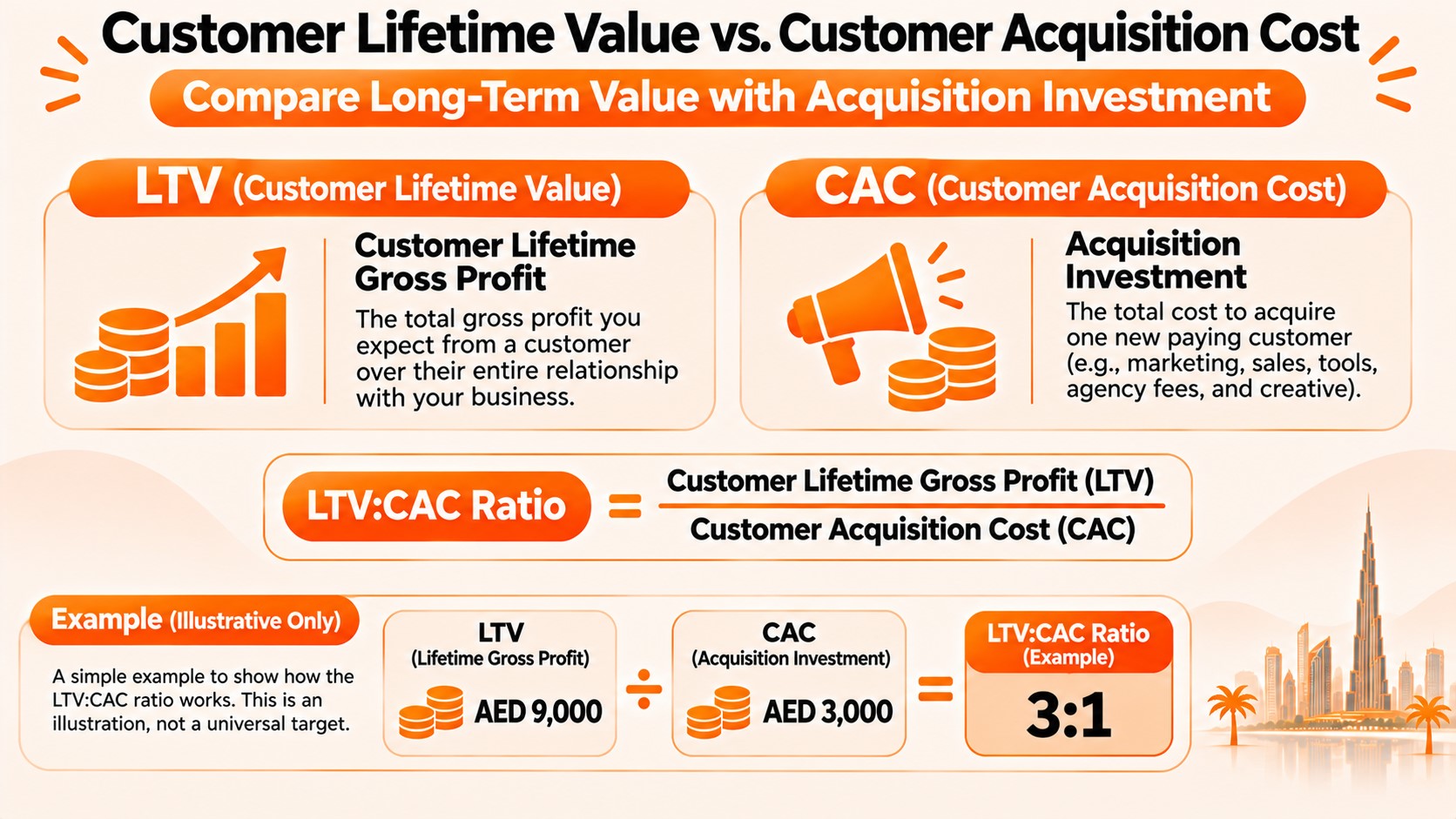
LTV:CAC = Gross-profit LTV ÷ CAC
If gross-profit LTV is $900 and CAC is $300, the ratio is 3:1. In simplified terms, the customer is expected to generate three dollars of gross profit over the relationship for every dollar spent acquiring them.
Shopify's LTV to CAC ratio guide explains the commonly referenced 3:1 target and why business model, margin, retention, and customer segment can change what a healthy ratio looks like.
A ratio below 1:1 means estimated gross-profit value is lower than acquisition cost, before considering overhead. A ratio around 1:1 may leave little room for operating expenses. A ratio above 3:1 can be attractive in some business models, but it does not automatically mean the business is healthy. The company may still face slow payback, high churn, poor cash flow, or expensive service delivery.
The popular 3:1 benchmark is a reference point, not a universal law. Interpreting CAC vs LTV requires context about margin, customer behaviour, and cash requirements. A marketplace, ecommerce shop, professional service firm, and subscription software company have different margins, buying cycles, retention patterns, and cash requirements. Use the ratio as a prompt for deeper analysis, not as a pass-or-fail score.
5. Why CAC Payback Period Matters
The LTV:CAC ratio estimates the total value relative to acquisition cost. CAC payback period asks a different question: how long does it take to recover the cost of acquiring a customer?
For a subscription business, a simplified formula is:
CAC payback period = CAC ÷ Monthly gross profit per customer
If CAC is $600 and a customer generates $100 in monthly gross profit, the payback period is six months, assuming the customer remains active and the margin is stable.
Payback matters because a business must fund acquisition before the expected lifetime value has been received. It adds a cash-flow perspective that CAC vs LTV alone cannot provide. A company may have attractive long-term unit economics but struggle if it takes too long to recover acquisition spending. This is especially important for businesses with limited cash reserves or fast growth plans.
For one-time purchases, payback may happen at the initial transaction if the contribution from the first order exceeds CAC. For repeat-purchase businesses, track the time until cumulative contribution covers the acquisition cost. Do not confuse revenue payback with gross-profit payback.
6. Compare CAC and LTV by Customer Cohort
A cohort is a group of customers who share a starting characteristic, such as acquisition month, channel, product, or customer segment. Cohort analysis helps reveal whether newer customers behave differently from older ones.
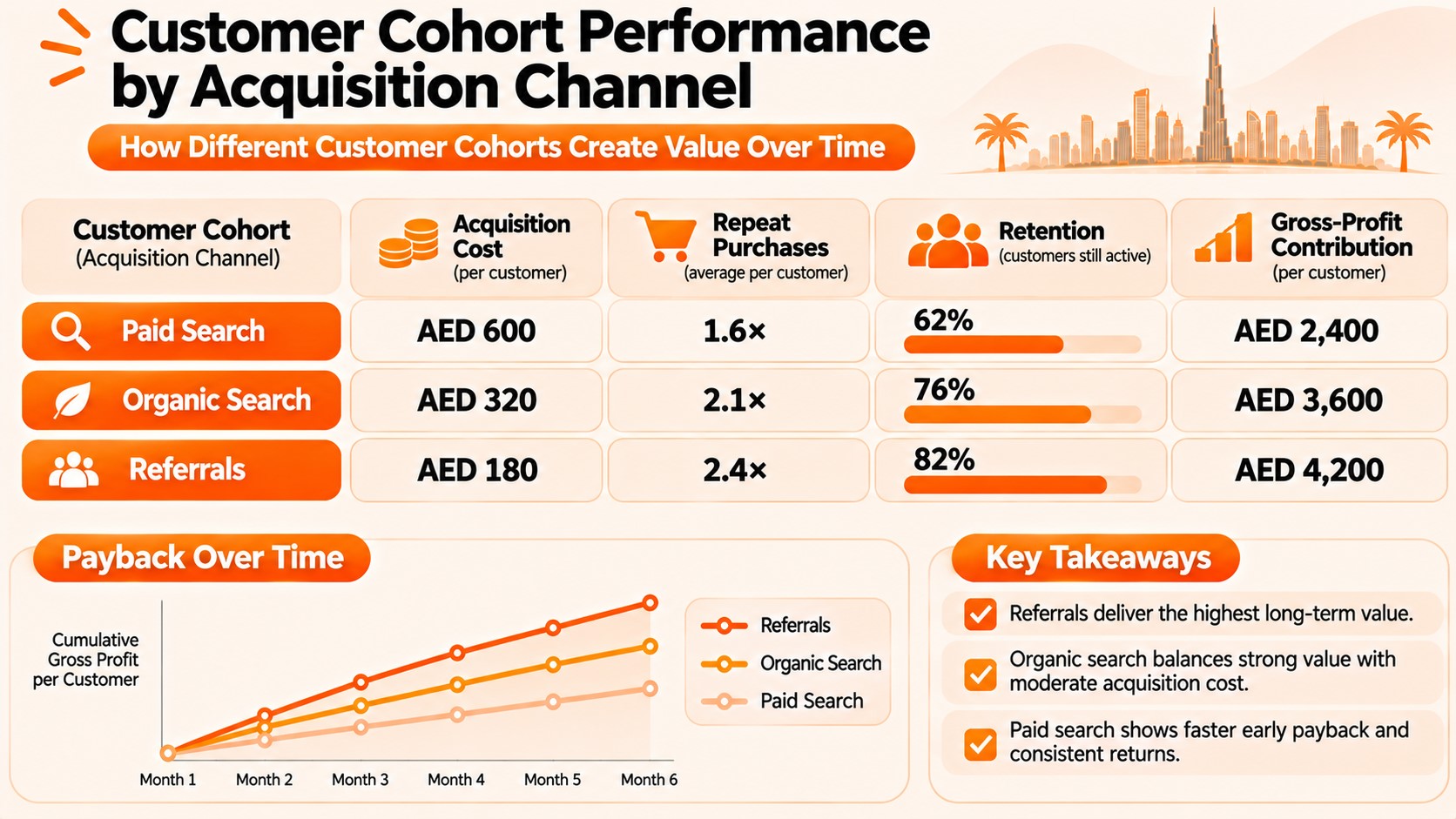
For example, customers acquired through paid social may cost less to acquire than customers from search, but they may also make fewer repeat purchases. Referral customers may have a higher initial acquisition cost if referral rewards are included, yet retain longer or purchase more often. Without cohort analysis, a blended average can hide these differences. Segmenting CAC vs LTV by acquisition source makes the economics easier to act on.
Track the same measures for each useful cohort: acquisition spend, new customers, gross-profit contribution, repeat purchases, churn, and payback. Make sure each group has had enough time to mature before comparing lifetime value. A cohort acquired last month cannot fairly be compared with one that has been buying for three years using observed lifetime revenue.
7. Common Mistakes That Make the Numbers Misleading
Several errors can make CAC look artificially low or LTV look unrealistically high:
Counting only advertising spend: Excluding sales salaries, commissions, agency fees, or acquisition tools can understate CAC.
Using revenue instead of contribution: Revenue-based LTV may overstate the value available to cover acquisition and operating costs.
Mixing time periods: The acquisition spend and customer conversions may not belong to the same cohort or sales cycle.
Ignoring refunds and discounts: Gross sales can overstate what the business actually keeps.
Assuming customers stay forever: A small change in churn or lifespan assumptions can materially change estimated LTV.
Relying only on blended averages: Strong customer segments can hide unprofitable channels, products, or campaigns.
A useful calculation should be explainable to someone in finance and someone in marketing. Keep definitions, assumptions, data sources, and exclusions visible. If the business changes how it counts acquisition costs, note the change so that comparisons remain meaningful.
8. How to Improve the Relationship Between CAC and LTV
There are two broad ways to improve unit economics: acquire customers more efficiently or increase the value and contribution generated by customers. The best option depends on what the data says. Review CAC vs LTV alongside payback and retention before deciding whether to reduce acquisition costs or invest in customer value.
Two areas deserve attention:
Acquisition efficiency: Review channel-level conversion, audience fit, sales qualification, landing-page performance, and follow-up time. Reduce spend on activity that produces low-quality leads, but do not cut a channel solely because its initial CAC is higher. It may attract customers with stronger retention or higher margins.
Customer value: Improve product quality, onboarding, customer support, relevant cross-sells, repeat purchase, renewal, and retention. Raising prices may improve revenue per customer, but only if the value proposition and customer experience support it. Discounts can increase conversion while reducing contribution, so measure profit rather than order volume alone.
BrandVexo's Growth Strategy service can help businesses connect channel performance, conversion tracking, and growth planning. Its article Stop Reporting Clicks. Start Reporting Revenue. also explains why campaign reporting should focus on meaningful business outcomes rather than activity alone. For a broader view of how performance should be measured across the customer journey, read the marketing funnel metrics guide.
9. Build a Practical Review Process
A useful review does not require a complex finance model at the beginning. It requires consistent inputs and a regular conversation between marketing, sales, finance, and customer success.
Define the customer: Decide what counts as a new customer and whether reactivated or expanded accounts are treated separately.
Agree on acquisition costs: Document the included expenses and the period used.
Choose an LTV method: Use a method suited to the business model and prefer gross profit or contribution when comparing with CAC.
Segment the results: Review by channel, product, customer type, and cohort where data allows.
Add payback and cash context: Check how quickly acquisition costs are recovered and whether the business can fund the gap.
Record the decision: State what to change, who owns it, and when the result will be reviewed.
Conclusion
CAC and LTV are most useful when they are calculated consistently and interpreted together with margin, retention, payback, and cash flow. CAC shows the investment required to win a customer, while LTV estimates the contribution that customer may generate over time. Their ratio can help assess acquisition economics, but a benchmark alone cannot prove that growth is profitable. Define the costs carefully, use realistic customer value assumptions, compare cohorts and channels, and review how quickly acquisition spending is recovered. When the numbers are grounded in actual customer behaviour, CAC vs LTV becomes a practical tool for deciding how to grow without losing sight of profitability.
Frequently Asked Questions
1. What is the difference between CAC and LTV?
CAC measures the cost of acquiring a new customer. LTV estimates the value that customer generates over the relationship. CAC is an acquisition cost, while LTV is an estimate of future customer value.
2. What is a good LTV to CAC ratio?
A 3:1 ratio is a commonly used reference, especially in SaaS discussions, but it is not universal. The right target depends on gross margin, retention, business model, payback period, and cash requirements.
3. Should LTV be based on revenue or profit?
For unit economics, gross profit or contribution-based LTV is generally more useful because it accounts for direct costs of serving the customer. Revenue-based LTV can be shown separately, but should not be mistaken for profit.
4. What costs should be included in CAC?
Include the sales and marketing expenses directly involved in acquiring new customers, such as advertising, relevant salaries, commissions, agency fees, creative production, and acquisition tools. Define the scope consistently.
5. How often should a business calculate CAC and LTV?
Review CAC regularly, often monthly or quarterly depending on the sales cycle. Revisit LTV estimates as customer cohorts mature and retention, purchase frequency, and margins change.
6. What is CAC payback period?
It is the time required for the gross profit or contribution generated by a customer to recover the cost of acquiring that customer.
7. Can a business have a high LTV:CAC ratio and still struggle?
Yes. A high ratio can coexist with slow payback, poor cash flow, limited acquisition volume, high overhead, or unreliable LTV assumptions. The ratio should be considered alongside other financial and operating measures.
Free growth plan
Ready to grow your business?
Reading is a start — now let's build it. Tell us where you want to grow and a senior strategist will map the fastest, most profitable way to get there. Free, no obligation.
Discussion
Join the conversation
Be the first to comment. Comments are reviewed before they appear, so yours won't show up instantly — but we read every one.
Leave a comment
Keep reading
All articles
How UAE Businesses Can Reduce Customer Acquisition Costs

AI Search Visibility for Clinics: A Practical Guide
Improve AI Search Visibility for clinics with practical SEO, GEO, AEO, local search, and content strategies to reach more patients online.

IT Services for Small Businesses: A Complete Guide for Medical Clinics
Explore IT services for small businesses and how managed IT support helps medical clinics improve cybersecurity, protect patient data and reduce downtime.