

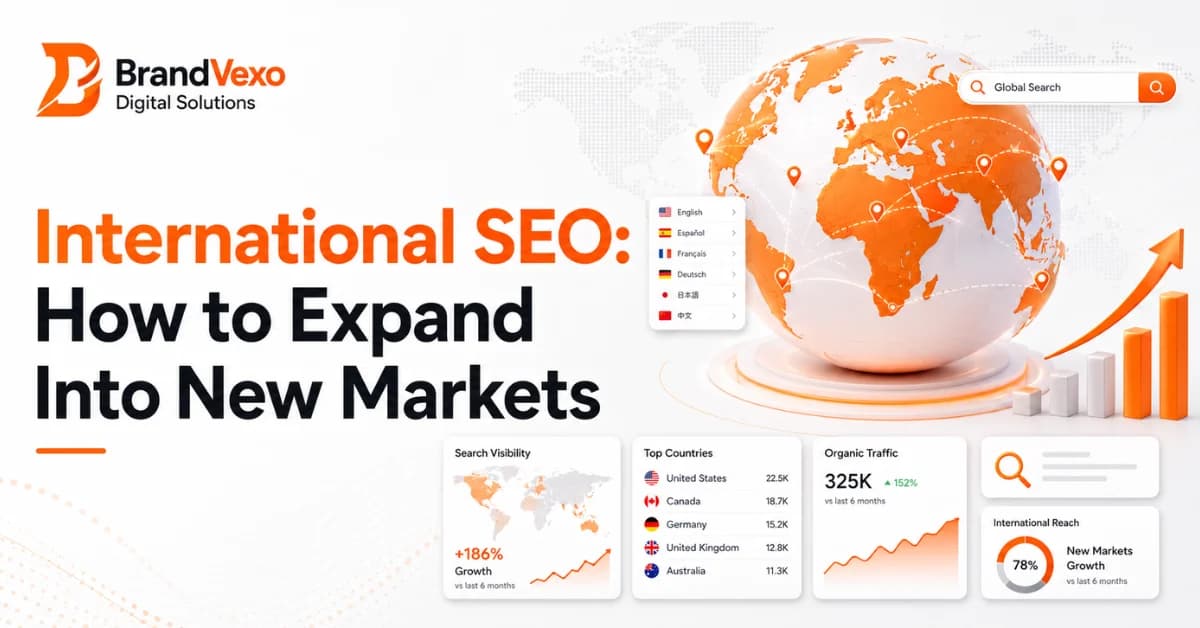
International SEO: How to Expand Into New Markets
Expanding a business into another country can open the door to new customers, revenue streams, and long-term growth. But launching a website in a new market does not automatically make it visible to local searchers. This is where International SEO becomes important.
International SEO helps businesses structure, optimize, and localize their websites for audiences in different countries and languages. It combines technical SEO, international keyword research, content localization, country targeting, and authority building to create a better search experience for users in each market.
For example, a UAE-based company planning to enter Saudi Arabia, the UK, or Singapore should not simply copy its existing website and change a few words. Each market can have different search behavior, terminology, competition, customer expectations, and commercial intent.
Google's current guidance continues to emphasize helpful, reliable, people-first content and a strong overall user experience rather than content created primarily to manipulate rankings.
What Is International SEO and Why Does It Matter for Global Growth?
International SEO is the process of optimizing a website so that search engines can understand which content is relevant to users in different countries and languages.
A successful international search strategy considers more than keywords. It may involve:
Country and language targeting
International keyword research
Website URL structure
Hreflang implementation
Content localization
Technical SEO
Internal linking
Regional authority and backlinks
Conversion tracking by market
The goal is simple: show the right content to the right audience in the right market.
International SEO becomes particularly valuable when a company wants to move beyond its domestic market. Instead of treating international visitors as one large audience, businesses can create experiences that match the needs of individual regions.
International SEO vs Local SEO vs Multilingual SEO
These terms are related, but they are not identical.
International SEO focuses on reaching users across different countries or regions.
Multilingual SEO focuses primarily on optimizing content for different languages.
Local SEO focuses on visibility within a specific geographic area, such as a city or service location.
A company can use all three. For example, an international business may use International SEO to target Saudi Arabia, multilingual SEO for Arabic and English content, and local SEO to improve visibility for customers in Riyadh.
How to Choose the Right International Markets
One of the biggest mistakes businesses make is choosing international markets based only on population size.
A large country does not automatically represent the best SEO opportunity. The market should also have relevant search demand, manageable competition, commercial potential, and a realistic path to serving customers.
Before expanding, evaluate:
Existing organic traffic by country
Search demand for your products or services
Keyword competition
Competitor visibility
Conversion potential
Average customer value
Purchasing behavior
Language requirements
Product or service availability
Operational and regulatory requirements
Use SEO Data to Validate New Markets
Your existing website can provide useful clues about where demand already exists.
For example, if Google Search Console shows that your website receives significant impressions from Saudi Arabia but relatively few clicks, that market may deserve further investigation.
Look at:
Organic impressions by country
Organic clicks
Average search position
Click-through rate
Existing conversions
Revenue by location
Top-performing pages
Search queries generating international visibility
Do not treat traffic alone as proof of market opportunity. A smaller market with strong conversion potential can be more valuable than a large market that generates visitors but few customers.
Create a Market Prioritization Score
A simple framework can help you compare countries:
Market opportunity = search demand + business fit + conversion potential − competition and expansion difficulty
You can score each factor from 1 to 5 and prioritize the countries with the strongest overall opportunity.
This approach creates a more practical global SEO strategy than launching localized pages in every country at once.
How to Build a Global SEO Strategy Before Expanding
International expansion should start with strategy rather than website development.
First decide which markets you want to enter, what you want to sell there, and how customers search for those products or services.
Your global SEO strategy should answer four questions:
Which countries should we target?
Which languages should we support?
What does each audience search for?
What website structure will make those regional pages easy to understand and manage?
Define Your Country and Language Targeting
Country targeting and language targeting are not always the same.
For example, English is used in many countries, but users may use different terminology, spelling, and search phrases.
Likewise, Arabic-speaking audiences across different countries may have different expectations, purchasing behavior, and terminology.
Your strategy should therefore identify whether you need:
One language for several countries
Several languages for one country
Several languages across several countries
This decision affects your content, URLs, hreflang setup, keyword research, and website management.
Build an International Keyword Strategy
Never assume that translating your existing keywords will produce the best results in another country.
International keyword research should examine how people in each market actually search.
Consider:
Local terminology
Search intent
Commercial phrases
Informational queries
Product names
Regional spelling
Industry terminology
Customer questions
Competitor keywords
For example, a keyword that performs well in the UAE may not have the same search demand or wording in the UK. Even English-speaking audiences can use different phrases for the same product or service.
This is why international keyword research should happen before creating large volumes of localized content.
Website Structure for International SEO: Which URL Structure Should You Use?
Your URL structure sends important signals about how your website organizes international content.
Three common approaches are country-code top-level domains, subdirectories, and subdomains.
Country-Code Top-Level Domains
Examples include:
example.aeexample.co.ukexample.fr
A ccTLD provides a clear country association and can work well for businesses with strong local operations.
However, managing several domains can require more resources. You may also need separate SEO strategies, technical management, and authority-building efforts for each domain.
Subdirectories
Examples include:
example.com/ae/example.com/uk/example.com/fr/
Subdirectories allow businesses to keep international content within one primary domain.
They can be practical for companies that want centralized website management while maintaining clear country or language sections.
Subdomains
Examples include:
ae.example.comuk.example.comfr.example.com
Subdomains can make sense when regional operations require greater separation.
However, they can also introduce additional management complexity. The right choice depends on your business model, technical resources, brand structure, and international expansion plans.
Which International URL Structure Is Best?
There is no single URL structure that works for every business.
StructureSuitable ForMain ConsiderationccTLDStrong country-specific operationsMore domains to manageSubdirectoryCentralized international websitesRequires clear organizationSubdomainMore separated regional operationsAdditional management complexity
Choose the structure you can maintain consistently rather than selecting one simply because another company uses it.
Hreflang: How to Tell Google Which Country and Language Page to Show
Hreflang is an important technical element for websites with multiple language or regional versions.
It helps search engines understand the relationship between alternate versions of a page.
For example, a business could have:
An English global page
An English UK page
A French page
A German page
Hreflang annotations can help communicate which versions are intended for particular language and regional audiences.
However, hreflang is not a translation system. It does not create localized content, guarantee rankings, or replace good technical SEO.
Common Hreflang Implementation Methods
Hreflang can be implemented through:
HTML link annotations
HTTP headers
XML sitemaps
The method should fit your website's technical architecture and maintenance process.
A Simple Hreflang Example
Conceptually, a page might identify alternate versions for English UK and French users.
<link rel="alternate" hreflang="en-gb"
      href="https://example.com/uk/page/" />

<link rel="alternate" hreflang="fr"
      href="https://example.com/fr/page/" />
The exact implementation should be validated carefully across all corresponding regional pages.
Common Hreflang Mistakes
Watch for:
Incorrect language or regional codes
Broken alternate URLs
Missing return references
Incorrect page relationships
Conflicting canonical signals
Regional pages that cannot be crawled
Incomplete implementation across page variants
A technical audit should verify the complete hreflang relationship rather than checking only whether a tag exists.
Multilingual SEO: Translating Content Is Not Enough
One of the biggest differences between basic website translation and effective multilingual SEO is localization.
A translated page may be grammatically correct but still fail to match how people search, compare products, or make purchasing decisions in that market.
Translation vs Localization
Translation changes language.
Localization adapts the experience to the audience.
Localization may involve:
Local terminology
Currency
Date and measurement formats
Cultural references
Examples
Offers
Calls to action
Product information
Customer expectations
Search intent
For example, an English page written for a UAE audience may need more than direct translation when adapted for another country.
How to Create SEO-Friendly Multilingual Content
A practical workflow is:
Research keywords in the target language.
Identify the local search intent.
Create or professionally localize the content.
Optimize title tags and headings.
Adapt internal links.
Review terminology with native-language expertise.
Check the content for cultural relevance.
Verify the final page technically.
AI tools can support research and drafting workflows, but businesses should still review important localized content for accuracy, usefulness, and natural language. Google's guidance focuses on quality, accuracy, relevance, and added value rather than simply how content was produced.
Country Targeting: How Google Understands Your International Pages
Search engines can use multiple signals to understand geographic and language relevance.
These can include:
Country-specific domains
URL structure
Hreflang
Page language
Localized content
Regional business information
Internal linking
Relevant local signals
Regional authority
Do not rely on a single signal.
A strong international website creates a consistent relationship between its content, URL structure, language, regional targeting, and user experience.
Should You Create a Separate Page for Every Country?
Not necessarily.
Creating dozens of pages with almost identical content can create unnecessary maintenance and poor user experiences.
Instead, create country-specific pages when users in that country genuinely need different information.
A regional page makes more sense when there are differences in:
Products
Services
Pricing
Availability
Regulations
Delivery
Currency
Customer expectations
Local search intent
The objective should be useful regional content, not simply more indexed URLs.
International Technical SEO Checklist
Before launching a new market, review the technical foundation.
Technical SEO Elements to Check
Crawlability
Indexability
XML sitemaps
Canonical tags
Hreflang
Robots.txt
Internal links
Mobile usability
Page performance
HTTPS
Redirects
Broken links
Duplicate content
URL consistency
Structured data
Search Console configuration
Google recommends making content accessible to its systems so pages can be discovered, crawled, indexed, and considered for Search.
International SEO Launch Checklist
Before publishing a new regional section, confirm that you have:
Selected a priority market
Completed local keyword research
Chosen the URL structure
Localized important content
Implemented hreflang where appropriate
Reviewed canonical tags
Built relevant internal links
Updated XML sitemaps
Checked indexability
Verified regional pages
Set up performance tracking
Defined conversion goals
How to Build Authority in a New Country
A localized website still needs authority to compete.
If you enter a market where established local competitors already have strong visibility, publishing translated content alone may not be enough.
Focus on earning relevant mentions and links from credible sources.
International Link-Building Opportunities
Potential opportunities include:
Local industry publications
Relevant business directories
Industry associations
Regional partnerships
Digital PR
Expert contributions
Local media
Original research
Useful market-specific resources
The goal should be relevance and credibility, not simply increasing the number of backlinks.
A smaller number of genuinely relevant references can be more useful than a large collection of unrelated links.
How to Measure International SEO Performance
International SEO should ultimately support business growth, so rankings should not be your only KPI.
Key International SEO KPIs
Track:
Organic traffic by country
Organic impressions
Organic clicks
Keyword rankings
Click-through rate
Indexed pages
Organic leads
Conversion rate
Revenue
Customer acquisition performance
Engagement by market
A market that produces fewer visitors but significantly more qualified leads may deserve greater investment than a market generating large volumes of low-value traffic.
Use Search Console and Analytics to Compare Markets
Review performance by country and look for patterns.
For example:
High impressions + low clicks:
Your content may have visibility but weak relevance, titles, snippets, or positioning.
High traffic + low conversions:
The market may generate interest but lack strong commercial alignment.
Low impressions + strong conversion potential:
You may have an opportunity to expand keyword coverage and content authority.
This turns International SEO from a traffic project into a measurable growth strategy.
Common International SEO Mistakes to Avoid
International expansion becomes harder when businesses scale before establishing a reliable foundation.
Avoid these common mistakes:
Translating content word-for-word
Using identical keywords in every country
Ignoring local search intent
Implementing hreflang incorrectly
Creating thin country pages
Producing duplicate regional content
Blocking important pages from crawling
Using inconsistent URL structures
Ignoring canonical tags
Expanding into too many countries simultaneously
Building irrelevant international backlinks
Measuring only traffic
Making unsupported ranking promises
A useful rule is simple: every international page should have a clear audience, purpose, and reason to exist.
International SEO Example: Expanding a UAE Business Into New Markets
Imagine a UAE-based digital services company wants to expand into Saudi Arabia, the UK, and Singapore.
Instead of immediately creating three translated versions of every page, it could take a phased approach.
Step 1 — Identify Market Opportunity
The business reviews organic data, customer inquiries, search demand, competition, and commercial potential.
Suppose Saudi Arabia shows strong existing interest and a clear service fit. The company could prioritize Saudi Arabia first.
Step 2 — Research Local Search Terms
The SEO team researches how potential customers search for the company's services in Saudi Arabia.
It compares:
Commercial keywords
Informational queries
Local terminology
Competitor pages
Search intent
Step 3 — Build Regional Pages
The company creates genuinely useful regional pages rather than copying its UAE pages.
The new content could address relevant market differences, customer expectations, service availability, and local terminology.
Step 4 — Implement Hreflang
Where multiple language or regional alternatives exist, the technical team connects the relevant pages using appropriate hreflang signals.
Step 5 — Measure Results
The business monitors:
Saudi organic impressions
Clicks
Rankings
Leads
Conversion rate
Revenue
If the market performs well, the company can then evaluate its next expansion opportunity.
This phased model reduces unnecessary investment and allows the business to learn from real search and customer data.
How Long Does International SEO Take to Show Results?
There is no universal timeline for International SEO.
Results can depend on:
Domain strength
Existing organic visibility
Market competition
Content quality
Technical implementation
Local authority
Search demand
Website history
Industry competitiveness
Some technical changes may become visible relatively quickly, while building sustainable organic visibility can take considerably longer.
Google also notes that Search results are dynamic and that improvements do not guarantee a particular ranking outcome or timeline.
For this reason, businesses should measure progress through multiple indicators instead of expecting a specific ranking within a fixed number of weeks.
International SEO Best Practices for 2026
The most sustainable approach is to expand carefully rather than create large numbers of low-value regional pages.
Prioritize Quality Over Mass Expansion
Start with markets where you have a strong business case.
A well-researched presence in one or two countries can be more valuable than dozens of poorly localized pages.
Google's current people-first guidance emphasizes original, useful, reliable content that genuinely satisfies visitors rather than content produced primarily to attract search traffic.
Combine Technical SEO With Local Relevance
Successful International SEO brings together:
Technical infrastructure + localized content + search intent + authority + measurement
Technical implementation helps search engines understand your website, while localized content helps users understand why your business is relevant to them.
You need both.
Optimize for People First
Do not build international pages simply because a keyword tool suggests a country has search volume.
Ask:
Will this page help someone in this market?
Does the content answer their actual question?
Is the terminology natural?
Is the offer relevant?
Can the visitor easily take the next step?
Google's guidance also encourages creators to consider the Who, How, and Why behind content, with the central purpose being to help people rather than manipulate search rankings.
How BrandVexo Can Help With International SEO
BrandVexo helps businesses strengthen their online presence through SEO, digital marketing, web development, AI automation, and business solutions. Our team can help you build a practical SEO strategy, improve search visibility, and prepare your website for growth in new markets.
Contact BrandVexo:
Phone: +971 52 356 5409
Email: info@brandvexo.com
Website: www.brandvexo.com
Frequently Asked Questions
What is International SEO?
International SEO is the process of optimizing a website to reach audiences across different countries and languages. It includes country targeting, international keyword research, technical SEO, localization, URL structures, and relevant regional signals.
What is the difference between International SEO and multilingual SEO?
International SEO focuses on international markets and geographic targeting, while multilingual SEO focuses primarily on optimizing content for different languages. A business can use both as part of one global SEO strategy.
Why is hreflang important for International SEO?
Hreflang helps search engines understand relationships between alternate language and regional versions of pages. It can be particularly useful when similar content exists for different languages or regions.
Which URL structure is best for International SEO?
There is no universal answer. ccTLDs, subdirectories, and subdomains can all work depending on your business structure, technical resources, branding, and country-targeting requirements.
Is translating a website enough for International SEO?
No. Effective international expansion usually requires local keyword research, search-intent analysis, content localization, technical optimization, and regional relevance.
How do I choose which countries to target first?
Compare search demand, competition, business fit, conversion potential, customer value, operational feasibility, and existing international visibility. Start with markets where the overall opportunity is strongest.
Can a small business use International SEO?
Yes. Small businesses do not need to target every country. Starting with one high-potential market can make international SEO more manageable and allow the business to learn before expanding further.
Final Takeaway
International SEO is not simply about translating a website or adding country names to existing pages. It requires a thoughtful combination of country targeting, multilingual SEO, international keyword research, technical optimization, hreflang, localization, and authority building. The strongest approach is to start with markets that have genuine business potential, create content that serves local search intent, and measure results through both organic visibility and conversions.
For brands planning international growth, the best next step is to audit existing international demand and identify the market where SEO can create the clearest business opportunity. From there, build one strong regional experience, measure its performance, and expand based on evidence.
Disclaimer
This article is for general informational and educational purposes only. SEO results may vary based on industry, competition, market, and search engine updates. For specific SEO advice, consult a qualified professional.
Free growth plan
Ready to grow your business?
Reading is a start — now let's build it. Tell us where you want to grow and a senior strategist will map the fastest, most profitable way to get there. Free, no obligation.
Discussion
Join the conversation
Be the first to comment. Comments are reviewed before they appear, so yours won't show up instantly — but we read every one.
Leave a comment
Keep reading
All articles SEO
SEOSEO Audit Scope: A Practical Guide for Startups
Define your SEO Audit Scope with this practical startup guide covering technical SEO, content, keywords, competitors, performance, backlinks, and ROI.
 SEO
SEOSEO Agency Selection: A Practical Checklist for B2B Teams
Use this practical SEO agency selection checklist to compare B2B SEO partners, evaluate expertise, ask the right questions, and avoid costly red flags.
 SEO
SEOLocal SEO Dubai: How Service Businesses Win Google Maps
Learn how Local SEO Dubai helps service businesses improve Google Maps visibility, attract local customers, generate leads, and grow in Dubai.