

Marketing Attribution for Small Businesses: How to Know What Generates Revenue

You are paying for Google Ads, publishing social content, sending emails, and generating enquiries. Some leads become customers, but can you explain which activity brought them in? If the answer is a guess, you may be spending money on channels that look busy rather than channels that produce profitable sales.
Marketing attribution helps small businesses connect marketing activity with enquiries, customers, and revenue. You do not need enterprise software to begin. You need consistent tracking, accurate lead records, and a simple process for reviewing what happens after someone responds.
Introduction
Marketing attribution is the process of identifying and evaluating the marketing touchpoints that contribute to a conversion, such as a qualified enquiry, booked appointment, purchase, or signed contract. It answers a practical question: where did this customer come from, and what influenced the decision to buy?
A customer might see an Instagram post, search for your service later, read a review, ask a friend, and then call. Some of these interactions will not appear in analytics. A useful system accepts that limitation and combines website data with CRM records, call enquiries, and customer feedback. The aim is not perfect tracking. It is a more reliable basis for business decisions.
1. Why Marketing Attribution Matters to Small Businesses
Small businesses usually have limited budgets, fewer staff, and less time to interpret dashboards. That makes clear measurement important. Social platforms report reach and engagement, ad platforms report clicks, and analytics tools report visits. None of these figures alone confirms how much profitable business came through the door.
Marketing attribution connects those signals to commercial outcomes. A simple marketing attribution report should connect channel activity with sales records. It helps identify channels that introduce prospects, channels that support consideration, and activities that appear near the final purchase. It can help you:
Allocate budget: Compare channels using qualified leads, customers, revenue, and cost rather than clicks alone.
Improve campaigns: Find where prospects drop out, then improve the offer, landing page, follow-up, or sales process.
Align teams: Give marketing and sales a shared view of lead sources and customer outcomes.
Set realistic expectations: Recognise that content, referrals, and brand activity may support demand over time rather than create instant sales.
Attribution is a decision-making aid, not proof that one channel caused a sale. Treat the results as evidence with limitations.
2. Understand the Main Attribution Models
An attribution model is a rule for assigning credit to marketing interactions. Marketing attribution models answer different questions, so choose based on the decision you need to make, your sales cycle, and the quality of your data.
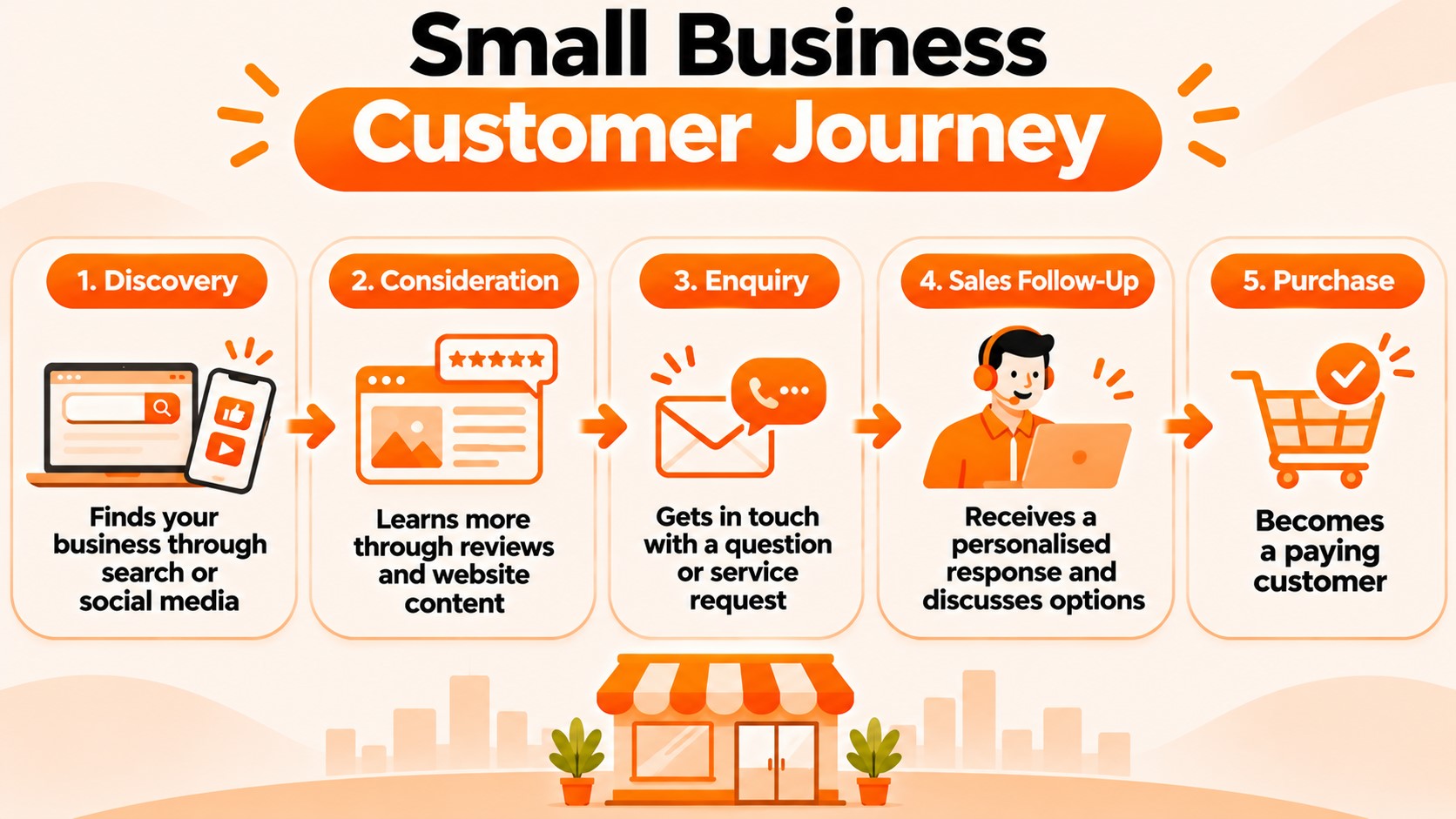
First-touch attribution
First-touch gives credit to the first recorded interaction. If a customer discovers your business through organic search and later buys after several other interactions, organic search receives the credit. This helps identify channels that introduce new prospects, but ignores later activity that may help close the sale.
Last-touch attribution
Last-touch gives credit to the final recorded interaction before conversion. It is easy to understand and can help assess direct-response campaigns. However, it may overvalue the final click and overlook the content, referral, or earlier advertising that created interest.
Multi-touch attribution
Multi-touch models distribute credit across several recorded interactions. Some split credit evenly; others give different weights to different stages. Shopify's guide to multi-touch attribution models explains common approaches and their trade-offs.
Multi-touch can provide a broader view, but it requires reliable tracking and enough conversion data. A business with only a few monthly sales may gain little from a complex model with arbitrary weights.
Self-reported attribution
Self-reported attribution asks customers how they heard about the business. A form or team member might ask, “How did you first hear about us?” This can capture word of mouth, local events, offline conversations, and social recommendations that digital tracking misses. Customer memory is imperfect, so compare the answer with tracked data.
For many small businesses, comparing first recorded source, latest recorded source, and the customer's own answer is a practical starting point. More advanced marketing attribution can come later if data volume justifies it.
3. Decide What You Need to Measure
Define what counts as a meaningful result before installing tools. A website visit is not a lead, and a lead is not a paying customer. An online shop may track completed purchases. A home services company may track qualified quote requests and booked jobs. A consultant may track qualified enquiries, proposals, and signed contracts.
Choose a small set of measures and define each consistently:
Measure | What it tells you |
|---|---|
Leads by source | Which channels generate enquiries |
Qualified leads by source | Which channels attract suitable prospects |
Customers by source | Which sources produce paying customers |
Revenue by source | Recorded sales value associated with each source |
Cost per lead | Cost to generate an enquiry |
Customer acquisition cost | Cost to acquire a customer |
Conversion rate | How often someone takes the next step |
If one employee calls every enquiry a lead while another only counts qualified prospects, comparisons will be misleading. Define revenue too. Use invoiced or recorded sales consistently, and do not compare ad spend with revenue in one channel and profit in another.
4. Build a Simple Tracking Foundation
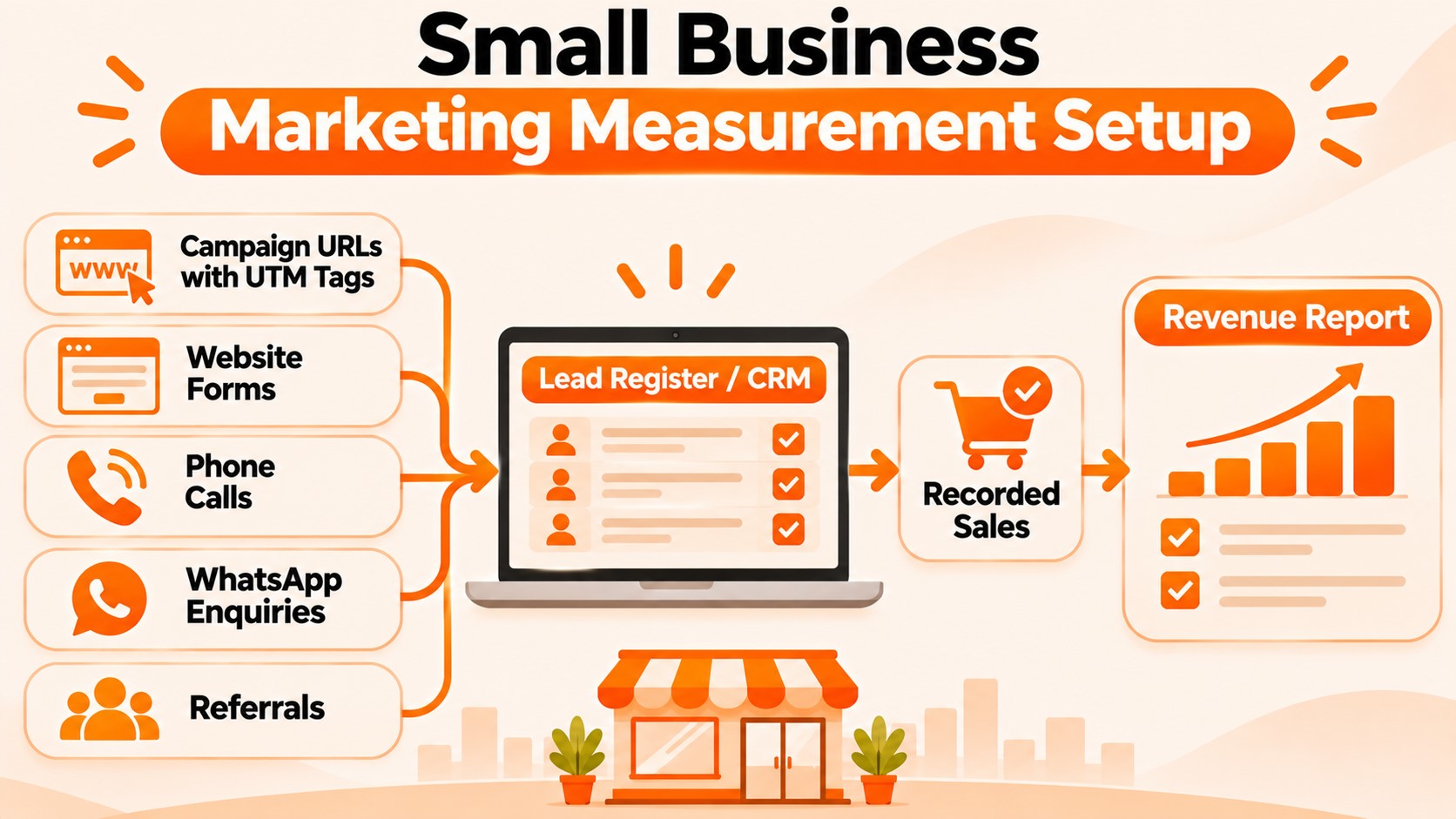
You can start with website analytics, campaign links, a spreadsheet, and a CRM or lead register. Each enquiry should be connected to a source and followed through to an outcome.
Use consistent UTM parameters
UTM parameters are tags added to campaign URLs. They help analytics tools identify the source, medium, and campaign associated with a visit. Google explains how to use its campaign URL builder and UTM parameters. Use a shared naming convention. Do not alternate between “facebook”, “Facebook”, and “fb-paid” when they describe the same source.
Track meaningful actions
Set up analytics events for actions that indicate genuine interest or business value, such as a submitted form, click-to-call action, appointment booking, checkout, or completed purchase. Do not count every button click as a conversion. Test events to confirm they fire once and at the correct point. For ecommerce, check that purchase value and currency are passed correctly.
Capture source information
When a form is submitted, save the first known source, latest source, campaign, date, and landing page with the lead. For phone enquiries, ask callers how they found you. For walk-ins, referrals, and WhatsApp enquiries, give staff a short source list. Keep an “Other” option and review those answers regularly.
A spreadsheet can work at the beginning if it is maintained. BrandVexo's B2B digital marketing strategy guide explains why source data, lead qualification, and pipeline outcomes need to connect.
Use this simple implementation sequence:
Create a standard list of sources and campaign names.
Add source fields to enquiry forms and lead records.
Test UTM links, forms, calls, and conversion events.
Assign someone to update lead status and sale value when an enquiry progresses or closes.
5. Connect Marketing Sources to Actual Revenue
Many tracking setups stop at the form submission. They count an enquiry as a success but never check whether it became a customer. This is where marketing attribution loses much of its business value. Reliable marketing attribution follows the lead beyond the first conversion event.
Create a lead record with a unique ID or clear contact reference. Include enquiry date, source, campaign if known, product or service requested, lead status, close date, sale value, and reason lost where practical. Limit access to personal information and collect only what the business needs.
Use consistent statuses such as new, contacted, qualified, proposal sent, won, and lost. When a deal closes, update the original record instead of creating a separate, unconnected sales entry.
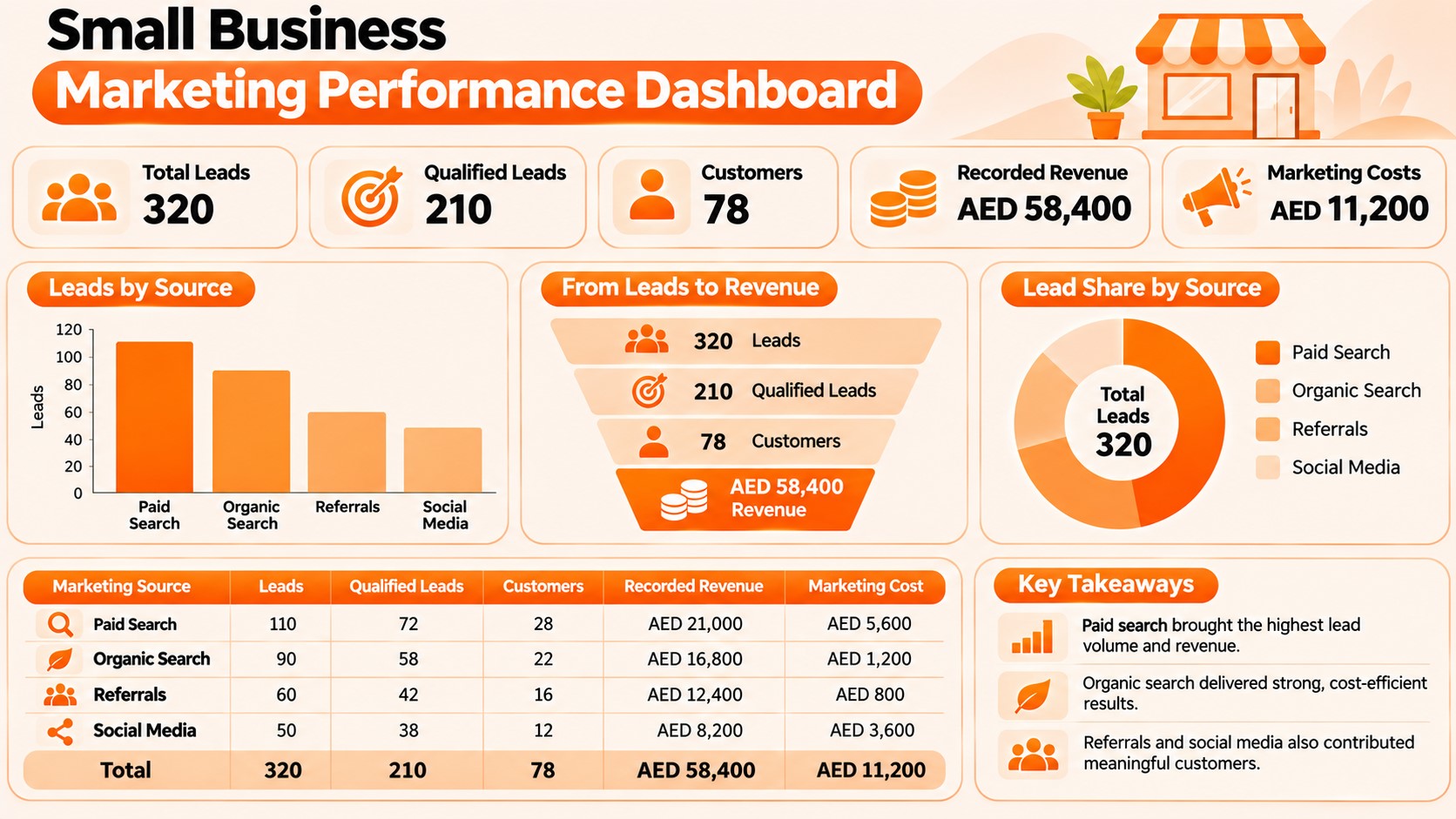
Imagine a local renovation company receives 30 enquiries in a month: 12 from paid search, 8 from organic search, 6 from referrals, and 4 from social media. If these become 3, 4, 5, and 1 customers respectively, referrals generated fewer enquiries than paid search but more customers.
Now compare sales value and cost. If referral customers generate $18,000 in recorded sales while paid search customers generate $9,000, the company has a reason to investigate its referral process. It should not automatically stop paid search because those ads may introduce customers who return through another channel. These figures guide investigation; they do not prove what caused each sale.
6. Choose Tools That Match Your Size
Do not buy software before deciding which question it needs to answer. A small service business may need analytics, call or form tracking, and a shared lead register. An online store may need ecommerce events connected to order data. A business with a longer sales cycle may benefit from a CRM that records multiple interactions and opportunity stages.
A practical marketing attribution setup can begin with a few connected tools. A practical starter setup includes:
Website analytics: Measure traffic sources and important website actions.
Campaign tagging: Use consistent UTM values for email, paid campaigns, and partner links.
Lead management: Record source, status, outcome, and sale value in one place.
Offline tracking: Record phone enquiries, walk-ins, referrals, and in-person conversions.
Monthly scorecard: Bring the most useful measures together in a report the team can understand.
Google Analytics' key event attribution paths report shows recorded paths before important actions, with metrics such as revenue and touchpoints. Its usefulness depends on correct setup and observable data. It will not automatically capture every offline conversation or identify every person across devices.
If you need a connected approach, BrandVexo's Growth Strategy service includes analytics and tracking setup, channel planning, and KPI reporting.
7. Review the Numbers Without Drawing the Wrong Conclusions
Review results at a frequency that matches your sales cycle. An online shop with daily orders may review weekly. A consultant whose clients take two months to decide may need monthly or quarterly analysis.
Use a repeatable review:
Check tracking for missing sources, duplicate events, unassigned leads, and unusual changes.
Compare leads, qualified leads, customers, revenue, and costs by source. Do not judge a channel using one metric alone.
Separate open opportunities from closed outcomes. Recent leads may need more time to convert.
Compare reports with invoices, payment records, or ecommerce orders. Investigate gaps instead of forcing totals to match.
Decide what to increase, reduce, pause, or test only when the evidence is strong enough for the decision.
Do not overreact to a small sample. One unusually large sale can make a channel look exceptional. Review several months where possible and consider customer value, gross margin, repeat purchases, and your capacity to serve new demand.
Attribution is also different from incrementality. Attribution assigns credit to observed interactions. Incrementality asks whether marketing generated additional results that would not otherwise have happened. Experiments or geographic comparisons can help investigate that question, but a basic channel report cannot prove causation.
8. Common Attribution Mistakes to Avoid
Small businesses rarely need a sophisticated model before they need consistent data. Common mistakes include counting clicks as revenue, ignoring calls and referrals, using inconsistent campaign names, failing to update lead outcomes, and giving one channel all the credit.
Another problem is changing tracking halfway through a comparison without documenting it. A new form, CRM field, or event definition can make this month's numbers different for reasons unrelated to campaign performance. Keep a short record of changes to campaigns, tracking, pricing, and sales processes. This context makes the report more useful.
9. Turn Attribution Insights Into Better Marketing Decisions
The purpose of measurement is to improve decisions, not create more dashboards. Strong marketing attribution turns those findings into better budget choices. If organic search generates qualified prospects who become profitable customers, examine which pages and search topics attract them. If paid campaigns bring many enquiries but few qualified leads, review targeting, landing page promises, and qualification. If referrals close at a high rate, make referrals easier without assuming the channel can scale indefinitely.
Use the findings to run focused tests. Change one meaningful part of a campaign or customer journey, define the expected outcome, and allow enough time to gather a useful sample. Keep notes on what changed and what happened afterward.
A clear monthly summary is often more useful than a complex dashboard. State what happened, what you think it means, how confident you are, and what action you recommend. This makes marketing attribution a practical management tool.
Conclusion
Small businesses do not need perfect tracking to make better marketing decisions, but they do need consistent records that connect campaigns, enquiries, customers, and revenue. Start with clear conversion definitions, standardised campaign tags, source fields in lead records, and a review that includes offline enquiries and closed sales. Compare more than one view of the customer journey, acknowledge missing data, and do not treat attributed credit as proof of causation. When the system is simple enough to maintain, marketing attribution can help you understand what is working, identify wasted effort, and make more confident decisions about your next investment.
Want to know which channels are contributing to your growth? Request a BrandVexo marketing attribution audit or consultation. We can review your tracking, lead sources, conversion journey, and reporting gaps, then help you build a practical measurement plan. You can also review BrandVexo's growth options before booking a conversation.
Frequently Asked Questions
1. What is marketing attribution in simple terms?
Marketing attribution connects sales to the marketing interactions that may have influenced a customer's decision.
2. Which attribution model is best for a small business?
There is no single best model. Compare first-touch, last-touch, and self-reported sources before changing budgets.
3. Can I track marketing attribution without a CRM?
Yes. A spreadsheet can record source, date, lead status, customer outcome, and sale value.
4. How do I track customers who call my business?
Ask callers how they heard about you and record the answer. Use consistent categories and follow applicable privacy rules.
5. How often should I review attribution reports?
Review monthly in most cases, or more often for frequent online orders. Match the review period to your sales cycle.
6. Is marketing attribution always accurate?
No. Some interactions are missed and customer memory is imperfect. Compare estimates with sales records and customer feedback.
7. What is the difference between marketing attribution and marketing ROI?
Attribution assigns credit to touchpoints. Marketing ROI compares financial return with marketing cost.
Free growth plan
Ready to grow your business?
Reading is a start — now let's build it. Tell us where you want to grow and a senior strategist will map the fastest, most profitable way to get there. Free, no obligation.
Discussion
Join the conversation
Be the first to comment. Comments are reviewed before they appear, so yours won't show up instantly — but we read every one.
Leave a comment
Keep reading
All articles
Social Media Reporting: 10 Metrics That Matter to Business Owners
Understand social media reporting metrics that matter to business owners. Track engagement, reach, leads, conversions and ROI to improve results.
CAC vs LTV: The Metrics Every Growing Business Should Understand