

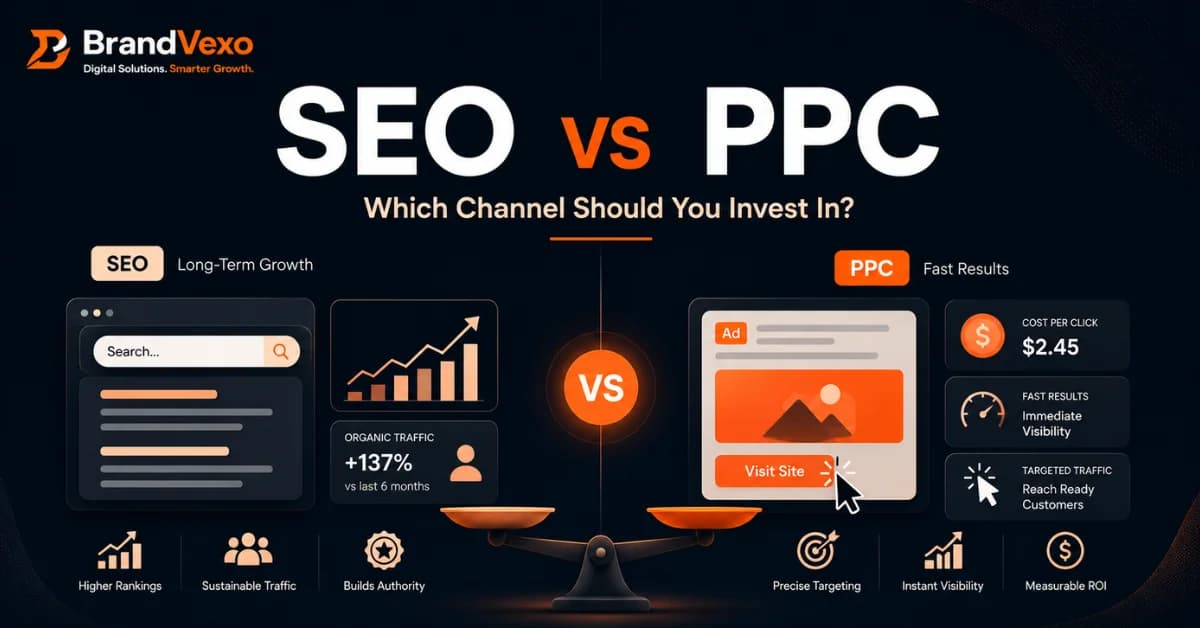
SEO vs PPC: Which Channel Should You Invest In?
Choosing between SEO and PPC is not simply a question of which marketing channel is better. The right choice depends on how quickly you need results, how much you can invest, your competition, your customer journey, and the value of each conversion. SEO vs PPC is a common decision for businesses that want more visibility on Google. SEO focuses on earning organic search visibility over time, while PPC, such as Google Ads Search campaigns, allows businesses to pay for placements when people search for relevant products or services. Google describes Search campaigns as a way to reach people actively searching for what a business offers.
For many businesses, the smartest approach is not choosing one forever. A well-planned combination can use PPC for immediate demand while SEO builds sustainable organic visibility.
SEO vs PPC: What Is the Difference?
SEO, or search engine optimization, is the process of improving a website so search engines can crawl, understand, and potentially rank its content for relevant searches. It can involve technical SEO, content, keyword targeting, internal linking, website experience, and authority-building activities. Google’s SEO guidance emphasizes making content accessible and understandable to both search engines and users.
PPC, or pay-per-click advertising, allows businesses to pay for advertising placements. With Google Search campaigns, advertisers select targeting, create ads, set budgets, and direct users to relevant landing pages.
The fundamental difference is simple:
SEO earns visibility through organic search results.
PPC buys visibility through advertising.
SEO generally requires patience and continuous optimization.
PPC can provide visibility much faster when campaigns are properly configured.
SEO can continue generating organic traffic after individual content pieces are published.
PPC traffic depends on continued advertising activity and budget.
Neither channel automatically produces better business results. The better investment is the one that matches your objectives and economics.
Organic Search vs Paid Search: How Do They Work?
Understanding organic search vs paid search makes the investment decision much easier.
How Organic Search Works
When someone searches Google, search systems determine which results are relevant and useful for that query. SEO helps a website make its content easier to discover, understand, and evaluate.
A strong organic search strategy can include:
Keyword and search-intent research
Helpful website content
On-page SEO
Technical SEO
Internal linking
Content optimization
Structured data where appropriate
Website performance and usability
Authority and reputation development
The goal is not simply to publish as many pages as possible. Google specifically recommends creating helpful, reliable, people-first content that provides substantial value rather than content created primarily to manipulate rankings.
How Paid Search Works
Paid search places advertisements in relevant search environments. Google Ads allows businesses to target relevant searches and optimize campaigns around goals such as sales, leads, or website traffic.
A PPC campaign typically involves:
Keyword or audience targeting
Campaign structure
Ad copy
Budget allocation
Bidding
Landing pages
Conversion tracking
Performance analysis
For example, a business selling web development services might target searches related to "web development agency" through Google Ads while simultaneously building SEO content around web development costs, website strategy, and related informational searches.
SEO vs PPC: Which Gives Faster Results?
If speed is the priority, PPC usually has an advantage. A properly configured Google Search campaign can place ads in front of people actively searching for relevant products or services. Google states that Search campaigns can help businesses drive sales, leads, or website traffic and reach users searching for what they offer.
SEO works differently.
A new website or newly published page may need time to be crawled, indexed, evaluated, and competitive enough to earn meaningful organic visibility. Results also depend on the quality of the website, content, competition, authority, technical health, and search demand.
Faster Does Not Always Mean Better
A business should not choose PPC simply because it produces faster traffic. Suppose a company spends AED 5,000 on advertising and generates 100 leads. That sounds positive until the business discovers that only five leads become customers.
The better question is not:
"How much traffic did we generate?"
It is:
"How much profitable revenue did the channel generate?"
The same principle applies to SEO. Ranking for thousands of low-value searches may look impressive but may contribute little to revenue.
SEO vs PPC: Cost and Budget Comparison
SEO and PPC require investment, but the investment behaves differently. With SEO, businesses may spend on strategy, technical optimization, content creation, digital PR, link development, tools, and ongoing management. The cost is not tied directly to every individual organic click.
PPC involves advertising spend, and businesses can also incur costs for campaign management, landing-page development, creative work, tracking, and optimization.
How Much Does SEO Cost?
There is no universal SEO price because the required investment depends on:
Website size
Industry competition
Geographic market
Number of target topics
Existing authority
Technical problems
Content requirements
Business objectives
A local business with a focused service area may require a very different SEO strategy from a national eCommerce company.
How Much Does PPC Cost?
PPC costs depend on factors such as keyword competition, targeting, campaign settings, ad quality, landing-page experience, and conversion performance.
Businesses should avoid setting a PPC budget without understanding their economics.
A useful starting calculation is:
Maximum sustainable customer acquisition cost = customer value − acceptable profit and operating costs
Then compare actual acquisition costs with that threshold.
Which Has Better ROI?
There is no universal winner. SEO can become increasingly valuable as a website accumulates useful content and organic visibility. PPC can become highly effective when campaigns consistently generate profitable conversions.
Google Ads provides metrics such as conversion rate, conversion value, and return on ad spend to help advertisers evaluate business outcomes rather than looking only at clicks.
SEO or Google Ads: Which Is Better for Your Business?
The SEO or Google Ads decision becomes easier when you start with your business objective.
Choose SEO If You Want To:
Build long-term organic visibility
Create a sustainable source of search traffic
Establish topical authority
Capture informational and commercial searches
Reduce dependence on paid acquisition over time
Build valuable website assets
Support long-term brand discovery
SEO is particularly useful when customers research before purchasing and when the business can create genuinely useful content around their problems.
Choose Google Ads If You Want To:
Generate visibility quickly
Promote a new service or offer
Capture high-intent searches
Test market demand
Generate leads for a proven offer
Control campaign budgets and targeting
Measure paid campaign performance
Google Ads also gives businesses the ability to structure campaigns around specific objectives and conversion goals.
Choose Both When You Need Short-Term and Long-Term Growth
For many businesses, SEO and PPC work better together than separately. PPC can capture demand today while SEO builds visibility for future searches. PPC data can also reveal which keywords, messages, offers, and landing pages generate conversions. Those insights can help shape organic content priorities.
At the same time, strong SEO pages can become useful landing destinations for paid campaigns when their content and conversion experience match the advertising objective.
SEO vs PPC: Which Channel Produces Better Leads?
Traffic volume does not equal business success. A channel that generates 1,000 visitors with a 1% conversion rate may be less valuable than one that generates 200 highly qualified visitors with a 10% conversion rate.
Lead Quality Matters More Than Traffic
Businesses should evaluate:
Qualified leads
Conversion rate
Cost per lead
Customer acquisition cost
Sales-qualified leads
Average customer value
Customer lifetime value
Revenue generated
For PPC, conversion tracking is particularly important. Google recommends using conversion tracking and conversion values to understand the business impact of advertising campaigns.
Search Intent Changes Conversion Potential
Consider two searches:
"How to improve website SEO"
and
"SEO agency for small business"
The first search may indicate research or learning intent. The second is more commercially focused.
An SEO strategy should address both types of searches, while PPC may be especially useful for commercially valuable queries where immediate lead generation matters.
SEO vs PPC for Different Business Types
The right channel also depends on the business model.
SEO vs PPC for Local Businesses
Local businesses can benefit from both organic and paid visibility. SEO can support local search visibility through relevant service pages, useful local content, and a well-maintained Google Business Profile.
PPC can help a business promote specific services and capture searches from people who are ready to contact or purchase.
SEO vs PPC for eCommerce
eCommerce businesses often need visibility across product, category, commercial, and informational searches. SEO can build organic visibility for category pages, product-related searches, buying guides, and educational content.
PPC can support product promotion, high-intent searches, seasonal campaigns, and specific commercial objectives.
SEO vs PPC for B2B Companies
B2B businesses often have longer sales cycles and higher customer values. SEO can attract prospects researching solutions, problems, technologies, and suppliers. PPC can capture high-intent searches and support lead generation while the business develops its organic presence.
SEO vs PPC for Startups
Startups often need to balance limited budgets with the need to validate demand. PPC can help test offers and messaging relatively quickly. SEO can then build longer-term visibility around topics that demonstrate genuine demand and business relevance.
SEO vs PPC: A Practical Channel Comparison
SEO and PPC differ mainly in how quickly they generate visibility, how businesses invest in them, and what they are best suited to achieve. SEO is usually slower to produce results, but it can build sustainable organic visibility and long-term value as a website gains useful content and authority. PPC, on the other hand, can generate traffic faster because businesses pay for targeted search placements. SEO offers less direct control over individual clicks and rankings, while PPC provides greater control over budgets, targeting, testing, and campaign adjustments. Both channels support strong keyword targeting, but PPC typically allows faster testing of keywords, offers, and messaging. SEO creates lasting content value, while PPC can strengthen landing-page performance and conversion-focused campaigns. Both can support conversion tracking and performance measurement, although PPC relies heavily on accurate campaign tracking. Ultimately, SEO works well for long-term growth and sustainable search visibility, while PPC is valuable for immediate demand capture and targeted campaigns. Rather than treating SEO and PPC as substitutes, businesses can use them together to create a more balanced search marketing strategy.
When Should You Invest in SEO, PPC, or Both?
Before choosing a channel, answer five questions.
1. How Quickly Do You Need Results?
If you need leads immediately, PPC may deserve more initial attention. If you are building a long-term acquisition channel, SEO should be part of the plan.
2. What Is Your Customer Lifetime Value?
Higher-value customers may justify more investment in acquisition.
For example, a B2B company earning AED 20,000 from an average customer can evaluate acquisition differently from a company selling a AED 50 product.
3. How Competitive Are Your Keywords?
Some markets have highly competitive organic and paid search results. Research the search landscape before committing the majority of your budget to one channel.
4. Can You Track Conversions?
If you cannot determine which campaigns, keywords, pages, or channels generate meaningful business outcomes, optimization becomes difficult.
5. Do You Need Demand Capture or Demand Creation?
SEO can help businesses become visible when people research a problem or solution. PPC can capture existing demand with highly targeted campaigns.
In many cases, businesses need both.
How to Build an SEO and PPC Strategy Together
One of the biggest mistakes businesses make is treating SEO and PPC as completely separate activities.
A stronger approach connects the data.
Use PPC Data to Improve SEO
PPC campaigns can reveal:
High-converting keywords
Strong commercial search intent
Effective messaging
Profitable landing pages
Valuable audience segments
Businesses can use those insights to prioritize organic content and landing-page improvements.
Use SEO Data to Improve PPC
SEO performance can also reveal:
Pages attracting qualified organic visitors
Topics with strong search demand
Keywords generating conversions
Content that answers customer questions
Search queries worth testing through paid campaigns
This creates a feedback loop between organic search and paid search.
Build a Full-Funnel Search Strategy
Think of your search strategy as:
Awareness → Consideration → Intent → Conversion
SEO can support customers throughout research and consideration, while PPC can capture high-intent searches and promote specific offers.
The strongest strategy depends on the business, but combining channels can help reduce reliance on a single source of acquisition.
Common SEO vs PPC Mistakes Businesses Should Avoid
Avoid these common mistakes:
Choosing a channel only because competitors use it
Measuring traffic instead of revenue
Expecting SEO results immediately
Running PPC without conversion tracking
Targeting broad keywords without understanding intent
Sending paid traffic to weak landing pages
Stopping SEO before giving the strategy enough time
Focusing only on CPC
Ignoring customer acquisition cost
Treating SEO and PPC as competing departments instead of complementary channels
The goal should always be better business outcomes, not simply higher traffic numbers.
How to Decide Between SEO vs PPC: A Simple Framework
Choosing between SEO and PPC should depend on your business goals, timeline, budget, and customer behavior. If you need leads quickly or want to test a new offer, PPC can provide faster visibility and measurable campaign data. If your goal is to build sustainable organic visibility and strengthen topical authority, SEO is often the better long-term investment. Businesses operating in highly competitive markets may benefit from combining SEO and PPC to capture both organic and paid search opportunities. Similarly, companies with long customer research journeys can use SEO to educate prospects while PPC captures high-intent searches. If you already have a profitable offer and reliable conversion tracking, combining PPC with SEO can help scale acquisition while building long-term visibility. For businesses with limited budgets and long-term growth objectives, a focused SEO strategy may provide a more sustainable starting point. Ultimately, this framework is only a starting point; your decision should be based on keyword research, competitor analysis, conversion data, profit margins, customer lifetime value, and actual customer behavior.
SEO vs PPC: The Best Investment Depends on Your Goals
So, SEO vs PPC: which channel should you invest in? If your priority is immediate visibility and measurable paid campaigns, PPC may be the better starting point. If you want to build long-term organic visibility and create content assets that can attract relevant visitors over time, SEO deserves consistent investment.
For many businesses, however, the strongest answer is SEO and PPC together.
Use PPC to capture immediate demand, test messaging, and gather performance data. Use SEO to build sustainable visibility, answer customer questions, and strengthen your website's long-term search presence.
The best strategy is not the channel that produces the most clicks. It is the channel, or combination of channels, that produces the right customers at an economically sustainable cost.
How BrandVexo Can Help With SEO and Digital Marketing
Choosing between SEO and PPC becomes easier when you understand your audience, search intent, competition, budget, and conversion economics. BrandVexo can help businesses develop a search-focused digital marketing strategy that connects SEO, content, paid search, website performance, and conversion goals. The approach can include keyword research, technical SEO, content strategy, on-page optimization, PPC campaign planning, landing-page optimization, and performance tracking.
If you are unsure whether your business should prioritize SEO, Google Ads, or both, a strategic assessment can help identify where your budget is most likely to create meaningful growth.
+971 52 356 5409
Frequently Asked Questions
Is SEO better than PPC?
Neither is universally better. SEO is generally more suitable for long-term organic visibility, while PPC can be useful when a business needs faster paid visibility and precise campaign control.
Is PPC faster than SEO?
Generally, yes. PPC can provide paid search visibility once a campaign is eligible and running, while SEO usually requires sustained optimization and time to build organic visibility.
Is SEO cheaper than Google Ads?
SEO does not charge businesses for every organic click, but effective SEO still requires investment in strategy, content, technical work, and ongoing optimization. PPC involves direct advertising spend.
Should a small business use SEO or Google Ads?
It depends on the business. A small business that needs immediate leads may benefit from PPC, while one building a long-term customer acquisition channel may prioritize SEO. Many can benefit from a focused combination.
Can SEO and PPC work together?
Yes. PPC can provide fast feedback about keywords, messaging, and conversion performance, while SEO can build long-term organic visibility. Data from each channel can inform the other.
Which has better ROI, SEO or PPC?
There is no universal answer. ROI depends on conversion rates, customer value, competition, acquisition costs, margins, campaign quality, and the time period being measured.
Conclusion
SEO and PPC are not two versions of the same marketing strategy. SEO focuses on building organic visibility and long-term search value, while PPC can help businesses capture demand quickly through paid placements. The right choice depends on your goals, budget, competition, customer journey, and economics.
For many businesses, combining both channels creates a stronger search strategy. Use data to decide where to invest, measure qualified conversions rather than vanity metrics, and continuously improve the channels that produce profitable growth.
Free growth plan
Ready to grow your business?
Reading is a start — now let's build it. Tell us where you want to grow and a senior strategist will map the fastest, most profitable way to get there. Free, no obligation.
Discussion
Join the conversation
Be the first to comment. Comments are reviewed before they appear, so yours won't show up instantly — but we read every one.
Leave a comment
Keep reading
All articles SEO
SEOAI Search Visibility: How to Improve Your Brand’s Reach
Improve AI Search Visibility with practical SEO, GEO, and AEO strategies that help your brand build authority, earn citations, and reach more customers.
 SEO
SEOSEO Agency Selection for Consultants: A Practical Guide
Learn SEO Agency Selection for consultants, compare SEO services, evaluate pricing, spot red flags, and choose an agency focused on qualified leads and growth.
 SEO
SEOLocal SEO for Multi-Location Businesses: A Startup Guide
Learn how startups can scale local SEO across multiple locations with Google Business Profiles, local landing pages, reviews, and practical tracking tips.