

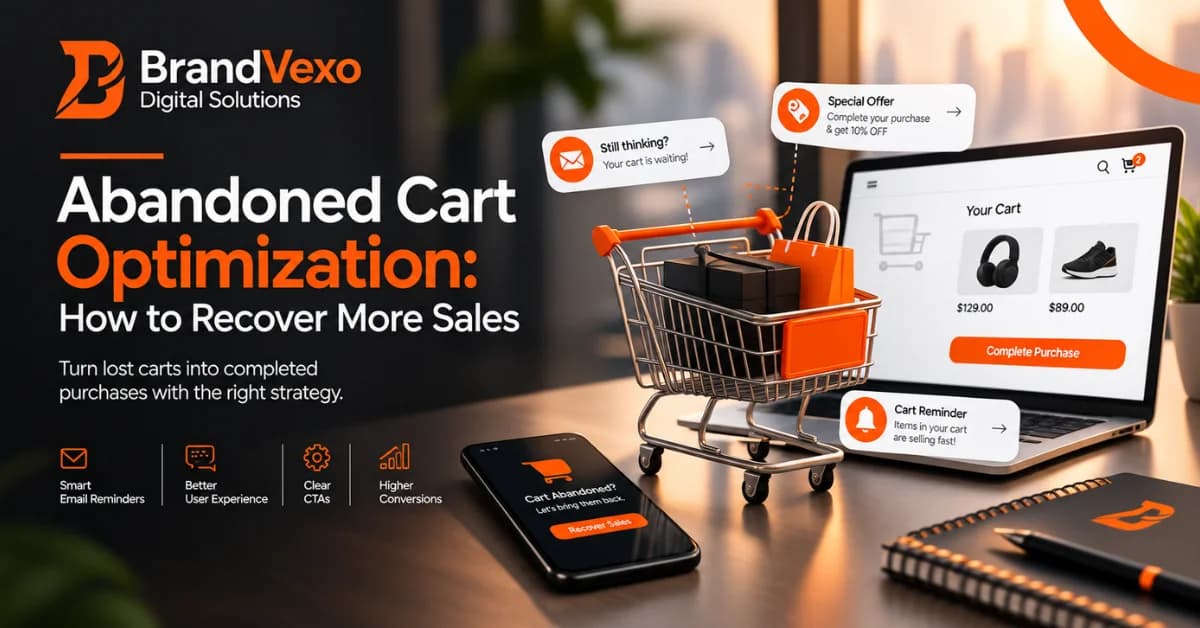
Abandoned Cart Optimization: How to Recover More Sales
Online stores can attract visitors, generate product interest, and still lose potential revenue at the checkout stage. This is where Abandoned Cart Optimization becomes important. Instead of treating every abandoned cart as a lost customer, ecommerce businesses can identify why shoppers leave, remove unnecessary checkout friction, and create timely recovery opportunities.
Baymard's latest research places the average documented online shopping cart abandonment rate at around 70%. However, not every abandonment represents a checkout problem. Some shoppers are browsing, comparing prices, saving products for later, or simply not ready to purchase.
What Is Abandoned Cart Optimization?
Abandoned Cart Optimization is the process of improving the ecommerce journey so fewer shoppers leave unnecessarily and more qualified shoppers return to complete their purchases.
It combines two connected activities:
Preventing avoidable cart abandonment
Recovering shoppers who already left
This can involve improving checkout design, making delivery costs clearer, offering suitable payment methods, simplifying forms, using abandoned cart emails, and analyzing where customers leave the purchase journey.
Cart Abandonment vs. Abandoned Checkout
These terms are related but not identical.
Cart abandonment happens when a shopper adds products to their shopping cart but leaves without completing the purchase.
Abandoned checkout usually refers to a shopper who has entered the checkout process but leaves before placing the order.
This distinction matters because the recovery strategy can differ. A shopper who leaves after adding an item may need more product or delivery information, while someone who reaches the payment screen may have encountered payment friction, unexpected costs, or a technical problem.
Why Do Customers Abandon Their Shopping Carts?
There is no single reason behind cart abandonment. Baymard's 2026 data shows that, among surveyed US online shoppers, common reasons include extra costs, slow delivery, lack of trust, forced account creation, complicated checkout, website errors, unsatisfactory return policies, and payment problems.
Unexpected Shipping, Taxes, or Extra Fees
Unexpected costs can change the customer's decision at the final stage.
A shopper may accept a product price of $80 but reconsider when an additional $20 appears for shipping and fees.
Businesses can reduce this friction by:
Showing shipping costs as early as practical
Providing delivery estimates
Displaying taxes or applicable fees clearly
Showing the final order total before payment
Explaining free-shipping thresholds
Transparency gives shoppers the information they need before they commit.
Complicated or Long Checkout
A checkout that asks for unnecessary information can interrupt purchase intent.
Baymard's research identifies overly long or complicated checkout as a significant abandonment reason and reports substantial opportunities to reduce unnecessary form elements in many ecommerce checkouts.
Review every field and ask whether it is genuinely necessary. Use autofill, clear validation messages, logical field order, and simple navigation wherever possible.
Lack of Trust or Payment Options
Customers need confidence before entering payment information.
Trust can be affected by:
Unclear returns information
Missing security signals
Unexpected redirects
Poor website design
Limited payment choices
Payment errors
Providing familiar payment methods and clear policies can make the checkout experience easier to understand.
Customers Are Not Ready to Buy
Not every abandoned cart needs fixing.
Baymard reports that 42% of surveyed US online shoppers had abandoned a cart because they were simply browsing or not ready to buy.
A customer may be comparing products, checking prices, researching a gift, or waiting for payday.
This is why businesses should focus on recovering qualified purchase intent, rather than assuming every abandoned cart represents a failed checkout.
How Abandoned Cart Optimization Works
A practical optimization process can follow six steps:
Identify → Diagnose → Prevent → Recover → Measure → Improve
Identify Where Shoppers Drop Off
Start with ecommerce analytics.
Look at:
Cart-to-checkout conversion
Checkout-to-purchase conversion
Device type
Traffic source
Product category
Order value
Payment step
New versus returning visitors
For example, if mobile shoppers abandon at a much higher rate than desktop users, the problem may involve mobile usability rather than product demand.
Diagnose the Reason
Analytics can show where users leave, but it may not fully explain why.
Combine quantitative data with:
Checkout testing
Customer surveys
Support conversations
Session recordings where appropriate
UX reviews
Payment error reports
This creates a clearer picture of the customer journey.
9 Abandoned Cart Optimization Strategies to Recover More Sales
1. Show Total Costs Before Checkout
Don't wait until the final payment step to reveal important costs.
Customers should understand:
Product price
Shipping
Taxes where applicable
Discounts
Delivery options
Final order total
If shipping varies by location, provide an estimate before the customer reaches the final payment screen.
2. Simplify the Checkout Process
A streamlined checkout removes distractions and unnecessary work.
Consider:
Reducing unnecessary fields
Using autofill
Enabling address lookup
Providing clear error messages
Keeping important information visible
Making the primary CTA obvious
Reducing unnecessary checkout steps
Baymard's research consistently identifies checkout design and flow as important contributors to abandonment.
Don't simplify checkout based only on assumptions. Test changes against actual customer behavior.
3. Offer Guest Checkout
Forcing customers to create an account can interrupt the purchase process.
A guest checkout option lets shoppers complete their order without committing to an account first.
After purchase, the business can invite the customer to create an account using information already associated with the order.
This approach can reduce unnecessary friction while still creating an opportunity for future ecommerce retention.
4. Optimize the Mobile Checkout Experience
Mobile shoppers often deal with smaller screens, touch keyboards, variable connections, and more limited attention.
Make mobile checkout easier by:
Using responsive layouts
Keeping buttons easy to tap
Minimizing typing
Supporting autofill
Making error messages visible
Offering suitable mobile payment options
Avoiding unnecessary popups
Baymard's checkout research separately benchmarks desktop, mobile, and app experiences, highlighting that checkout UX issues affect multiple device types.
5. Use Abandoned Cart Emails Strategically
An abandoned cart email can bring a shopper back without requiring the customer to search for the product again.
A simple recovery sequence can include three stages.
Email 1: Reminder
Remind the shopper about the products they left behind and provide a direct link back to the cart.
Email 2: Help
Address common objections such as delivery, returns, product information, or payment options.
Email 3: Final Reminder
Give the customer one more useful reason to return without creating unnecessary pressure.
What Should an Abandoned Cart Email Include?
A useful recovery email can contain:
Product image
Product name
Price
Cart link
Clear CTA
Delivery information
Returns information
Customer support option
Keep the message focused. The objective is to make returning to the purchase easy.
6. Personalize Cart Recovery Messages
Generic messages can become easy to ignore.
Where appropriate, personalize recovery campaigns using information such as:
Products left in the cart
Customer segment
Previous purchase behavior
Customer's stage in the buying journey
Relevant product information
However, personalization should remain useful rather than intrusive.
A customer who abandoned running shoes may appreciate a reminder showing the exact shoes they considered. They probably do not need an overly detailed message about every action they took on the website.
7. Use Exit-Intent and On-Site Recovery Carefully
An exit-intent message can give a shopper one final opportunity to reconsider.
Instead of immediately offering a discount, consider using the message to:
Remind shoppers about their cart
Explain delivery options
Highlight return policies
Offer customer support
Answer a common product question
Discounts should not become the automatic solution.
8. Offer Relevant Payment and Delivery Options
Payment friction can stop a purchase even when the customer wants the product.
Review whether your target audience expects:
Credit or debit cards
Digital wallets
Local payment methods
Buy-now-pay-later options where appropriate
Other relevant payment choices
Also communicate delivery options clearly.
Baymard's current abandonment research identifies slow delivery, insufficient payment methods, and declined cards among documented reasons shoppers abandon purchases.
9. Connect Cart Recovery With Ecommerce Retention
A recovered cart should not be viewed as the end of the customer relationship.
Once someone purchases, businesses can build longer-term value through:
Relevant product recommendations
Post-purchase communication
Loyalty programs
Helpful educational content
Replenishment reminders
Personalized offers
Win-back campaigns
This connects cart recovery with broader ecommerce retention.
The objective is not simply to recover one order. It is to create a customer experience that makes future purchases easier.
How to Create an Abandoned Cart Recovery Email Sequence
A recovery campaign works best when each message has a clear purpose.
First Message: Reminder
Keep the first message simple. Show the products, remind the customer that the cart is available, and provide a direct route back to checkout.
Second Message: Remove Objections
The second message can address questions that may have prevented the purchase.
For example:
How long will delivery take?
What is the return policy?
Which payment methods are available?
Does the product come in another size?
Is customer support available?
This approach provides value instead of simply repeating the sales message.
Third Message: Final Follow-Up
The final message can remind the shopper about the saved cart.
Avoid creating artificial urgency or making unsupported claims about stock availability.
Should You Always Offer a Discount?
No.
A discount may help a price-sensitive customer, but automatically offering one to every abandoned-cart shopper can reduce margins and potentially train customers to wait for promotions.
Test different approaches:
Reminder only
Helpful information
Free shipping where commercially viable
Limited incentive
No incentive
Then compare recovered revenue and profitability rather than looking only at the number of recovered orders.
Cart Recovery Example: From Abandonment to Purchase
Consider an illustrative UAE online fashion store with a customer who adds products worth د.إ500 to their cart.
The customer reaches checkout but leaves after seeing delivery information.
Instead of immediately offering a discount, the store could:
Make delivery charges visible earlier.
Explain expected delivery timing.
Simplify the checkout form.
Send a timely cart reminder.
Link directly to the saved cart.
Track whether the customer returns and purchases.
The business can then compare performance before and after the changes.
This example demonstrates an important principle: cart recovery should not replace checkout optimization. If customers repeatedly abandon because of unclear delivery costs, better email automation alone will not solve the underlying issue.
How to Measure Abandoned Cart Optimization
You cannot improve what you do not measure.
Track metrics across both checkout performance and recovery campaigns.
Key Metrics to Track
Cart abandonment rate
Checkout abandonment rate
Cart recovery rate
Abandoned cart email conversion rate
Checkout conversion rate
Recovered revenue
Average order value
Revenue per visitor
Payment failure rate
Mobile versus desktop abandonment
Repeat purchase rate
Cart Recovery Rate Formula
A simple measurement is:
Cart Recovery Rate = Recovered Carts ÷ Eligible Abandoned Carts × 100
For example, if 1,000 eligible abandoned carts generate 80 completed purchases after recovery activity, the recovery rate would be 8%.
However, don't judge a campaign only by recovery rate. Also measure the revenue recovered, margin impact, customer value, and incremental purchases.
How to Find the Biggest Checkout Friction Points
A structured checkout audit can reveal problems that standard analytics may miss.
Checkout Audit Checklist
Test the checkout on mobile and desktop.
Test every payment method.
Check shipping calculations.
Review error messages.
Test guest checkout.
Review unnecessary form fields.
Check whether the cart persists correctly.
Test abandoned-cart recovery links.
Review page speed.
Examine abandonment by device.
Review payment failures.
Check whether customers can easily return to their cart.
Baymard's research provides extensive evidence that checkout UX can contain many individual friction points, including issues involving forms, payment methods, delivery, account creation, and order review.
Common Abandoned Cart Optimization Mistakes
Businesses often focus heavily on recovery emails while overlooking the checkout experience itself.
Avoid these mistakes:
Sending too many recovery emails
Offering discounts immediately
Hiding shipping costs
Ignoring mobile shoppers
Forcing account creation
Using generic recovery messages
Sending customers to an empty cart
Ignoring payment failures
Measuring emails but not checkout performance
Treating every abandonment as recoverable
A good recovery strategy starts by understanding the customer's reason for leaving.
Abandoned Cart Optimization Best Practices
Do:
Make costs transparent.
Keep checkout simple.
Optimize the mobile experience.
Provide relevant payment methods.
Use timely recovery messages.
Personalize where it adds value.
Test changes systematically.
Measure recovered revenue.
Improve the underlying checkout experience.
Don't:
Depend entirely on discounts.
Add unnecessary checkout fields.
Hide delivery information.
Send excessive reminders.
Assume every abandoned cart represents strong purchase intent.
How BrandVexo Can Help!
BrandVexo Digital Solutions helps businesses build practical digital growth systems across digital marketing, SEO, web development, AI automation, and business solutions. Our approach focuses on useful strategies, measurable outcomes, and solutions that address real business challenges rather than vanity metrics.
Phone: +971 52 356 5409
Email: info@brandvexo.com
Website: www.brandvexo.com
For businesses looking to improve ecommerce performance, the right starting point is often a clear understanding of where customers drop off and what is creating friction in the customer journey.
FAQs
What is abandoned cart optimization?
Abandoned Cart Optimization is the process of reducing avoidable shopping cart abandonment and recovering qualified shoppers who leave before completing their purchases. It can include checkout improvements, cart recovery emails, payment optimization, personalization, and ecommerce retention strategies.
What is the best way to recover an abandoned cart?
There is no single recovery tactic that works for every store. Start by identifying why customers leave, then combine checkout improvements with relevant recovery messages. A direct cart reminder can work well when the customer already has strong purchase intent.
How does abandoned cart recovery work?
Abandoned cart recovery identifies shoppers who leave products in their cart and uses appropriate follow-up methods to encourage them to return. These methods can include email, on-site messages, customer support, or other permitted marketing channels.
What is a good cart abandonment rate?
There is no universal rate that defines a healthy ecommerce store. Results vary by industry, product type, device mix, traffic source, customer intent, and measurement method. Baymard's 2026 research reports an average documented abandonment rate of about 70%, but businesses should compare their own performance over time and against relevant benchmarks.
How many abandoned cart emails should you send?
There is no universal number. A short sequence can include a reminder, an objection-handling message, and a final follow-up. Test timing and frequency against revenue, unsubscribes, customer experience, and incremental conversions.
Should I offer a discount for abandoned carts?
Not automatically. Discounts can help some price-sensitive shoppers but can also reduce margins. Test discounts against non-discount recovery messages and measure the actual incremental value.
What is the difference between cart abandonment and checkout abandonment?
Cart abandonment generally occurs when someone adds products but leaves before completing the purchase. Checkout abandonment occurs after the shopper enters the checkout process but leaves before placing the order.
How can I reduce checkout abandonment?
Start by identifying the biggest friction points. Review unexpected costs, checkout length, account requirements, payment methods, delivery information, mobile usability, technical errors, and trust signals. Then test improvements and measure their effect.
Final Thoughts
Effective Abandoned Cart Optimization is more than sending an automated reminder. Businesses need to understand why customers leave, remove unnecessary checkout friction, communicate costs clearly, support convenient payment methods, and create recovery messages that match customer intent.
The strongest approach combines checkout optimization, cart recovery, and ecommerce retention. Instead of trying to recover every abandoned cart, focus on making the buying journey easier for customers who are genuinely ready to purchase.
Disclaimer: This article provides general information about abandoned cart optimization, ecommerce retention, and checkout strategies. Results may vary based on your industry, audience, platform, and customer behavior, so businesses should test strategies against their own data before making changes.
Free growth plan
Ready to grow your business?
Reading is a start — now let's build it. Tell us where you want to grow and a senior strategist will map the fastest, most profitable way to get there. Free, no obligation.
Discussion
Join the conversation
Be the first to comment. Comments are reviewed before they appear, so yours won't show up instantly — but we read every one.
Leave a comment
Keep reading
All articles Growth
Ecommerce Conversion Optimization: 12 Tests to Try
Test 12 ecommerce conversion optimization ideas, from product pages and CTAs to checkout, mobile UX, payment options and cart recovery.
 Growth
Lead Generation Dubai: Channels, Costs and Strategy
Learn how lead generation Dubai works, which channels to use, what affects lead generation cost UAE, and how to build a scalable strategy.
 Growth
WhatsApp Lead Generation: From Click to Conversation
Learn how WhatsApp lead generation turns clicks into conversations, qualified leads, follow-ups, and conversions with practical strategies for businesses.