

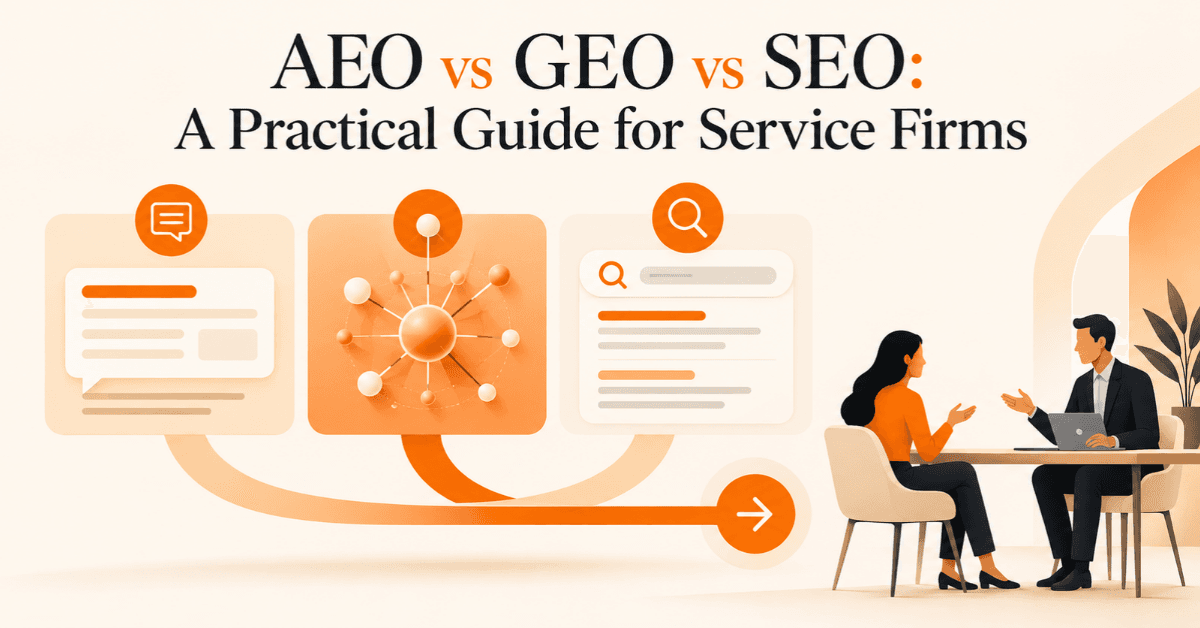
AEO vs GEO vs SEO: A Practical Guide
Service firms need more than traditional search rankings to reach potential clients online. People still use Google to compare providers, but they also ask conversational questions, look for direct answers, and use AI-powered search tools to research services. This shift makes AEO vs GEO vs SEO an important topic for consultants, digital agencies, IT companies, and other B2B service providers.
Search Engine Optimization (SEO) helps businesses improve their visibility in search results. Answer Engine Optimization (AEO) focuses on making content useful for direct answers, while Generative Engine Optimization (GEO) aims to improve a brand’s visibility in AI-generated responses.
These approaches overlap, but each offers a different way to support online discovery. For service firms, the goal is not to abandon SEO or chase every new platform. It is to build a practical search strategy that answers customer questions, demonstrates expertise, and attracts qualified leads.
What Are AEO, GEO, and SEO?
Understanding each approach helps service firms decide where to invest their time and resources.
What Is Answer Engine Optimization (AEO)?
Answer Engine Optimization (AEO) involves structuring and improving content so answer-focused search experiences can identify useful responses to users’ questions. These experiences may include featured snippets, direct answers, voice assistants, and conversational interfaces.
For example, an accounting firm could publish a page answering, “What documents does a small business need for bookkeeping?” A clear opening answer, followed by a practical checklist, helps readers find the information they need.
An effective AEO strategy for B2B services includes:
Answering common customer questions directly.
Using descriptive headings that reflect real search queries.
Adding relevant FAQs and step-by-step explanations.
Providing accurate information in a clear, easy-to-understand format.
Using structured data when it genuinely applies to the page.
Voice search optimization and conversational AI queries can also inform content planning. However, businesses should focus on answering real customer needs rather than creating separate pages for every minor wording variation.
What Is Generative Engine Optimization (GEO)?
Generative Engine Optimization (GEO) focuses on improving the chances that a business’s content will be discovered, used, mentioned, or cited in AI-generated responses.
These experiences may appear in tools such as ChatGPT Search, Google’s AI search experiences, and Perplexity. Their systems differ, so visibility in one does not guarantee visibility in another.
Consider a Dubai-based IT consultancy that publishes an original guide comparing managed IT support plans. The guide explains service scope, pricing factors, security considerations, and the sources behind its recommendations. This detailed information gives potential customers more value and may make the content useful to AI systems that retrieve and synthesize information.
Useful GEO optimization techniques include:
Publishing original insights, practical examples, and relevant case studies.
Supporting factual claims with credible sources.
Explaining services, terminology, and processes clearly.
Maintaining accurate and consistent company information.
Demonstrating relevant experience and subject-matter expertise.
GEO is not a guaranteed ranking formula. The aim is to make content genuinely useful, credible, and accessible to systems that generate answers.
What Is Search Engine Optimization (SEO)?
Search Engine Optimization (SEO) helps websites become easier for search engines to discover, understand, and present for relevant queries.
For service firms, SEO supports visibility when potential customers search for solutions, compare providers, or look for local expertise.
Core SEO activities include:
Keyword research: Identify relevant terms and understand customer search intent.
On-page optimization: Improve page titles, headings, content, and internal links.
Technical SEO: Ensure search engines can crawl and index important pages.
Local SEO: Help nearby customers find relevant services and accurate business information.
Content quality: Publish helpful, original information that meets the needs of the target audience.
Authority building: Earn relevant mentions and links through useful work and credible industry contributions.
For example, a UAE-based digital marketing agency may target searches such as “SEO services in Dubai” and publish supporting guides about technical SEO, local search, and lead generation.
SEO remains a foundation for online visibility. AEO and GEO complement that foundation by addressing how people discover and consume information through answer-focused and generative search experiences.
AEO vs GEO vs SEO: What Is the Difference?
The main difference between SEO, AEO, and GEO lies in how each approach supports online discovery. SEO provides the foundation, AEO emphasizes direct answers, and GEO focuses on visibility in generative AI responses.
Comparison point | SEO | AEO | GEO |
|---|---|---|---|
Main goal | Improve search visibility | Support direct answers | Improve visibility in AI-generated responses |
Content focus | Relevant, useful web pages | Clear answers to specific questions | Credible, informative content that supports AI answers |
Common opportunities | Organic results and local search | Featured snippets and answer-focused experiences | AI mentions, references, and citations |
Useful techniques | Technical SEO, keyword research, internal links | Question-led headings, concise answers, FAQs | Original insights, credible evidence, clear brand information |
Measurement | Impressions, clicks, traffic, conversions | Answer visibility where measurable | AI mentions, referrals, and qualified leads where measurable |
These categories overlap. A well-written service page can support all three approaches without requiring three separate versions of the same content.
For Google specifically, its official guidance on AI search features confirms that established SEO practices remain relevant to generative search. Google also emphasizes useful, original content rather than special optimization tricks.
How AEO, GEO, and SEO Work Together for Service Firms
Service businesses often need to explain complex offerings before a prospect feels comfortable contacting them. Combining these approaches can help customers find that information through different search experiences.
Consider a Dubai-based IT consultancy targeting the question, “How much does managed IT support cost in Dubai?”
SEO: Create a dedicated service page explaining managed IT support, the service area, pricing factors, and the company's capabilities.
AEO: Answer common questions about monthly fees, contract terms, response times, and included services.
GEO: Publish original insights about choosing an IT support provider, explain the methodology behind any pricing examples, and reference credible technical sources.
The page can then serve customers who want a conventional search result, a quick answer, or a more detailed AI-generated comparison.
This is a practical multi-engine optimization framework: build one useful resource around customer intent, then make its information clear, accessible, and credible. Avoid creating duplicate pages simply to target minor variations of the same query.
How to Build an AEO Strategy for B2B and Professional Services
1. Identify the Questions Your Prospects Ask
Start with real customer questions rather than guessing what answer engines might prefer. Review sales calls, customer emails, support requests, Search Console data, and discussions with your service team.
For example, a business consultancy may identify questions such as:
How much does business consulting cost?
What does a consulting engagement include?
How long does implementation take?
Which documents should a client prepare?
How can a business measure the results?
Group related questions by service, buying stage, and customer need. This helps you create content that supports prospects from early research to provider selection.
2. Structure Pages Around Clear Answers
Answer the main question near the beginning of the relevant section. Add the context, examples, limitations, and next steps readers need to make a decision.
Use descriptive headings, short paragraphs, meaningful lists, and relevant FAQs. For example, a heading such as “What Does Monthly SEO Management Include?” gives readers a clearer expectation than a vague heading such as “Our Approach.”
3. Use Structured Data Where It Fits
Structured data can help search engines interpret eligible content and may support certain search features. Depending on the page, suitable types may include Organization, LocalBusiness, or BreadcrumbList.
Keep structured data accurate and consistent with the information visible on the page. Do not add markup that misrepresents your business or services. Schema does not guarantee featured snippets, AI citations, or enhanced search results.
GEO Optimization Techniques That Help Service Businesses Earn AI Visibility
Publish Original, Specific, and Verifiable Information
Generic articles often repeat information that readers can find elsewhere. Service firms can offer more value by sharing real expertise, original analysis, documented processes, and useful examples.
A cybersecurity consultancy, for instance, could publish a guide explaining how it assesses risks for small businesses. It could describe the assessment stages, explain common findings, and cite relevant security standards.
Only publish case studies and performance figures that you can substantiate. If you discuss a client project, obtain appropriate permission and protect confidential information.
Strengthen Entity and Brand Clarity
Make it easy for people and search systems to understand who your business is, what it offers, and whom it serves.
Keep your company name, service descriptions, contact details, author information, and relevant business profiles consistent. Provide clear information about your experience and explain the qualifications or processes that support your claims.
Relevant third-party references and genuine industry contributions can also strengthen credibility. Avoid buying artificial mentions or publishing promotional content across unrelated websites solely to influence AI systems.
Make Important Information Easy to Understand
Use descriptive headings, straightforward definitions, clear comparisons, and supporting evidence. Explain technical terms when your audience may not know them.
These practices improve usability for people and make your content easier to interpret. However, no particular paragraph length, content chunking technique, or keyword formula guarantees AI citations.
SEO Best Practices That Still Matter in AI Search
Improve Technical SEO and Website Experience
Check that search engines can crawl your important pages and that the pages you want to appear in search are eligible for indexing. Review broken links, duplicate URLs, mobile usability, page performance, and internal linking.
Ensure your key service information is available in a format search systems can access. Use Google Search Console to monitor indexing, impressions, clicks, and potential technical problems.
Target High-Intent and Local Search Queries
Service firms should target searches that reflect what prospective clients need. Examples include “accounting services in Dubai,” “B2B SEO agency UAE,” and “IT support for small businesses.”
Build dedicated service pages where the offerings genuinely differ. Add useful location information when it helps customers understand your service area, rather than creating many near-identical city pages.
Demonstrate Experience and Expertise
Explain how your service works, what clients should expect, and which factors affect the outcome. Use relevant examples, accurate claims, credible references, and clear authorship. A strong SEO strategy for service firms connects content to customer decisions. Instead of publishing articles solely to attract organic search traffic, help readers understand their problem and evaluate their options.
Google's SEO Starter Guide provides a useful reference for foundational practices.
AEO vs GEO vs SEO: Which Approach Should Your Service Firm Prioritize?
The right starting point depends on your website's current performance, target audience, and available resources. You do not need to implement every tactic at once.
Prioritize SEO if your important service pages are missing, difficult to find, poorly structured, or targeting the wrong search intent.
Focus on AEO if prospects regularly ask questions that your website does not answer clearly.
Expand GEO efforts if your business has useful expertise and wants to improve its visibility in AI-generated answers.
Combine all three when your SEO foundations are sound and you can consistently create and maintain high-quality content.
For example, a small UAE consulting firm might first improve its service pages and local SEO, then add useful answers to common client questions, and finally develop original industry guides that demonstrate its expertise.
This phased approach helps businesses improve their search strategy without spreading limited marketing resources too thinly.
How to Measure AEO, GEO, and SEO Performance
Measure results using a combination of visibility, engagement, and business outcomes.
SEO metrics: Organic impressions, clicks, relevant keyword performance, qualified website traffic, and conversions.
AEO metrics: Featured snippet appearances where measurable, relevant search appearances, and qualified visits from answer-focused experiences.
GEO metrics: Verified AI mentions or citations, referral traffic where available, and leads influenced by AI-driven discovery.
Google Search Console can help monitor performance in Google Search, including eligible generative AI search experiences through its available reporting. Other AI platforms may require separate referral analysis and manual visibility checks.
Check results consistently because AI responses can vary by query, location, platform, and date. Most importantly, connect visibility to meaningful business outcomes, such as qualified enquiries, consultation bookings, and sales.
Common AEO, GEO, and SEO Mistakes to Avoid
Service firms should avoid these common mistakes when building an AI search strategy:
Publishing generic AI-generated articles without original insights or expert review.
Adding FAQs or structured data solely to chase search features.
Treating keyword density as a fixed ranking formula.
Assuming an AI mention will automatically generate leads.
Neglecting technical SEO while focusing only on GEO.
Creating repetitive pages for minor keyword variations.
Measuring rankings and citations without tracking business results.
Google's guidance emphasizes helpful, reliable, people-first content. AI tools can support research and drafting, but the final content should provide genuine value, remain accurate, and reflect appropriate human oversight.
FAQs
Is GEO replacing SEO?
No. GEO is a developing approach to improving visibility in generative AI experiences, while SEO supports discovery through conventional search and remains relevant to many AI-powered search features. Businesses should strengthen their SEO foundations while adapting their content to customer needs.
What is the main difference between AEO and GEO?
AEO focuses on helping content provide useful answers to specific questions. GEO focuses on improving the chances that credible content will be discovered, referenced, or cited in AI-generated responses. Both approaches overlap with SEO and benefit from clear, trustworthy content.
Can small service businesses benefit from AEO and GEO?
Yes. Small firms can answer common customer questions, improve service pages, publish original insights, and maintain accurate business information. These steps can support discoverability without requiring a large marketing budget or a separate page for every question.
How long does it take to see results from AEO, GEO, and SEO?
There is no universal timeline. Results depend on competition, website health, content quality, search demand, and how each platform discovers and presents information. Track progress consistently and evaluate meaningful outcomes rather than expecting immediate rankings or guaranteed AI citations.
Build a Search Strategy That Supports Long-Term Business Growth
AEO, GEO, and SEO serve different purposes, but they share an important foundation: useful content that helps people make informed decisions. SEO supports discoverability, AEO helps deliver clear answers, and GEO focuses on visibility in generative AI responses.
For service firms, the best approach is to understand customer intent, improve the website's technical foundations, answer genuine questions, and publish credible expertise. Measure progress through relevant visibility, qualified traffic, and business enquiries rather than rankings alone.
BrandVexo Digital Solutions helps businesses build practical digital growth systems through SEO, digital marketing, web development, AI automation, and content strategy. If your business wants to strengthen its traditional search presence and explore AI search visibility, reviewing your existing website and content strategy is a useful place to start.
How BrandVexo Can Help!
BrandVexo Digital Solutions helps businesses build practical digital growth systems across SEO, digital marketing, web development, AI automation, and business solutions. Our approach focuses on measurable business outcomes rather than vanity metrics. We help businesses improve their online visibility, strengthen their brand presence, and connect digital activities with commercial goals. From content strategy to website optimization, we focus on solutions that support sustainable growth.
Contact BrandVexo
Phone: +971 52 356 5409
Email: info@brandvexo.com
Website: www.brandvexo.com
Disclaimer: Search engine and AI platform features can change over time, and no optimization method guarantees rankings, citations, or leads. Businesses should evaluate their search strategy using current platform guidance, accurate information, and measurable business outcomes.
Free growth plan
Ready to grow your business?
Reading is a start — now let's build it. Tell us where you want to grow and a senior strategist will map the fastest, most profitable way to get there. Free, no obligation.
Discussion
Join the conversation
Be the first to comment. Comments are reviewed before they appear, so yours won't show up instantly — but we read every one.
Leave a comment
Keep reading
All articles Growth
Google Ads Management for B2B Teams | BrandVexo
Google Ads Management helps B2B teams attract qualified leads, improve campaign performance, track sales pipeline, and measure advertising ROI.
 Growth
Managed IT Services for Small Businesses: A Guide
Explore IT services for small businesses, including managed IT support, cybersecurity, cloud management, backups, costs, and provider selection tips.
 Growth
Core Web Vitals for Business Websites: Guide for Consultants
How Core Web Vitals affect consulting websites, SEO and B2B leads. Explore LCP, INP, CLS, testing tools and practical performance fixes.