

How to Find the Biggest Growth Bottlenecks in Your Business

Hook
Your business may not need more leads, another employee, a new software platform or a bigger advertising budget. It may need one problem fixed.
A company can be busy and still be stuck. The sales team may be generating enquiries, but delivery is already overloaded. Operations may be working long hours, while slow approvals hold every project up. Revenue may be rising, but cash may be disappearing because margins are thin or customers pay late.
These are different problems, and they need different solutions. If you treat every symptom as a separate project, you can spend months improving parts of the business that are not limiting growth.
The practical starting point is to find the constraint that is restricting the whole system. That is how you identify the biggest business growth bottlenecks and decide what deserves attention first.
Introduction
A growth bottleneck is a constraint that limits how effectively a business can attract customers, convert demand, deliver its product or service, retain customers and generate profitable revenue. It can sit in marketing, sales, operations, finance, leadership or the customer experience.
The challenge is that the most visible problem is not always the most important one. A founder might see an empty sales pipeline and assume marketing is failing. But if the offer is unclear, the sales process is slow or the business has a poor reputation, increasing traffic may not improve revenue. Likewise, more orders will not help if the company cannot fulfil them on time.
This guide explains how to find business bottlenecks using evidence rather than guesswork. You will learn where to look, which numbers to review, how to separate root causes from symptoms and how to prioritise the constraint holding back your next stage of growth.
1. Understand What a Growth Bottleneck Really Is
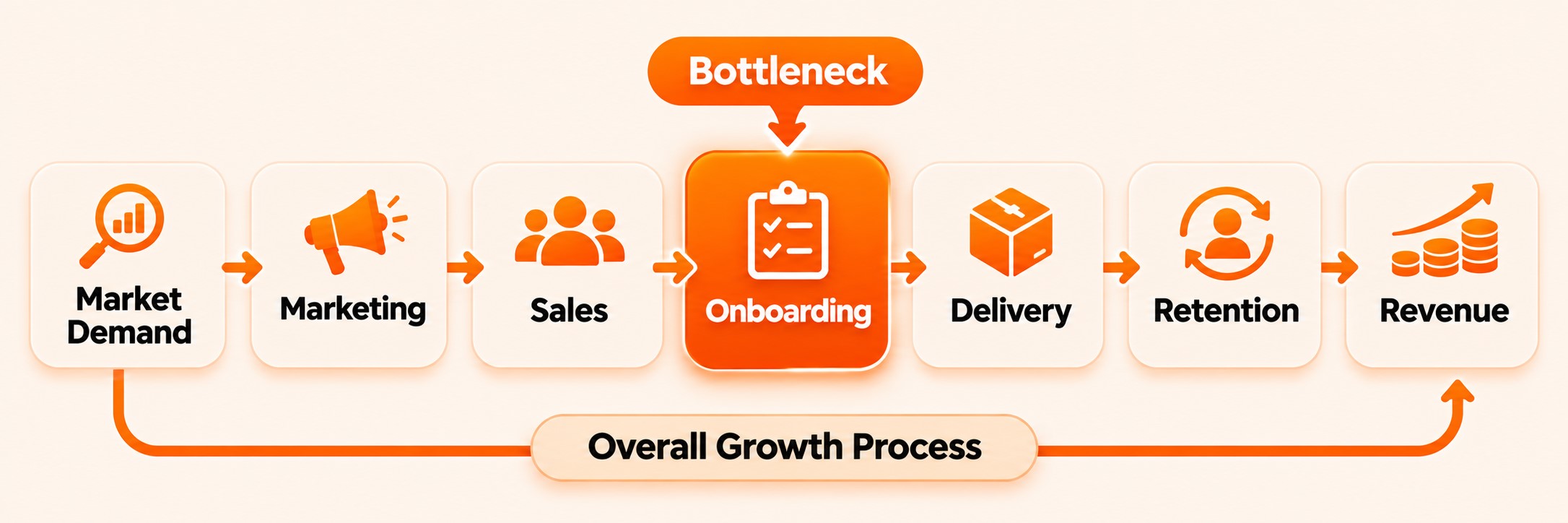
A bottleneck is the point in a process or system that restricts the output of the whole system. Imagine a service company that can generate 100 qualified enquiries each month, but its sales team can only handle 35 properly. The business does not have a lead-volume problem at that moment. Its sales capacity or process may be the limiting factor.
A bottleneck is not simply a task that feels difficult, a department that is busy or a metric that looks disappointing. It is a constraint that has a meaningful effect on the result the business is trying to improve.
This distinction matters because businesses often optimise what is easy to see. Marketing teams may focus on website traffic, sales managers may focus on call volume and operations managers may focus on staff utilisation. Each metric can improve while the overall business result stays flat.
The Theory of Constraints offers a useful management principle: focus on the system's limiting factor instead of trying to maximise every individual part at once. The constraint may change after an improvement, so diagnosis should be repeated rather than treated as a one-time exercise. The Theory of Constraints Institute explains how strengthening a non-limiting part of a system may fail to improve overall output.
Theory of Constraints Institute
For a growing business, the goal is not to make every department look busy or every dashboard number rise. The goal is to improve the flow from customer demand to profitable delivery and repeat business.
2. Start With the Outcome You Need to Improve
Before searching for business growth bottlenecks, define what growth means for the business right now. A company trying to increase qualified sales may need a different diagnosis from one trying to improve gross margin, reduce delivery delays or increase repeat purchases.
Choose one business outcome and define the period you will assess. Examples include monthly gross profit, qualified opportunities, completed projects, recurring revenue or customer retention. Avoid starting with a broad statement such as “we need more growth”. It does not tell the team what to investigate.
Then set a baseline using recent, reliable data. Use a period long enough to reduce the effect of unusual days or one-off deals. For a seasonal business, compare equivalent periods where possible. Record the source of each number and note any gaps in tracking.
A useful baseline connects the outcome to the stages that create it. For example, revenue from new customers may depend on qualified enquiries, sales conversion, average order value and fulfilment. If one stage has weakened, the change may explain the revenue problem better than a general decline in marketing activity.
Do not choose a metric only because it is easy to measure. Website visits, social engagement and total enquiries can be useful indicators, but they do not prove that the business is attracting the right customers or converting them profitably.
3. Map the Full Customer and Delivery Journey
The next step is to map how a person moves from first discovering the business to becoming a satisfied, paying and ideally repeat customer. Include the work that happens behind the scenes after a sale.
For many businesses, the journey includes awareness, enquiry, qualification, proposal, purchase, onboarding, delivery, support, renewal or repeat purchase. A manufacturer may need additional stages for procurement, production, quality checks and shipping. A professional services firm may need discovery, scoping, resource allocation, project work and client approval.
At each stage, ask three questions: what must happen, who owns it and what evidence shows that it is working? Record waiting time, rework, missed handoffs and customer drop-offs. A stage may appear efficient on paper but still create delays because information arrives late or decisions wait for one person.
Look for queues. If work consistently piles up before a particular person, approval, machine or team, that point deserves investigation. A queue does not automatically prove a bottleneck, but repeated queues combined with missed deadlines or capped output are useful evidence.
The map should include both customer-facing and internal steps. A business can have a strong sales funnel but weak onboarding. It can deliver projects well but take too long to invoice. It can attract first-time customers but fail to encourage repeat business. A narrow marketing-only review can miss these constraints.
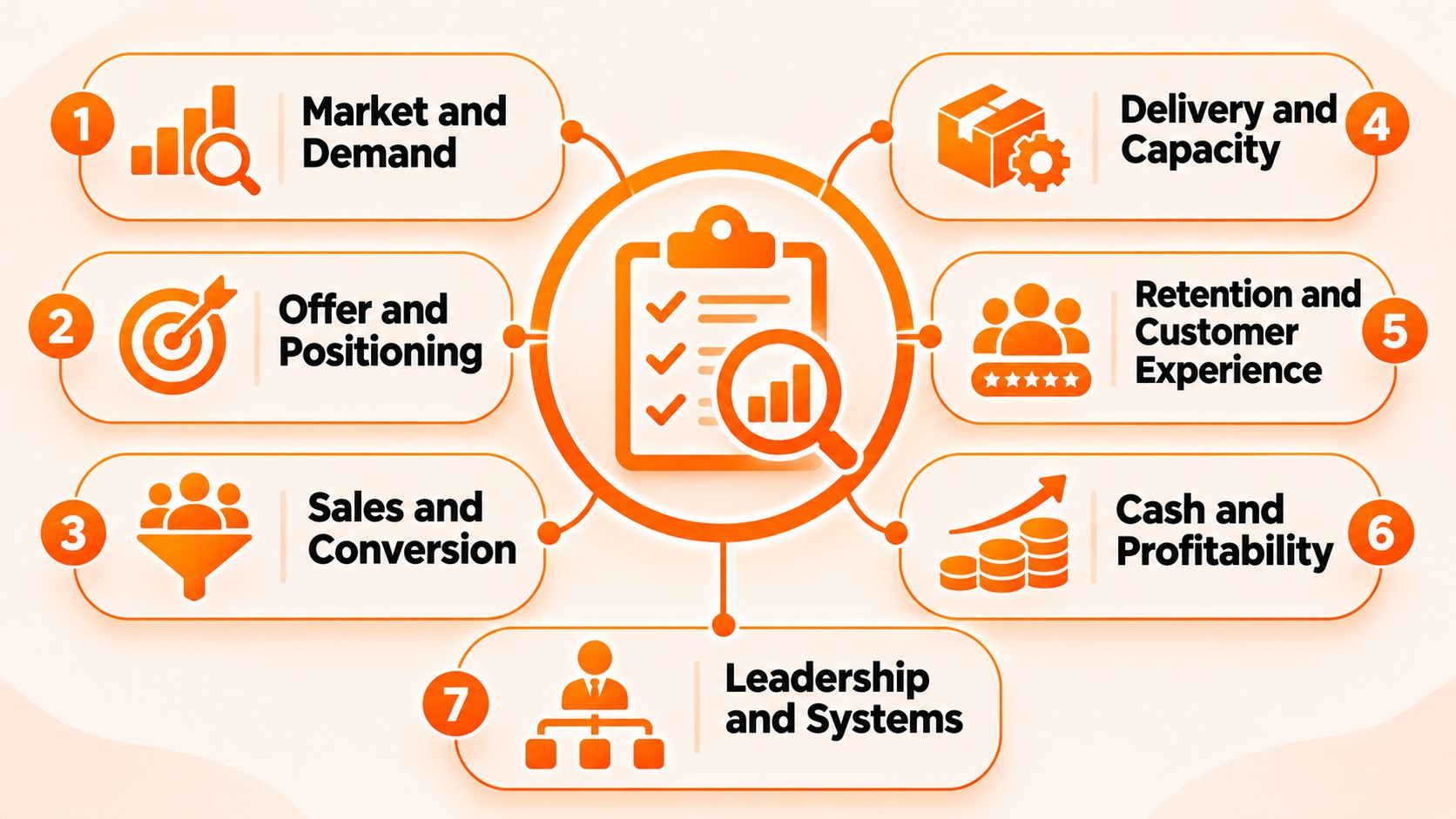
4. Check the Seven Common Areas Where Growth Gets Stuck
Use these areas as places to investigate, not as a checklist that assumes every business has seven problems. The aim is to find the one constraint with the strongest evidence and the greatest effect on your chosen outcome.
Market and demand: Are enough suitable customers aware of the offer? Check qualified enquiries, source mix, market changes and the proportion of leads that match your ideal customer profile.
Offer and positioning: Do prospects understand the value, trust the business and see a clear reason to choose it? Review win-loss feedback, objections, pricing and proposal acceptance.
Sales and conversion: Are enquiries handled quickly and consistently? Check response time, contact rate, meeting attendance, proposal-to-sale conversion and time to close.
Delivery and capacity: Can the team complete more work without delays, errors or quality problems? Review utilisation, backlog, turnaround time, rework and on-time delivery.
Retention and customer experience: Do customers stay, return, renew or recommend the business? Examine repeat purchase, churn, complaints, refunds and reasons for leaving.
Cash and profitability: Does each sale contribute enough profit, and does cash arrive in time to fund operations? Review gross margin, contribution margin, payment delays, receivables and working capital.
Leadership and systems: Are decisions, approvals, key knowledge or customer relationships dependent on one person? Look for repeated escalations, unclear ownership, manual handoffs and work that stops when someone is absent.
These areas interact. Poor positioning can create low-quality leads. Weak onboarding can cause retention problems. Slow invoicing can create cash pressure even when sales are healthy. The diagnosis must follow the relationships between stages instead of assigning blame to a department.
5. Use Business Data to Separate Symptoms From Causes
A useful diagnosis compares what the business expects to happen with what actually happens. Start with the most recent reliable figures, then break them down by product, customer type, channel, location or team where relevant. Averages can hide a serious problem in one segment.
For example, a company may report a 20% decline in sales conversion. That figure alone does not explain why. If conversion is stable for referrals but falling for paid campaigns, the problem may be lead quality or campaign targeting. If conversion has fallen across every source, the offer, pricing or sales process may need attention.
Use a simple sequence to investigate the evidence:
Define the business outcome that is underperforming and the period in which the change occurred.
Break the outcome into the stages, inputs and decisions that influence it.
Compare current performance with the business's own baseline and segment the data to locate where the change is concentrated.
Speak with employees and customers who experience the process, then compare their observations with records and metrics.
Write down the likely root cause, the evidence supporting it and what evidence would disprove it.
This is where teams need to be careful with assumptions. A founder may believe the team needs more training, while the real issue is that the process changes every week. A sales manager may blame lead quality, while records show that enquiries wait two days for a response. Interviews provide context, but they should not replace operational evidence.
Useful measures depend on the business model. A subscription company should pay close attention to activation, retention and recurring revenue. A project-based company may need to examine proposal conversion, delivery time, project margin and client approval delays. A retailer may focus on stock availability, conversion, basket size, returns and repeat purchase.
6. Prioritise the Bottleneck With the Greatest Business Impact
You may find several weak areas. That does not mean you should launch several improvement projects at once. Prioritise the constraint most likely to limit the outcome you selected.
Assess each candidate against four factors: impact on the business outcome, strength of evidence, urgency and ability to influence it. A problem that is severe but outside your control may require a different response from a problem that your team can fix this month. A visible issue with weak evidence should not automatically outrank a less obvious issue supported by clear data.
Consider a small consultancy with a steady flow of qualified enquiries. Proposals are sent quickly, but projects start late because only the founder can approve scope, allocate specialists and resolve client questions. Hiring another salesperson may increase the pipeline, but it could make delivery delays worse. The stronger first move may be to document approval rules, delegate routine decisions and create a reliable resource-planning process.
The point is not that sales or hiring are unimportant. It is that the business should remove the current constraint before increasing pressure elsewhere.
A practical scorecard can help the team discuss priorities consistently. Rate each candidate from 1 to 5 for business impact, evidence confidence and urgency. Keep the scores as a discussion aid, not a scientific prediction. Explain why each rating was chosen and record what data is missing.
7. Test One Improvement Before Scaling It
Once you have a leading diagnosis, design a small test that could show whether the suspected constraint is real. Define the change, the owner, the time period and the result you expect to observe. Keep other major changes stable where possible, so you can interpret what happened.
If response time appears to be the sales bottleneck, test a faster enquiry-routing and follow-up process. If delivery capacity is constrained by repeated approvals, test clear decision limits for a defined project type. If customers are leaving after onboarding, review the first 30 days and test a more structured welcome and support process.
Track both the target metric and possible side effects. Faster sales follow-up might improve meeting bookings but create poor-fit appointments. Increasing production might raise output but increase defects. More discounting might improve conversion while reducing contribution margin.
Use a short review cycle that suits the business process. Some changes can be assessed in a week; others need a full sales cycle, delivery cycle or renewal period. Do not declare success based on one unusually good day. Look for a repeatable improvement and check whether the original constraint has shifted.
The improvement process should be specific enough that another manager could understand what changed and why. “Improve operations” is not a test. “Reduce the average approval wait for standard proposals by introducing a delegated approval limit” is a testable intervention.
8. Build a Simple Bottleneck Review Into Management
A one-time review can uncover a problem, but growth conditions change. New customers, products, staff, suppliers and channels can create new constraints. Make bottleneck review part of normal management rather than waiting until revenue stalls or customers complain.
A useful monthly review can cover:
The main business outcome and its trend against the baseline.
The stage with the largest meaningful delay, loss or capacity limit.
The evidence that supports the current bottleneck diagnosis.
The improvement being tested, its owner and the review date.
Any new constraint created or exposed by the previous improvement.
Keep the review focused. A dashboard with dozens of metrics can make it harder to see the important signal. Choose a small set of measures that connect to the business outcome, then use deeper analysis when a measure changes unexpectedly.
Document decisions and assumptions. If the team decides that lead quality is the main issue, record why. If the test does not improve results, update the diagnosis rather than defending the original idea. Good operators change their view when the evidence changes.
9. Know When the Problem Requires Outside Help
Some bottlenecks are difficult to diagnose internally because the people closest to the process are also responsible for defending it. Teams may have incomplete tracking, unclear ownership or different definitions of success. An external review can help challenge assumptions and connect data across marketing, sales, operations and finance.
Outside help is especially useful when the problem crosses departments, when growth has stalled despite repeated initiatives or when the business cannot agree on which metric matters most. A useful audit should not simply recommend more advertising, more software or more headcount. It should explain where the constraint appears, what evidence supports that conclusion and what should be tested first.
For businesses where digital acquisition or conversion is the likely constraint, a focused review of website performance, search visibility, campaign quality, lead handling and analytics may reveal gaps. BrandVexo's Growth Strategy service is built around auditing channels and drop-offs, planning connected improvements and measuring performance against business outcomes.
BrandVexo
If the evidence points to a slow or confusing website journey, a conversion-focused website review may be more relevant than increasing traffic. If the issue is a lack of qualified search demand, review the business's SEO and search visibility before deciding to increase paid spend. The right service depends on the diagnosed constraint, not the agency's preferred deliverable.
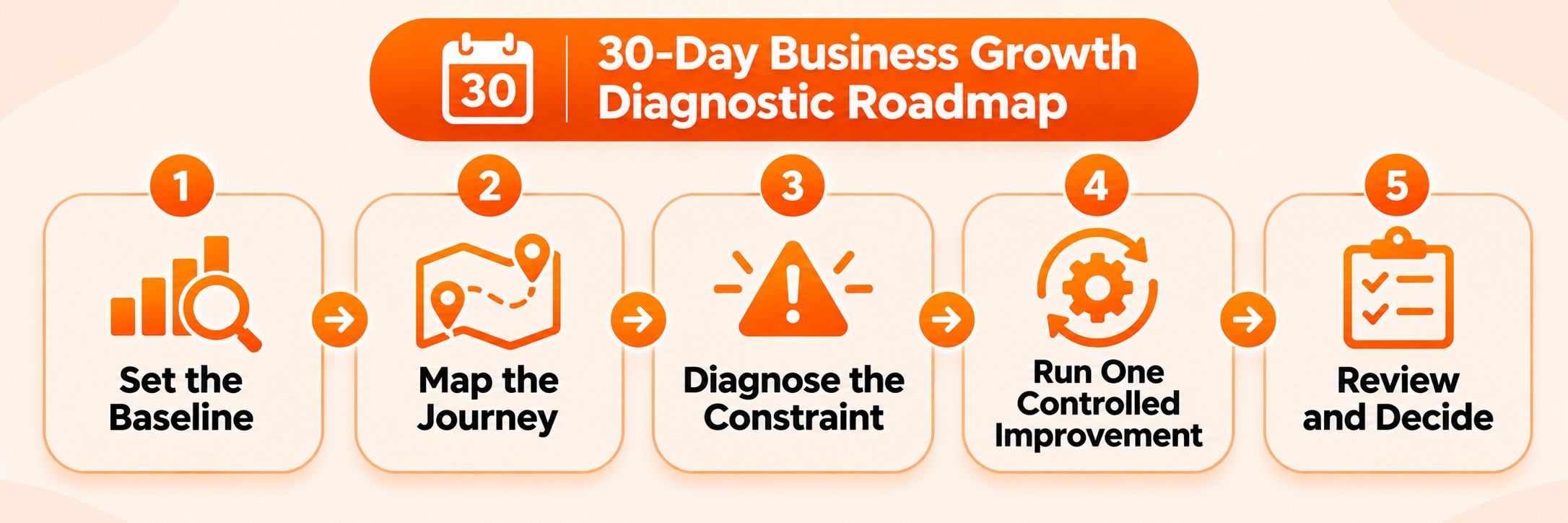
10. A Practical 30-Day Plan to Find and Address Your Biggest Bottleneck
You do not need a large transformation project to begin. A short, disciplined review can help a leadership team move from assumptions to a testable priority.
Days 1–5: Set the baseline. Choose one growth outcome, collect the latest reliable data and agree on how the result will be measured.
Days 6–10: Map the journey. Trace the customer and delivery process, identify queues and delays, and speak with the people who own each stage.
Days 11–15: Diagnose the constraint. Compare the evidence, segment the numbers and rank the most plausible causes by impact and confidence.
Days 16–25: Run one controlled improvement. Assign an owner, define the change and monitor the target metric along with potential side effects.
Days 26–30: Review and decide. Compare the result with the baseline, keep or adjust the change, and check whether another constraint has become more important.
The 30-day schedule is a practical starting point, not a guarantee that every business can diagnose every issue within a month. A long sales cycle, seasonal demand or limited historical data may require a longer observation period. The important thing is to work in a clear sequence and avoid changing everything at once.
Conclusion
Finding the biggest business growth bottlenecks starts with a clear business outcome, a map of how value moves through the company and evidence about where progress slows down. The loudest problem is not always the limiting one, and adding marketing, people or technology before confirming the cause can increase cost without improving results. Review the full customer and delivery journey, compare performance with a reliable baseline, test the most likely constraint and reassess after each improvement. When the business focuses on the factor that truly limits performance, its next growth decision becomes more deliberate, measurable and commercially useful.
Want to know what is holding your business back? BrandVexo can help you review your growth system, identify gaps across your digital channels and build a practical improvement roadmap. Request a growth audit or consultation to discuss the evidence, priorities and next steps.
Frequently Asked Questions
1. What is a business growth bottleneck?
A business growth bottleneck is a constraint that limits the company's ability to attract customers, convert sales, deliver reliably, retain customers or generate profitable revenue. It may sit in one department or between several departments.
2. What are the most common business bottlenecks?
Common areas include weak demand, unclear positioning, low sales conversion, limited delivery capacity, poor retention, cash-flow pressure, low margins and overdependence on the owner. The most important one depends on the company's business model and current objective.
3. How do I know whether marketing or sales is the bottleneck?
Compare qualified enquiries, lead sources, response times, meeting rates, proposal conversion and closed sales. If suitable prospects are not entering the pipeline, demand generation or positioning may be the issue. If qualified prospects enter but do not progress, investigate response speed, sales process, offer fit and objections.
4. Can a business have more than one bottleneck?
A business can have several weaknesses at the same time, and constraints can interact. However, one constraint often has the greatest effect on the outcome being assessed at a particular moment. Prioritise the strongest current constraint, improve it and then reassess.
5. Which metrics should I track to find a growth bottleneck?
Choose metrics that match the business model. Common examples include qualified lead volume, conversion rate, sales cycle length, gross margin, delivery time, rework, repeat purchase rate, churn, customer acquisition cost and cash collection time. Avoid tracking metrics without a clear link to the outcome.
6. How often should a business review its bottlenecks?
A monthly review is a useful starting point for many businesses, with more frequent checks for fast-moving processes. Review sooner when there is a major change in demand, staffing, product mix, capacity or customer behaviour.
7. When should I get a professional growth audit?
Consider an external audit when growth has stalled despite repeated efforts, teams disagree about the cause, tracking is incomplete or the issue crosses marketing, sales and operations. A useful audit should identify evidence, prioritise the constraint and recommend measurable next steps.
Free growth plan
Ready to grow your business?
Reading is a start — now let's build it. Tell us where you want to grow and a senior strategist will map the fastest, most profitable way to get there. Free, no obligation.
Discussion
Join the conversation
Be the first to comment. Comments are reviewed before they appear, so yours won't show up instantly — but we read every one.
Leave a comment
Keep reading
All articles
What Is Full-Funnel Marketing? A Business Growth Guide

How UAE Businesses Can Reduce Customer Acquisition Costs

AI Search Visibility for Clinics: A Practical Guide
Improve AI Search Visibility for clinics with practical SEO, GEO, AEO, local search, and content strategies to reach more patients online.