


Content Marketing for B2B: From Expertise to Pipeline
B2B companies have more ways than ever to publish content, but publishing more does not automatically create more business. A company can produce blog posts, reports, social media updates, and videos every week and still struggle to generate qualified leads. The difference often comes down to strategy. Content Marketing for B2B works best when expertise connects with real buyer problems, search intent, trust, and a clear path toward conversion.
Instead of treating content as a traffic-generating activity, businesses can use it as part of a wider growth system. A strong B2B content strategy helps potential buyers understand their problems, evaluate solutions, and build confidence before they speak with sales.
This approach also aligns with Google's people-first guidance, which emphasizes useful, reliable content created primarily to help audiences rather than content produced simply to attract search traffic.
What Is Content Marketing for B2B?
Content Marketing for B2B is the process of creating and distributing useful information for business buyers to attract relevant audiences, build credibility, support decision-making, and contribute to business growth.
B2B purchases often involve multiple stakeholders, longer sales cycles, and more research than many consumer purchases. A potential customer may read several articles, compare providers, review case studies, watch a webinar, and speak with colleagues before making a decision.
That makes educational content particularly valuable.
A well-planned B2B content program can support different stages of the buyer journey:
Awareness: Help buyers understand a problem.
Consideration: Explain possible approaches and solutions.
Decision: Provide evidence, comparisons, and practical details.
Retention: Help existing customers get more value.
The goal is not simply to make a company visible. The goal is to become useful at the moments when buyers need reliable information.
Why Expertise Alone Does Not Create a B2B Pipeline
Expertise gives a business something valuable to share, but expertise alone does not guarantee visibility, engagement, or leads. A company may know its industry extremely well but still create content that does not match what prospects search for or ask during the buying process.
Effective B2B content connects four elements:
Expertise → Buyer needs → Search intent → Business action
For example, a cybersecurity company could publish a highly technical article about security architecture. That may demonstrate expertise, but a potential customer might first search for information about reducing ransomware risks, choosing security software, or preparing for an audit.
The content strategy should connect the company's knowledge with those real questions.
Common B2B Content Mistakes
Many businesses encounter the same problems:
Publishing without a defined audience.
Writing mainly about their own services.
Targeting keywords without understanding search intent.
Creating only top-of-funnel content.
Ignoring commercial and bottom-of-funnel searches.
Measuring traffic without tracking qualified opportunities.
Publishing content without a distribution strategy.
Treating every article as a standalone project.
A better approach connects individual pieces of content to broader buyer journeys and business objectives.
Build a B2B Content Strategy Around Buyer Problems
A practical B2B content strategy starts with the audience rather than the publishing calendar.
Before creating an article, ask:
Who is the target buyer?
What problem are they trying to solve?
What questions do they ask during research?
What information do they need at this stage?
What search intent sits behind the query?
What business objective should the content support?
What should the reader do next?
This approach prevents content from becoming a collection of unrelated blog posts.
For example, a B2B accounting software company might create separate content for a finance manager researching automation, a business owner comparing accounting platforms, and an existing customer looking for implementation guidance.
Each audience needs different information.
Match Content to Search Intent
Search intent helps determine what type of information a reader expects.
Informational intent:
A buyer wants to understand something, such as “What is B2B demand generation?”
Problem-focused intent:
The reader wants to solve an issue, such as “Why are B2B leads not converting?”
Solution-focused intent:
The buyer is exploring possible approaches, such as “How to build a B2B content strategy?”
Commercial intent:
The prospect is evaluating providers, products, or services.
Understanding these differences allows marketers to create content that serves a purpose instead of simply inserting keywords into an article.
Use Thought Leadership to Build Trust Before the Sales Call
Thought leadership should provide more than a collection of opinions. Strong thought leadership demonstrates expertise through useful explanations, original perspectives, evidence, practical experience, and meaningful analysis. For instance, instead of publishing another generic article about “the future of digital marketing,” a B2B marketing company could explain how changing buyer behavior affects content distribution, supported by its own observations, relevant research, and practical examples.
This gives readers something more useful than a rewritten summary of information already available elsewhere.
Google's guidance encourages creators to demonstrate experience, expertise, authoritativeness, and trustworthiness, while making it clear who created the content and why it was produced.
What Makes B2B Thought Leadership Credible?
Useful thought leadership can include:
First-hand industry experience.
Original research or company data where appropriate.
Expert interviews.
Practical examples.
Clear explanations of complex topics.
Proper attribution of external research.
Transparent discussion of limitations.
An identifiable author with relevant expertise.
The strongest content answers a question while adding something the reader could not easily get from ten generic articles.
Create Demand Generation Content That Moves Buyers Forward
Demand generation content helps businesses create awareness and interest while educating potential customers about problems and possible solutions. It should not be confused with direct advertising. A useful demand generation asset might explain a costly business problem, show how other companies approach it, or provide a framework for evaluating solutions.
Effective formats include:
Industry research reports.
Original data studies.
Expert guides.
Case studies.
Comparison articles.
Webinars.
ROI resources.
Implementation guides.
Buyer checklists.
Detailed solution explainers.
For example, a B2B software company could publish a report about common workflow inefficiencies in its target industry. The report may attract decision-makers who recognize the problem but have not yet chosen a solution.
That is where content can create demand and begin a commercial conversation.
Build a B2B Content Funnel From Awareness to Pipeline
Not every reader is ready to contact a business. A successful B2B content funnel provides different types of information based on buyer readiness.
Top-of-Funnel Content
Top-of-funnel content introduces problems and educates potential buyers.
Examples include:
Beginner guides.
Educational blog posts.
Industry trends.
Problem-focused articles.
Definitions and explainers.
The goal is to reach relevant prospects and help them understand an issue.
Middle-of-Funnel Content
Middle-of-funnel content helps buyers evaluate possible approaches.
Examples include:
Case studies.
Comparison guides.
Research reports.
Frameworks.
Webinars.
Expert guides.
At this stage, the reader is often asking, “What should I do about this problem?”
Bottom-of-Funnel Content
Bottom-of-funnel content supports the decision stage.
Examples include:
Solution comparisons.
Implementation guides.
Pricing information.
ROI resources.
Service pages.
Product demonstrations.
Customer proof.
This stage matters because a content strategy focused only on informational traffic can miss readers who are already close to making a purchase.
Turn Content Into Pipeline With Clear Conversion Paths
Useful content needs an appropriate next step.
The CTA should match the reader's intent instead of forcing a sales message into every article.
For example:
Beginner guide → Download a related resource.
Industry report → Subscribe for future research.
Comparison article → Explore solution options.
Case study → Request a consultation.
High-intent service article → Contact the business.
This creates a natural progression from content engagement to conversion.
Consider a B2B consultancy that publishes an article about improving sales operations. Instead of ending with a generic “Contact us,” it could offer a practical assessment or checklist related to the problem discussed.
The CTA becomes part of the reader's journey rather than an interruption.
Distribute B2B Content Beyond Google Search
Publishing an excellent article is only one part of content marketing.
B2B audiences can discover and consume content through multiple channels, including:
LinkedIn.
Email newsletters.
Sales outreach.
Industry communities.
Webinars.
Partner channels.
Organic search.
Direct traffic.
A single strong asset can also become multiple pieces of content.
Repurpose One Strong Content Asset
For example:
Original research report →
Detailed blog article.
LinkedIn posts.
Email newsletter.
Sales presentation.
Short-form videos.
Infographic.
Webinar discussion.
This approach allows a company to distribute one valuable idea across several relevant touchpoints without creating completely new research every time.
Measure Content Marketing by Business Impact
Pageviews can show that people are visiting, but traffic alone does not explain whether content is helping the business.
B2B marketers should connect content performance with meaningful business outcomes where measurement allows.
Useful metrics include:
Relevant organic traffic.
Returning visitors.
Content engagement.
Content-assisted conversions.
Marketing-qualified leads.
Sales-qualified leads.
Opportunity creation.
Content-to-lead conversion rate.
Pipeline influenced by content.
Revenue-related outcomes.
For example, an article receiving 1,000 visitors may appear more successful than a technical guide receiving 200 visitors. But if the smaller guide attracts several qualified prospects while the broader article produces none, the second asset may have greater commercial value.
The lesson is simple: measure content according to its purpose.
How AI Search Is Changing B2B Content Strategy
B2B buyers increasingly ask detailed, conversational questions across search and AI-powered experiences. This makes useful, well-structured content even more important. Google states that its AI search experiences continue to rely on foundational SEO practices and that there are no special technical requirements or separate “AI optimization” markup required for inclusion in AI Overviews or AI Mode.
For B2B content, this means businesses should focus on fundamentals such as:
Answering questions directly.
Using clear headings.
Providing original insights.
Explaining technical concepts simply.
Supporting important claims with reliable sources.
Creating content around genuine audience needs.
Maintaining strong internal linking.
Making important information available in text.
Google's current guidance also emphasizes unique, valuable, non-commodity content rather than creating large quantities of similar pages simply to capture search variations.
Make B2B Content Easy to Understand and Cite
A useful article should make its main answer easy to find.
Use descriptive headings, short paragraphs, clear examples, relevant statistics where available, and direct answers to common questions.
Avoid creating separate pages for every minor keyword variation. Build comprehensive resources that genuinely solve the audience's problem.
A Practical B2B Content Marketing Framework
A simple framework can keep the process focused:
Research → Plan → Create → Optimize → Distribute → Convert → Measure → Improve
Research: Understand your audience, competitors, questions, and search intent.
Plan: Connect topics with buyer stages and business objectives.
Create: Produce useful content with genuine expertise and clear examples.
Optimize: Improve structure, headings, internal links, metadata, and search accessibility.
Distribute: Share content through search, social, email, sales, and relevant communities.
Convert: Give readers an appropriate next step.
Measure: Track meaningful engagement, leads, opportunities, and pipeline.
Improve: Update and expand content based on evidence and audience needs.
This creates a repeatable system rather than a cycle of publishing and hoping for results.
Common B2B Content Marketing Mistakes to Avoid
Avoid these common problems:
Creating content without a clear business objective.
Trying to target everyone.
Focusing only on high-volume keywords.
Publishing generic content that adds little new information.
Using AI without expert review or meaningful human input.
Ignoring existing high-performing content.
Using the same CTA on every page.
Separating marketing content from sales needs.
Measuring success only through traffic.
Publishing frequently without analyzing performance.
AI can assist with research, organization, and drafting, but it should not replace subject expertise or quality control. Google's guidance focuses on the usefulness and originality of the final content rather than simply whether AI was used in the process.
FAQs
What is Content Marketing for B2B?
Content Marketing for B2B involves creating and distributing useful information that helps business buyers understand problems, evaluate solutions, and make informed decisions while supporting marketing and sales objectives.
Why is content marketing important for B2B companies?
B2B buyers often research extensively before contacting a provider. Useful content can help a company become visible during that research process, demonstrate expertise, answer important questions, and build trust.
What is a B2B content strategy?
A B2B content strategy is a structured plan that connects audience needs, buyer intent, content topics, formats, distribution channels, conversion paths, and measurable business objectives.
What type of content works best for B2B marketing?
There is no single format that works for every business. Depending on the buyer stage, useful formats can include educational articles, research reports, case studies, comparison guides, webinars, implementation resources, and service or product content.
How does B2B content generate leads?
Content can attract relevant prospects through search and other channels, educate them about a problem, and guide them toward an appropriate action such as downloading a resource, requesting an assessment, or contacting a business.
How do you measure B2B content marketing?
Measure performance according to the content's objective. Relevant metrics can include qualified traffic, engagement, conversions, qualified leads, opportunities, pipeline influence, and revenue-related outcomes.
What is the difference between thought leadership and demand generation content?
Thought leadership primarily demonstrates expertise and provides valuable perspectives, while demand generation content focuses on creating or capturing interest around problems and solutions. The two can work together within the same B2B content strategy.
Final Takeaway
The strongest Content Marketing for B2B programs do more than demonstrate expertise. They turn expertise into useful answers, useful answers into trust, trust into engagement, and relevant engagement into opportunities. A focused B2B content strategy provides direction. Thought leadership establishes credibility. Demand generation content creates awareness and interest. Bottom-of-funnel resources help qualified buyers evaluate their options, while appropriate conversion paths connect content with business development.
Disclaimer: This article provides general digital marketing and SEO information for educational purposes. Results from B2B content marketing vary based on the industry, audience, competition, content quality, distribution, and overall marketing strategy.
Free growth plan
Ready to grow your business?
Reading is a start — now let's build it. Tell us where you want to grow and a senior strategist will map the fastest, most profitable way to get there. Free, no obligation.
Discussion
Join the conversation
Be the first to comment. Comments are reviewed before they appear, so yours won't show up instantly — but we read every one.
Leave a comment
Keep reading
All articles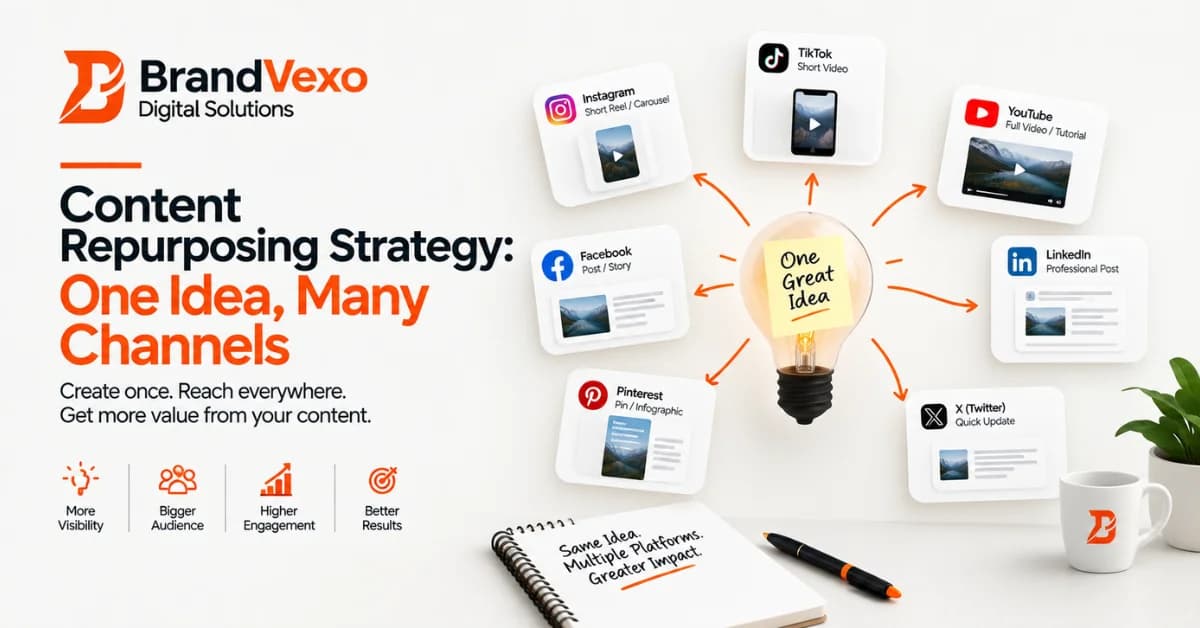 Growth
Content Repurposing Strategy: One Idea, Many Channels
Build a Content Repurposing Strategy to turn one strong idea into multi-channel content, improve distribution, and get more value from every content asset.
 Growth
AI Content for SEO: How to Use It Without Publishing Slop
Learn how to use AI content for SEO without publishing low-quality content. Explore AI writing, human editing, fact-checking, and practical SEO workflows.
 Growth
Blog SEO: How to Turn Articles Into Organic Growth
Learn how Blog SEO can turn useful articles into organic growth with search intent, content optimization, internal linking, measurement, and content refreshes.