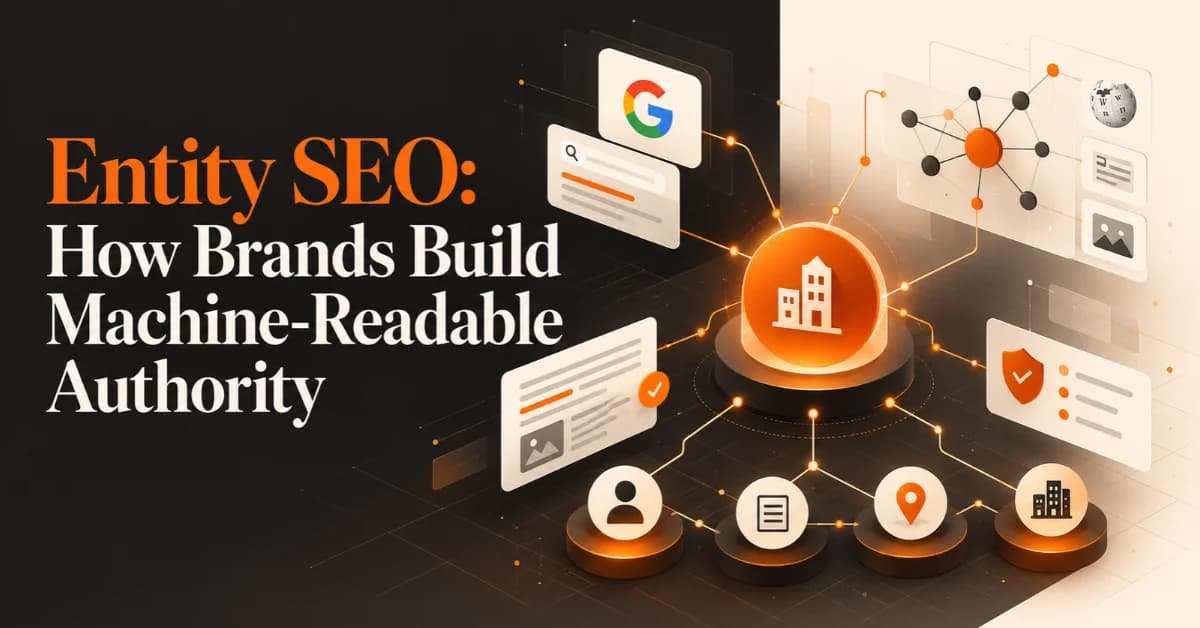
Entity SEO: How Brands Build Machine-Readable Authority
Search engines are becoming better at understanding entities, relationships, context, and real-world organizations. That means ranking for a keyword is no longer the only consideration for brands that want sustainable search visibility. Search engines also need to understand who a brand is, what it does, where it operates, and how its website relates to other information across the web. This is where Entity SEO becomes important.
Entity SEO focuses on making a business easier for search engines and AI systems to identify, interpret, and connect with related information. It brings together clear brand information, structured data, consistent profiles, authoritative mentions, and meaningful relationships between people, organizations, products, and services.
For example, a digital agency should not only target keywords such as “SEO agency” or “digital marketing services.” Its website should also clearly communicate the organization's identity, services, location, people, website, and official profiles.
What Is Entity SEO?
Entity SEO is the practice of helping search engines understand a specific entity and its relationships with other entities.
An entity can be a:
Business or organization
Person
Product
Service
Place
Brand
Software platform
Publication
Traditional SEO often starts with keywords. Entity SEO adds another layer by asking: What does this keyword represent, and how does that thing relate to other things?
For example, “Apple” could refer to a fruit, a technology company, or another organization. Search engines use context and signals from multiple sources to determine which entity a query refers to.
For businesses, this means establishing a consistent and recognizable digital identity matters.
Entity SEO vs. Traditional Keyword SEO
Keyword SEO focuses heavily on matching content with what people search for. Entity SEO focuses on helping search systems understand the underlying subject. Consider a company offering SEO, web development, and AI automation.
A keyword-focused approach might create pages targeting:
SEO services
Web development services
AI automation services
An entity-focused approach also connects those services to one clearly defined organization. The website establishes who owns the domain, what the organization does, who its people are, where it operates, and which official profiles belong to it.
Both approaches work together. Entity SEO does not replace keyword research or content optimization. Instead, it adds stronger context around the information a website already provides.
What Is a Brand Entity?
A brand entity is a recognizable business or organization that search systems can distinguish from other organizations.
A strong digital identity usually includes consistent information such as:
Official business name
Website domain
Logo
Business description
Location
Contact information
Services or products
Founders or key people
Official social profiles
Relevant third-party references
The more consistently these signals describe the same organization, the easier it becomes to establish a coherent digital identity.
Why Entity SEO Matters for Modern Search
Search engines increasingly need to answer questions that involve context rather than simple keyword matching.
A user might search:
“Which digital marketing agency offers SEO and AI automation?”
The search system needs to understand organizations, services, relationships, and relevance to determine useful results.
This makes entity understanding increasingly important for brands competing in crowded markets.
Search Engines Need Context, Not Just Keywords
Imagine two companies using the same phrase: “AI solutions.”
That phrase alone does not explain:
Which company offers the service
What type of AI solution it provides
Where it operates
Who runs the business
Whether the company has relevant expertise
Which website represents the official organization
Clear entity signals provide additional context.
This is particularly useful for businesses with common names, multiple locations, several services, or a large online presence.
Entity Understanding and AI Search
AI-powered search experiences also need to interpret information from different sources and connect concepts.
However, businesses should avoid treating Entity SEO as an “AI ranking trick.” There is no guaranteed schema property that automatically places a company in AI-generated answers.
A better strategy is to create accurate, well-structured, trustworthy information that clearly establishes the organization's identity.
That means investing in fundamentals rather than chasing an artificial shortcut.
How Search Engines Build an Understanding of a Brand
Search engines can encounter information about a business in many places.
A company's website may identify its services and leadership. Its social profiles may provide additional information. Industry websites, news publications, directories, and other authoritative sources may mention the organization.
Together, these references can contribute to a broader understanding of the entity.
The Role of the Knowledge Graph
A knowledge graph represents information as entities and relationships.
Think of it as a network:
Brand → Founder → Services → Products → Location → Website → Official Profiles
Instead of viewing each piece of information independently, an entity-based approach considers how those pieces relate.
For example:
BrandVexo → Digital Solutions → SEO → Web Development → AI Automation
The important point is that businesses do not simply “create a knowledge graph” by adding schema to their website. Search systems independently build and maintain their understanding of entities from available information.
Your role is to provide clear, accurate, consistent signals.
Entity Signals Search Engines Can Connect
Important brand signals can include:
Official website and domain
Business name
Logo
Organization information
Business address
Contact details
Founder or leadership information
Services and products
Official social profiles
Relevant business listings
Industry publications
News coverage
Expert contributions
Partnerships and legitimate third-party mentions
Consistency matters more than simply creating a large number of profiles.
Organization Schema: The Foundation of Brand Entity Signals
Organization schema is a form of structured data that provides machine-readable information about an organization. Google explains that Organization structured data can help it better understand an organization's administrative details and distinguish it from other organizations. Google also recommends adding relevant properties rather than treating schema as a fixed checklist.
What Is Organization Schema?
Structured data gives search engines explicit information about what a page represents.
For an organization, this can include:
Organization name
Website
Logo
Description
Address
Telephone
Email
Business identifiers
Social or other authoritative profile URLs
JSON-LD is the recommended structured-data format in Google's general guidance.
Organization markup generally belongs on the homepage or a page that describes the organization, such as an About page. Google says it does not need to be placed on every page.
Important Organization Schema Properties
Depending on the organization and what information is genuinely applicable, useful properties can include:
@typenamealternateNameurllogodescriptionsameAsaddresstelephoneemailcontactPointfounderlegalNameRelevant business identifiers
The correct properties depend on the actual organization. Businesses should never add information simply because a schema generator offers the field.
How sameAs Helps Connect Brand Profiles
The sameAs property can identify external pages that unambiguously represent the same organization.
For example, a company could connect its official website with genuine organizational profiles on relevant platforms.
Schema.org describes sameAs as a URL pointing to a reference page that clearly identifies the same item.
The important word is unambiguously.
Do not use sameAs to link every website that mentions your company. It should represent genuine identity relationships.
Structured Data Is Not the Same as Entity Authority
Adding structured data is useful, but it does not automatically create authority.
Structured data communicates information in a machine-readable format. Entity SEO is broader.
A strong entity strategy can combine:
Accurate structured data
Consistent brand information
Helpful website content
Strong About and Contact pages
Clear service descriptions
Authoritative external references
Genuine brand mentions
Relevant business profiles
Clear relationships between people, services, products, and the organization
Google also states that correctly implemented structured data does not guarantee that a particular search feature will appear.
Why Adding Schema Alone Is Not Enough
Schema cannot repair a confused brand identity.
For example, suppose a company uses three different business names across its website and social profiles. Its phone number changes between directories, and its website does not clearly explain who owns the organization.
Adding Organization schema will not magically solve those inconsistencies.
The better approach is to establish a consistent identity first and then represent that identity accurately with structured data.
How to Build a Strong Brand Entity Step by Step
1. Establish One Consistent Brand Identity
Start with the basics.
Use a consistent:
Business name
Domain
Logo
Description
Contact information
Location
Social profile identity
If a legal business name and public-facing brand name differ, explain the relationship clearly rather than using inconsistent versions randomly.
2. Create a Strong About Page
Your About page should make the organization easy to understand.
Explain:
Who the company is
What it does
Who it serves
Where it operates
What expertise it provides
Who leads the organization
What makes its approach different
Avoid turning the page into a collection of vague marketing claims. Specific, verifiable information provides more useful context.
3. Implement Accurate Organization Schema
Add relevant Organization structured data to the appropriate page. Use information that matches the visible content and actual organization. Google recommends validating structured data and using tools such as the Rich Results Test and URL Inspection to check implementation.
4. Connect Related Entities
Create meaningful relationships between relevant pages.
For example:
Organization → Founder → Author Profile → Services → Case Studies → Website
A service page should clearly identify the organization providing the service. Author pages can establish the people behind content where appropriate.
5. Keep Brand Information Consistent Across the Web
Review important external profiles and listings.
Check:
Company name
Website
Logo
Address
Phone number
Description
Social profiles
Fix significant inconsistencies rather than creating hundreds of new listings simply for SEO purposes.
6. Build Genuine Third-Party Mentions
A brand becomes more recognizable when relevant, independent websites discuss it.
Potential sources include:
Industry publications
Business associations
Relevant news websites
Expert interviews
Partnerships
Conference profiles
Legitimate directories
Original research and data
Focus on relevance and credibility rather than volume.
Entity SEO for Local and UAE Businesses
Entity SEO can be particularly useful for businesses operating in competitive local markets such as the UAE. A UAE company may appear across its own website, Google Business Profile, LinkedIn, industry directories, media websites, and other business platforms.
Keeping core information consistent helps establish a clearer digital identity.
For example, a UAE digital agency should make it easy to determine:
Its official business name
Website
Main services
Operating location
Contact information
Official social profiles
Organization details
Example: A UAE Digital Agency Building Its Brand Entity
Imagine an agency that has:
“ABC Digital” on its website
“ABC Digital Marketing LLC” on LinkedIn
A different phone number on a directory
An outdated address on another platform
No clear About page
No Organization structured data
The problem is not simply a missing schema tag.
The organization has a consistency problem.
A stronger approach would establish the official brand identity, update important profiles, create a clear About page, implement relevant structured data, and build credible external references.
The goal is to make the organization easier to identify and understand—not to manufacture authority.
Common Entity SEO Mistakes That Weaken Brand Authority
Inconsistent Business Information
Different names, addresses, phone numbers, or descriptions can make a brand harder to distinguish.
Using the Wrong Schema Type
Use the most appropriate Schema.org type for the actual organization. Google recommends using the most specific applicable Organization subtype and following additional guidance for businesses such as LocalBusiness where relevant.
Fake or Irrelevant sameAs Profiles
Only connect profiles that genuinely represent the same organization.
Creating Thin Entity Pages
Creating dozens of low-value pages for founders, locations, or services does not automatically strengthen entity authority.
Every page should serve a genuine user need.
Treating Schema as a Ranking Shortcut
Structured data can help search engines interpret information, but it is not a shortcut around useful content, technical SEO, credibility, or search quality.
Entity SEO Checklist for Brands
Use this checklist when auditing your brand entity.
Brand Identity
Consistent official brand name
Official website and domain
Consistent logo
Clear business description
Consistent contact information
Website
Strong About page
Clear Contact page
Detailed service or product pages
Consistent organization information
Logical internal linking
Structured Data
Relevant Organization schema
Accurate JSON-LD
Correct
sameAsreferencesSchema matches visible content
No misleading properties
External Signals
Official social profiles
Relevant business listings
Industry mentions
Legitimate media coverage
Consistent external information
How to Measure Entity SEO Progress
Entity SEO does not have one universal “authority score” that tells you whether your strategy works.
Instead, monitor several meaningful indicators.
Look at:
Branded search growth
Brand-related search queries
Knowledge Panel presence where applicable
Consistency across important profiles
Relevant brand mentions
Organic visibility for entity-related topics
Traffic to important brand pages
Structured-data validation
Search Console performance
Search appearance changes
Google recommends Search Console for monitoring how websites perform in Google Search, while structured-data tools can help validate implementation.
What Not to Measure
Avoid using these as your primary success metrics:
Number of schema properties
Number of directory submissions
Number of pages with schema
Raw brand mentions without relevance
Guaranteed AI citations
More markup does not necessarily mean better entity understanding.
Entity SEO vs. Structured Data: What Is the Difference?
These terms are connected, but they are not interchangeable.
Entity SEO is the broader strategy for helping search engines understand a brand and its relationships.
Structured data is a machine-readable format that communicates information about webpage content and entities.
Organization schema describes an organization using structured data.
Knowledge graph refers to connected information about entities and their relationships.
Brand entity refers to the identifiable organization that search systems can distinguish and associate with related information.
Understanding these differences helps prevent businesses from treating schema as the entire Entity SEO strategy.
The Future of Entity SEO in AI Search
Search is moving toward experiences that require stronger contextual understanding.
Users increasingly ask complex questions instead of entering short keyword phrases. AI-powered search experiences also need to interpret relationships between organizations, people, products, services, and topics.
That makes a clear digital identity increasingly valuable.
Businesses should therefore focus on fundamentals:
Publish accurate information.
Clearly explain who the organization is.
Build useful service and product pages.
Connect related entities logically.
Keep important business information consistent.
Use structured data accurately.
Earn legitimate third-party recognition.
The strongest Entity SEO strategy is not about manipulating an algorithm. It is about creating a digital presence that makes sense to both humans and machines.
FAQs
What is Entity SEO?
Entity SEO is the practice of helping search engines understand a specific entity, such as a business, person, product, or organization, and its relationships with other entities. It combines clear content, consistent identity signals, structured data, and relevant external references.
How does Entity SEO differ from traditional SEO?
Traditional SEO often focuses on keywords, search intent, content, links, and technical optimization. Entity SEO adds a focus on understanding the underlying people, organizations, products, services, and relationships represented by that content.
What is organization schema?
Organization schema is structured data that describes an organization in a machine-readable format. Relevant information can include the organization's name, website, logo, address, contact details, description, and other applicable identifiers or profiles.
Does organization schema improve Google rankings?
Not automatically. Google says structured data can help it understand page content and may support certain search features, but correctly implemented structured data does not guarantee a specific search appearance or ranking improvement.
What is a knowledge graph in SEO?
A knowledge graph represents entities and relationships between them. In practical SEO terms, it helps explain why search engines need to understand connections between organizations, people, products, services, locations, and other entities.
How can a business become a recognizable brand entity?
Start with a consistent brand identity, a strong official website, clear About information, accurate structured data, consistent business profiles, relevant third-party mentions, and clear relationships between the organization and its people, products, and services.
Does Entity SEO help with AI search?
Clear entity information can make it easier for search and AI systems to interpret a business and its content. However, there is no guaranteed Entity SEO technique that ensures inclusion or citation in AI-generated search results. Businesses should focus on accurate, useful, authoritative information rather than attempting to manipulate AI systems.
How BrandVexo Can Help!
BrandVexo helps businesses build practical digital growth systems across digital marketing, SEO, web development, AI automation, and business solutions. Our approach focuses on solving audience problems and connecting digital activity with measurable commercial outcomes rather than chasing vanity metrics.
We can support businesses with SEO, web development, digital marketing, AI automation, social media management, content strategy, and personal or business branding.
For practical digital growth support, contact BrandVexo Digital Solutions:
Phone: +971 52 356 5409
Email: info@brandvexo.com
Website: www.brandvexo.com
Final Takeaway
Entity SEO expands the way businesses think about search visibility.
Instead of asking only, “Which keyword should we rank for?”, brands should also ask:
“Can search engines clearly understand who we are, what we do, and how our information connects across the web?”
Organization schema and structured data can provide useful machine-readable clues. A clear About page can establish organizational context. Consistent profiles can reduce ambiguity. Relevant third-party mentions can provide additional evidence.
Together, these elements create a stronger and more coherent digital identity.
For businesses preparing for modern search and AI-driven discovery, the goal should not be to find a shortcut. The goal is to make the brand clear, consistent, credible, and easy to understand.
Disclaimer: Search engines continuously update how they interpret and display structured data and entity information. This article provides general SEO guidance and does not guarantee rankings, Knowledge Panel visibility, or inclusion in AI-generated search results.
Free growth plan
Ready to grow your business?
Reading is a start — now let's build it. Tell us where you want to grow and a senior strategist will map the fastest, most profitable way to get there. Free, no obligation.
Discussion
Join the conversation
Be the first to comment. Comments are reviewed before they appear, so yours won't show up instantly — but we read every one.
Leave a comment
Keep reading
All articles Growth
Google Ads Management for B2B Teams | BrandVexo
Google Ads Management helps B2B teams attract qualified leads, improve campaign performance, track sales pipeline, and measure advertising ROI.
 Growth
Managed IT Services for Small Businesses: A Guide
Explore IT services for small businesses, including managed IT support, cybersecurity, cloud management, backups, costs, and provider selection tips.
 Growth
Core Web Vitals for Business Websites: Guide for Consultants
How Core Web Vitals affect consulting websites, SEO and B2B leads. Explore LCP, INP, CLS, testing tools and practical performance fixes.