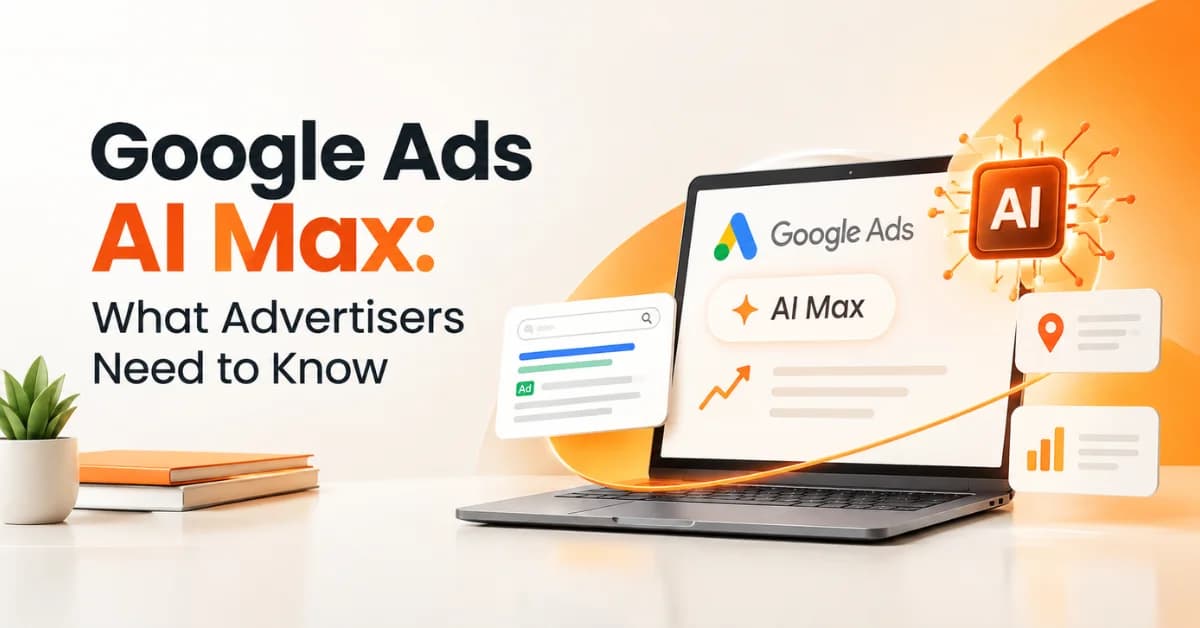
Google Ads AI Max: What Advertisers Need to Know
Google Ads is moving further toward AI-powered Search advertising, and Google Ads AI Max is one of the biggest changes advertisers need to understand. AI Max for Search campaigns brings together AI-powered capabilities for search-term matching, ad asset optimization, and landing-page expansion to help advertisers reach relevant customers beyond traditional keyword-based targeting.
For advertisers, the opportunity is significant, but so is the need for careful campaign management. More automation does not automatically mean better results. Your conversion tracking, website content, ad assets, campaign goals, and data quality still influence how effectively Google's systems can optimize a campaign.
What Is Google Ads AI Max?
Google Ads AI Max is a suite of AI-powered features for Search campaigns. It is designed to help advertisers expand relevant search reach and improve the relevance of ads and landing pages based on user intent.
Rather than relying only on manually selected keywords and fixed ad messaging, AI Max can use signals from existing keywords, creative assets, website content, and URLs to identify additional relevant opportunities.
The important point is that AI Max is not simply another bidding strategy. It affects several parts of a Search campaign.
How AI Max for Search Works
AI Max brings together capabilities that can influence:
Search-term matching
Ad text and asset optimization
Final URL expansion
Search intent interpretation
Brand and location controls
Performance reporting
Google says AI Max search-term matching can expand beyond existing keywords using broad match and keywordless technology. It can use campaign inputs such as keywords, creatives, and URLs to identify relevant searches that may otherwise be missed.
This creates a shift in how advertisers should think about Search advertising. Instead of treating a keyword list as the complete definition of targeting, advertisers increasingly need to think about the broader intent behind a customer's search.
What Changes When You Use AI Max in Search Campaigns?
AI Max can change how Google finds searches, creates messaging, and selects landing pages for users. That makes campaign inputs more important than ever. Advertisers need to give Google's systems accurate information and then monitor the outcomes.
Broader Search Query Matching
Traditional Search campaigns often revolve around carefully selected keyword themes and match types. AI Max can expand search-term matching to find additional relevant queries. This can help advertisers capture demand that does not perfectly match the wording of their existing keywords.
For example, a company targeting the keyword "website development Dubai" might have customers searching in many different ways, such as questions about building a business website, redesigning an existing site, or hiring a Dubai web development company.
AI-powered matching can help identify relevant variations and intent signals.
However, broader reach also creates a responsibility to monitor traffic quality. More impressions and clicks do not necessarily mean more valuable customers.
AI-Powered Ad Text and Asset Optimization
AI Max also includes asset optimization. Its text customization capability can generate additional headlines and descriptions based on information such as the advertiser's website, landing pages, existing ads, and keywords.
This allows Google to tailor ad messaging to different searches.
Advertisers should still provide strong original assets. Clear value propositions, accurate claims, relevant services, and consistent brand messaging give the system better material to work with.
AI should support the creative strategy rather than replace it.
Landing Page Expansion
AI Max can also use Final URL expansion to direct users to relevant pages on an advertiser's website. Instead of always sending every user to one fixed landing page, Google can select a page it predicts will provide a more relevant experience for the user's search.
This makes website architecture increasingly important.
If a business has multiple well-written service pages, clear navigation, and strong conversion paths, AI-powered landing-page selection has more useful content to work with.
Google Ads AI Max vs Traditional Search Campaigns
The biggest difference is the balance between manual control and AI-assisted optimization.
Traditional Search management often puts more emphasis on keyword lists, manually written ad variations, and predetermined landing pages. AI Max introduces more automation across those areas.
More Manual Control vs More Automation
Automation can save time, but advertisers should understand what they are giving the system permission to optimize. AI Max can make decisions about matching searches, adapting ad assets, and selecting relevant landing pages. That does not mean advertisers lose all control. Google provides controls for areas such as brand associations and locations of interest, while reporting tools provide more visibility into search terms, assets, and landing pages.
The practical approach is to automate repetitive decisions while keeping control over important business and brand boundaries.
From Keywords to Search Intent
One of the biggest strategic changes is the growing importance of search intent. A keyword is still useful, but it should represent a broader customer need rather than being treated as an isolated phrase.
For example, a business selling accounting software should think beyond individual keywords and understand whether someone wants to compare software, request a demo, check pricing, or solve a specific accounting problem.
That intent-based thinking helps advertisers create better campaigns and landing pages.
Advertiser Inputs Still Matter
Google Ads automation works best when advertisers provide reliable inputs.
Important inputs include:
Accurate conversion tracking
Relevant keywords and campaign themes
High-quality ad assets
Useful website content
Strong landing pages
Clear conversion goals
Appropriate audience and location settings
Relevant exclusions and brand controls
Automation does not remove the need for strategy. It changes where strategic work happens.
Key Benefits of Google Ads AI Max
AI Max can create several opportunities for advertisers, particularly businesses that want to expand Search reach without managing every variation manually.
Reach More Relevant Searches
AI-powered matching can help advertisers identify searches that may not appear in their original keyword lists. This can be useful when customers use different terminology, longer queries, conversational wording, or unexpected ways of describing the same need.
Improve Ad Relevance
AI-powered asset optimization can create additional combinations of messaging based on search context. When the underlying website and advertising information are accurate, this can help make ad messaging more relevant to individual searches.
Simplify Campaign Management
Google Ads automation can reduce some repetitive campaign-management tasks. Instead of manually creating every possible keyword variation, headline variation, or landing-page combination, advertisers can allow Google's systems to handle more of the optimization process. This can free marketers to spend more time on strategy, positioning, creative direction, and conversion quality.
Optimize Toward Business Outcomes
The real objective should not be generating more traffic. For a lead-generation business, success might mean more qualified enquiries. For an ecommerce company, it may mean profitable sales and conversion value. AI Max should therefore be evaluated against meaningful business objectives rather than impressions or clicks alone.
What Are the Risks and Limitations of AI Max?
AI-powered advertising is not risk-free. Advertisers should understand the trade-offs before relying heavily on automation.
Less Granular Manual Control
The more decisions Google makes automatically, the less control advertisers may have over individual targeting and creative combinations. This can be beneficial for scale, but businesses with highly specific targeting requirements may need to use available controls carefully.
Irrelevant Search Traffic
Broader matching can create opportunities, but advertisers still need to monitor search quality. A campaign can receive more clicks while generating fewer qualified leads. This is why advertisers should evaluate search terms alongside conversions and lead quality instead of focusing only on traffic volume.
Dependence on Conversion Data
Automation needs meaningful signals. If a campaign counts every form submission as an equally valuable conversion, Google may optimize toward quantity rather than business value. Advertisers should review which actions represent genuine business outcomes and, where appropriate, connect qualified or offline conversion data to the advertising system.
Brand and Messaging Concerns
AI-generated or AI-assisted ad assets still need human oversight. Google's documentation recommends monitoring generated content for accuracy, while advertisers remain responsible for ensuring their website and advertising information is accurate and compliant with applicable policies.
Businesses should therefore review messaging regularly and remove or adjust content that does not reflect their brand.
How to Prepare a Search Campaign for AI Max
Before increasing automation, fix the fundamentals.
Audit Your Conversion Tracking
Start by checking whether your conversion actions accurately represent business value.
Review:
Primary conversion actions
Secondary conversions
Duplicate conversions
Lead quality
Sales or revenue tracking
Offline conversion data where relevant
If the data going into the system is weak, automation may optimize toward the wrong outcome.
Review Your Keyword and Search-Term Data
Look at the searches that have historically generated valuable customers.
Identify:
High-value search themes
Irrelevant queries
Low-quality traffic
Strong commercial intent
Brand-related searches
Location-specific demand
This gives you a better understanding of where AI-powered expansion could create opportunities and where tighter controls may be necessary.
Improve Your Ad Assets
Provide Google with useful material to work with.
Your headlines and descriptions should clearly communicate:
What you offer
Who you serve
Why customers should choose you
Your strongest differentiator
The next action users should take
Avoid vague claims that AI-generated variations could amplify.
Strengthen Landing Pages
Your landing pages should directly address the user's intent.
Check that each important page has:
A clear headline
Relevant information
Strong internal navigation
A visible call to action
Mobile-friendly design
Fast loading performance
Trust signals
Accurate business information
The better your website content, the more useful it can become as an input for AI-powered campaign optimization.
Best Practices for Using Google Ads AI Max
Advertisers can use the following principles when testing AI Max:
Define a clear conversion objective before enabling additional automation.
Make sure conversion tracking accurately reflects business outcomes.
Use strong, accurate ad assets.
Keep landing pages closely aligned with search intent.
Monitor search-term relevance and conversion quality.
Use available brand and location controls where appropriate.
Review generated ad assets regularly.
Measure qualified leads or revenue rather than clicks alone.
Establish a performance baseline before making major changes.
Avoid changing multiple campaign variables at the same time.
Give campaigns enough time and data to evaluate meaningful trends.
The goal is not to automate everything. The goal is to automate the right things while maintaining strategic oversight.
How to Measure AI Max Performance
Measuring AI Max requires more than checking whether traffic increased.
Look Beyond Clicks and CTR
Useful performance indicators can include:
Conversion rate
Cost per conversion
Qualified lead rate
Conversion value
Return on ad spend
Customer acquisition cost
Revenue
Sales quality
The right metrics depend on the business model.
For example, a B2B company might receive 100 leads from a campaign, but only 15 may meet its sales criteria. In that situation, lead quality matters more than the total number of form submissions.
Compare Before and After Carefully
Establish a baseline before making a major campaign change.
Then consider:
Previous conversion performance
Cost per qualified lead
Conversion value
Search-term quality
Budget changes
Seasonality
Changes to landing pages
Changes to conversion tracking
Avoid declaring success or failure based on a few days of data.
Monitor Search Terms, Assets and Landing Pages
Google provides reporting options for AI Max that can help advertisers review search terms, keywords, assets, and landing pages. Google also highlights reporting around headline and landing-page combinations and asset performance.
This reporting is important because advertisers should understand not only whether performance changed, but also what contributed to that change.
Is Google Ads AI Max Right for Every Advertiser?
No. AI Max can be useful, but it should fit the campaign's goals, data quality, and level of control required.
AI Max May Make Sense When
You want to expand relevant Search reach.
Your conversion tracking is reliable.
Your campaigns have useful performance data.
Your website has strong, relevant content.
You are comfortable with greater automation.
You can monitor performance regularly.
You May Need More Caution When
Conversion tracking is inaccurate.
Your campaign has very limited data.
Your targeting requirements are extremely narrow.
Your landing pages need significant improvement.
Brand controls are especially important.
Your budget cannot tolerate inefficient experimentation.
AI Max should be treated as a strategic test rather than an automatic solution for every Search campaign.
Google Ads AI Max for Small and UAE Businesses
For UAE businesses, the value of AI Max can depend heavily on the quality of local targeting, website content, and lead qualification. Consider a Dubai-based digital services company running a Search campaign for business enquiries. Instead of targeting only a small list of exact phrases, the company could structure its campaign around broader commercial intent. It could provide strong service pages, clear ad assets, accurate conversion tracking, and meaningful lead-generation goals.
The business could then monitor which search themes generate qualified enquiries and which produce low-value traffic.
What UAE Advertisers Should Consider
Local businesses should pay attention to:
Dubai or UAE-specific search intent
Service-area targeting
English and Arabic search behaviour where relevant
High-value enquiries
Lead qualification
Landing-page localization
Accurate conversion tracking
Clear business information
For a consultancy, web agency, accounting firm, or business setup provider, the number of enquiries alone may not tell the complete story. The quality and commercial value of those enquiries matter.
AI Max can help with reach and optimization, but the business still needs a clear definition of what a valuable customer looks like.
Frequently Asked Questions
What is Google Ads AI Max?
Google Ads AI Max is a suite of AI-powered features for Search campaigns. It can expand search-term matching, optimize ad assets, and use Final URL expansion to connect users with potentially more relevant pages on an advertiser's website.
Is AI Max available for Google Search campaigns?
Yes. AI Max is designed for Search campaigns and brings together several AI-powered capabilities that can improve reach, creative relevance, and landing-page selection.
Is AI Max the same as Google Ads automation?
Not exactly. Google Ads automation covers many different automated features, including bidding and campaign optimization. AI Max is a specific suite of capabilities focused on expanding and optimizing Search campaigns.
Does AI Max replace keywords?
AI Max changes the role keywords play rather than simply eliminating them. Google can use existing keywords together with broader matching and keywordless technology to identify relevant searches.
Does AI Max guarantee better Google Ads performance?
No. AI Max can create additional opportunities for reach and optimization, but results depend on factors such as conversion data, campaign structure, website quality, creative assets, budget, competition, and business goals.
Should small businesses use AI Max?
Small businesses can consider AI Max when they have reliable conversion tracking, clear goals, good landing pages, and the ability to monitor campaign quality. Businesses with limited data or highly restrictive targeting requirements may need a more cautious approach.
How should advertisers measure AI Max?
Advertisers should focus on meaningful outcomes such as qualified leads, sales, conversion value, cost per acquisition, revenue, and return on ad spend where appropriate. Clicks and impressions can provide context but should not be the primary measure of business success.
Final Takeaway
Google Ads AI Max represents a broader shift toward AI-powered Search advertising. It can help advertisers discover additional search opportunities, adapt ad messaging, and connect users with relevant website pages. But automation does not remove the need for good marketing strategy.
The strongest approach is to give Google accurate conversion signals, useful creative assets, relevant landing pages, and clear business goals. Then use reporting to understand what the automation is actually doing.
About BrandVexo Digital Solutions
BrandVexo Digital Solutions helps businesses build practical digital growth systems across digital marketing, SEO, web development, AI automation, and business solutions. Our approach focuses on measurable business outcomes rather than vanity metrics.
For businesses exploring Google Ads automation, PPC strategy, conversion tracking, or broader digital growth, we focus on understanding the business objective first and then building a practical strategy around it.
Phone: +971 52 356 5409
Email: info@brandvexo.com
Website: www.brandvexo.com
Disclaimer: Google Ads features, availability, controls, and policies can change over time. Always review the latest Google Ads documentation and your account-specific settings before making campaign changes.
Free growth plan
Ready to grow your business?
Reading is a start — now let's build it. Tell us where you want to grow and a senior strategist will map the fastest, most profitable way to get there. Free, no obligation.
Discussion
Join the conversation
Be the first to comment. Comments are reviewed before they appear, so yours won't show up instantly — but we read every one.
Leave a comment
Keep reading
All articles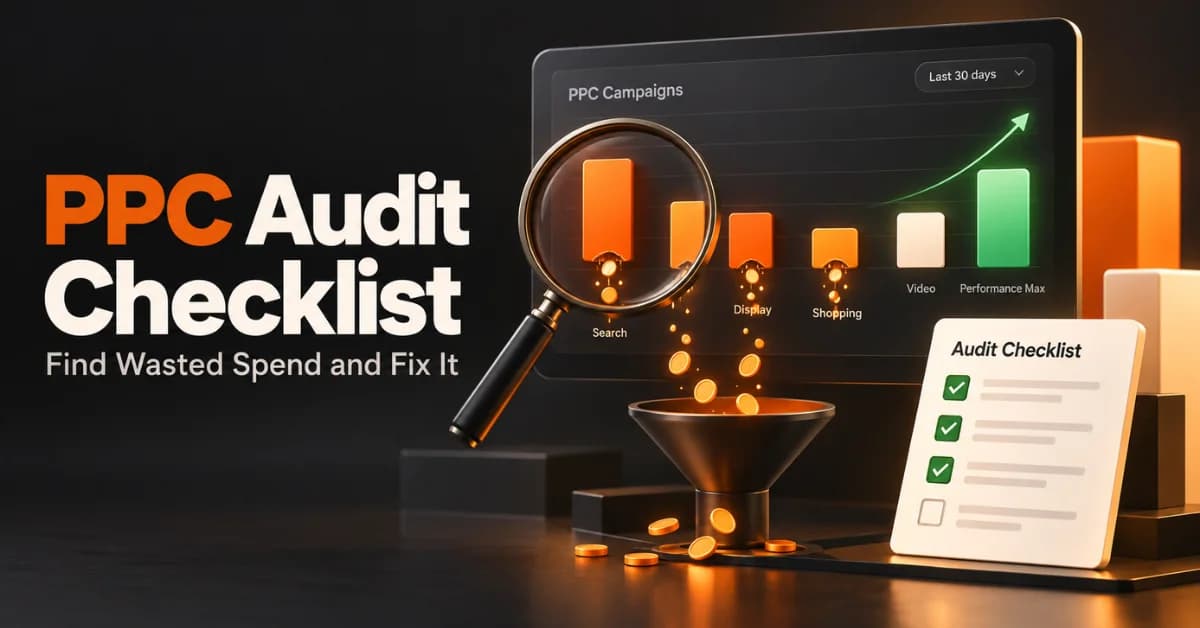 Paid Ads
PPC Audit Checklist: Find Wasted Spend and Fix It
Use this PPC Audit Checklist to find wasted ad spend, review Google Ads performance, fix targeting issues, and improve PPC optimization.
 Paid Ads
Google Ads Dubai: Costs, Strategy and Agency Options
Explore Google Ads Dubai costs, PPC strategy, budgeting, tracking, and agency options to build campaigns that attract qualified leads and sales.
 Paid Ads
Retargeting Strategy: How to Win Back High-Intent Visitors
Build a smarter Retargeting Strategy with practical tips for remarketing, Meta retargeting, Google remarketing, funnel targeting, and conversions.