

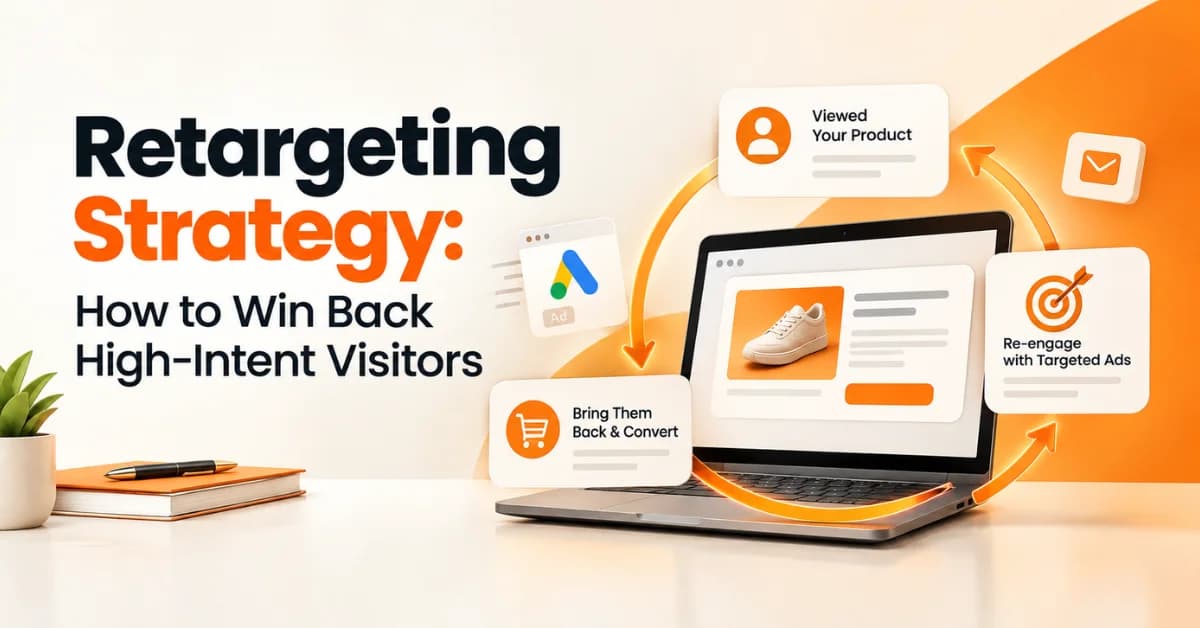
Retargeting Strategy: How to Win Back High-Intent Visitors
Getting someone to visit your website is only the first step. Many visitors browse a service page, compare options, check pricing, or add a product to their cart and then leave without converting. That does not always mean they have lost interest. Often, they simply need more information, another reminder, or a stronger reason to take action. A well-planned retargeting strategy helps businesses reconnect with these previous visitors through relevant advertising. Instead of treating every visitor as a new prospect, retargeting uses previous interactions to create more relevant follow-up messages.
This approach can include remarketing, Meta retargeting, Google remarketing, and funnel retargeting. The goal is not to repeatedly show the same advertisement. The goal is to understand visitor intent and give people a useful next step.
What Is a Retargeting Strategy?
A retargeting strategy is a structured approach to reaching people who have previously interacted with a business, website, app, or advertising campaign.
For example, imagine someone visits a company's web development page, reads the service details, and leaves without submitting a contact form. A retargeting campaign can later show that person an advertisement related to web development rather than a generic company advertisement.
Google Ads allows advertisers to create audience segments that include previous website visitors and refine those segments using actions and page-based rules.
The important part is relevance. A strong strategy considers what the visitor did before deciding what they should see next.
Retargeting vs Remarketing: What Is the Difference?
The terms retargeting and remarketing are often used interchangeably, but marketers sometimes use them differently.
Retargeting commonly refers to paid advertising aimed at people who have already interacted with a website, app, or brand.
Remarketing can describe a broader re-engagement approach, including advertising and customer communication such as email.
Google's current Ads terminology increasingly uses “your data” segments for audiences based on previous interactions with a business, although “remarketing” remains widely used in marketing discussions.
For practical marketing purposes, the key idea is simple: reconnect with people who already showed some level of interest.
Why Retargeting Works for High-Intent Visitors
Not every website visitor has the same level of buying intent.
Someone who reads a blog post for two minutes may still be researching. Someone who visits pricing, checks a product, and starts checkout has demonstrated much stronger intent.
High-intent signals can include:
Visiting a pricing page
Viewing a specific product or service
Returning to the website multiple times
Adding a product to a cart
Starting a lead form
Visiting a contact page
Watching a significant portion of a product video
Engaging with previous advertisements
These actions can help marketers create more relevant audience segments instead of delivering one generic message to everyone.
Which Visitors Should You Retarget?
A good retargeting strategy starts with segmentation. The objective is not simply to collect as many previous visitors as possible. It is to understand why they visited and what they might need next.
Product or Service Page Visitors
A visitor who views a specific service has already expressed an interest in that subject.
For example, a digital agency could create a separate audience for people who viewed its SEO service page. Instead of showing them a general branding advertisement, the campaign could promote an SEO case study, service benefit, or consultation.
Pricing and High-Intent Page Visitors
Pricing-page visitors deserve special attention because they are often evaluating whether the offer fits their needs and budget.
A suitable retargeting message could answer common objections instead of simply repeating the price.
For example:
Previous action: Viewed pricing page
Possible concern: “Is this service right for my business?”
Retargeting message: Case study, service comparison, or consultation
CTA: Discuss your requirements
Cart and Form Abandoners
Cart abandonment is one of the clearest retargeting opportunities in eCommerce.
Lead-generation businesses can use a similar approach for visitors who begin but do not complete a form.
The message should remove friction rather than pressure the user. A reminder, product benefit, FAQ, testimonial, or simpler next step may work better than an aggressive discount.
Engaged Visitors Who Did Not Convert
Some visitors show meaningful engagement without reaching a traditional conversion point.
Businesses can consider segments based on:
Returning visitors
Multiple-page sessions
Content engagement
Video engagement
Social interactions
Previous ad engagement
These audiences can receive educational or trust-building content before the business asks for a conversion.
Build a Retargeting Funnel Instead of Showing the Same Ad to Everyone
One of the biggest weaknesses in basic retargeting campaigns is treating every visitor as if they were at the same stage of the buying journey.
Funnel retargeting solves this by changing the message according to visitor intent.
Top-of-Funnel Retargeting
These users may know the brand but have not demonstrated strong buying intent.
Useful content includes:
Educational guides
Helpful videos
Problem-focused content
Industry insights
Introductory case studies
The goal is to build familiarity and answer early questions.
Middle-of-Funnel Retargeting
These visitors have shown more interest and may be comparing solutions.
Consider using:
Customer testimonials
Detailed case studies
Product demonstrations
Service comparisons
FAQs
Feature explanations
Objection-handling content
The CTA can remain relatively low-pressure, such as viewing a case study or discussing requirements.
Bottom-of-Funnel Retargeting
These users have demonstrated strong intent.
Examples include people who:
Viewed pricing
Added a product to cart
Started checkout
Visited a contact page
Started a lead form
Here, the campaign can use a direct CTA such as requesting a quote, completing a purchase, booking a consultation, or starting a trial.
The basic framework is:
Previous behavior → relevant message → appropriate CTA
Meta Retargeting: How to Re-Engage Social Media Audiences
Meta retargeting can help businesses reconnect with people who previously interacted with their website or Meta properties.
Instead of building one broad audience, marketers should match the advertisement to the person's previous interaction.
Audiences to Consider for Meta Retargeting
Depending on the campaign and available platform features, businesses can build audiences around interactions such as:
Website activity
Social media engagement
Video engagement
Lead interactions
Previous customers
Other permitted first-party data sources
The exact audience options and eligibility can change, so campaign settings should always be checked against current Meta requirements before launch.
Match the Ad to the Visitor's Previous Action
Consider a simple example.
A visitor lands on a web development service page but leaves without contacting the business.
Showing a generic “Grow Your Business” advertisement wastes the information already available about their interest.
A stronger approach would be:
Previous action: Web development page visit
Retargeting creative: Website transformation case study
Message: Show how a better website can improve user experience and conversions
CTA: Discuss your website project
This makes the ad feel like a continuation of the visitor's journey.
Google Remarketing: Reach Users Across Their Buying Journey
Google remarketing allows businesses to reconnect with people who previously interacted with their website, app, or other Google-related properties.
Google currently describes these audiences as your data segments. Businesses can create segments for previous website visitors and use different rules to refine who belongs in each audience.
Google also supports using previous visitors in Search campaigns, allowing advertisers to tailor ads or bidding strategies for people who have already interacted with the website.
Use Different Google Audiences for Different Intent Levels
For example:
General website visitors → educational message
Service-page visitors → service-specific message
Pricing visitors → objection-handling message
Cart abandoners → product reminder
Previous customers → relevant cross-sell or retention message
For businesses with products or services that can be matched to previous browsing behavior, Google's dynamic remarketing capabilities can also tailor ads around products or services users viewed.
How to Create a High-Converting Retargeting Strategy
A practical campaign does not need dozens of audiences at the beginning. Start with the audiences that represent the clearest business value.
Step 1 — Define the Conversion Goal
Decide what you want the returning visitor to do.
Possible goals include:
Purchase a product
Submit a lead form
Request a quotation
Book a consultation
Start a free trial
Schedule a demo
Make a phone call
Without a clear conversion goal, it becomes difficult to judge whether the campaign is actually working.
Step 2 — Segment Visitors by Intent
Start with a manageable structure:
All relevant visitors
Product or service viewers
High-engagement visitors
Pricing-page visitors
Cart or form abandoners
Existing customers
Google allows website visitor segments to use page and action rules, making it possible to build more specific audiences rather than relying only on an all-visitor list.
Step 3 — Set Appropriate Retargeting Windows
Recency matters.
A person who visited yesterday may have a very different level of intent from someone who visited four months ago.
A useful starting framework is:
1–7 days: Strong recent intent
8–30 days: Active consideration
31–90 days: Longer-term re-engagement
These are planning guidelines rather than universal rules. A business selling an expensive B2B service may need a longer consideration period than an online store selling low-cost products.
Step 4 — Create Message-Specific Ads
Do not create one advertisement and send it to every audience.
Instead, ask:
What did this visitor already know?
Then ask:
What information would help them take the next step?
This approach improves message relevance and can reduce unnecessary repetition.
Step 5 — Control Frequency
Seeing the same advertisement repeatedly can create ad fatigue.
Monitor frequency and campaign performance. If people continue seeing the same creative without converting, consider:
Rotating creative
Changing the message
Narrowing the audience
Shortening the campaign window
Excluding converted users
Step 6 — Exclude Converted Users
If someone already completed the main conversion, continuing to show them the same acquisition advertisement can waste budget.
Instead, move them into an appropriate customer or retention audience when relevant.
Retargeting Ad Examples for Different Visitor Types
Example 1 — eCommerce Cart Abandoner
Behavior: Added a product to the cart but did not purchase.
Better retargeting: Remind the visitor about the product and reinforce a relevant benefit.
CTA: Complete your purchase.
Example 2 — B2B Service Visitor
Behavior: Viewed a service and pricing page.
Better retargeting: Show a relevant case study, proof point, or consultation message.
CTA: Discuss your requirements.
Example 3 — SaaS Visitor
Behavior: Viewed pricing but did not start a trial.
Better retargeting: Explain a key product benefit or demonstrate how the platform solves a specific problem.
CTA: Start a trial or request a demo.
Example 4 — Local Business Visitor
Behavior: Viewed a service page but did not contact the business.
Better retargeting: Use service-specific messaging, customer proof, and a simple contact option.
CTA: Request a quote.
The common principle is simple: the visitor's previous action should influence the next message.
Common Retargeting Mistakes That Waste Ad Spend
A campaign can have technically correct tracking and still perform poorly.
Watch for these common mistakes:
Retargeting every visitor with the same advertisement
Ignoring visitor intent
Showing acquisition ads to existing customers
Using excessive frequency
Running the same creative for too long
Sending visitors to irrelevant landing pages
Using discounts when the real objection is trust
Measuring clicks without measuring conversions
Creating audiences that are too broad
Ignoring privacy and consent requirements
Assuming every returning visitor is ready to buy
Retargeting should make the customer journey more relevant, not more intrusive.
How to Measure Retargeting Campaign Performance
Clicks and impressions can provide useful context, but they do not tell the complete story.
Conversion Rate
Measure how often retargeted visitors complete the desired action.
Cost Per Conversion
Compare campaign spending with the number of meaningful conversions generated.
Return on Ad Spend
For revenue-driven campaigns, ROAS can help connect advertising costs with attributed revenue.
Frequency
Monitor how often users are exposed to your advertisements. A rising frequency combined with weak engagement can indicate creative fatigue.
View-Through and Click-Through Performance
These metrics can help explain how people interact with advertisements, but they should not replace conversion analysis.
Incremental Impact
One of the more important questions is:
Would this person have converted without the retargeting advertisement?
Attribution can overstate the value of a campaign when retargeted users were already close to converting. Businesses should therefore consider testing and broader conversion evidence instead of relying only on attributed conversions.
Retargeting Strategy and Privacy: What Businesses Should Consider
A responsible retargeting strategy should consider privacy, consent, platform rules, and applicable data-protection requirements. Tracking technologies and audience features do not work identically for every user or platform. For example, Google notes that some users who opt out of tracking may not be included in exported advertising audiences.
Businesses should therefore:
Use tracking in accordance with applicable requirements
Review platform advertising policies
Maintain appropriate privacy disclosures
Handle customer data responsibly
Avoid inappropriate targeting
Respect available consent and user choices
Marketing performance should never come at the expense of responsible data practices.
When Should You Use Retargeting?
Retargeting can be particularly useful when a business already has:
Consistent website traffic
Qualified visitors
A measurable conversion goal
A multi-step buying journey
Valuable products or services
Enough audience volume to support meaningful campaigns
It may not be the first priority for a website with very little qualified traffic.
If only a handful of people visit a website each day, building several tiny retargeting audiences may create more complexity than value. Improving qualified traffic, landing pages, conversion tracking, or the initial offer may provide a stronger foundation.
A Simple Retargeting Strategy You Can Start With
Businesses can start with four practical audience groups.
Audience 1: Recent high-intent visitors
Show a product or service-specific advertisement with a direct CTA.
Audience 2: Engaged but undecided visitors
Show a case study, testimonial, guide, or educational resource.
Audience 3: Abandoned conversions
Remind users about the action they started and remove the biggest friction point.
Audience 4: Existing customers
Use relevant cross-sell, upsell, retention, or repeat-purchase messaging where appropriate.
This structure is simple enough to manage while still recognizing that different visitors need different messages.
Final Thoughts
A successful retargeting strategy is not about following every visitor with the same advertisement. It is about using previous interactions to understand intent, segmenting audiences intelligently, and providing a relevant next step. Remarketing, Meta retargeting, Google remarketing, and funnel retargeting can all support this process when businesses use them strategically.
Frequently Asked Questions
What is a retargeting strategy?
A retargeting strategy is a plan for reconnecting with people who have previously interacted with a business through its website, app, social media, or other permitted channels. The strategy uses audience segmentation and relevant advertising to encourage the visitor to continue their customer journey.
What is the difference between retargeting and remarketing?
Retargeting usually refers to paid advertising aimed at previous visitors or users, while remarketing can describe a broader re-engagement approach. In practice, marketers often use both terms interchangeably.
How does Meta retargeting work?
Meta retargeting uses eligible audience signals from previous interactions to help businesses reconnect with people who have already engaged with their brand. Advertisers can then create messages based on the user's previous behavior and campaign objective.
What is Google remarketing?
Google remarketing refers to advertising that reconnects with people who previously interacted with a business. Google now commonly refers to these audiences as your data segments, which can include website or app visitors and other eligible first-party audiences.
What is funnel retargeting?
Funnel retargeting changes advertising messages according to where a visitor is in the buying journey. Early-stage visitors may receive educational content, while high-intent visitors may receive product reminders, proof, or direct conversion offers.
How long should you retarget website visitors?
There is no universal retargeting period. Short windows can work well for high-intent actions, while businesses with longer sales cycles may need longer audience windows. The appropriate duration depends on the product, buying cycle, audience behavior, and campaign objective.
Is retargeting effective for small businesses?
Retargeting can be useful for small businesses when they have enough qualified website traffic and a clear conversion goal. However, businesses with very limited traffic should first ensure that their acquisition, website experience, conversion tracking, and offer provide a strong foundation.
How often should someone see a retargeting ad?
There is no single frequency that works for every campaign. Businesses should monitor frequency, engagement, conversions, and signs of creative fatigue. If repeated exposure does not improve results, adjust the audience, creative, message, or campaign window.
About BrandVexo Digital Solutions
BrandVexo helps businesses build practical digital growth systems across digital marketing, SEO, web development, AI automation, and business solutions. Our approach focuses on measurable business outcomes rather than vanity metrics.
If you are reviewing your paid advertising, audience targeting, website conversion journey, or broader digital marketing strategy, our team can help identify practical opportunities to improve performance.
Phone: +971 52 356 5409
Email: info@brandvexo.com
Website: www.brandvexo.com
Disclaimer: Advertising platforms regularly update their features, terminology, targeting options, and policies. Always verify current platform requirements before implementing a campaign. This article provides general marketing information and should not replace platform-specific or legal advice.
Free growth plan
Ready to grow your business?
Reading is a start — now let's build it. Tell us where you want to grow and a senior strategist will map the fastest, most profitable way to get there. Free, no obligation.
Discussion
Join the conversation
Be the first to comment. Comments are reviewed before they appear, so yours won't show up instantly — but we read every one.
Leave a comment
Keep reading
All articles Paid Ads
PPC Audit Checklist: Find Wasted Spend and Fix It
Use this PPC Audit Checklist to find wasted ad spend, review Google Ads performance, fix targeting issues, and improve PPC optimization.
 Paid Ads
Google Ads Dubai: Costs, Strategy and Agency Options
Explore Google Ads Dubai costs, PPC strategy, budgeting, tracking, and agency options to build campaigns that attract qualified leads and sales.
 Paid Ads
Google Ads AI Max: What Advertisers Need to Know
Google Ads AI Max changes Search campaigns with AI-powered targeting, ad assets and landing pages. Learn how AI Max works and what advertisers should know.