

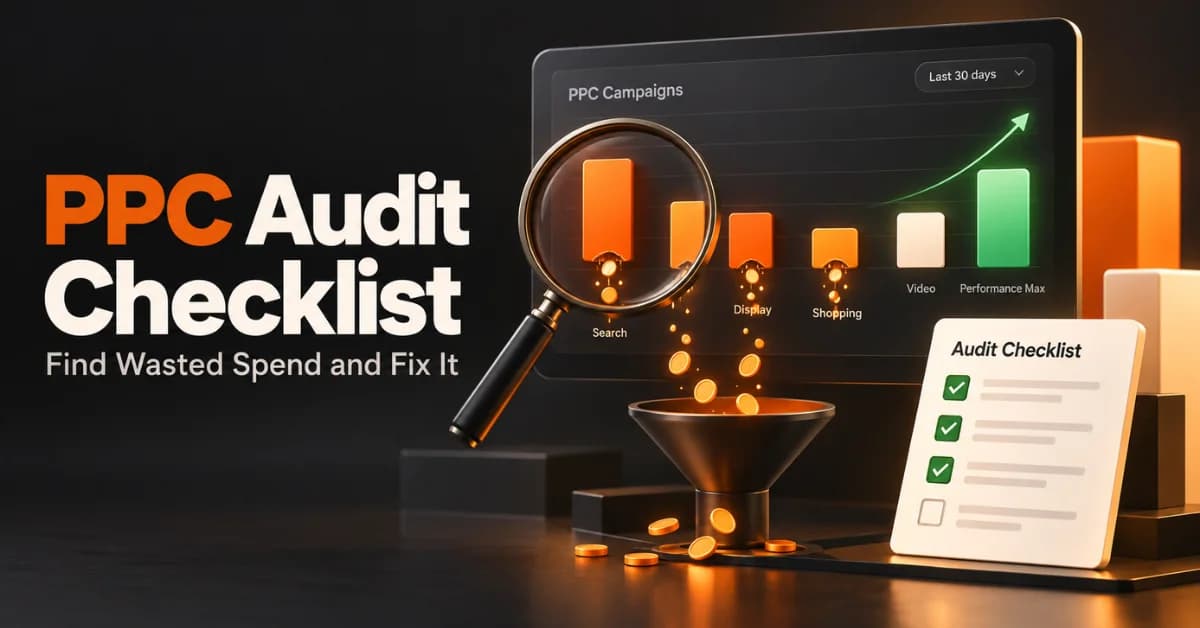
PPC Audit Checklist: Find Wasted Spend and Fix It
Pay-per-click advertising can generate highly targeted traffic, but a campaign can also consume budget without producing enough business value. A few irrelevant search terms, weak conversion tracking, poor targeting, or an ineffective landing page can quietly increase wasted ad spend. A structured PPC Audit Checklist helps you identify where your advertising budget goes, which parts of the account underperform, and what deserves attention first. Instead of changing campaigns based on assumptions, you can use actual performance data to make better decisions.
What Is a PPC Audit and Why Does It Matter?
A PPC audit is a systematic review of your paid advertising account. It examines campaign settings, budgets, keywords, search terms, ads, audiences, bidding, conversion tracking, landing pages, and business results.
A useful audit does more than identify low-performing keywords. It helps answer three important questions:
Where is the advertising budget being spent?
Which traffic or campaigns produce little business value?
What should you fix or test first?
This matters because a campaign can have a reasonable click-through rate while still producing poor-quality leads or unprofitable sales.
What a PPC Audit Should Reveal
A complete audit should help you identify:
Campaigns consuming excessive budget
Keywords generating expensive but weak traffic
Irrelevant search queries
Missing negative keywords
Poor-performing locations or devices
Weak ad messaging
Tracking problems
Landing-page friction
Low-quality leads
Opportunities for PPC optimization
The goal is not to make every metric look better. The goal is to improve the relationship between advertising spend and business results.
PPC Audit Checklist: 10 Areas to Review
Use the following checklist as a practical framework. Start with the areas that can create the largest financial impact instead of making dozens of small changes at once.
1. Review Campaign Goals and Account Structure
Start by checking whether every campaign has a clear objective. A campaign designed to generate leads should not use the same success criteria as one designed to drive e-commerce purchases. Similarly, brand campaigns, non-brand campaigns, remarketing campaigns, and product-specific campaigns may require different approaches.
Look for:
Duplicate campaigns
Overlapping targeting
Unclear campaign objectives
Poor campaign naming
Unnecessary account complexity
Campaigns that no longer support current business priorities
A clean structure makes it easier to understand performance and allocate budget appropriately.
2. Check Budget Allocation and Campaign Spend
Next, examine where the money is actually going. Compare campaign spending against conversions, conversion value, lead quality, and other meaningful business outcomes. A campaign consuming a large share of the budget should receive particular attention if it produces little value.
For example, imagine a service business spends 40% of its monthly PPC budget on one campaign, but that campaign produces only a small number of qualified enquiries. That does not automatically mean the campaign should be paused. It means you should investigate the cause.
Check:
Daily budgets
Campaign-level spend
Cost per conversion
Conversion value
High-spend campaigns
Low-spend campaigns with strong results
Significant changes in spending
Budget decisions should follow evidence rather than assumptions.
3. Analyze Keywords and Search Terms
Keyword analysis is one of the most important parts of a PPC audit. Your keyword list tells Google what you want to target, while search-term data helps you understand the queries that actually triggered your ads. Reviewing these queries can expose irrelevant traffic, unexpected intent, and opportunities for better targeting.
Look for:
High-cost keywords with weak results
Search terms unrelated to your offer
Expensive queries with no meaningful conversions
Keywords attracting the wrong type of customer
Duplicate or overlapping targeting
Strong search terms that deserve further attention
Do not judge a keyword only by its click-through rate. Consider the quality and value of the traffic it generates.
4. Audit Match Types and Negative Keywords
Negative keywords can help prevent ads from appearing for searches that do not fit your business. Google explains that negative keywords can exclude specific search terms and help advertisers focus on more relevant traffic.
During your audit, review the search-term report and identify recurring irrelevant themes.
For example, a business selling premium business consulting may not want clicks from searches focused on:
Free services
Jobs
Courses
Templates
DIY solutions
Unrelated products
Create negative keyword rules carefully. Adding too many exclusions can also reduce useful traffic, so every negative keyword should have a clear reason behind it.
A simple process is:
Review search terms.
Identify irrelevant patterns.
Group similar searches.
Add appropriate negative keywords.
Monitor results after the change.
5. Review Ad Copy and Assets
Your advertisements should clearly connect the user's search intent with your offer.
Review:
Headlines
Descriptions
Calls to action
Offers
Benefits
Brand messaging
Ad relevance
Final URLs
Asset performance
Google's current guidance recommends using responsive search ads with multiple relevant headlines and descriptions so the system can test different combinations. Google also advises matching ad messaging with the landing page and keeping assets relevant to the audience.
However, do not assume that a higher click-through rate automatically means better performance. An ad can attract many clicks while bringing visitors who are unlikely to become customers.
6. Check Location, Device, Audience, and Schedule Targeting
Average campaign results can hide important differences between segments.
Review performance by:
Location
Device
Audience
Day of week
Time of day
New versus returning users, where relevant
For example, a campaign might receive most of its clicks from mobile devices but generate more qualified leads from desktop users.
That does not automatically mean you should stop mobile advertising. First investigate whether the mobile landing page, form, page speed, or user experience is causing the difference.
The same principle applies to locations and schedules. Look for meaningful performance differences before making aggressive exclusions.
7. Audit Bidding Strategy and CPC
Review whether your bidding approach supports your campaign objective and available conversion data.
Look at:
Average CPC
Cost per conversion
Conversion volume
Conversion value
Impression share where relevant
Current bidding strategy
Significant bid changes
Performance trends
There is no single bidding strategy that works for every account. The appropriate approach depends on campaign objectives, data quality, conversion volume, budget, and business economics.
Avoid changing bidding strategies simply because another account uses a different approach. Test changes with a clear hypothesis and enough data to evaluate the result.
8. Check Conversion Tracking and Attribution
This is one of the most important parts of a Google Ads audit. If the account does not measure conversions correctly, your optimization decisions may also be wrong.
Review whether you are accurately tracking meaningful actions such as:
Purchases
Lead forms
Phone calls
Bookings
Qualified enquiries
Sign-ups
Revenue or conversion value
Also check for duplicate conversions, incorrect conversion values, broken tracking, or actions being counted as primary conversions when they should not influence optimization.
A form submission is not necessarily a valuable lead. If your business receives many enquiries but only a small percentage are qualified, your PPC reporting should eventually reflect that difference.
9. Audit Landing Pages
The advertising journey does not end when someone clicks. Your landing page needs to continue the promise made by the advertisement. If the ad promotes a specific service but sends visitors to a generic homepage, the visitor may struggle to find the information they expected.
Review whether the landing page:
Matches the ad message
Matches search intent
Works properly on mobile
Loads efficiently
Has a clear call to action
Provides useful information
Builds trust
Makes the next step obvious
This is an important PPC optimization opportunity because an advertising problem can sometimes actually be a website or landing-page problem.
10. Measure Profitability, Not Just Clicks
Clicks and impressions are useful diagnostic metrics, but they are not the final business outcome.
Where possible, review:
Conversion rate
Cost per lead
Cost per acquisition
Conversion value
Revenue
Return on ad spend
Qualified lead rate
Customer value
A low-cost conversion is not automatically a good conversion.
For example, paying less for 20 irrelevant leads may be worse than paying more for five enquiries from customers who are genuinely interested in buying.
How to Find Wasted Ad Spend in a PPC Account
The simplest way to identify potential wasted ad spend is to look for the combination of significant spending and weak business value.
Common warning signs include:
High spend with no meaningful conversions
Expensive clicks with poor conversion rates
Irrelevant search terms
Weak negative keyword coverage
Poor-performing locations
Low-value audiences
Campaigns generating unqualified leads
Ads receiving clicks but producing weak downstream results
Conversion actions that do not represent genuine business outcomes
Landing pages that fail to support the campaign goal
Do not automatically label every low-converting campaign as waste.
Some campaigns support brand awareness, assist other channels, or target customers earlier in the buying journey. The audit should consider the campaign's intended role before you decide whether the spend is inefficient.
How to Turn a PPC Audit Into PPC Optimization
An audit only creates value when you turn its findings into actions.
Start by ranking problems according to financial impact and confidence.
Prioritize High-Impact Fixes
High priority:
Broken conversion tracking
Significant irrelevant traffic
Major budget leakage
High-spend campaigns producing no meaningful outcome
Medium priority:
Weak ad messaging
Poor audience segmentation
Landing-page friction
Bid inefficiencies
Lower priority:
Minor naming issues
Cosmetic account organization
Small performance differences with little financial impact
This approach prevents teams from spending hours fixing low-impact issues while major budget problems remain unresolved.
Google Ads Audit: What Should You Check First?
When conducting a Google Ads audit, start with measurement and business objectives before focusing on individual keywords.
A practical sequence is:
Conversion tracking
Campaign objectives
Budget allocation
Search terms
Keywords and negative keywords
Location and audience targeting
Ad messaging
Bidding
Landing pages
Business outcomes
This order helps you avoid optimizing the wrong problem.
Google Ads Audit Example
Imagine a UAE-based professional services company that receives website enquiries through Google Ads but feels that its advertising budget is producing inconsistent results.
An audit might reveal several issues:
Broad targeting attracts irrelevant searches.
Negative keyword coverage is incomplete.
Mobile visitors encounter friction on the enquiry form.
The account counts low-value interactions as conversions.
Campaign budgets do not reflect which services generate better-qualified enquiries.
Simply increasing the budget would not solve these problems.
The better approach would be to improve measurement, remove clearly irrelevant traffic, improve the landing experience, and then reassess campaign performance.
What to Do After Completing a PPC Audit
Turn your findings into a written action plan.
Create a PPC Audit Action List
Separate findings into four categories:
Fix now: Tracking problems and major budget leakage
Test next: Ads, landing pages, targeting, and bidding changes
Monitor: Areas that require more data
Document: What changed, why it changed, and when it changed
This documentation becomes particularly valuable when several people manage the account.
Re-Audit Your PPC Account Regularly
PPC accounts change continuously. New search terms appear. Customer behavior changes. Competitors adjust their offers. Landing pages change. Conversion goals evolve. Google Ads also continues to introduce new automation and campaign capabilities.
For that reason, treat auditing as an ongoing management process rather than a one-time exercise.
Review search terms and performance regularly, and perform a deeper account review whenever spending, campaign structure, website experience, or conversion goals change significantly.
Common PPC Audit Mistakes to Avoid
Optimizing for Clicks Instead of Outcomes
A campaign can generate thousands of clicks without producing meaningful business results. Always connect PPC metrics to the actual objective.
Pausing Keywords Too Quickly
A keyword with weak short-term performance may not have enough meaningful data for a reliable decision. Consider spend, conversion volume, conversion value, and business context before making major changes.
Ignoring Search Terms
The keyword list alone does not tell the complete story. Search-term analysis can reveal irrelevant queries and new opportunities.
Changing Too Many Variables at Once
If you change targeting, bidding, ads, budgets, and landing pages simultaneously, you may struggle to identify what actually influenced performance.
Ignoring Landing Pages
PPC performance depends on what happens after the click. A strong advertisement cannot compensate for a confusing or poorly matched landing page.
PPC Audit Checklist: Quick Review Before You Make Changes
Use this quick checklist before making major account changes:
Campaign goals are clearly defined
Budget allocation matches business priorities
High-spend campaigns produce meaningful results
Search terms are relevant
Negative keywords are maintained
Keyword targeting matches user intent
Ad messaging matches the offer
Location and device performance is reviewed
Bidding strategy fits the campaign objective
Conversion tracking is accurate
Landing pages support the ad message
Lead quality is measured
Profitability is considered
Major findings have a clear action priority
The checklist is most useful when you connect every finding to a decision. Do not make changes simply to make the account look cleaner.
How BrandVexo Digital Solutions Can Help With PPC Optimization
A PPC audit becomes more useful when you look at advertising as part of the wider digital customer journey. At BrandVexo Digital Solutions, we can help businesses review how paid advertising connects with search intent, landing pages, conversion tracking, SEO, digital marketing, and broader business goals.
If your campaigns generate traffic but you are unsure where your budget is being lost, a structured review can help identify practical areas for improvement.
Phone: +971 52 356 5409
Email: info@brandvexo.com
Website: www.brandvexo.com
Frequently Asked Questions
What is a PPC audit?
A PPC audit is a structured review of a paid advertising account. It examines campaigns, budgets, keywords, search terms, targeting, ads, bidding, conversion tracking, landing pages, and business results to identify inefficiencies and improvement opportunities.
How often should you conduct a PPC audit?
The right frequency depends on account size, spending, campaign activity, and business changes. Smaller accounts may need periodic deeper reviews, while active high-spend accounts benefit from ongoing monitoring and more frequent checks of important performance areas.
How do I identify wasted ad spend?
Start by looking for high spending combined with weak business outcomes. Review search terms, keywords, targeting, devices, locations, conversion tracking, lead quality, and landing pages to determine whether the traffic is relevant and valuable.
What should I check first in a Google Ads audit?
Start with conversion tracking and campaign objectives. If Google Ads is measuring the wrong actions, optimizing keywords or bids based on that data can lead to poor decisions.
Can a PPC audit improve conversion rates?
An audit can identify issues that may be reducing conversion performance, such as irrelevant traffic, weak targeting, poor ad relevance, tracking problems, or landing-page friction. Actual improvement depends on the changes implemented and tested afterward.
What is the difference between a PPC audit and PPC optimization?
A PPC audit diagnoses problems and opportunities. PPC optimization is the ongoing process of making, testing, measuring, and refining changes to improve campaign performance.
Conclusion
A good PPC Audit Checklist should do more than help you find keywords with high costs. It should give you a complete view of where your advertising budget goes and whether that spending contributes to meaningful business outcomes. Start with the fundamentals: accurate conversion tracking, clear campaign objectives, budget allocation, search terms, targeting, ad relevance, landing pages, and profitability. Then prioritize the problems with the greatest potential financial impact.
Disclaimer: PPC performance varies by business, industry, budget, targeting, and market conditions. This article provides general educational guidance and should not be treated as a guarantee of specific advertising results.
Free growth plan
Ready to grow your business?
Reading is a start — now let's build it. Tell us where you want to grow and a senior strategist will map the fastest, most profitable way to get there. Free, no obligation.
Discussion
Join the conversation
Be the first to comment. Comments are reviewed before they appear, so yours won't show up instantly — but we read every one.
Leave a comment
Keep reading
All articles Paid Ads
Google Ads Dubai: Costs, Strategy and Agency Options
Explore Google Ads Dubai costs, PPC strategy, budgeting, tracking, and agency options to build campaigns that attract qualified leads and sales.
 Paid Ads
Retargeting Strategy: How to Win Back High-Intent Visitors
Build a smarter Retargeting Strategy with practical tips for remarketing, Meta retargeting, Google remarketing, funnel targeting, and conversions.
 Paid Ads
Google Ads AI Max: What Advertisers Need to Know
Google Ads AI Max changes Search campaigns with AI-powered targeting, ad assets and landing pages. Learn how AI Max works and what advertisers should know.