

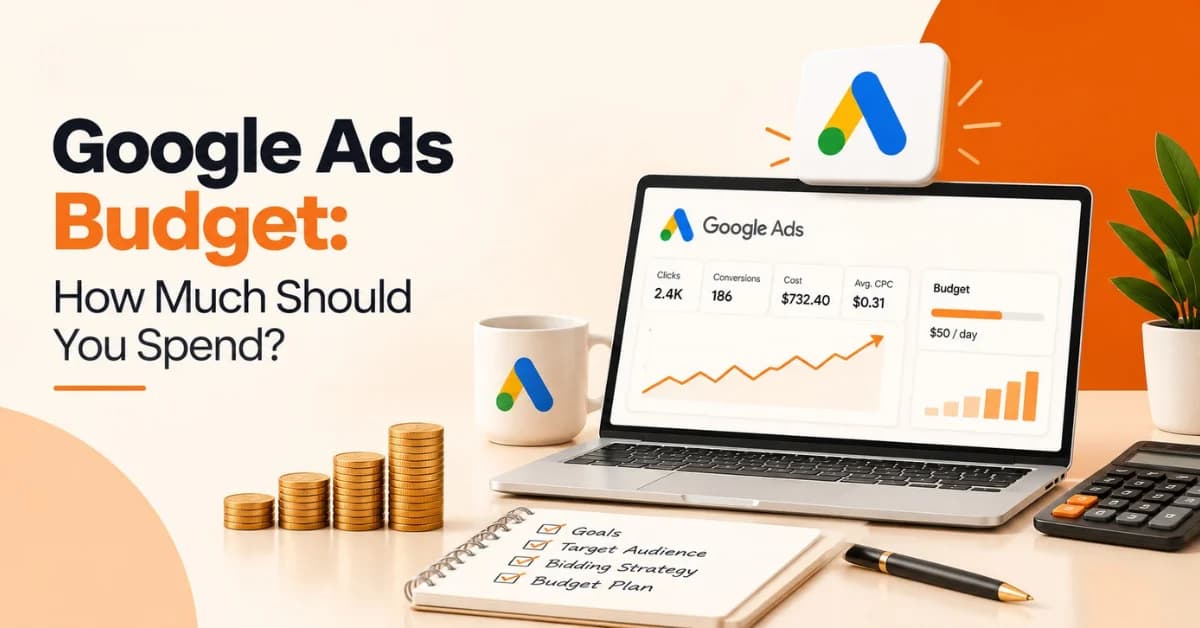
Google Ads Budget: How Much Should You Spend?
There is no single Google Ads Budget that works for every business. The right amount depends on your goals, target audience, industry, keyword competition, expected cost per click (CPC), conversion rate, and the value of each customer. A small local business may start with a modest PPC budget, while a competitive e-commerce or B2B company may need significantly more ad spend to generate enough data and conversions. The important question is not simply, “How much does Google Ads cost?” Instead, ask: How much can I afford to spend to acquire a profitable customer?
How Much Does Google Ads Cost?
Google Ads does not have a fixed price. You decide the average daily budget for each campaign, while the amount you actually spend depends on factors such as demand, competition, bidding, and campaign settings. Google states that an average daily budget represents the amount you are roughly comfortable spending per day over the course of a month.
Your Google Ads cost can vary considerably because every search auction is different.
Key factors include:
Keyword competition
Search intent
Industry
Geographic targeting
Ad relevance
Landing-page experience
Bid strategy
Expected conversion value
Audience and device
Available search volume
For example, someone searching for “buy running shoes online” has different commercial intent from someone searching for “how to choose running shoes.” Advertisers may value those clicks differently.
Google also explains that actual CPC can be lower than your maximum CPC bid because the auction determines the amount required for your ad to compete.
That is why businesses should avoid building their entire marketing plan around a single assumed CPC.
What Is a Good Google Ads Budget for a Small Business?
A good starting Google Ads budget should be large enough to generate useful traffic and conversion data without putting unnecessary pressure on your cash flow.
Instead of copying another company's budget, work backward from your business goals.
Consider:
How many leads or sales do you want?
What is your expected conversion rate?
What is your estimated CPC?
How much is one customer worth?
What customer acquisition cost can your business afford?
For example, imagine a UAE service business starts with an illustrative budget of AED 5,000 per month.
If the average CPC were AED 10:
AED 5,000 ÷ AED 10 = 500 potential clicks
If 5% of those visitors converted:
500 × 5% = 25 potential conversions
The resulting estimated cost per conversion would be:
AED 5,000 ÷ 25 = AED 200
These are planning assumptions, not guaranteed Google Ads results. Your actual numbers could be higher or lower depending on your campaign, audience, keywords, website, and offer.
The purpose of this calculation is to show how your PPC budget connects to measurable business outcomes.
How to Calculate Your Google Ads Budget
One of the simplest ways to plan your advertising budget is to start with the number of conversions you need.
A basic planning formula is:
Monthly Google Ads Budget = Target Conversions × Target Cost Per Conversion
For example, if you need 30 qualified leads and can sustainably acquire each lead for AED 200:
30 × AED 200 = AED 6,000 monthly budget
You can then work backward to estimate the clicks required.
Step 1: Set Your Conversion Goal
First, decide what you want Google Ads to generate.
Your goal could be:
20 qualified leads
50 product purchases
10 consultation bookings
100 online orders
30 phone calls
40 quote requests
Avoid setting a budget before defining what success means.
Step 2: Estimate Your Cost Per Click
Your cost per click depends on your keywords and market. If you have historical campaign data, use it instead of relying on generic industry estimates. If you are launching a new campaign, Google Keyword Planner can help provide traffic and CPC estimates for keywords. Google also recommends using tools such as Performance Planner to help evaluate budget and performance scenarios.
Step 3: Estimate Your Conversion Rate
Your conversion rate shows how many visitors take the desired action.
The basic calculation is:
Conversions = Clicks × Conversion Rate
For example:
1,000 clicks
4% conversion rate
40 conversions
Your website and offer can significantly influence this result. A highly relevant landing page may perform differently from a generic homepage.
Step 4: Calculate Your Required Ad Spend
Suppose your expected CPC is AED 8 and you need 1,000 clicks.
1,000 × AED 8 = AED 8,000
Your estimated ad spend would therefore be AED 8,000.
Remember that this is a planning model, not a guaranteed invoice.
What Is Cost Per Click and Why Does It Matter?
Cost per click (CPC) tells you how much you pay for an individual ad click. CPC matters because it determines how many visitors your budget can potentially generate.
For example, an AED 2 CPC can theoretically generate more clicks from the same budget than an AED 10 CPC. However, that does not automatically make the AED 2 keyword better.
A cheaper keyword may attract people who are only researching. A more expensive commercial keyword may attract people who are ready to contact a business or make a purchase.
Google explains that actual CPC is determined through the ad auction and can be lower than the advertiser's maximum CPC bid. Ad Rank considers factors including bid and auction-time ad quality.
Low CPC vs. High CPC: Which Is Better?
Low CPC
Can generate more clicks
May allow broader testing
Can work well with strong conversion rates
Does not guarantee qualified traffic
High CPC
Can produce fewer clicks
Often occurs in competitive markets
May target valuable commercial searches
Can still be profitable when customer value is high
The better question is not “How can I get the cheapest click?”
It is:
“How much can I profitably pay for a qualified customer?”
How Much Should You Spend on Google Ads Per Day?
Your daily budget depends on the monthly amount you are comfortable allocating. Google calculates an average daily budget for each campaign. For planning purposes, Google says you can divide a monthly budget by 30.4 to calculate the corresponding average daily budget.
For example:
AED 1,500/month ≈ AED 49/day
AED 3,000/month ≈ AED 99/day
AED 6,000/month ≈ AED 197/day
AED 10,000/month ≈ AED 329/day
These are approximate planning figures.
It is also important to understand that Google Ads spending does not necessarily remain identical every day. For most campaigns, Google can spend more than the average daily budget on some days and less on others, while applying the relevant monthly spending limit.
Should You Start With a Small or Large Budget?
For a new campaign, starting with a controlled testing budget is usually more sensible than committing a large amount before you understand performance.
Use this process:
Test → Measure → Optimize → Scale
Start with enough budget to collect meaningful data, then increase spending when the campaign demonstrates acceptable results.
How Industry and Competition Affect Your PPC Budget
Your industry can have a major effect on your required PPC budget. Businesses competing for high-value commercial searches may face stronger competition than businesses targeting highly specific or less competitive terms.
Examples include:
Legal services
Real estate
Insurance
Financial services
B2B consulting
E-commerce
Healthcare services
Home services
A business selling a AED 50 product cannot usually evaluate advertising economics in the same way as a company selling a AED 50,000 service.
Why Competitive Keywords Cost More
Advertisers compete in Google's auction every time an eligible search occurs. Ad Rank influences whether and where an ad appears, and Google considers factors such as bid, ad quality, relevance, and landing-page experience.
This means simply increasing your bid is not always the best way to improve performance.
Better ads and relevant landing pages can also contribute to stronger ad performance and potentially lower CPC.
How to Set a Google Ads Budget Based on Your Business Goals
Your budget should reflect what you want your advertising to accomplish.
Lead Generation Businesses
For service businesses, focus on:
Cost per lead
Qualified lead rate
Lead-to-customer rate
Customer acquisition cost
Customer lifetime value
For example, if your average customer generates AED 5,000 in gross profit, paying AED 500 for a qualified customer could make sense while paying AED 2,000 might not.
The right threshold depends on your margins and business model.
E-commerce Businesses
E-commerce companies should consider:
Average order value
Gross margin
Conversion rate
Customer acquisition cost
Repeat purchases
ROAS
Profit after advertising
A campaign producing AED 20,000 in sales from AED 5,000 in ad spend may look attractive at first. But you still need to consider product costs, shipping, payment fees, returns, and other expenses.
Brand Awareness Campaigns
Brand campaigns may focus more heavily on:
Impressions
Reach
Search visibility
Website traffic
Engagement
Assisted conversions
Not every campaign should be judged using the same KPI.
Google Ads Budget vs. Ad Spend: What's the Difference?
Your Google Ads budget and actual ad spend are related but not identical.
Budget is the amount you plan or configure to make available for advertising.
Ad spend is what the campaign actually spends.
Google describes the average daily budget as the amount you're roughly comfortable spending each day. Campaign spending can fluctuate depending on traffic and predicted opportunities.
This distinction matters when analyzing campaign performance.
For example, you may set an average daily budget of AED 200, but actual daily spending can vary.
Don't Judge Campaign Success by Ad Spend Alone
Spending more money does not automatically produce more profit.
Imagine two campaigns:
Campaign A
Spend: AED 10,000
Revenue: AED 30,000
Campaign B
Spend: AED 2,000
Revenue: AED 3,000
Campaign A generated more revenue, but profitability still depends on margins and other costs.
Always connect advertising spend with business outcomes.
How to Know If Your Google Ads Budget Is Working
Monitor your campaigns using metrics that relate directly to your goals.
CTR: Measures how often people click after seeing your ad.
CPC: Shows your average cost per click.
Conversion rate: Shows how effectively clicks become conversions.
Cost per conversion: Shows what you spend for each conversion.
CPA: Helps evaluate customer acquisition costs.
ROAS: Compares advertising revenue with advertising spend.
Conversion value: Helps quantify the financial value generated.
The Most Important Metric Depends on Your Goal
An e-commerce company may care heavily about ROAS and profit margin. A B2B service company may care more about qualified leads and eventual revenue. A local business may focus on calls, bookings, or quote requests. Don't optimize for a metric simply because it looks impressive in a dashboard.
Common Google Ads Budget Mistakes to Avoid
Setting a Budget Without a Conversion Goal
If you don't know what you want your budget to achieve, it becomes difficult to determine whether the campaign is successful.
Focusing Only on Cheap Cost Per Click
A cheap click has little value if it never produces a qualified lead or sale.
Spending Without Conversion Tracking
Without reliable tracking, you may not know which keywords, ads, or campaigns generate valuable customers.
Changing Campaigns Too Frequently
Constant changes can make performance difficult to evaluate. Give campaigns enough time and data to identify useful patterns before making major decisions.
Scaling Before Finding a Profitable Campaign
More budget should amplify something that already works—not simply increase spending on a campaign that is losing money.
Ignoring Landing-Page Performance
Even an excellent ad cannot fix a confusing, slow, irrelevant, or poorly designed landing page.
How to Scale Your Google Ads Budget Safely
Once you identify campaigns that consistently generate valuable conversions at an acceptable acquisition cost, you can consider increasing your budget.
Use the following framework:
Test → Measure → Optimize → Scale
When Should You Increase Your Budget?
Consider increasing your budget when:
Campaigns consistently generate conversions
Cost per conversion remains acceptable
Lead quality is strong
Conversion tracking works correctly
Search demand exists
Additional budget could capture more qualified demand
Google notes that if a campaign is limited by budget and generating conversions at a reasonable CPA, increasing the budget can help capture additional demand.
When Should You Reduce Your Budget?
Review your spending when:
CPA continues to rise
Lead quality declines
Conversion rates fall
Campaigns attract irrelevant traffic
Landing pages underperform
Advertising becomes unprofitable
Don't reduce spending based on one bad day. Look for meaningful performance patterns.
Google Ads Budget Example for a UAE Business
Consider a fictional Dubai-based service company that wants 30 qualified leads per month.
Suppose its planning assumptions are:
Target leads: 30
Estimated conversion rate: 5%
Required clicks: 600
Illustrative CPC: AED 12
Estimated monthly ad spend: AED 7,200
The calculation is:
600 clicks × AED 12 = AED 7,200
If 5% of the 600 clicks convert:
600 × 5% = 30 leads
The resulting estimated cost per lead is:
AED 7,200 ÷ 30 = AED 240
The business should then ask whether AED 240 per lead makes commercial sense.
If only 10% of those leads become customers, the company would acquire approximately three customers. The economics would therefore depend on the revenue and profit generated by those customers.
This is why a realistic Google Ads budget should connect clicks to conversions and conversions to revenue.
FAQs
How much should a beginner spend on Google Ads?
There is no universal starting amount. Begin with a controlled budget that you can afford to test while generating enough traffic to evaluate performance. Base the amount on expected CPC, conversion rate, customer value, and your advertising goals.
Is AED 1,000 enough for Google Ads?
AED 1,000 can be enough for an initial test in some markets, but the usefulness of that amount depends on CPC, search volume, conversion rate, and campaign objectives. In a highly competitive market, AED 1,000 may produce limited data.
How much does Google Ads cost per click?
There is no single Google Ads CPC. Actual CPC varies by auction, keyword, competition, ad quality, targeting, and other factors. Google explains that actual CPC is often lower than the maximum CPC bid.
What is a good PPC budget for a small business?
A good PPC budget is one that supports your conversion goals while remaining financially sustainable. Calculate the required conversions, acceptable cost per conversion, estimated CPC, and expected conversion rate before setting the budget.
Should I set a daily or monthly Google Ads budget?
Google Ads commonly uses an average daily budget at campaign level. If you think in monthly terms, Google recommends dividing the desired monthly amount by 30.4 to calculate an average daily budget.
How do I calculate my Google Ads budget?
Start with your target number of conversions and acceptable cost per conversion. For example, 30 target conversions at AED 200 each gives a planning budget of AED 6,000. Then validate your assumptions using actual campaign data.
Is Google Ads worth the money?
Google Ads can be worthwhile when it consistently produces profitable customers or valuable business outcomes. Profitability depends on factors such as CPC, conversion rate, customer value, margins, and campaign management.
How can I reduce my Google Ads cost?
Improve keyword targeting, ad relevance, landing-page experience, conversion tracking, and campaign structure. Don't focus only on reducing CPC; focus on reducing the cost of acquiring valuable customers.
Final Takeaway
The right Google Ads budget is not necessarily the biggest budget or the cheapest possible one. It is the amount that gives your business a realistic opportunity to generate profitable results. Start with your objective. Estimate your cost per click, conversion rate, target cost per conversion, and customer value. Then create a manageable PPC budget, measure actual performance, and increase your ad spend when the data supports it.
Disclaimer: Google Ads performance, CPC, conversion rates, and advertising costs vary by industry, market, keywords, competition, targeting, campaign settings, and business performance. Examples in this article are illustrative and should not be treated as guaranteed results.
Free growth plan
Ready to grow your business?
Reading is a start — now let's build it. Tell us where you want to grow and a senior strategist will map the fastest, most profitable way to get there. Free, no obligation.
Discussion
Join the conversation
Be the first to comment. Comments are reviewed before they appear, so yours won't show up instantly — but we read every one.
Leave a comment
Keep reading
All articles Paid Ads
PPC Audit Checklist: Find Wasted Spend and Fix It
Use this PPC Audit Checklist to find wasted ad spend, review Google Ads performance, fix targeting issues, and improve PPC optimization.
 Paid Ads
Google Ads Dubai: Costs, Strategy and Agency Options
Explore Google Ads Dubai costs, PPC strategy, budgeting, tracking, and agency options to build campaigns that attract qualified leads and sales.
 Paid Ads
Retargeting Strategy: How to Win Back High-Intent Visitors
Build a smarter Retargeting Strategy with practical tips for remarketing, Meta retargeting, Google remarketing, funnel targeting, and conversions.