

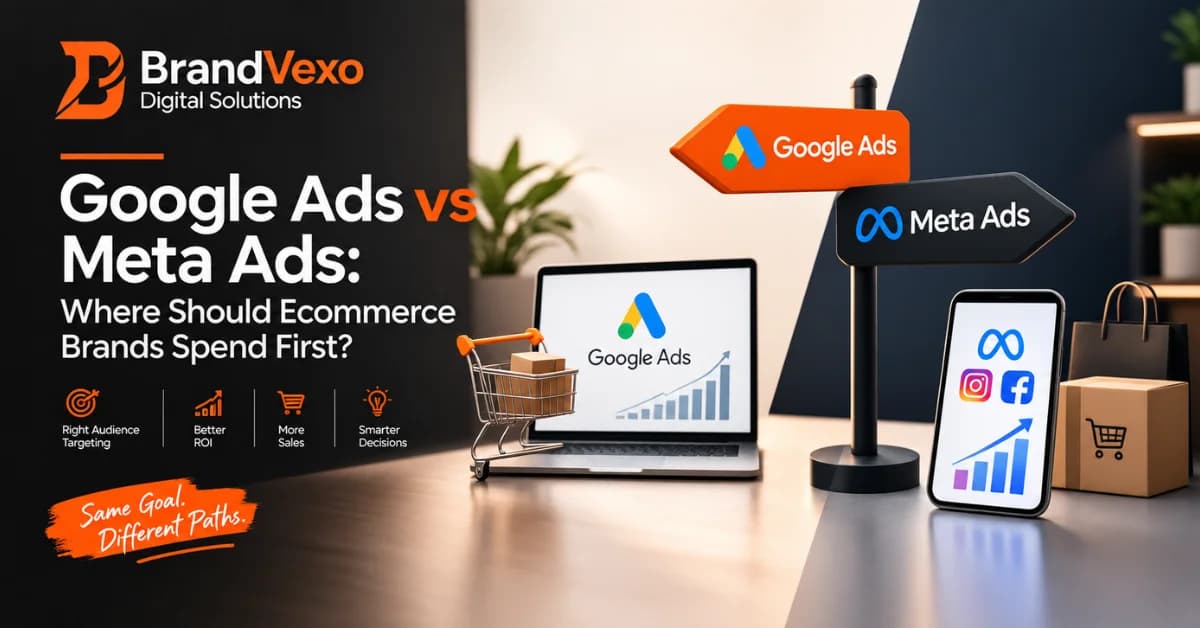
Google Ads vs Meta Ads: Where Should Ecommerce Brands Spend First?
Choosing between Google Ads and Meta Ads can feel difficult when an ecommerce business has a limited advertising budget. Both platforms can generate sales, but they approach customers differently. Google Ads can help ecommerce brands capture existing purchase intent when people actively search for products. Meta Ads, including Facebook and Instagram advertising, can introduce products to people based on audience signals, interests, behavior, and creative.
So, Google Ads vs Meta Ads is not simply a question of which platform is better. The more useful question is: which platform matches your product, customer journey, search demand, margins, and marketing resources?
Google Ads vs Meta Ads: What Is the Difference?
Google Ads and Meta Ads can both drive ecommerce sales, but they usually enter the customer journey at different points. Google is particularly useful when customers already have an idea of what they want. Someone searching for “women's running shoes,” “wireless earbuds,” or “leather laptop bag” is actively expressing an interest in a product or category.
Meta works differently. A customer may not be searching for your product at all. Instead, they might see a product video, creator-style demonstration, lifestyle image, or offer while browsing Facebook or Instagram.
That makes the distinction simple:
Google Ads: Capture existing demand.
Meta Ads: Generate or stimulate product discovery.
Google Shopping: Put product information in front of people searching for relevant products.
Meta retargeting: Re-engage people who have already interacted with your brand.
Both platforms: Can contribute to a broader ecommerce advertising strategy.
How Google Ads Works for Ecommerce
Google Shopping ads use product information supplied through Google Merchant Center. Product data can include information such as the product title, image, price, availability, and other attributes. Google uses that information to determine when products are relevant to searches.
For ecommerce businesses, Google can therefore be valuable when customers already demonstrate commercial intent.
Common opportunities include:
Google Search campaigns
Shopping campaigns
Performance Max
Brand searches
Non-brand product searches
Product-category searches
Google also requires accurate product data and a linked Merchant Center account for Shopping campaigns.
How Meta Ads Works for Ecommerce
Meta advertising gives ecommerce businesses a visual environment for presenting products through formats such as images, videos, Stories, and Reels.
This can work particularly well when the product benefits from demonstration, visual storytelling, social proof, or lifestyle positioning.
For example, a skincare brand could use a short product demonstration, while a fashion brand could show several ways to style the same item.
The customer does not necessarily need to search for the product first. The advertisement can create interest and encourage the person to visit the store.
Shopping Ads vs Meta Ads: Which Platform Fits Your Product?
The shopping ads vs Meta ads comparison becomes more useful when you look at the type of product being sold.
A platform that works well for a product with strong search demand may not produce the same results for a completely new product that customers do not know exists.
Google Ads Can Work Well When Customers Already Search for Your Product
Consider a business selling replacement laptop batteries.
A customer whose battery has stopped working may actively search for a compatible replacement. Google can capture that intent because the customer has already identified a problem and is looking for a solution.
The same logic can apply to:
Electronics
Home appliances
Fitness equipment
Office products
Automotive accessories
Established consumer products
Shopping ads can display product information before a user clicks, including product imagery, price, and store information. This can help shoppers understand the offer before visiting the website.
Meta Ads Can Work Well for Visual or Discovery-Led Products
Meta can be useful when the product needs to be shown rather than searched for.
Examples include:
Fashion
Beauty products
Home décor
Lifestyle products
Accessories
New consumer products
Giftable products
Imagine launching a new skincare product with no established brand awareness. Instead of waiting for people to search for the exact product, Meta can help present the product through video demonstrations, customer-style content, benefits, and visual creative.
The important consideration is not whether one platform is universally superior. It is whether the platform matches how customers discover and purchase the product.
Where Should Ecommerce Brands Spend First?
There is no universal starting budget split that works for every ecommerce store.
Instead, consider five factors:
Existing search demand
Product type
Average order value
Gross margin
Creative resources
Website conversion rate
Tracking quality
Customer buying journey
Start With Google Ads When Search Demand Is Strong
Google may be a logical starting point when customers actively search for your products or product categories.
For example, an ecommerce store selling established products such as running shoes can target searches that demonstrate clear buying intent.
Before investing heavily, check:
Are people searching for the product?
Can you compete on price and value?
Is the product feed accurate?
Are product pages optimized?
Is purchase tracking working?
Can your margins support the acquisition cost?
Google notes that Shopping performance is closely connected to product data quality, including information such as price, availability, shipping details, and product identifiers.
Consider Meta Ads When You Need to Generate Demand
Meta can make sense when your product depends heavily on creative presentation and audience discovery.
For example, a fashion business may have several strong product images, short videos, customer-generated content, and different creative angles.
You can test whether customers respond to:
Product benefits
Price or promotions
Lifestyle positioning
Customer testimonials
Demonstrations
Problem-and-solution messaging
The quality of the creative becomes an important part of the advertising strategy.
Google Ads vs Meta Ads for Different Ecommerce Business Types
Different ecommerce categories can require different approaches.
Fashion and Apparel
Fashion is highly visual, so Meta can provide opportunities to showcase outfits, styling ideas, seasonal collections, and short-form content. Google Shopping can also capture shoppers who search for specific products, brands, categories, sizes, or styles.
A fashion store may therefore benefit from testing both discovery and search-based demand rather than treating the platforms as substitutes.
Electronics and High-Consideration Products
Electronics often involve more research.
Customers may search for:
Product names
Specifications
Features
Prices
Alternatives
Reviews
Google can capture these research and purchase-related searches. Meta can support awareness, product demonstrations, remarketing, and creative storytelling.
Beauty and Skincare
Beauty products can benefit from both visual discovery and active search. A Meta campaign might demonstrate how a product is used, while Google can capture searches such as product-category or problem-specific queries.
New or Niche Products
New products can present a different challenge because search demand may be limited. If customers do not know the product exists, there may be fewer relevant searches to capture.
In this situation, a discovery-focused approach can help test whether different audiences and creative messages generate interest. Once awareness and search demand grow, search and Shopping campaigns can become additional acquisition channels.
Ecommerce PPC Budget: How Much Should You Put Into Each Platform?
A common mistake is choosing a budget based only on what competitors reportedly spend.
Your ecommerce PPC budget should reflect your own economics.
Start by understanding:
Average order value
Gross margin
Fulfillment costs
Payment fees
Discounts
Customer acquisition cost
Repeat purchase rate
Customer lifetime value
Calculate Your Break-Even Customer Acquisition Cost
Suppose a product sells for $100, but the business has $60 in product, fulfillment, payment, and other variable costs. That leaves $40 before advertising and other relevant expenses. A business cannot automatically assume that spending $40 to acquire every customer is sustainable. It needs to account for operating costs and its desired contribution margin.
This is why revenue and ROAS alone do not tell the complete story.
Use a Test Budget Before Scaling
Rather than immediately committing a large budget:
Define the primary conversion.
Verify purchase tracking.
Select a focused product range.
Launch controlled campaigns.
Monitor cost per purchase and conversion rate.
Review product-level profitability.
Increase spending only after validating the economics.
Google also recommends conversion tracking for Shopping campaigns so advertisers can evaluate campaign performance and optimize toward meaningful outcomes.
Google Ads vs Meta Ads: What Should You Measure?
Clicks are useful, but ecommerce businesses ultimately need to understand what happens after the click.
Google Ads Metrics
Monitor metrics such as:
Click-through rate
Cost per click
Conversion rate
Cost per conversion
Conversion value
ROAS
Search terms
Product-level performance
Google provides product-level reporting and tools such as product reports, auction insights, and bid simulators for Shopping campaigns.
Meta Ads Metrics
Depending on campaign setup, monitor:
Impressions
CPM
CTR
CPC
Landing-page views
Add-to-cart rate
Purchase conversion rate
Cost per purchase
ROAS
Look Beyond ROAS
A campaign with a high ROAS is not automatically more valuable if it produces low-margin customers.
Also consider:
New customer acquisition
Repeat purchases
Customer lifetime value
Profit after advertising
Product-level margin
Assisted conversions
Incremental sales
The goal should be profitable growth rather than simply generating inexpensive traffic.
When Should You Use Google Ads and Meta Ads Together?
The strongest ecommerce ad strategy does not always require choosing one platform permanently. The two channels can support different parts of the customer journey.
Use Meta for Discovery
Meta can help introduce products to potential customers through:
Video
Lifestyle creative
Product demonstrations
Customer-generated content
Offers
Social proof
Use Google for High-Intent Capture
Google can help capture people who later search for:
Your brand
Your product
A product category
A specific solution
A particular product feature
Google Shopping can show product information directly in relevant shopping experiences, while Performance Max can distribute eligible ads across multiple Google properties using campaign inputs such as budget and product-feed data.
Use Both for Retargeting
Someone might first see a product on Instagram, visit the website, leave without purchasing, and later search for the brand or product on Google. That journey demonstrates why evaluating channels independently can sometimes miss the bigger customer journey.
Common Ecommerce Advertising Mistakes to Avoid
Avoid these common problems when building an ecommerce advertising campaign:
Choosing a platform simply because competitors use it
Optimizing for clicks instead of purchases
Running campaigns without reliable conversion tracking
Sending traffic to weak product pages
Ignoring mobile checkout performance
Scaling before understanding profitability
Comparing platforms using inconsistent attribution methods
Changing campaigns too frequently
Using the same creative for every audience
Ignoring Google Merchant Center product-data issues
For Google Shopping in particular, inaccurate or outdated product information can affect campaign performance because ads rely heavily on Merchant Center product data.
How to Choose Your First Ecommerce Ad Platform
Use this checklist before deciding where to spend first.
Consider Google Ads First If:
Customers actively search for your products.
Your product has clear commercial search terms.
You have an accurate product feed.
Your product pages convert visitors effectively.
You can compete on price, quality, availability, or another clear value proposition.
Consider Meta Ads First If:
Your products are highly visual.
You have strong photography or video.
Your product benefits from demonstrations.
You can produce multiple creative concepts.
Your audience needs education or inspiration before purchasing.
Your product is new and has limited existing search demand.
These are strategic starting points rather than guarantees of performance.
A Practical 30-Day Ecommerce Ads Testing Plan
A structured test can help an ecommerce business make decisions using its own data.
Week 1: Tracking and Setup
Before spending heavily:
Verify purchase tracking.
Check product feeds.
Review landing pages.
Confirm mobile checkout.
Define acceptable acquisition costs.
Establish reporting for revenue and purchases.
Week 2: Launch Initial Tests
Keep the campaign structure focused. Test relevant products, audiences, search demand, or creative concepts without introducing too many variables at once.
Week 3: Analyze Performance
Compare:
Purchases
Conversion rate
Cost per purchase
Revenue
ROAS
Product-level performance
Profitability
Do not judge the campaign only by clicks or impressions.
Week 4: Optimize and Scale
Use the data to identify what deserves further testing.
You may:
Reduce spend on weak products.
Improve landing pages.
Refresh weak creative.
Improve product information.
Expand validated audiences or search coverage.
Develop remarketing campaigns.
Google notes that new Shopping and Performance Max campaigns can go through a learning period, during which performance can fluctuate.
FAQs
Is Google Ads or Meta Ads better for ecommerce?
Neither platform is universally better. Google can be useful for capturing existing search and shopping intent, while Meta can support product discovery and demand generation. Your product category, search demand, creative assets, margins, tracking, and customer journey should influence the decision.
Is Google Ads more expensive than Meta Ads?
There is no universal cost comparison that applies to every business. CPC, CPM, conversion rate, customer acquisition cost, product margin, and competition can vary substantially by market and category. Compare the platforms using meaningful business outcomes rather than CPC alone.
Should a new ecommerce store use Google Ads or Meta Ads?
Start by examining whether customers already search for your product. Strong search demand can create an opportunity for Google. A highly visual product with limited existing demand may benefit from creative-led audience testing on Meta.
Are Google Shopping Ads good for ecommerce?
Shopping ads are specifically designed to promote products using information from a Merchant Center feed. They can show details such as product imagery, title, price, and store information, helping shoppers evaluate products before clicking.
Can I run Google Ads and Meta Ads at the same time?
Yes. Many ecommerce businesses can use the platforms for different stages of the customer journey. For example, Meta can support product discovery and remarketing while Google captures brand, category, and product-related search demand.
What is the best ecommerce ad strategy for a small budget?
Focus on measurement and controlled testing before expanding. Select a manageable product range, verify conversion tracking, understand your break-even acquisition cost, and avoid spreading a small budget across too many campaigns.
How BrandVexo Can Help!
BrandVexo Digital Solutions helps businesses build practical digital growth systems across digital marketing, SEO, web development, AI automation, and business solutions. Our approach focuses on measurable commercial outcomes rather than vanity metrics. For ecommerce businesses, that means connecting advertising, landing pages, tracking, content, and conversion strategy into a more practical growth system.
Phone: +971 52 356 5409
Email: info@brandvexo.com
Website: www.brandvexo.com
If you are reviewing your ecommerce advertising strategy, start by checking your tracking, product pages, product feed, customer journey, and acquisition economics before increasing your ad budget.
Final Takeaway
The Google Ads vs Meta Ads decision should start with your customers rather than the advertising platforms themselves. Google can help capture people who already demonstrate search or shopping intent. Meta can help introduce products, test creative ideas, and generate demand among relevant audiences. For an ecommerce business, the right starting point depends on product type, existing demand, margins, creative capability, website experience, and tracking quality.
Instead of committing to a platform based on assumptions, start with a controlled test, measure purchases and profitability, and use the results to shape a broader ecommerce PPC strategy.
Disclaimer: Advertising results vary by industry, product, audience, competition, budget, creative quality, tracking, and market conditions. Platform features and campaign options can also change over time, so businesses should verify current requirements before launching or scaling campaigns.
Free growth plan
Ready to grow your business?
Reading is a start — now let's build it. Tell us where you want to grow and a senior strategist will map the fastest, most profitable way to get there. Free, no obligation.
Discussion
Join the conversation
Be the first to comment. Comments are reviewed before they appear, so yours won't show up instantly — but we read every one.
Leave a comment
Keep reading
All articles Growth
Abandoned Cart Optimization: How to Recover More Sales
Learn how abandoned cart optimization can reduce checkout friction, improve cart recovery, and help ecommerce businesses recover more sales.
 Growth
Ecommerce Conversion Optimization: 12 Tests to Try
Test 12 ecommerce conversion optimization ideas, from product pages and CTAs to checkout, mobile UX, payment options and cart recovery.
 Growth
Lead Generation Dubai: Channels, Costs and Strategy
Learn how lead generation Dubai works, which channels to use, what affects lead generation cost UAE, and how to build a scalable strategy.