

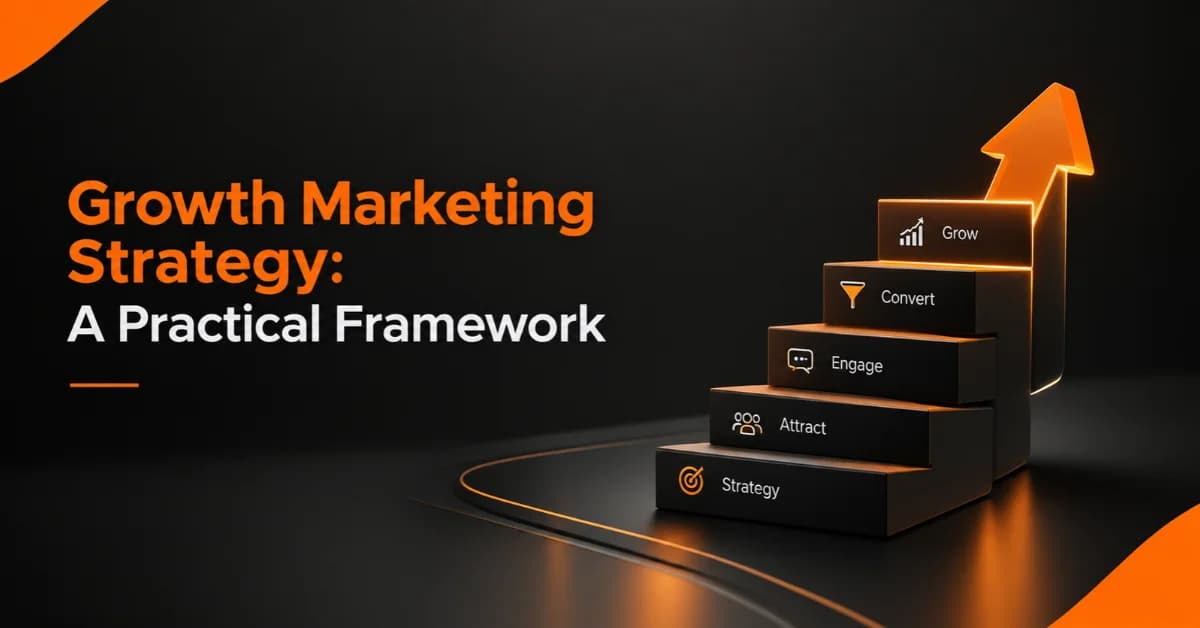
Growth Marketing Strategy: A Practical Framework
A Growth Marketing Strategy gives businesses a structured way to improve growth across the entire customer journey. Instead of focusing only on getting more traffic or launching more campaigns, growth marketing examines what happens before, during, and after a customer converts. The process connects customer acquisition, activation, conversion, retention, referral, and revenue. It also relies on data and continuous testing to identify what works and what needs improvement.
For example, a business may generate thousands of website visits but receive very few leads. Increasing traffic may not solve the real problem. Improving the landing page, offer, messaging, or conversion process could have a greater impact.
What Is a Growth Marketing Strategy?
A Growth Marketing Strategy is a data-informed approach to growing a business by continuously improving different stages of the customer journey. Traditional marketing often focuses on campaigns, channels, and promotional activities. Growth marketing takes a broader view. It asks questions such as:
How are customers finding the business?
What makes them take the next step?
Where do potential customers drop off?
Why do customers stay or leave?
Which experiments can improve performance?
Which activities contribute to revenue?
Growth marketing therefore connects marketing activity with measurable business outcomes.
Rather than assuming that one campaign will solve a growth problem, teams collect evidence, form hypotheses, test ideas, analyze results, and improve their approach.
Growth Marketing vs Traditional Marketing
The main difference lies in the approach.
Traditional marketing may focus heavily on planning and executing campaigns. Growth marketing places greater emphasis on continuous optimization.
A growth-focused team might test:
Different landing page messages
Multiple calls to action
New acquisition channels
Onboarding experiences
Email sequences
Pricing or promotional messages
Retention campaigns
The objective is not simply to run more marketing activities. It is to identify which activities create meaningful improvements.
What Does Growth Marketing Focus On?
A complete growth marketing approach can cover:
Customer acquisition
Customer activation
Conversion optimization
Customer retention
Referrals
Revenue growth
Customer lifetime value
Experimentation
Data analysis
This full-funnel perspective helps businesses avoid optimizing one metric while damaging another.
Why Businesses Need a Growth Marketing Framework
Businesses can easily collect dozens of marketing ideas without knowing which one deserves attention first.
One team may want to increase social media activity. Another may want to launch paid advertising. Someone else may suggest improving SEO. Meanwhile, the actual problem could be a weak checkout process or poor customer retention.
A growth marketing framework creates a repeatable process for finding and solving these bottlenecks.
It helps businesses:
Establish clear growth objectives
Understand customer behavior
Identify funnel problems
Prioritize opportunities
Run controlled experiments
Measure meaningful results
Scale activities that demonstrate value
The framework also prevents businesses from confusing activity with progress.
The Difference Between Growth Tactics and a Growth Strategy
A tactic is an individual action.
Publishing a blog post, running a Google Ads campaign, sending an email, or posting on social media are all tactics.
A strategy explains why those activities matter and how they connect.
For example, an ecommerce business might use SEO to attract people searching for its products. Those visitors then land on optimized product pages, receive useful purchase information, complete an order, and later receive relevant post-purchase communication.
Each activity supports a different part of the customer journey.
That is strategy rather than simply collecting marketing tactics.
The Growth Marketing Funnel: From Acquisition to Retention
A useful growth funnel can be viewed as:
Acquisition → Activation → Conversion → Retention → Referral → Revenue
Each stage presents a different opportunity.
1. Acquisition
Acquisition is about attracting relevant potential customers.
Common acquisition channels include:
SEO
Paid search
Social media
Content marketing
Email marketing
Partnerships
Referral channels
The goal should not be maximum traffic at any cost. Businesses need traffic from people who are likely to become customers.
2. Activation
Activation happens when a potential customer experiences meaningful value.
For a SaaS company, this might mean completing onboarding and using an important feature.
For a service business, it could mean booking a consultation.
For an ecommerce store, it could involve adding a product to a cart or completing the first purchase.
If acquisition performs well but activation remains weak, the business may have a problem with its offer, onboarding, messaging, or user experience.
3. Conversion
Conversion is the point where a prospect takes the desired action.
Businesses can improve conversion through:
Clearer messaging
Stronger calls to action
Shorter forms
Better product information
Trust signals
Customer reviews
Better landing pages
Simpler checkout processes
This is where conversion rate optimization can make existing traffic more valuable.
4. Retention
Retention focuses on keeping customers engaged and encouraging repeat value.
A strong retention strategy may include:
Better onboarding
Customer education
Helpful support
Personalized communication
Re-engagement campaigns
Loyalty initiatives
Product improvements
Acquiring customers only to lose them shortly afterward can create an inefficient growth model.
5. Referral
Satisfied customers can become another source of acquisition.
Businesses can encourage referrals through:
Referral programs
Customer reviews
Testimonials
User-generated content
Loyalty initiatives
Word-of-mouth experiences
The strongest referral systems usually begin with a good customer experience rather than simply asking customers to recommend a company.
6. Revenue
The final objective is commercial growth.
Businesses can improve revenue through:
More customers
Higher conversion rates
Repeat purchases
Upselling
Cross-selling
Subscription revenue
Higher customer lifetime value
This keeps marketing connected to business performance rather than vanity metrics.
How to Build a Growth Marketing Strategy Step by Step
A practical strategy should begin with the business problem rather than a specific marketing channel.
Step 1: Define Your Growth Objective
Start with one clear objective.
For example:
Increase qualified leads
Improve trial-to-paid conversion
Increase repeat purchases
Reduce customer churn
Improve customer lifetime value
Avoid selecting too many objectives at once. A focused goal makes it easier to decide which activities deserve attention.
Step 2: Understand Your Ideal Customer
A growth strategy should reflect real customer needs.
Study:
Customer pain points
Buying motivations
Common objections
Search behavior
Preferred communication channels
Purchase triggers
Reasons for choosing competitors
Customer interviews, surveys, analytics, sales conversations, and support requests can all provide useful evidence.
Step 3: Map the Customer Journey
Map the journey from first interaction to repeat purchase or referral.
A simple model is:
Awareness → Consideration → Conversion → Onboarding → Retention → Advocacy
At every stage, ask:
What does the customer need to move forward?
This question can reveal gaps that channel-level reporting may miss.
Step 4: Identify the Biggest Growth Opportunity
Do not automatically assume that more traffic is the answer.
Consider these situations:
High traffic + low leads: The conversion experience may need improvement.
Many signups + low usage: Activation or onboarding may be the problem.
Strong sales + high churn: The business may need a stronger retention strategy.
High conversions + weak profitability: Customer acquisition costs or unit economics may need attention.
The biggest opportunity is often the point where customers experience the greatest friction.
Step 5: Choose the Right Marketing Channels
Select channels based on customer behavior rather than trends.
Consider:
Where your customers search
How they research purchases
How long the buying cycle takes
How much acquisition costs
Which channels already produce quality customers
What resources the business can realistically support
SEO may suit a business that can capture ongoing search demand. Paid advertising may help when the economics support it. Partnerships may work well where trust and relationships influence purchasing decisions.
There is no universal channel mix for every business.
How to Run Growth Experiments That Actually Teach You Something
Growth experiments help businesses replace assumptions with evidence.
A useful experiment starts with a clearly defined problem.
What Is a Growth Experiment?
A growth experiment tests a specific hypothesis to determine whether a change produces a measurable outcome.
For example:
Problem: Many visitors reach a service page but do not submit the form.
Hypothesis: The form asks for too much information too early.
Experiment: Reduce the number of required fields.
Metric: Form conversion rate.
This approach gives the team something specific to measure.
The Growth Experiment Process
Use a repeatable process:
Identify a problem.
Form a hypothesis.
Select the main metric.
Define the change.
Run the experiment.
Analyze the result.
Document the learning.
Decide whether to scale, modify, or stop.
Not every experiment will produce a positive result.
A test that disproves an assumption can still save the business from investing more resources in the wrong idea.
Examples of Growth Experiments
A business could test:
Two landing page headlines
Different CTA wording
Shorter signup forms
Alternative onboarding emails
Different product-page layouts
Checkout messages
Retargeting audiences
Different promotional offers
The key is to avoid changing everything simultaneously when the goal is to understand which change influenced the result.
Building an Acquisition Strategy That Scales
An effective acquisition strategy focuses on bringing in customers who create sustainable business value.
Cheap traffic is not necessarily valuable traffic.
For example, one advertising channel might produce inexpensive clicks but few customers. Another channel might generate fewer visitors but a higher percentage of qualified buyers.
The second channel may deserve more attention if the overall economics support it.
Choose Acquisition Channels Based on Customer Intent
Businesses can consider:
Organic search
Paid search
Social media
Content marketing
Email
Partnerships
Referral marketing
The right mix depends on the customer, product, sales cycle, and business model.
Measure Customer Acquisition Cost
Customer acquisition cost, or CAC, helps businesses understand how much they spend to acquire customers.
A simple formula is:
CAC = Total acquisition costs ÷ Number of new customers
CAC should not be analyzed in isolation.
A business should also consider customer lifetime value, retention, conversion rates, and revenue contribution.
Optimize for Qualified Customers, Not Cheap Traffic
Suppose Channel A generates 1,000 visitors and Channel B generates 300 visitors.
Channel A may look stronger based on traffic alone. But if Channel B produces more qualified leads and customers, the smaller audience may create greater business value.
Growth marketing therefore looks beyond surface-level volume.
Creating a Retention Strategy That Supports Long-Term Growth
A retention strategy helps businesses increase the value they receive from existing customers.
Retention often starts with understanding why customers leave.
Find Out Why Customers Leave
Businesses can analyze:
Cancellation feedback
Customer surveys
Support conversations
Product usage
Repeat purchase behavior
Churn patterns
Exit interviews
These sources can reveal problems that advertising data cannot show.
Improve the Customer Experience
Practical retention activities include:
Make onboarding easier
Help customers reach value quickly
Provide useful educational content
Respond to support issues promptly
Personalize communication where appropriate
Re-engage inactive customers
Give loyal customers relevant incentives
Retention should not rely only on discounts. Improving the underlying customer experience can create more sustainable results.
Measure Retention and Churn
Important retention metrics include:
Retention rate: The percentage of customers who remain active over a defined period.
Churn rate: The percentage of customers who stop using a service or leave during a defined period.
Repeat purchase rate: The proportion of customers who purchase again.
Customer lifetime value: An estimate of the revenue a customer generates over the relationship with a business.
These metrics help businesses understand whether growth continues after the initial conversion.
The Key Metrics to Measure Growth Marketing Performance
Growth marketing works best when teams measure a manageable set of meaningful metrics.
Acquisition Metrics
Track:
Website traffic
Qualified traffic
Cost per click
Cost per lead
Customer acquisition cost
Qualified leads
Activation and Conversion Metrics
Useful metrics include:
Activation rate
Conversion rate
Trial-to-paid conversion
Lead-to-customer rate
Checkout conversion rate
Retention Metrics
Track:
Retention rate
Churn rate
Repeat purchase rate
Customer lifetime value
Customer engagement
Revenue Metrics
Depending on the business model, consider:
Average order value
Revenue per customer
Customer lifetime value
Marketing return on investment
The goal is not to track every available metric. Choose measurements that help answer important business questions.
How to Prioritize Growth Opportunities
A long list of ideas can become a problem if the team has no way to prioritize them.
One practical approach is to evaluate every opportunity using three factors:
Impact
How much could this change improve the business if the hypothesis proves correct?
Confidence
How strong is the evidence supporting the idea?
Effort
How much time, money, technology, or team capacity will implementation require?
This simple framework helps teams focus resources on opportunities that have a reasonable combination of potential impact and feasibility.
Create a Growth Experiment Backlog
Document each potential experiment with:
Problem
Hypothesis
Target metric
Proposed change
Expected impact
Required effort
Owner
Status
Result
Key learning
Over time, this backlog becomes a record of what the business has tested and learned.
Growth Marketing Example: Putting the Framework Into Practice
Consider a UAE ecommerce business that receives consistent website traffic but struggles to convert visitors into customers.
Instead of immediately increasing its advertising budget, the business could investigate the conversion stage.
Problem: Product pages receive traffic but generate fewer purchases than expected.
Hypothesis: Customers need more information before making a purchase decision.
Experiment: Improve product descriptions, add relevant FAQs, clarify delivery information, strengthen trust signals, and improve CTA placement.
Primary metric: Product-page conversion rate.
The business can compare the results against its previous baseline and determine whether the changes improved performance.
The growth process does not end with the purchase.
The business could then test post-purchase emails, reorder reminders, customer support improvements, and personalized offers as part of its retention strategy.
This example demonstrates the central principle of growth marketing: find the bottleneck, form a hypothesis, test the change, measure the result, and apply the learning.
Common Growth Marketing Mistakes to Avoid
Even a well-designed strategy can fail when teams focus on activity instead of learning.
Common mistakes include:
Chasing traffic without considering quality
Running too many experiments at once
Changing multiple variables without a clear testing plan
Ignoring customer retention
Choosing channels because they are trending
Focusing on vanity metrics
Copying competitors without understanding customers
Ending experiments before collecting useful evidence
Failing to document results
Scaling campaigns before understanding their economics
A growth mindset requires patience and disciplined measurement.
How to Create a 90-Day Growth Marketing Plan
A three-month plan can turn the framework into a practical operating process.
Days 1–30: Research and Diagnose
Focus on understanding the current situation.
Define the primary growth objective
Audit acquisition channels
Analyze the customer journey
Review conversion data
Identify retention problems
Establish baseline metrics
Gather customer feedback
The goal is to understand where the biggest opportunity exists.
Days 31–60: Test and Optimize
Move from diagnosis to experimentation.
Launch priority growth experiments
Improve important conversion points
Test acquisition opportunities
Improve onboarding
Introduce retention initiatives
Track results consistently
Keep each experiment tied to a specific hypothesis and metric.
Days 61–90: Scale What Works
At this stage, review the evidence.
Analyze experiment results
Stop activities that do not justify continued investment
Expand successful initiatives
Improve reporting
Update customer insights
Build the next experiment backlog
The next 90-day cycle should build on what the previous cycle taught the business.
FAQs
What is a Growth Marketing Strategy?
A Growth Marketing Strategy is a systematic approach to improving business growth across customer acquisition, activation, conversion, retention, referral, and revenue. It combines customer insights, data analysis, experimentation, and continuous optimization instead of relying only on individual campaigns.
What are the main stages of growth marketing?
The main stages are acquisition, activation, conversion, retention, referral, and revenue. Businesses use this framework to understand how customers move through the journey and identify where improvements can create greater business value.
What is the difference between growth marketing and digital marketing?
Digital marketing refers to marketing activities carried out through digital channels such as search engines, websites, email, social media, and advertising platforms. Growth marketing takes a broader, experimentation-led approach and focuses on improving the complete customer journey and measurable business outcomes.
What are growth experiments?
Growth experiments are structured tests designed to evaluate a specific business or marketing hypothesis. They may involve testing landing pages, CTAs, onboarding processes, email campaigns, offers, product experiences, or acquisition channels.
How do you create an acquisition strategy?
Start by understanding your target customers, their search and buying behavior, and the channels they use. Then select relevant acquisition channels, establish measurable goals, track customer acquisition costs, and optimize based on the quality and value of customers generated.
Why is a retention strategy important?
A retention strategy helps businesses maintain customer relationships after the initial purchase or conversion. Improving retention can increase repeat purchases, customer lifetime value, and long-term customer value while helping businesses identify problems that cause customers to leave.
What metrics should you track in growth marketing?
The right metrics depend on the business model and objective. Common measurements include customer acquisition cost, conversion rate, activation rate, retention rate, churn rate, repeat purchase rate, customer lifetime value, and revenue per customer.
How long does it take to see results from a Growth Marketing Strategy?
There is no universal timeline. Some conversion experiments can provide directional evidence relatively quickly, while SEO, retention initiatives, and broader acquisition programs may require longer measurement periods. Results also depend on traffic volume, sales cycles, business model, and the quality of the baseline data.
How BrandVexo Can Help!
BrandVexo helps businesses build practical digital growth systems across digital marketing, SEO, web development, AI automation, and business solutions. We focus on measurable outcomes rather than vanity metrics, helping businesses connect their digital activities with real commercial goals. Our services also include social media management and optimization, content strategy, and personal and business branding. If you are planning your next growth initiative, we can help review your current digital approach and identify practical opportunities for improvement.
Phone: +971 52 356 5409
Email: info@brandvexo.com
Website: www.brandvexo.com
Final Takeaway
A successful Growth Marketing Strategy is not simply a collection of advertising campaigns, social posts, or content initiatives. It is a system for understanding customers, finding bottlenecks, testing ideas, measuring outcomes, and continuously improving the customer journey. Start with one clear business objective. Understand where customers experience friction. Build an acquisition strategy around qualified demand, improve activation and conversion, and create a retention strategy that keeps customers engaged.
Disclaimer: This article provides general information about growth marketing strategies and should not be treated as a guarantee of specific business results. Marketing outcomes can vary based on the business model, audience, market conditions, budget, and implementation.
Free growth plan
Ready to grow your business?
Reading is a start — now let's build it. Tell us where you want to grow and a senior strategist will map the fastest, most profitable way to get there. Free, no obligation.
Discussion
Join the conversation
Be the first to comment. Comments are reviewed before they appear, so yours won't show up instantly — but we read every one.
Leave a comment
Keep reading
All articles Growth
Content Marketing for B2B: From Expertise to Pipeline
Learn how Content Marketing for B2B turns expertise into demand, qualified leads, and pipeline through strategy, thought leadership, and useful content.
 Growth
Content Repurposing Strategy: One Idea, Many Channels
Build a Content Repurposing Strategy to turn one strong idea into multi-channel content, improve distribution, and get more value from every content asset.
 Growth
AI Content for SEO: How to Use It Without Publishing Slop
Learn how to use AI content for SEO without publishing low-quality content. Explore AI writing, human editing, fact-checking, and practical SEO workflows.