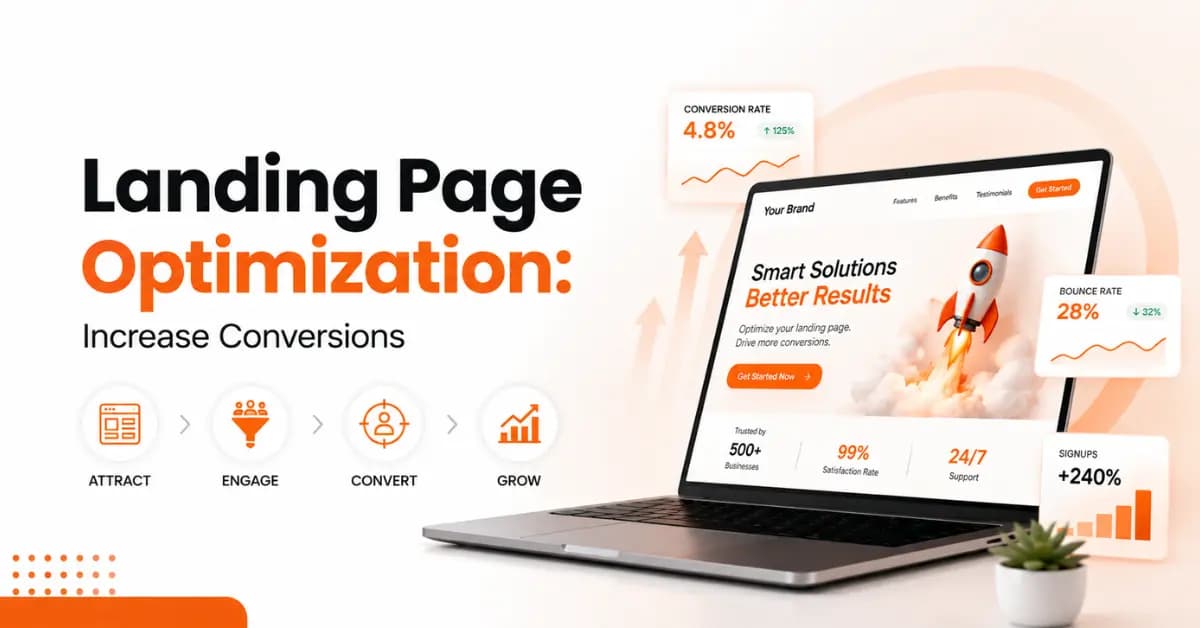
Landing Page Optimization: How to Increase Conversions
Getting visitors to your website is only half the battle. If people arrive on your landing page but leave without filling out a form, booking a call, requesting a quote, or making a purchase, your marketing budget may not be delivering its full potential. Landing Page Optimization helps businesses turn more existing visitors into meaningful actions. Instead of simply increasing traffic, you improve the page experience, messaging, offer, user experience, and calls-to-action so visitors have a clearer reason to convert.
Whether you run a service business, SaaS company, eCommerce store, or startup, effective landing page CRO can help you get more value from the traffic you already have.
What Is Landing Page Optimization?
Landing Page Optimization is the process of improving a landing page to increase the percentage of visitors who complete a desired action.
That action could include:
Filling out a lead form
Booking a consultation
Requesting a quote
Downloading a resource
Signing up for a free trial
Purchasing a product
Calling a business
Starting a demo
Optimization can involve everything from the headline and landing page copy to the form, CTA, page speed, mobile experience, trust signals, and overall design.
How Landing Page Optimization Works
A high-converting landing page typically guides visitors through a simple journey:
Traffic → Relevant Message → Value Proposition → Trust → CTA → Conversion
If one part of this journey creates confusion or friction, visitors may leave before converting.
For example, imagine someone searches for "SEO services for small businesses" and clicks an advertisement promising a free SEO consultation. If the landing page instead presents a generic digital marketing message with no obvious consultation offer, the visitor may question whether they are in the right place.
Good optimization creates consistency between the visitor's expectations and the page experience.
Landing Page Optimization vs. Conversion Rate Optimization
Landing Page Optimization focuses on improving a specific landing page and its ability to generate conversions. Conversion rate optimization (CRO) is broader. It can cover the entire customer journey, including website navigation, checkout, product pages, forms, pricing, emails, and other conversion points.
Landing page CRO is therefore a focused part of a wider conversion optimization strategy.
Why Landing Page Optimization Matters for Conversions
Increasing website traffic can be expensive. If your existing traffic does not convert efficiently, simply attracting more visitors may not solve the underlying problem.
Landing page optimization can help businesses:
Generate more leads from existing traffic
Improve the efficiency of paid campaigns
Reduce wasted advertising spend
Improve the user experience
Increase qualified inquiries
Reduce unnecessary friction
Improve marketing ROI
Traffic Does Not Equal Conversions
Consider a simple example.
A landing page receives 5,000 visitors per month and converts at 1%.
That produces:
5,000 × 1% = 50 conversions
If improvements raise the conversion rate to 2%, the same traffic could generate:
5,000 × 2% = 100 conversions
This is an illustrative example, not a guaranteed outcome. Actual results depend on factors such as traffic quality, industry, offer, audience, device, and conversion goal.
The important point is that improving the page can create additional opportunities without requiring an equivalent increase in traffic.
10 Landing Page Best Practices That Increase Conversions
There is no single formula that guarantees a high conversion rate. However, several landing page best practices consistently help businesses create clearer and more persuasive experiences.
1. Write a Clear, Benefit-Focused Headline
Your headline is often the first major piece of copy visitors see.
A strong landing page headline should quickly communicate:
What you offer
Who it helps
The main benefit
Why the visitor should continue
Avoid vague statements such as "Take Your Business to the Next Level."
Instead, make the outcome clearer.
For example:
Weak:
"Grow Your Business With Better Marketing"
Stronger:
"Generate More Qualified Leads With a Data-Driven SEO Strategy"
The stronger version gives the visitor a clearer idea of the expected benefit.
2. Create a Strong Value Proposition
Your value proposition should answer a simple question:
Why should someone choose this offer instead of ignoring the page or choosing another option?
A useful value proposition connects the customer's problem with your solution.
Focus on:
The problem
The desired outcome
The unique benefit
Relevant proof
The next step
Avoid filling the hero section with technical jargon. Visitors should understand the offer without needing industry expertise.
3. Use One Clear Call-to-Action
CTA optimization is an important part of conversion optimization.
Your primary CTA should tell visitors exactly what to do next.
Examples include:
Book a Free Consultation
Get Your SEO Audit
Request a Quote
Start Your Free Trial
Download the Guide
Schedule a Demo
Avoid making several actions compete equally for attention.
A landing page can contain multiple CTA buttons, but they should generally support the same primary conversion goal rather than sending visitors in completely different directions.
4. Simplify Your Landing Page Design
Good landing page design is not about adding more visual elements. It is about helping visitors understand the page quickly.
Use:
Clear visual hierarchy
Enough white space
Short sections
Easy-to-read typography
Relevant images
Strong CTA visibility
Consistent branding
Remove elements that distract visitors from the intended action.
If a visitor has to work too hard to understand what the page is offering, you create unnecessary conversion friction.
5. Optimize Forms for More Leads
Forms are often one of the biggest barriers to lead generation.
If you only need a name, email address, and business requirement, asking for ten different fields may discourage visitors.
Review every field and ask:
Do we genuinely need this information at this stage?
Useful form optimization practices include:
Remove unnecessary fields
Use clear labels
Explain what happens after submission
Make errors easy to understand
Keep forms easy to complete on mobile
Test shorter versus longer forms
For complex B2B services, a multi-step form may sometimes work better than presenting a long form all at once. Test rather than assume.
6. Add Trust Signals and Social Proof
Visitors may hesitate when they do not know whether your business is trustworthy.
Relevant trust signals can include:
Customer testimonials
Case studies
Client logos
Reviews
Industry certifications
Results or performance data
Guarantees where appropriate
Clear contact information
For example, a service landing page can combine a concise customer testimonial with a specific outcome.
Avoid fabricated testimonials or unsupported performance claims. Trust signals work best when they are genuine and verifiable.
7. Make the Page Mobile-Friendly
A landing page that looks excellent on a desktop can still perform poorly on smartphones.
Check whether mobile visitors can:
Read the headline comfortably
Understand the offer quickly
Tap the CTA easily
Complete the form without frustration
View images correctly
Navigate the page without excessive scrolling or zooming
Mobile optimization should be part of your landing page UX rather than something you check after publishing.
8. Improve Landing Page Speed
A slow page can create friction before visitors even see your offer.
Review:
Image file sizes
Unnecessary scripts
Third-party tools
Page resources
Mobile loading performance
Core Web Vitals
Speed is not only a technical SEO concern. It also affects the overall experience of someone who is trying to access your offer.
9. Match the Landing Page to User Intent
One of the most overlooked landing page best practices is message match.
The promise that brings someone to your page should connect naturally with what they see after clicking.
For example:
Search/ad:
"Free SEO Audit for Small Businesses"
Landing page headline:
"Get a Free SEO Audit for Your Small Business"
CTA:
"Request My Free SEO Audit"
This consistency reduces confusion and reassures visitors that they have reached the right destination.
10. Remove Conversion Friction
Conversion friction is anything that makes the desired action harder than necessary.
Common examples include:
Confusing navigation
Weak CTAs
Long forms
Unclear pricing
Too many choices
Slow pages
Poor mobile layouts
Lack of trust signals
Unexpected requirements
Unclear next steps
Walk through your landing page as if you were a first-time visitor.
Ask:
What could make me hesitate here?
Then prioritize the biggest problems.
How to Improve Landing Page Copy for Higher Conversions
Design attracts attention, but landing page copy helps visitors understand why they should act. Effective copy should connect the visitor's problem with a useful solution.
Use Customer-Focused Language
Instead of making the page entirely about your company, focus on what the visitor wants to achieve.
A simple structure is:
Problem → Benefit → Proof → Action
For example:
Problem:
"Struggling to generate consistent leads from organic search?"
Benefit:
"Build a sustainable SEO strategy designed to attract high-intent customers."
Proof:
Support the claim with genuine experience, case studies, or relevant evidence.
Action:
"Book an SEO Consultation."
This structure makes the message easier to follow.
Make Copy Easy to Scan
Most visitors do not read every word immediately.
Use:
Short paragraphs
Descriptive headings
Bullet points
Bold emphasis where useful
Concise sentences
Clear CTA sections
Do not hide your main value proposition inside a large block of text.
Address Objections Before the CTA
Before converting, visitors may have questions such as:
Is this service suitable for my business?
What does it cost?
How does the process work?
How long does it take?
Is the company trustworthy?
What happens after I submit the form?
Answering relevant objections can reduce uncertainty and make the conversion decision easier.
Landing Page CRO: What Should You Test?
Landing page CRO should rely on evidence rather than personal preference. A page may look attractive to a designer but still fail to convert. Testing helps you understand what your audience actually responds to.
Elements Worth A/B Testing
Consider testing:
Headlines
Subheadings
CTA wording
CTA placement
Hero images
Form length
Form layout
Testimonials
Pricing presentation
Page structure
Offer positioning
Do not change every element at once if you want to understand what caused a performance change.
Test One Major Variable at a Time
Suppose you change the headline, form, CTA, hero image, and pricing section simultaneously. If conversions improve, you may not know which change caused the improvement. A more controlled approach allows you to learn from each experiment.
However, testing should also consider traffic and conversion volume. A low-traffic page may need more time before you can confidently evaluate a test.
How to Measure Landing Page Conversion Performance
Optimization requires measurement. Track the metrics that relate directly to your business objective rather than focusing only on vanity metrics.
Key Landing Page Metrics
Monitor:
Conversion rate
CTA click-through rate
Form completion rate
Cost per lead
Lead quality
Traffic source
Device performance
Engagement behavior
Revenue generated
For example, a landing page might increase its conversion rate from 2% to 3% while generating lower-quality leads.
That is not necessarily a successful optimization.
Look Beyond Conversion Rate
A good landing page should generate useful business outcomes, not just more clicks. If you run a B2B service business, qualified leads may matter more than total form submissions. Your measurement framework should therefore connect landing page activity to outcomes such as:
Visitor → Lead → Qualified Lead → Customer → Revenue
This gives you a more accurate view of conversion optimization.
Common Landing Page Optimization Mistakes to Avoid
Avoid these common problems:
Using several competing CTAs
Writing generic headlines
Focusing on features instead of benefits
Designing only for desktop
Using too many form fields
Adding unnecessary navigation
Making unsupported claims
Ignoring page speed
Using irrelevant stock images
Changing pages without measuring results
Optimizing clicks instead of qualified conversions
The goal is not to make a landing page look impressive. The goal is to make the visitor's decision easier.
Landing Page Optimization Example: Turning More Visitors Into Leads
Consider a hypothetical service business receiving 5,000 landing page visitors each month.
Before Optimization
The page has:
A generic headline
A long lead form
Several competing CTAs
Limited social proof
Weak mobile usability
Suppose it converts at 1%.
That produces approximately 50 leads from 5,000 visitors.
After Optimization
The business improves:
The headline
Value proposition
CTA clarity
Form experience
Mobile UX
Trust signals
Message match
If the page reaches an illustrative 2% conversion rate, it could generate approximately 100 leads from the same 5,000 visitors.
Again, this is an example for understanding the mathematics, not a promised performance benchmark.
The lesson is simple: before spending more money to acquire traffic, examine whether your existing landing page is converting the traffic effectively.
A Practical Landing Page Optimization Checklist
Use this checklist before publishing or redesigning a page.
Before Publishing
Is the main offer immediately clear?
Does the headline communicate a benefit?
Does the page match search or advertising intent?
Is the value proposition easy to understand?
Is there one obvious primary CTA?
Does the form request only necessary information?
Are genuine trust signals visible?
Does the page work well on mobile?
Are images optimized?
Does the page load efficiently?
Is conversion tracking configured?
Do all forms and buttons work?
Is the copy easy to scan?
After Publishing
Do not consider optimization finished once the page goes live.
Review your analytics regularly and look for:
Conversion drop-off
Mobile versus desktop differences
Traffic-source performance
Form abandonment
CTA interaction
Lead quality
Customer outcomes
Then use those findings to prioritize your next optimization experiment.
When Should You Optimize Your Landing Page?
You should consider landing page optimization when:
Your page receives traffic but generates few conversions
Paid campaigns generate clicks but not enough leads
Visitors abandon your forms
Mobile conversion rates are weak
Your offer has changed
Your target audience has changed
Your advertising message does not match the landing page
You cannot clearly identify why visitors are not taking action
You do not need to redesign the entire page every time.
Often, the best approach is to identify the biggest source of friction and improve that element first.
Frequently Asked Questions
What is landing page optimization?
Landing page optimization is the process of improving a landing page's content, design, user experience, forms, CTA, speed, and other elements to increase the percentage of visitors who complete a desired action.
How can I increase my landing page conversion rate?
Start by improving the headline, value proposition, CTA, offer relevance, form experience, trust signals, mobile UX, and page speed. Use analytics and controlled testing to determine which changes actually improve performance.
What is a good landing page conversion rate?
There is no universal conversion rate that works for every business. Results vary according to industry, traffic source, audience, offer, device, funnel stage, and conversion goal. Compare your performance with your own historical data and business objectives.
What is landing page CRO?
Landing page CRO is the practice of using conversion rate optimization techniques to improve the performance of a specific landing page. It involves identifying friction, testing changes, analyzing behavior, and improving the page based on evidence.
How often should I A/B test a landing page?
There is no fixed testing schedule. The appropriate timeframe depends on traffic, conversion volume, test design, and the size of the expected difference. Avoid ending tests prematurely based on small or unstable data sets.
What should I optimize first on a landing page?
Start with the elements most likely to influence the visitor's decision: offer relevance, headline, value proposition, CTA clarity, and major sources of friction. Analytics and user feedback can help you decide which issue deserves attention first.
Final Thoughts
Effective Landing Page Optimization is not about following a rigid formula or adding more design elements. It is about understanding what visitors need to know before they take action and removing unnecessary barriers along the way.
Disclaimer: The information provided in this article is intended for general educational and informational purposes only. Landing page performance and conversion rates can vary depending on your industry, audience, traffic sources, offer, and marketing strategy. Always review your own analytics and testing data before making significant business or marketing decisions.
Free growth plan
Ready to grow your business?
Reading is a start — now let's build it. Tell us where you want to grow and a senior strategist will map the fastest, most profitable way to get there. Free, no obligation.
Discussion
Join the conversation
Be the first to comment. Comments are reviewed before they appear, so yours won't show up instantly — but we read every one.
Leave a comment
Keep reading
All articles Web
WebWebsite Development Dubai: Costs, Process and Choices
Explore Website Development Dubai, including website cost Dubai, development steps, platform choices, SEO, timelines, and tips for choosing a website company.
 Web
WebWebsite Security Checklist for Small Businesses
Website Security Checklist for small businesses covering HTTPS, backups, MFA, updates, monitoring, access control, and practical website protection tips.
 Web
WebEcommerce Website Design: What Actually Drives Sales
Discover how ecommerce website design drives sales through better UX, mobile design, product pages, trust, speed, and conversion-focused checkout.