Local SEO for Multi-Language Websites: What to Plan First
Learn how to plan Local SEO for multi-language websites with localized keywords, hreflang tags, URL structures, and local business optimization.
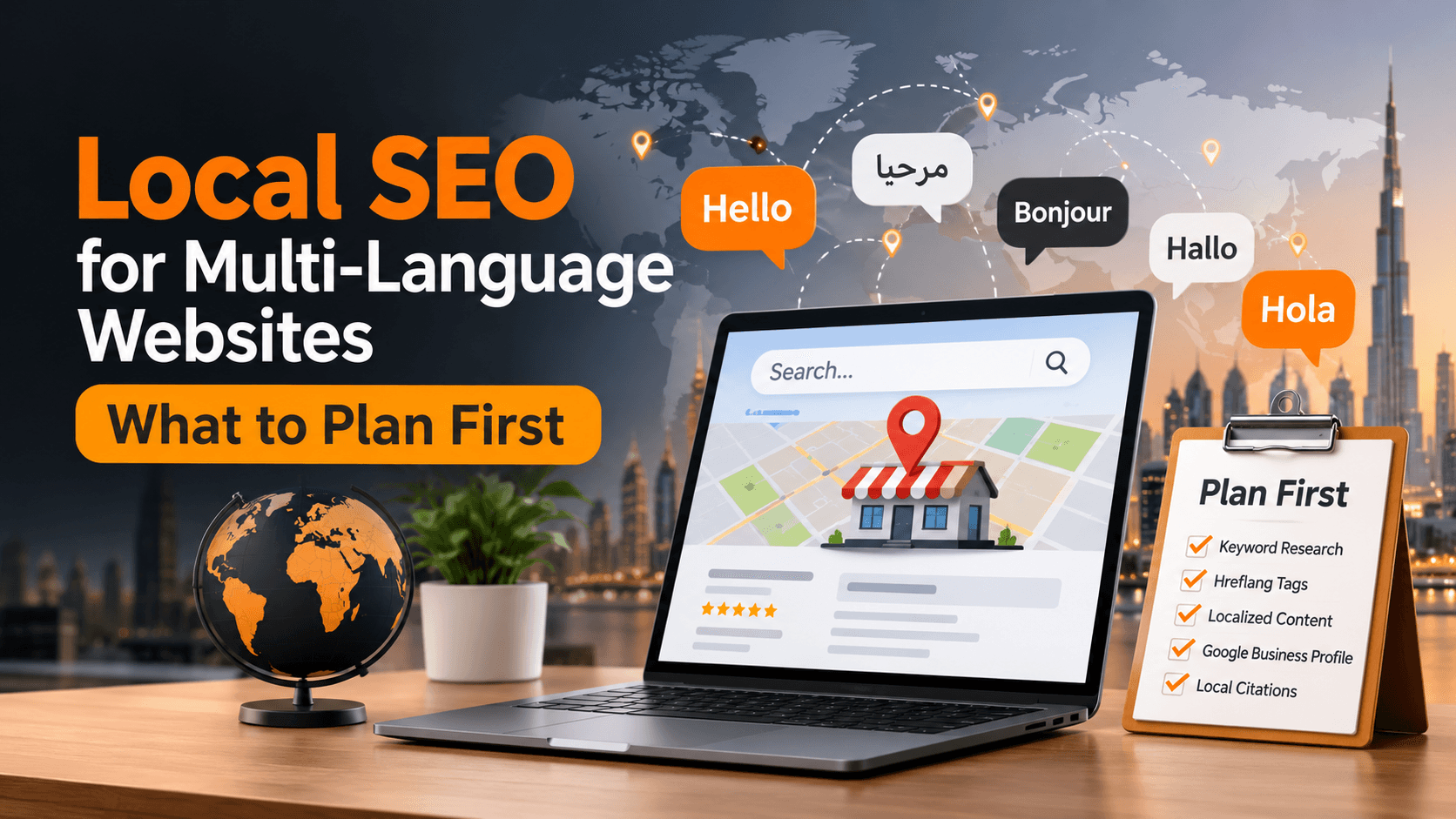
Businesses that target customers in different languages need more than a translated website. They need a clear strategy that helps each audience find relevant services in local search results. This is where Local SEO for multi-language websites becomes important. For example, a UAE-based company may serve English-speaking and Arabic-speaking customers across Dubai, Abu Dhabi, and other Emirates. Both audiences may search for the same service using different words, phrases, and search habits. A website that only translates its existing content may miss these differences.
An effective Local SEO strategy connects language, location, search intent, and technical website structure. Businesses should plan their keywords, URL structure, hreflang tags, localized landing pages, and business information before expanding into additional languages.
Understand How Local SEO Works for Multi-Language Websites
Local SEO helps businesses improve their visibility when people search for products or services in a particular location. It connects relevant website content, business information, geographic signals, and customer needs.
For multilingual websites, this process requires an additional layer of planning. Businesses must help search engines understand which language and regional version of a page serves each audience.
For example, a digital marketing agency in Dubai may have English and Arabic website versions. Both pages should explain the agency's services clearly, but each should use natural language and terminology that its intended audience understands.
How Language and Location Influence Local Search Results
Language and location work together to shape local search experiences. Search engines consider several signals when determining which results may be relevant to a user.
Important considerations include:
Search language: The language a customer uses when looking for a service.
Geographic relevance: The city, country, or service area associated with the search.
Website content: Whether the page provides useful information in the intended language.
Business information: Whether contact details and location information are accurate.
Local search presence: Whether the business has relevant visibility in Google Search and Maps.
Businesses should also understand that multilingual content does not automatically improve rankings. Every language version must provide useful information that matches its audience's needs.
Conduct Native Keyword Research for Each Target Market
Native keyword research is one of the most important parts of a multilingual local SEO strategy. Customers in different countries may use completely different expressions to search for the same product or service.
Directly translating an English keyword into Arabic, French, or another language does not always reflect how local customers search.
For example, an English-speaking customer might search for "business setup services in Dubai." An Arabic-speaking customer may use a different expression with the same commercial intent.
Businesses should research actual search behaviour instead of assuming that translated keywords will attract the right visitors.
How to Find Keywords in Different Languages
Use a combination of keyword research tools and local market knowledge.
Google Keyword Planner: Identify keyword ideas and search demand for selected locations and languages.
Google Search Console: Review the actual queries that bring visitors to existing website pages.
Google Trends: Compare search interest across regions and languages.
Competitor research: Study how local competitors describe their services.
Customer feedback: Identify the phrases customers naturally use when discussing products or services.
Build a Separate Keyword Map for Every Market
Organize keywords according to language, location, and search intent.
For example, a UAE-based web development company could organize its keyword strategy around:
English service keywords.
Arabic service keywords.
Dubai-specific search phrases.
Abu Dhabi-specific search phrases.
Commercial keywords such as web development services.
Informational searches about website design and development.
Create separate language-specific landing pages where they provide genuine value. Avoid placing every translated keyword on one page because this can weaken content relevance and user experience.
Choose the Right URL Structure for Multilingual Websites
URL structure for multilingual sites determines how businesses organize their language and regional content. Choosing the right structure early makes website management, internal linking, and technical SEO easier.
There are three common approaches.
Compare the Three Main URL Structures
1. Country-code top-level domains (ccTLDs)
Examples:
example.aeexample.frexample.de
Each domain represents a particular country. This structure can work well for businesses with separate country-specific websites, but managing multiple domains may require additional resources.
2. Subdomains
Examples:
ar.example.comfr.example.comde.example.com
Subdomains allow businesses to organize language or regional versions separately while maintaining a connection to the main domain.
3. Subdirectories
Examples:
example.com/ar/example.com/fr/example.com/de/
Subdirectories keep all language versions within one domain. They can provide a straightforward structure for businesses that want to manage multilingual content centrally.
Which URL Structure Should Businesses Choose?
The right option depends on the company's expansion plans, website management resources, and target markets.
Structure | Best suited for |
|---|---|
ccTLDs | Businesses operating distinct country websites |
Subdomains | Organizations managing separate regional sections |
Subdirectories | Businesses managing several languages under one domain |
For many small and medium-sized businesses, subdirectories offer a practical starting point. However, no URL structure guarantees higher rankings by itself.
Google also recommends using clear locale-specific URLs to help identify regional content.
Implement Hreflang Tags for Local SEO
Hreflang tags for Local SEO help Google understand the relationship between different language and regional versions of a webpage.
For example, a business may have one page for English-speaking customers in the United States and another for Arabic-speaking customers in the UAE.
Hreflang annotations help Google identify these alternatives and select an appropriate version for users.
Importantly, hreflang does not directly improve rankings. It helps search engines understand which page to serve for a particular language or regional audience.
How to Set Up Hreflang Correctly
Consider these important implementation steps:
Use valid language and country codes.
Add the appropriate alternate URLs to each relevant page.
Include a self-referencing hreflang annotation.
Ensure alternate pages reference one another.
Use accessible and indexable URLs.
Keep canonical tags consistent with the intended page versions.
Consider
x-defaultfor a suitable fallback page.
For example, a business targeting English-speaking customers in the United States and Arabic-speaking customers in the UAE could use:
<link rel="alternate"
      hreflang="en-US"
      href="https://example.com/en-us/" />

<link rel="alternate"
      hreflang="ar-AE"
      href="https://example.com/ar-ae/" />
Each page should include its own hreflang reference and the other relevant language alternatives.
Common Hreflang Mistakes to Avoid
Using incorrect language or country codes.
Linking to broken or redirected pages.
Missing reciprocal hreflang references.
Forgetting the self-referencing annotation.
Creating conflicts between canonical and alternate URLs.
Google supports HTML, HTTP headers, and XML sitemaps for indicating localized page versions. Choose a manageable implementation method and keep it consistent.
Create Localized Content Instead of Directly Translating Pages
Localizing website content means adapting information to the language, location, expectations, and search behaviour of a specific audience. Translation changes the language of existing content. Localization makes that content relevant to the people reading it.
For example, a UAE-based company may need different examples, service descriptions, terminology, and contact information for its English and Arabic audiences.
Translation vs. Transcreation: What Is the Difference?
Both approaches have a role in multilingual content production.
Direct translation: Converts existing information into another language while preserving its original meaning.
Human transcreation: Adapts the message, tone, expressions, and cultural references for a particular audience.
Machine translation: Helps produce initial translations quickly but requires human review for accuracy and natural language.
A business should not publish automated translations without checking their meaning, readability, and accuracy.
What Should Every Localized Landing Page Include?
Each language-specific landing page should provide:
A relevant page title and meta description.
Naturally written local keywords.
Clear service descriptions.
Accurate contact details and business information.
Relevant location references.
Locally appropriate examples and testimonials.
Clear calls to action.
Internal links to related pages in the same language.
For example, an Arabic landing page for a Dubai service provider should use natural Arabic terminology rather than mechanically translating every English heading.
This approach makes the page more useful and helps visitors understand the services without struggling with unfamiliar expressions.
Optimize Google Business Profile for Different Languages
A multilingual Google Business Profile strategy should support the same accurate business identity presented on the company's website. Google Business Profile helps eligible businesses manage how their information appears across Google Search and Maps.
Important information includes the business name, address, phone number, operating hours, category, and website.
For businesses serving multilingual customers, accurate information matters more than simply adding translated keywords to the profile.
How to Maintain Accurate Multilingual Business Information
Follow these practices:
Keep the official business name accurate and consistent.
Maintain correct addresses and contact numbers.
Add the most relevant website and landing page links.
Keep opening hours updated.
Respond to customer reviews professionally in the appropriate language.
Use accurate business categories.
Avoid keyword stuffing in the business name.
A business should not create duplicate profiles simply because it serves customers in different languages. Profiles should represent eligible real-world business locations and follow Google's guidelines.
For businesses with multiple branches, each eligible location should have accurate and independently maintained information.
Build Local Citations and Backlinks in Each Language
Local citation building in multiple languages helps businesses maintain consistent information across relevant regional directories and business platforms. A local citation generally includes details such as the business name, address, and phone number. These details are often called NAP information.
For example, if a company operates in Dubai, its official contact information should remain consistent across relevant business directories, industry platforms, and its website.
Local Citation Building Checklist
Consider listing your business on:
Relevant country-specific business directories.
Local industry associations.
Regional business listing platforms.
Local publications and news websites.
Relevant language-specific business communities.
How to Earn Relevant Local Backlinks
Local link building should focus on relevance and genuine relationships rather than collecting large numbers of low-quality links.
Businesses can:
Publish useful local industry resources.
Collaborate with regional organizations.
Participate in local business events.
Contribute expert insights to relevant publications.
Develop partnerships with reputable local websites.
A relevant link from a trusted regional organization can provide more meaningful value than a large number of unrelated directory links.
Prevent Duplicate Content and Technical SEO Problems
Multilingual websites require careful technical SEO management. Businesses should ensure that search engines can crawl, understand, and index the correct version of each page.
However, similar content across different languages is not automatically a duplicate content problem. Google explains that fully translated pages are generally not treated as duplicates simply because they communicate similar information in different languages.
Problems can arise when businesses publish identical content across several URLs without meaningful localization or proper technical signals.
Technical SEO Checklist for Multilingual Websites
Check the following elements before publishing:
Canonical tags: Use the correct canonical URL for each language page.
Hreflang tags: Connect relevant language and regional alternatives.
Indexability: Ensure important language pages can be crawled and indexed.
XML sitemaps: Include the relevant localized URLs and hreflang annotations where appropriate.
Internal links: Link users to relevant pages in their preferred language.
Mobile responsiveness: Ensure every version works properly on smartphones.
Page speed: Optimize images, scripts, and other website resources.
Redirects: Avoid forced redirects that prevent users or search engines from accessing other language versions.
Businesses should also provide visible language selectors so visitors can choose their preferred version instead of relying entirely on automatic location-based redirects.
Use Local Business Schema and Monitor Performance
Schema markup for local businesses helps search engines understand important business information in a structured format.
For example, LocalBusiness structured data can describe business details such as its name, address, telephone number, opening hours, and other relevant information.
Important LocalBusiness Schema Properties
Depending on the business, useful properties may include:
nameaddresstelephoneurlgeoopeningHoursSpecificationareaServed
Use accurate information that matches the visible content of the website. Do not add unsupported locations, reviews, or business details.
Tools to Monitor Multilingual Local SEO
Use these tools to measure performance:
Google Search Console: Monitor search queries, clicks, impressions, indexing, and page performance.
Google Analytics 4: Compare engagement and conversions across language-specific sections.
Google Business Profile Performance: Review available customer interactions and profile performance.
Schema Markup Validator: Check structured data implementation.
Google Rich Results Test: Test eligibility for supported rich results.
Businesses should compare organic traffic, enquiries, and conversions by language and target location.
One important point: Google Search Console no longer provides the old International Targeting report. Businesses should use current Search Console reporting and URL inspection tools instead.
Google's official LocalBusiness structured data documentation explains the supported properties and implementation requirements.
Common Local SEO Mistakes on Multi-Language Websites
Even a well-designed multilingual website can struggle with local visibility when businesses overlook important optimization details.
Avoid these common mistakes:
Translating keywords without researching local search intent.
Publishing machine-translated content without human review.
Using incorrect hreflang annotations.
Creating thin or nearly identical regional landing pages.
Maintaining inconsistent NAP information.
Using incorrect canonical tags.
Ignoring local citations and relevant backlinks.
Creating unnecessary duplicate Google Business Profiles.
Neglecting mobile usability and page performance.
Linking every language version to unrelated pages.
Businesses should review these issues regularly, especially when adding new languages or entering additional markets.
How to Plan a Multilingual Local SEO Strategy Before Launch
A successful multilingual website starts with a clear plan. Businesses should identify their target audiences, research local search behaviour, and establish a technical structure before publishing additional language versions.
Pre-Launch Multilingual Local SEO Checklist
Use this checklist to prepare your website:
Identify target countries, cities, and languages.
Research native-language keywords.
Choose an appropriate URL structure.
Create useful language-specific landing pages.
Implement hreflang and canonical tags.
Verify business information and NAP consistency.
Optimize eligible Google Business Profiles.
Add relevant LocalBusiness schema.
Build relevant local citations and backlinks.
Check mobile usability and page speed.
Review indexing and internal links.
Set up language and location-based performance tracking.
Start with one important market or language version. Test its content quality, technical setup, and performance before expanding the same strategy to additional regions.
This approach helps businesses identify problems early and manage international growth more effectively.
FAQs
1. How to do local SEO for a multilingual website?
Start with native keyword research for every target language and location. Create localized landing pages, organize URLs clearly, implement hreflang tags, and maintain accurate business information. Also build relevant local citations, optimize eligible Google Business Profiles, and monitor organic performance separately for each market.
2. Does translating a website help with local SEO?
Yes, translating a website can help businesses reach customers who search in different languages. However, translation alone does not guarantee better local rankings. Businesses should also localize keywords, adapt content to regional search intent, maintain accurate contact information, and implement appropriate technical SEO signals.
3. How do hreflang tags affect local search rankings?
Hreflang tags help Google understand which language or regional version of a webpage is intended for particular audiences. They can help Google serve the appropriate page in search results, but they are not a direct ranking factor. Correct implementation also requires reciprocal references between alternate pages.
4. Can you have multiple languages on one Google Business Profile?
Businesses can support multilingual customers while maintaining accurate information on an eligible Google Business Profile. They should keep their business identity and location details accurate, provide suitable website links, and communicate with customers in relevant languages. They should not create duplicate profiles solely to represent different languages.
5. What is the best URL structure for multilingual local SEO?
The best URL structure depends on the business's target markets and technical resources. ccTLDs work for distinct country websites, subdomains organize separate sections, and subdirectories keep language versions under one domain. Businesses should choose a structure they can manage consistently over time.
6. How to avoid duplicate content on multi-language local pages?
Create genuinely localized content instead of publishing identical pages with only minor wording changes. Use appropriate canonical tags, reciprocal hreflang annotations, and unique regional information where relevant. Fully translated pages are not automatically considered problematic duplicate content by Google.
How BrandVexo Can Help!
BrandVexo helps businesses build practical digital growth systems through SEO, website development, digital marketing, and AI automation. We focus on improving online visibility, strengthening digital presence, and attracting relevant customers. Our approach combines search strategy, engaging content, and performance-focused website solutions.
We help businesses connect their digital activities with measurable commercial goals.
Contact BrandVexo
Phone: +971 52 356 5409
Email: info@brandvexo.com
Website: www.brandvexo.com
Conclusion
Local SEO for multi-language websites requires more than translating existing content. Businesses need to understand how different audiences search, organize language-specific URLs, implement hreflang correctly, and maintain accurate local business information.
A well-planned multilingual website connects technical SEO with relevant content and a useful customer experience. By investing in native keyword research, localized landing pages, local citations, and performance tracking, businesses can build a stronger foundation for reaching customers across different markets.
Disclaimer: This article provides general information about multilingual website optimization and Local SEO. Search engine guidelines and technical requirements may change, so businesses should review current documentation and assess their website requirements before implementation.
Free growth plan
Ready to grow your business?
Reading is a start — now let's build it. Tell us where you want to grow and a senior strategist will map the fastest, most profitable way to get there. Free, no obligation.
Discussion
Join the conversation
Be the first to comment. Comments are reviewed before they appear, so yours won't show up instantly — but we read every one.
Leave a comment
Keep reading
All articles
Local SEO Citations: How to Check Business Listing Accuracy
Learn how to check Local SEO Citations, fix incorrect business listings, maintain NAP consistency and improve your business's local search visibility.
Website Migration SEO: Complete Checklist for Business Owners
Follow this website migration SEO checklist to protect rankings, preserve organic traffic, manage redirects, and avoid common technical SEO mistakes.

Local SEO Reviews: A Practical System to Earn More Trust
Learn how Local SEO Reviews build customer trust, support Google rankings, and improve local visibility with practical review management strategies.