

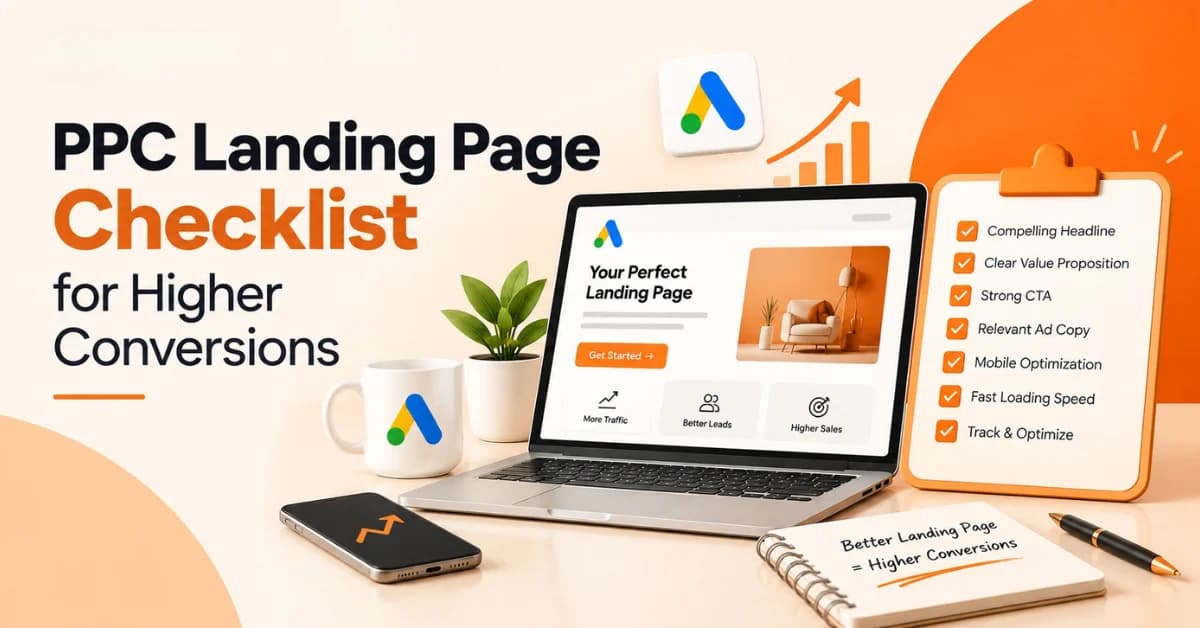
PPC Landing Page Checklist for Higher Conversion Rates
Getting clicks from Google Ads is only half the job. If visitors reach your website but do not take the desired action, your advertising budget can disappear without producing enough business. A well-designed PPC landing page bridges the gap between an ad click and a conversion. It gives visitors the information they expect, answers their questions, builds trust, and guides them toward one clear next step.
The best landing pages do not rely on complicated design or aggressive sales copy. They focus on relevance, clarity, usability, trust, and continuous improvement. This PPC landing page checklist explains what to review before launching or scaling a paid campaign and how landing page CRO can help improve your PPC conversion rate.
What Is a PPC Landing Page?
A PPC landing page is a dedicated web page designed to receive visitors from paid advertising campaigns.
Unlike a general homepage, a PPC landing page usually focuses on a specific:
Product or service
Search intent
Audience
Offer
Campaign
Conversion goal
For example, a business advertising “accounting services in Dubai” could send visitors to a dedicated accounting services page instead of its general homepage.
The dedicated page can immediately explain the service, benefits, proof, process, and next step.
PPC Landing Page vs. Homepage
A homepage normally introduces an entire business and gives visitors several navigation options.
A PPC landing page should usually provide a much more focused experience.
A homepage may contain:
Multiple services
Company information
Blog links
Several CTAs
Extensive navigation
A PPC landing page can focus on:
One campaign
One primary offer
One audience
One conversion objective
The goal is not to remove useful information. It is to reduce unnecessary friction between the visitor and the action you want them to take.
PPC Landing Page Checklist: 12 Things to Check
Before launching a paid campaign, review these 12 elements.
1. Match the Landing Page to Search Intent
Search intent should guide the entire landing page. Someone searching for “Google Ads management Dubai” has a different expectation from someone searching for “what is PPC advertising?”
Your landing page should answer the specific need behind the search.
Check that:
The page addresses the searcher's problem.
The offer matches the keyword.
The content provides the information promised in the ad.
The visitor can quickly understand what you provide.
The page does not force visitors to search through unrelated content.
For example, a visitor searching for a specific business service should ideally reach a page focused on that service rather than a generic homepage.
2. Create Strong Message Match Between the Ad and Page
Message match means maintaining consistency between the user's search, your advertisement, and the landing page.
Think of the journey as:
Keyword → Ad → PPC Landing Page → CTA → Conversion
If the ad promises one thing but the page immediately talks about something else, visitors may question whether they reached the right place.
For example:
Ad:
“Professional Accounting Services in Dubai”
Landing Page Headline:
“Accounting Services for Dubai Businesses”
The wording does not need to be identical, but the intent and offer should remain consistent.
3. Write a Clear, Benefit-Focused Headline
Your headline is one of the first things visitors see.
It should quickly answer:
What is this page offering, and why should I care?
Avoid vague headlines such as:
“Your Success Starts Here”
A more useful headline might communicate the actual service and benefit:
“Simplify Your Business Accounting With Expert Support”
Support the headline with a concise subheading that explains the offer in more detail.
A useful five-second test is:
Can a new visitor understand the offer, target audience, and next step within a few seconds?
If not, simplify the message.
4. Use One Primary Call to Action
A PPC landing page should make the next action obvious.
Depending on the business model, the CTA could be:
Get a Free Consultation
Request a Quote
Book a Call
Start Your Free Trial
Get Pricing
Contact an Expert
Avoid making visitors decide between several equally prominent actions.
You can repeat the same primary CTA throughout a longer page, but keep the conversion objective consistent.
5. Make the Offer Easy to Understand
Visitors should not have to work hard to understand what they receive.
Your page should clearly communicate:
What you offer
Who it is for
The main benefits
What happens after conversion
Any important conditions
Why the visitor should consider taking action
A useful framework is to answer four questions:
What am I getting?
Why do I need it?
Why should I trust this business?
What happens after I click?
The clearer the answers, the less uncertainty the visitor needs to overcome.
6. Optimize the Lead Form
Every additional form field can introduce friction, especially when the visitor has only just discovered your business.
Ask for information that you genuinely need.
For example, a simple consultation request may only require:
Name
Business email
Phone number
Service requirement
A more complex B2B sales process may require additional qualification information.
The right form length depends on the value of the conversion and how your sales process works.
A useful rule is:
Ask for information only when it helps you take the next meaningful action.
Also test your form on mobile devices. A form that looks simple on desktop can become frustrating on a small screen.
7. Build Trust Before Asking for the Conversion
Paid traffic often comes from people who have never interacted with your company before. They need reasons to believe that your business is legitimate and capable of delivering what the advertisement promised.
Useful trust elements include:
Genuine customer testimonials
Relevant case studies
Reviews
Client logos where appropriate
Certifications
Industry experience
Transparent business information
Clear contact details
Relevant guarantees, when legitimate
Do not use fabricated testimonials, exaggerated claims, or unsupported statistics.
For E-E-A-T, demonstrate real experience and expertise instead of simply claiming to be an expert. Google recommends creating helpful, reliable content that demonstrates expertise and trust and is genuinely useful to people rather than primarily designed to attract search traffic.
8. Make the PPC Landing Page Mobile-Friendly
A large proportion of paid traffic can come from mobile users, so your landing page needs to work comfortably on smaller screens.
Check:
Font size
Button size
Form usability
Image scaling
Page spacing
Navigation
Loading experience
CTA visibility
Avoid forcing users to zoom, horizontally scroll, or fight with small form fields.
A mobile-friendly landing page should make the desired action feel simple.
9. Improve Page Speed and User Experience
A visitor cannot convert if the page takes too long to become usable.
Review:
Image sizes
Scripts
Third-party tools
Hosting performance
Mobile loading
Layout stability
Interactive elements
Google's Core Web Vitals focus on loading performance, responsiveness, and visual stability. Current Core Web Vitals include Largest Contentful Paint (LCP), Interaction to Next Paint (INP), and Cumulative Layout Shift (CLS).
Use performance tools to identify actual problems rather than optimizing blindly.
10. Remove Unnecessary Distractions
A focused PPC landing page should make the intended action easy to find.
Review whether the page contains:
Too many competing CTAs
Unnecessary navigation
Excessive animations
Irrelevant links
Multiple unrelated offers
Distracting pop-ups
However, do not remove useful information simply because someone says “landing pages should have no navigation.”
The correct structure depends on the audience, offer, and campaign.
11. Address Objections Before They Stop the Conversion
People often hesitate because they still have unanswered questions.
For example:
“How much does it cost?”
“Can I trust this company?”
“What happens after I submit the form?”
“Is this service suitable for my business?”
Use relevant content to answer those questions.
You can include:
FAQs
Process explanations
Testimonials
Case studies
Pricing information where appropriate
Guarantees where legitimate
Service details
This is one of the most useful opportunities for landing page CRO because it tackles the reasons visitors hesitate rather than simply asking them to convert harder.
12. Test and Improve the Page Continuously
Your first landing page does not have to be your final landing page.
Use data to identify opportunities and test meaningful changes such as:
Headline
CTA wording
Offer positioning
Form length
Social proof
Page structure
Images
Supporting copy
Avoid changing everything simultaneously because you may not know which change influenced the result.
A structured testing process produces more useful insights.
How to Improve Your PPC Conversion Rate With Landing Page CRO
Landing page CRO, or landing page conversion rate optimization, is the process of improving a page so that more relevant visitors complete the desired action.
CRO should not mean randomly changing button colors or headlines.
Start by identifying where users experience friction.
Consider this funnel:
Ad click → Landing page → CTA → Form → Lead → Customer
If you receive many clicks but few conversions, investigate the landing page.
If visitors start the form but rarely complete it, investigate form friction.
If you receive many leads but few become customers, examine lead quality, targeting, qualification, and the offer.
Don't Optimize for Conversions Alone
A higher conversion rate does not automatically mean better business results.
Imagine one landing page generates 100 leads, but most are irrelevant.
Another generates 40 leads, but 15 become qualified sales opportunities.
The second page may create considerably more value.
That is why your measurement strategy should consider:
Conversion volume
Qualified leads
Cost per qualified lead
Sales opportunities
Customers acquired
Revenue
Your goal should be better business outcomes, not simply a higher percentage on a dashboard.
Google Ads Landing Page Best Practices
A strong Google Ads landing page should provide a relevant experience after someone clicks your advertisement. Keep the relationship between the keyword, advertisement, and landing page clear.
Build Campaign-Specific Landing Pages
Consider separate pages when search intent differs significantly.
For example, a digital marketing company could create dedicated pages for:
Google Ads management
SEO services
Social media marketing
Web development
A visitor searching for one service should not have to navigate through several unrelated services before finding what they need.
Avoid Sending Every Ad to the Homepage
Your homepage may be an excellent introduction to your brand, but it is not always the best destination for paid traffic.
A dedicated landing page can provide:
Greater message relevance
A clearer offer
Fewer distractions
Better campaign alignment
More focused conversion tracking
The right choice still depends on your campaign and user journey. A homepage is not automatically wrong, but a dedicated page can make more sense when the search intent is highly specific.
Make Conversion Tracking Part of the Strategy
Do not launch paid traffic without knowing what counts as a valuable conversion. Google Ads conversion measurement can track valuable customer actions such as purchases, sign-ups, quote requests, and phone calls. Google also notes that correctly configuring conversion actions helps campaigns optimize around meaningful signals.
For lead-generation businesses, consider measuring not only form submissions but also qualified leads and eventual sales where your systems allow it.
PPC Landing Page Checklist Before You Launch
Use this quick checklist before sending paid traffic to your page.
Content
Headline matches the advertising message
Search intent is addressed
Offer is immediately understandable
Benefits are clear
Important objections are addressed
Conversion
Primary CTA is obvious
Form asks only necessary questions
CTA works on mobile
Thank-you experience is configured
Conversion tracking works
Trust
Testimonials are genuine
Claims are accurate
Business information is clear
Relevant proof is visible
Privacy expectations are communicated
Technical
Page loads efficiently
Mobile layout works
Forms work
Buttons work
Analytics is configured
Conversion tracking has been tested
Common PPC Landing Page Mistakes That Reduce Conversions
Even a well-funded PPC campaign can struggle when the landing page creates unnecessary friction.
Common problems include:
Sending All Paid Traffic to the Homepage
A generic homepage can force visitors to find the information they expected from the ad.
Using Too Much Copy
Detailed information can be valuable, but users should be able to scan the page easily. Use headings, short paragraphs, bullets, and clear visual hierarchy.
Using Too Many CTAs
Multiple competing actions can make the conversion path unclear.
Ignoring Lead Quality
Do not judge your campaign exclusively by the number of forms submitted. Measure whether those leads actually have commercial value.
Failing to Test the Entire Funnel
The landing page may not be the only problem.
A low conversion rate could result from:
Poor keyword targeting
Weak ad messaging
Incorrect audience targeting
Irrelevant offers
Landing page friction
Complicated forms
Poor sales follow-up
Look at the entire customer journey.
How to Measure PPC Landing Page Performance
A useful PPC conversion rate formula is:
PPC Conversion Rate = Conversions ÷ Landing Page Visitors × 100
For example, if 1,000 relevant visitors reach your page and 50 complete the desired action:
50 ÷ 1,000 × 100 = 5% conversion rate
However, there is no universal conversion rate that every PPC campaign should achieve.
Performance varies according to:
Industry
Offer
Search intent
Traffic quality
Competition
Device
Audience
Conversion type
Sales process
Track business-relevant metrics such as:
Conversion rate
Cost per conversion
Cost per qualified lead
CTA click rate
Form completion rate
Lead-to-customer rate
Revenue
Return on ad spend
Google's conversion measurement tools are designed to help advertisers understand which campaigns, ads, and keywords drive valuable customer actions.
PPC Landing Page Example: Turning Clicks Into Qualified Leads
Consider a UAE B2B service business running paid search campaigns.
Before
The company sends all advertising traffic to its homepage.
Visitors see:
Several services
General company information
Multiple CTAs
A long contact form
No campaign-specific offer
The page may be professionally designed, but it does not immediately address the intent behind the advertisement.
After
The company creates a dedicated PPC landing page with:
A keyword-aligned headline
A clear service offer
Concise benefit-focused copy
Relevant customer proof
A short lead form
One primary CTA
Mobile-friendly design
Conversion tracking
The important lesson is not that a specific redesign will guarantee a particular conversion rate.
Instead, the business creates a clearer path between search intent, advertisement, landing page, and conversion.
It can then use real campaign data to identify what should be improved next.
Frequently Asked Questions About PPC Landing Pages
What is a PPC landing page?
A PPC landing page is a dedicated page designed to receive visitors from paid advertising and guide them toward a specific conversion, such as a purchase, consultation request, registration, or quote request.
What makes a good PPC landing page?
A good PPC landing page is relevant to the advertisement, clearly communicates the offer, builds trust, works well on mobile devices, provides a clear CTA, and removes unnecessary conversion friction.
Should Google Ads go to a landing page or homepage?
It depends on the campaign. A dedicated landing page can be useful when the search intent and offer are specific because it allows you to create a more focused experience. A homepage may still be appropriate for broader campaigns.
How can I improve my PPC conversion rate?
Start by checking message match, search intent, offer clarity, CTA visibility, form friction, trust signals, mobile usability, page speed, and conversion tracking. Then use campaign data to prioritize testing.
What is landing page CRO?
Landing page CRO is the process of improving a landing page so that a greater proportion of relevant visitors complete the desired action.
How long should a PPC landing page be?
There is no universal ideal length. Use enough content to answer the visitor's questions, communicate value, overcome relevant objections, and support the conversion. Simple offers may need less content, while complex B2B services may require more explanation.
How many form fields should a PPC landing page have?
Use the minimum information needed to process or qualify the lead effectively. A simple offer may require only a few fields, while a complex sales process may justify additional qualification questions.
What should I test on a PPC landing page?
Test elements that can materially affect user behavior, including headlines, offers, CTA copy, forms, page structure, supporting proof, and messaging. Use data to decide what to test rather than changing elements randomly.
Final PPC Landing Page Checklist
A successful PPC landing page is not simply a page with an attractive design.
It should create a logical journey:
Search Intent → Relevant Ad → Relevant Landing Page → Clear Value → Trust → CTA → Conversion
Before launching your campaign, make sure the page:
Matches search intent
Matches the ad
Communicates value quickly
Uses a clear CTA
Minimizes unnecessary form friction
Builds trust
Works on mobile
Loads efficiently
Addresses objections
Tracks meaningful conversions
Uses data for continuous testing
Focuses on qualified leads and business outcomes
The biggest opportunity often comes from improving the experience that happens after the click. Increasing traffic will not solve a landing page that fails to communicate relevance or value.
How BrandVexo Can Help With PPC and Landing Page Optimization
A PPC campaign works best when advertising, landing pages, tracking, and broader digital strategy work together. BrandVexo Digital Solutions helps businesses with digital marketing, SEO, web development, AI automation, and business solutions. Our approach focuses on creating useful digital experiences that support measurable business goals rather than chasing clicks alone.
Our services can support businesses with:
PPC and Google Ads strategy
PPC landing page planning
Landing page CRO
Conversion tracking
SEO strategy
Website development
Digital marketing
Content strategy
AI automation
If your campaigns generate clicks but not enough qualified leads, reviewing the landing page can be a practical place to start.
BrandVexo Digital Solutions
Phone: +971 52 356 5409
Email: info@brandvexo.com
Website: www.brandvexo.com
A stronger PPC campaign does not always require more ad spend. Sometimes, the biggest opportunity is making better use of the traffic you already have.
Disclaimer: This article is for general informational purposes only and does not guarantee specific PPC, conversion, or advertising results. Strategies and platform policies may change, so review your campaign data and current Google Ads guidelines before making decisions.
Free growth plan
Ready to grow your business?
Reading is a start — now let's build it. Tell us where you want to grow and a senior strategist will map the fastest, most profitable way to get there. Free, no obligation.
Discussion
Join the conversation
Be the first to comment. Comments are reviewed before they appear, so yours won't show up instantly — but we read every one.
Leave a comment
Keep reading
All articles Paid Ads
PPC Audit Checklist: Find Wasted Spend and Fix It
Use this PPC Audit Checklist to find wasted ad spend, review Google Ads performance, fix targeting issues, and improve PPC optimization.
 Paid Ads
Google Ads Dubai: Costs, Strategy and Agency Options
Explore Google Ads Dubai costs, PPC strategy, budgeting, tracking, and agency options to build campaigns that attract qualified leads and sales.
 Paid Ads
Retargeting Strategy: How to Win Back High-Intent Visitors
Build a smarter Retargeting Strategy with practical tips for remarketing, Meta retargeting, Google remarketing, funnel targeting, and conversions.