

Website Development Strategies for Business Growth in 2026
Explore Website Development Strategies for 2026, including mobile-first design, SEO, AI integration, website speed and conversion optimisation.
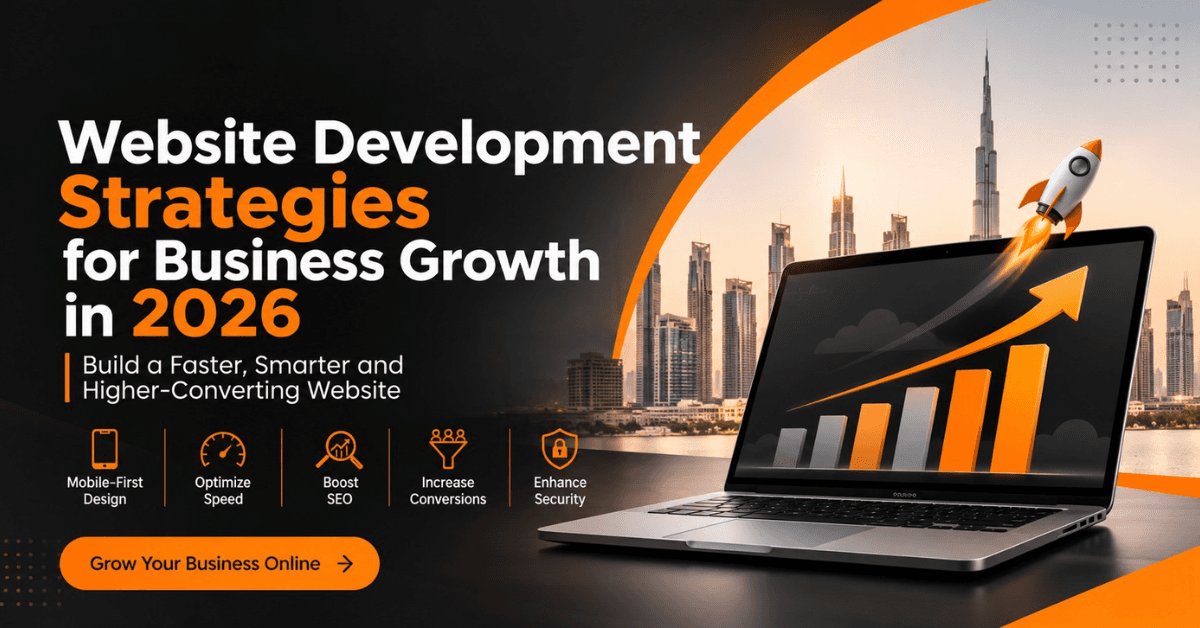
A business website should do more than display information. It should attract potential customers, communicate value, build trust, and turn visitors into enquiries or sales. In 2026, businesses need websites that combine responsive design, strong technical performance, search engine optimisation, security, and useful digital experiences. The right Website Development Strategies can help businesses improve online visibility, deliver better customer experiences, and support long-term growth. From mobile-first design and Core Web Vitals optimisation to AI-powered features and CRM integration, modern website development connects technology with measurable business goals.
However, choosing the right approach requires more than following the latest design trends. Businesses must consider their audience, objectives, budget, and future requirements before investing in website development.
How Does Web Development Drive Business Growth?
Web development supports business growth by creating a reliable digital platform where customers can understand services, compare solutions, and take action. A well-developed website strengthens brand credibility while making it easier for potential customers to interact with a business.
For example, a professional services company can use dedicated service pages, enquiry forms, customer testimonials, and clear calls to action to attract and convert potential clients.
The main business benefits include:
Increased online visibility: SEO-friendly development helps search engines understand and index website content.
Better customer experience: Simple navigation and responsive layouts make information easier to access.
Higher lead generation: Strategic landing pages and enquiry forms encourage visitors to contact the business.
Improved brand credibility: Professional design, security, and useful content build customer confidence.
Business scalability: Flexible website architecture supports new services, features, and integrations.
Better decision-making: Analytics reveal how visitors interact with website content.
A website becomes a valuable business asset when its design, functionality, and content work together to support commercial objectives.
10 High-ROI Website Development Strategies for Business Growth in 2026
Businesses should prioritise website improvements that solve customer problems and deliver measurable results. The following website development strategies focus on performance, usability, search visibility, lead generation, and long-term scalability.
1. Adopt Mobile-First Responsive Web Design
Mobile-first responsive web design should be a priority because customers frequently use smartphones to research businesses, compare services, and make purchasing decisions. A website that works well on desktop but performs poorly on mobile can create unnecessary barriers for potential customers.
Mobile-first development starts with smaller screens and gradually adapts the experience to tablets and desktops. This approach helps developers prioritise essential content, simple navigation, readable text, and accessible buttons.
Businesses should focus on:
Responsive layouts that adjust to different screen sizes.
Easy-to-use mobile navigation menus.
Readable fonts and appropriate spacing.
Touch-friendly buttons and enquiry forms.
Optimised images for mobile connections.
Consistent functionality across modern browsers.
For example, a digital marketing agency can simplify its mobile homepage by displaying its main services, key benefits, customer proof, and contact button without forcing visitors to navigate multiple pages.
A mobile-friendly website also supports Google's mobile-first indexing, which means Google primarily uses the mobile version of website content for indexing and ranking.
2. Prioritise Website Speed and Core Web Vitals Optimization
Website speed directly affects how visitors experience a business website. Slow-loading pages can frustrate users, increase abandonment, and reduce opportunities for engagement. Businesses should monitor Google's Core Web Vitals to understand important aspects of website performance.
The three key metrics include:
Largest Contentful Paint (LCP): Measures how quickly the main content becomes visible. Google recommends an LCP of 2.5 seconds or less.
Interaction to Next Paint (INP): Measures how quickly a page responds to user interactions. A good INP is 200 milliseconds or less.
Cumulative Layout Shift (CLS): Measures unexpected layout movement. A good CLS score is 0.1 or less.
Developers can improve website performance through several practical measures:
Compress images without reducing necessary quality.
Use modern image formats such as WebP or AVIF.
Minimise unnecessary JavaScript and CSS.
Enable browser caching and appropriate compression.
Use content delivery networks (CDNs).
Select reliable hosting infrastructure.
Reduce unnecessary third-party scripts.
Businesses should test real-user performance through Google PageSpeed Insights and other suitable monitoring tools. Aim for fast-loading pages, but avoid treating an arbitrary sub-two-second target as a Google ranking requirement.
3. Build an SEO-Friendly Website Development Infrastructure
SEO should influence website development from the beginning rather than become an afterthought. An SEO-friendly website makes it easier for search engines to crawl, understand, and index relevant pages.
Technical SEO and website architecture also help visitors find information without unnecessary navigation.
Important development practices include:
Create clear and descriptive URLs.
Organise pages into logical categories.
Use one clear H1 heading per page.
Maintain a proper H1, H2, and H3 structure.
Create XML sitemaps and configure robots.txt correctly.
Implement canonical tags where necessary.
Add relevant internal links between related pages.
Optimise page titles and meta descriptions.
Ensure important content remains accessible to search engines.
Implement relevant structured data.
For example, a web development company can create separate pages for web design, e-commerce development, website maintenance, and custom development. Each page should target a distinct search intent and provide useful information.
Businesses can also strengthen their content structure by publishing related educational articles. Explore BrandVexo's digital marketing solutions to understand how website development and digital growth activities can work together.
4. Focus on Conversion Rate Optimization (CRO) Web Design
Attracting website visitors is important, but converting those visitors into enquiries, customers, or sales is equally essential.
Conversion rate optimization (CRO) web design focuses on removing barriers that prevent visitors from taking meaningful action. Instead of relying only on attractive visuals, businesses should design pages around customer needs and clear conversion goals.
Effective CRO practices include:
Place clear calls to action on important pages.
Use simple and easy-to-complete contact forms.
Explain service benefits in straightforward language.
Display genuine customer testimonials.
Include relevant case studies and business credentials.
Improve navigation and page readability.
Test different headlines, layouts, and button placements.
Monitor form submissions and conversion performance.
For example, a software company can improve its service page by adding a clear product explanation, a demonstration request form, customer results, and answers to common questions.
Businesses should use analytics and controlled A/B testing to identify which changes improve results rather than making design decisions based only on personal opinions.
5. Invest in Modern Website Architecture for Business Scaling
A growing business needs a website that can handle increasing traffic, additional services, and new functionality without requiring a complete rebuild. Modern website architecture for business scaling gives businesses the flexibility to expand their digital operations as their requirements change.
Scalable website development focuses on flexible systems, efficient code, and reliable infrastructure. Developers should select technologies that support current business needs while allowing future improvements.
Important considerations include:
Modular development: Build reusable components that make future updates easier.
Cloud hosting: Choose infrastructure that can support changing traffic levels.
API integrations: Connect the website with CRM platforms, payment systems, and other applications.
Headless architecture: Separate the content management system from the frontend when the business needs greater flexibility.
Database performance: Organise and optimise data to support website functionality.
Enterprise web development: Use suitable architecture for complex websites, multiple departments, and large-scale operations.
For example, an online retailer may initially need a product catalogue and enquiry forms. As the business grows, it may require customer accounts, payment gateways, inventory management, and automated order notifications.
A scalable architecture makes these additions easier to manage.
6. Choose the Right Content Management System (CMS)
A content management system allows businesses to create, edit, organise, and publish website content without depending on developers for every small update.
Choosing the right CMS depends on the website's purpose, content requirements, technical resources, and future growth plans.
Businesses can consider different approaches:
Traditional CMS: Platforms such as WordPress offer content management, themes, plugins, and publishing tools.
Headless CMS: Separates content management from the presentation layer, allowing content to reach websites and other digital channels through APIs.
Custom CMS: Provides tailored functionality for businesses with specific operational requirements.
A headless CMS can be useful when a business manages content across several digital platforms. However, it may introduce additional development and maintenance requirements.
Before selecting a CMS, evaluate its security, editing experience, scalability, integration options, SEO capabilities, and total ownership cost.
The best CMS is not necessarily the most advanced one. It is the platform that supports business objectives without creating unnecessary complexity.
7. Integrate AI-Powered Features and Personalised User Experiences
AI-powered website development can help businesses improve customer interactions and reduce repetitive work. When implemented carefully, these features make websites more responsive to customer needs.
Businesses can introduce AI features such as:
Chatbots for answering common customer questions.
Automated enquiry classification and routing.
Personalised product or service recommendations.
Smart website search.
AI-assisted customer support.
Automated lead qualification.
Personalised content recommendations.
For example, a business consultancy can use a website chatbot to collect information about a visitor's requirements before directing the enquiry to the relevant team.
However, businesses should not add AI features simply because they are popular. Every feature should solve a real customer or operational problem.
Personalisation should also respect customer privacy. Businesses must communicate how they collect and use personal information and follow applicable data protection requirements.
8. Use Progressive Web Applications (PWAs) for Better Accessibility
Progressive Web Applications (PWAs) combine website technologies with selected app-like features. They can provide a more accessible experience without requiring customers to download a traditional application from an app store.
Depending on implementation and browser support, PWAs can offer:
Installability on supported devices.
Offline access to selected content.
Faster repeat visits through caching.
Responsive experiences across devices.
Push notifications where supported and permitted.
Easier access through a web browser.
For example, a delivery business could develop a PWA that allows customers to revisit selected information even when their internet connection becomes unreliable.
PWAs are particularly useful for businesses that need repeat customer engagement or app-like functionality without building separate native applications.
However, not every business needs a PWA. A standard responsive website may provide a better and more cost-effective solution for companies with straightforward requirements.
9. Strengthen Website Security and Data Protection
Website security protects business information, customer details, and digital operations. Security weaknesses can damage customer trust, interrupt business activities, and expose sensitive information.
Businesses should include security measures throughout the website development process rather than adding them only after launch.
Important website security practices include:
Install and maintain valid HTTPS certificates.
Use strong passwords and multi-factor authentication.
Apply regular CMS, plugin, and software updates.
Restrict administrative access to authorised users.
Maintain regular website backups.
Use secure payment processing where applicable.
Validate forms and protect against common web vulnerabilities.
Monitor suspicious activity and security alerts.
Establish a website recovery plan.
Businesses should also review their privacy policies, cookie practices, and data collection processes.
For example, an e-commerce website that collects customer names, addresses, and payment information needs suitable access controls and secure payment processing.
Regular security reviews help businesses protect their digital assets and maintain a reliable online presence.
10. Connect Your Website with CRM and Business Automation Tools
A website can become a stronger business development tool when it connects directly with customer relationship management (CRM) and automation platforms. Without proper integration, businesses may lose enquiries, delay follow-ups, or spend unnecessary time transferring customer information manually.
CRM integration helps businesses organise customer interactions and manage leads throughout the sales process.
Useful integrations include:
Contact forms connected to CRM platforms.
Automated enquiry notifications.
Email marketing systems.
WhatsApp communication integrations.
Appointment booking systems.
Lead assignment and qualification workflows.
Website analytics and conversion tracking.
Automated follow-up reminders.
For example, when a visitor submits a consultation request, the website can send the information directly to a CRM. The system can then notify the sales team, assign the enquiry, and trigger an appropriate follow-up.
This approach reduces manual work and helps businesses respond to potential customers more efficiently.
Businesses looking to connect website development with automated lead management can also explore BrandVexo's AI automation solutions.
What Are the Essential Website Features for Business Growth in 2026?
A growth-focused business website needs functionality that supports customer experience, visibility, security, and conversions. The exact requirements depend on the business model, but several features are important for most organisations.
A modern business website should include:
Responsive design: Consistent functionality across mobile, tablet, and desktop devices.
Fast-loading pages: Optimised assets, efficient code, and reliable hosting.
Clear navigation: Logical menus and accessible information.
Strong calls to action: Visible buttons that encourage enquiries, bookings, or purchases.
SEO-friendly structure: Descriptive URLs, headings, metadata, and internal links.
Secure browsing: HTTPS and appropriate security controls.
Accessible content: Readable text, suitable contrast, and keyboard-friendly navigation.
Lead capture forms: Simple forms that collect relevant customer information.
Customer trust signals: Genuine reviews, testimonials, and relevant credentials.
Analytics integration: Tools that measure traffic, engagement, and conversions.
These features should work together. A website with excellent design but confusing navigation or slow performance may struggle to achieve its business objectives.
How to Build an AI-Search-Ready Business Website?
Businesses should build websites that provide clear, reliable, and useful information for both visitors and search engines. AI-powered search experiences make content quality and technical accessibility increasingly important.
Google's guidance for generative AI search continues to emphasise established SEO practices, useful original content, crawlability, and a good page experience. It does not require special AI-specific schema or keyword-stuffing techniques.
To strengthen AI search readiness:
Publish original content that answers real customer questions.
Use descriptive H1, H2, and H3 headings.
Explain products and services with accurate details.
Build relevant topic clusters around core business subjects.
Add author and organisation information where appropriate.
Implement relevant structured data.
Maintain consistent business information across trusted platforms.
Make important website content accessible to search engines.
Connect related pages through meaningful internal links.
For example, a web development company can create a central web development service page supported by articles about website speed, responsive design, website security, and technical SEO.
This structure helps visitors explore related information and clarifies the website's subject coverage.
Businesses should focus on genuine expertise and useful information rather than trying to manipulate AI citations or relying on unsupported GEO shortcuts.
What Is the Best Web Development Tech Stack for SEO?
The best web development tech stack depends on the website's complexity, functionality, budget, and maintenance requirements. No single technology guarantees better search rankings.
A typical development stack may include:
Frontend: HTML, CSS, JavaScript, React, or Next.js.
Backend: Node.js, PHP, Python, or another suitable framework.
CMS: WordPress, a headless CMS, or a custom content platform.
Database: MySQL, PostgreSQL, or another suitable database.
Hosting: Managed hosting or scalable cloud infrastructure.
SEO and analytics: Google Search Console, Google Analytics 4, and performance monitoring tools.
Businesses should prioritise fast rendering, crawlable content, mobile usability, secure connections, and easy maintenance when selecting technologies.
The right stack should support the website's actual requirements rather than introduce unnecessary technical complexity.
How Can Businesses Measure Website Development Success?
Website development success should be measured through performance indicators that connect website activity with business results.
Businesses should monitor:
Organic search traffic.
Qualified enquiries and leads.
Website conversion rates.
Cost per lead.
Customer acquisition performance.
Core Web Vitals.
Mobile engagement.
Form completion rates.
Sales and revenue generated through website channels.
For example, a company may receive more organic visitors after improving its SEO infrastructure. However, if those visitors do not submit enquiries or purchase products, the business should review its landing pages, calls to action, and audience targeting.
Use Google Analytics 4, Google Search Console, and CRM reports to identify opportunities for improvement.
Regular performance reviews help businesses understand which website changes create meaningful results.
Website Development Strategies for UAE Businesses in 2026
UAE businesses operate in a competitive digital environment where customers often research companies online before making purchasing decisions. A professional website can help local businesses communicate their services, establish credibility, and generate enquiries.
Businesses targeting customers in Dubai and other UAE locations should consider:
English and Arabic website content where relevant.
Mobile-friendly layouts for smartphone users.
Local SEO and location-specific service pages.
Clear contact information and enquiry options.
Secure customer data collection.
CRM and WhatsApp integration where appropriate.
Content that addresses UAE customer requirements.
For example, a Dubai-based digital consultancy can create dedicated service pages, publish informative industry articles, and connect its enquiry forms to a CRM system. This approach can support organic visibility and make lead management more efficient.
For businesses targeting local customers, BrandVexo's SEO and Local SEO services can complement a well-developed website through technical optimisation, relevant content, and local search visibility.
FAQs
1. What Are the Best Website Development Strategies for Business Growth in 2026?
The best strategies include mobile-first design, website speed optimisation, technical SEO, conversion-focused layouts, scalable architecture, strong security, and CRM integration.
2. How Does Website Development Increase Business Revenue?
Website development can support revenue growth by improving customer experience, attracting organic traffic, generating qualified leads, and making it easier for visitors to purchase products or request services.
3. Why Is Mobile-First Website Development Important?
Mobile-first development ensures that websites work effectively on smartphones and tablets. It improves navigation, readability, accessibility, and the overall browsing experience.
4. How Much Does Business Website Development Cost?
Website development costs depend on design complexity, functionality, integrations, content requirements, technology, and maintenance. Custom websites generally require more planning and development than basic websites.
5. Is SEO-Friendly Website Development Important for Small Businesses?
Yes. SEO-friendly development helps small businesses build a crawlable website with clear navigation, responsive design, fast pages, and a logical content structure that supports organic search visibility.
6. How Often Should a Business Website Be Updated?
Businesses should review website performance, security, and software regularly. They should also update outdated content, improve user experience, and introduce new features when business requirements change.
Conclusion
Successful website development requires more than attractive design. Businesses need websites that combine speed, mobile responsiveness, technical SEO, security, and conversion-focused functionality.
The right Website Development Strategies help companies create better customer experiences, improve online visibility, generate qualified enquiries, and prepare for future growth. From AI-powered features to CRM integration and scalable architecture, every development decision should support a clear business objective.
Build a Website That Supports Your Business Growth with BrandVexo
At BrandVexo, we help businesses build digital experiences that connect website development with wider business objectives. Our approach combines modern web technologies, conversion-focused design, technical SEO, and digital growth strategies.
We focus on creating websites that are fast, responsive, user-friendly, and structured to support long-term growth. Whether you are launching a new website or improving an existing one, we can help identify the right development approach for your business.
Our services include:
Custom website design and development.
Responsive and mobile-first development.
SEO-friendly website architecture.
Website performance optimisation.
CRM and AI automation integration.
Contact BrandVexo Digital Solutions
Phone: +971 52 356 5409
Email: info@brandvexo.com
Website: www.brandvexo.com
Disclaimer: This article provides general information about website development strategies and digital growth practices in 2026. Technology, SEO guidelines, and business requirements may change, so consult a qualified web development professional before making important decisions.
Free growth plan
Ready to grow your business?
Reading is a start — now let's build it. Tell us where you want to grow and a senior strategist will map the fastest, most profitable way to get there. Free, no obligation.
Discussion
Join the conversation
Be the first to comment. Comments are reviewed before they appear, so yours won't show up instantly — but we read every one.
Leave a comment
Keep reading
All articles
How to Choose the Right Website Development Company
Learn how to choose the right website development company by comparing experience, technical skills, pricing, SEO expertise, services and support.
Core Web Vitals for Startups: Improve Website SEO
Learn how Core Web Vitals for Startups can improve website performance, user experience, mobile SEO, and your technical SEO strategy.
Website Development Dubai: Costs, Process and Choices
Explore Website Development Dubai, including website cost Dubai, development steps, platform choices, SEO, timelines, and tips for choosing a website company.