

What Is a Growth Engine? How Modern Businesses Build Compounding Growth
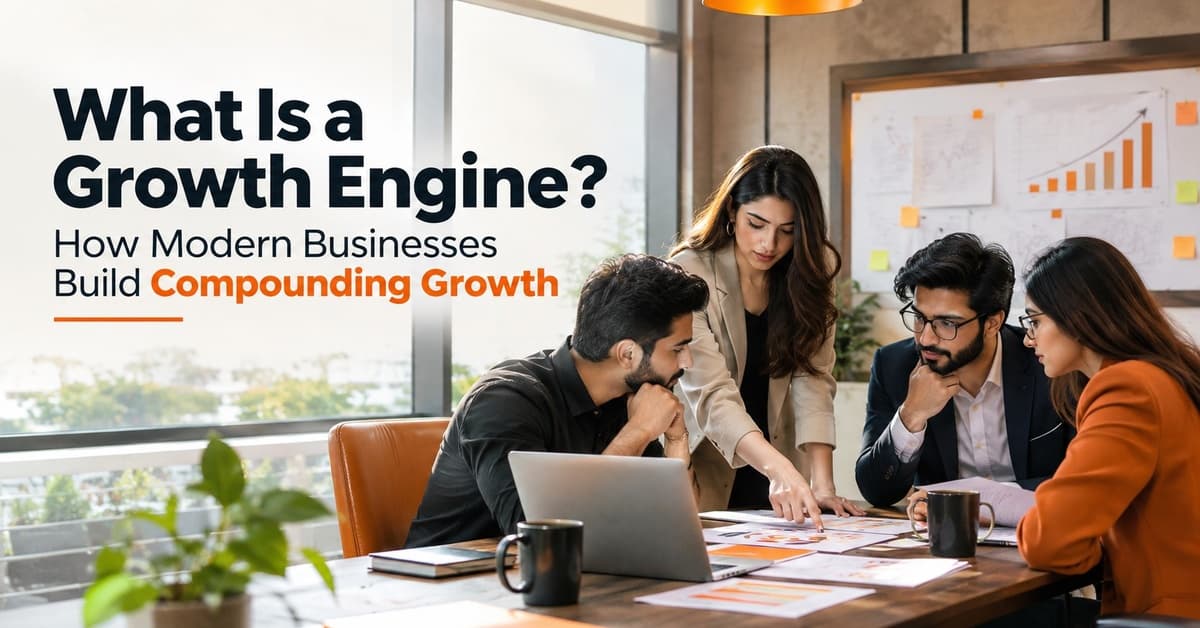
A business can invest in a website, advertising, search engine optimisation and sales tools yet still struggle to grow consistently. Often, the issue is not a lack of activity. Marketing attracts attention, the website collects enquiries and sales follows up, but each part works separately. A connected growth engine turns these efforts into a system that can be measured, improved and repeated.
Introduction
A growth engine is a repeatable business system connecting customer acquisition, conversion, sales, retention and referrals. It helps a company turn attention into customer relationships and revenue, then use what it learns to improve future performance.
The term has more than one use. This article uses it to mean the broader business system linking a company’s digital presence, marketing, sales and customer experience. It is not limited to one advertising channel or software platform. We will also explain Eric Ries’s more specific “engines of growth” framework from The Lean Startup, which identifies three mechanisms startups can use to sustain growth.
For business owners and founders, the practical question is whether the activities that attract customers connect with the activities that convert, serve and retain them. This guide explains the components, models, metrics and practical steps. That is the practical purpose of a growth engine.
1. What Is a Growth Engine?
A growth engine is a connected set of strategies, processes, channels and tools that helps a business attract suitable prospects, convert them into customers and build relationships that can generate repeat business or referrals.
The word “connected” matters. A growth engine is useful only when the stages support one another and have clear owners. A company might publish blog posts, run paid campaigns, send emails and ask sales staff to contact leads. These activities may produce isolated results. They become more useful when they support one customer journey and share relevant information.
For example, SEO content can bring a buyer to a service page. The page explains the offer and provides a way to enquire. The enquiry enters a customer relationship management system (CRM), where a team member reviews it and follows up. If the sale goes ahead, delivery and support shape the customer’s experience. A satisfied customer may return or recommend the business.
A useful growth engine also gives each team a shared view of the customer journey. It clarifies what happens after a click, who owns the next step and how the business learns from the outcome. Without those connections, even a strong channel can operate below its potential.
Growth engine vs. marketing funnel
A marketing funnel describes stages a prospect moves through, such as awareness, consideration and purchase. It helps teams understand a specific conversion journey.
A broader growth engine includes the funnel but also considers what happens before and after a purchase. It connects acquisition with sales operations, customer service, retention, referrals and measurement. A funnel can show where prospects drop out; the wider system helps explain how teams and customer experience affect the whole journey. A practical growth engine connects those findings to decisions about content, sales and service.
2. Why Modern Businesses Need a Connected Growth System
Disconnected activity makes it hard to understand why results change. Marketing may report more traffic while sales sees few qualified enquiries. Without shared definitions and tracking, teams can improve their own numbers while the overall business remains stuck. A connected approach shows where interest is created, where it is lost and which improvements matter.
A well-designed growth engine can help a business:
Attract people whose needs match its products or services.
Make the path from website visit to enquiry easier.
Give sales teams useful context about each prospect.
Identify delays and gaps between teams.
Learn from customer feedback, repeat purchases and referrals.
These are potential benefits, not automatic outcomes. They depend on the offer, execution, customer demand, data and ongoing management.
More channels do not automatically mean more growth
Imagine a service company receiving website visitors but few enquiries. Increasing its advertising budget may bring more visitors, but it will not fix unclear service information, a slow page, a confusing form or delayed follow-up.
First identify where suitable prospects stop moving forward. Sometimes a clearer landing page or faster response process is more valuable than another marketing channel.
3. The Main Components of a Business Growth Engine
The structure depends on the business model and buying process. Most service firms need to attract prospects, convert interest, manage enquiries, serve customers and learn from results.
Acquisition: Attracting the right audience
Acquisition brings potential customers through organic search, advertising, social media, email, partnerships or referrals. The goal is to reach people with a relevant need, not simply the largest audience. A web development firm might publish content for owners researching redesigns and run search ads for people comparing providers.
Conversion: Turning interest into an enquiry
Clear service descriptions, useful proof, navigation and calls to action help visitors understand an offer. Website structure, speed and forms affect whether they can make contact. BrandVexo’s website development service describes custom, mobile-first builds with SEO-ready structure and conversion-focused layouts.
Lead management: Organising opportunitie
A lead is a person or organisation that has shown interest. Lead management records that interest, assigns responsibility and tracks next steps. A CRM can store contact details, enquiry history, tasks and sales stages, but clear ownership is still essential.
Sales: Helping qualified prospects decide
Sales may involve consultations, demonstrations, proposals and follow-up. Use information already collected to understand requirements, explain the offer and decide whether there is a good fit.
Retention and referrals: Continuing the relationship
Reliable delivery, support and communication influence whether customers stay, buy again or recommend a business. Referrals are never guaranteed; they depend on customers receiving value and having a genuine reason to recommend the company.

4. How Compounding Growth Develops
Compounding growth occurs when earlier work contributes to later results. An article may attract visitors over time; some enquire, some become customers, and some return or refer others. Results are not automatic or permanent, so businesses must review changing demand, competition and channel performance.
The HubSpot Flywheel Model
HubSpot’s Flywheel Model uses three stages: attract, engage and delight. Good customer experiences can encourage recommendations; friction in sales or service can slow momentum. This business-wide model differs from Ries’s startup framework, which classifies specific mechanisms for sustainable growth.

5. Eric Ries’s Three Engines of Growth in The Lean Startup
In Eric Ries’s The Lean Startup, he describes three startup engines: sticky, viral and paid. They are feedback-loop models for sustainable customer growth, not a checklist for every department in an established business.
The sticky engine
The sticky engine relies on continued use or repeat purchases, as with subscriptions and memberships. Retention and churn are key measures: if customers leave as quickly as new ones arrive, sign-ups may not translate into growth.
The viral engine
The viral engine relies on product use bringing in new users. A collaboration tool, for example, may invite customers to add colleagues. Unlike occasional word of mouth, a viral loop is built into product use and gives users a natural reason to invite others.
The paid engine
The paid engine uses customer revenue to fund further acquisition. Advertising is one example; sales and distribution costs may also count. If acquisition costs exceed the contribution a customer generates, scaling the channel can increase losses.
A company may use more than one mechanism, but Ries advises startups to focus on the model that best fits their product and market. The broader system in this article can include these models alongside the website, sales, operations and measurement.
6. A Practical Example: A Service Business
Imagine a small web and digital marketing firm that receives enquiries through email, social media and its website, with no shared record. Some prospects get quick replies; others wait days. The company improves service pages, publishes useful content, simplifies its form and records enquiries in a CRM for consistent follow-up. After delivery, it asks for feedback. This is illustrative, not a reported BrandVexo result.
The company could organise its first implementation in four stages:
Attract: Reach a defined audience through useful content, search visibility, referrals or paid campaigns.
Convert: Explain the service clearly and make it easy for suitable visitors to enquire.
Manage: Record, qualify and assign enquiries, then track proposals and sales conversations.
Retain and learn: Deliver the agreed service, collect feedback and review repeat business or referral opportunities.
The sequence is a starting point, not a universal formula. It gives a small team a manageable way to test its growth engine before expanding. Adapt it to the way customers actually buy.
7. How to Build and Improve the System
A practical improvement cycle can be kept simple:
Map the journey: Record how people discover the business, enquire, speak with sales and experience delivery.
Find the constraint: Check whether the main issue is low relevant traffic, weak qualification, unclear pricing, slow follow-up or poor retention.
Test one improvement: Change the weakest stage, review the result and keep what works before adding more complexity.
Automation helps once a process is clear. BrandVexo’s AI automation service describes lead capture, qualification, follow-up, tool connections and appointment workflows. Automate repetitive handoffs, not judgement-heavy conversations.
8. Metrics That Show Whether It Is Working
Choose measures that match the business model. Start with a small set connecting activity to customers and revenue.
Metric | What it tells you | Basic calculation |
|---|---|---|
Customer acquisition cost (CAC) | Average acquisition spend per new customer | Acquisition costs ÷ new customers |
Lead-to-customer rate | Share of leads that become customers | New customers ÷ leads × 100 |
Customer retention rate | Share of starting customers retained | (Customers at end − new customers) ÷ customers at start × 100 |
Churn rate | Share of starting customers lost | Customers lost ÷ customers at start × 100 |
Customer lifetime value (CLV) | Estimated value from a customer relationship | Average purchase value × purchase frequency × customer lifespan |
Referral share | Portion of new customers attributed to referrals | Referral-sourced customers ÷ all new customers × 100 |
These are simplified measures. Define the period, customer group, cost categories and attribution rules consistently. CAC may include sales labour and agency fees, not just advertising. CLV is an estimate, not a guarantee.
Google Analytics measures website and app interactions through events. Its GA4 event setup documentation covers automatically collected, enhanced measurement, recommended and custom events. Correct configuration is needed to measure actions such as form submissions or purchases, alongside applicable privacy requirements.
Traffic and engagement are diagnostic signals, not substitutes for lead quality, sales, retention and revenue. Review them together to avoid improving one number at the expense of another.

9. Common Mistakes That Weaken the System
Common mistakes include adding channels before understanding the customer journey, tracking traffic without checking lead quality, and leaving enquiries without a clear owner. Automation can multiply errors if the process is unclear. Watch for these warning signs:
New channels are added before existing ones are measured.
Website traffic rises, but qualified enquiries do not.
Leads sit in inboxes without an assigned owner.
Automated messages are sent without checking relevance.
Define and test the process before automating it. Review the system as markets, offers and channel performance change.
10. How BrandVexo Connects Growth Activities
BrandVexo’s Growth Strategy service connects SEO, advertising, websites and follow-up. Its published method has four phases: Audit, Architecture, Orchestrate and Compound, supported by channel planning, conversion optimisation, analytics and KPI reporting. The website and automation services support this approach, but not every business needs every service. Start with the gap that matters most.
Conclusion
A growth engine is not one campaign or tool. It connects the website, marketing, sales, operations, retention and measurement so a business can attract suitable prospects, serve customers and learn from results. Eric Ries’s sticky, viral and paid engines are more specific startup mechanisms within that broader picture. The best starting point is to identify the main constraint and improve the customer journey one practical step at a time.
BrandVexo CTA
If your website, marketing and lead follow-up operate separately, identify where the customer journey loses momentum. Explore BrandVexo’s Growth Strategy service to see how channel planning, conversion optimisation and measurement can work together. Choose services that fit your needs.
Frequently Asked Questions
1. What is a growth engine in simple terms?
It is a repeatable business system connecting the activities used to attract customers, convert them, serve them and encourage continued relationships.
2. Is a growth engine the same as a marketing funnel?
No. A funnel describes stages in a prospect’s buying journey. The wider system also considers sales operations, customer experience, retention, referrals and measurement after purchase.
3. What are the three engines of growth in The Lean Startup?
Eric Ries identifies sticky, viral and paid engines. They describe growth mechanisms based on customer retention, product-driven sharing and paid acquisition funded by customer revenue.
4. Can a small business build this system without expensive software?
Yes. A small business can begin with a clear website, a simple way to record enquiries, assigned follow-up responsibility and a basic performance review. Software can be added when the process requires it.
5. How does automation support business growth?
Automation can connect forms, CRM records, notifications, follow-up tasks and appointment workflows. It is most useful when the underlying process is clear and automated steps are relevant to customers.
6. Which metrics should a business track first?
Start with a small set that reflects the business model: qualified leads, lead-to-customer rate, acquisition cost, retention or repeat purchase, and revenue. Add measures only when they support a specific decision.
7. How long does it take to build a growth engine?
There is no universal timeline. It depends on existing channels, data quality, sales process, resources and technical needs. Begin with the most important gap, test improvements and expand as the process becomes clearer.
Free growth plan
Ready to grow your business?
Reading is a start — now let's build it. Tell us where you want to grow and a senior strategist will map the fastest, most profitable way to get there. Free, no obligation.
Discussion
Join the conversation
Be the first to comment. Comments are reviewed before they appear, so yours won't show up instantly — but we read every one.
Leave a comment
Keep reading
All articles
LinkedIn Lead Generation: How to Turn Content Into Enquiries
Learn how to use LinkedIn content, optimize your profile and build relationships that turn engagement into qualified business enquiries.
Lead Nurturing for Service Businesses: A Simple Follow-Up Plan
Learn lead nurturing for service businesses with a simple follow-up plan, email examples, CRM automation tips, and practical ways to convert more enquiries.
Social Media Reporting: 10 Metrics That Matter to Business Owners
Understand social media reporting metrics that matter to business owners. Track engagement, reach, leads, conversions and ROI to improve results.