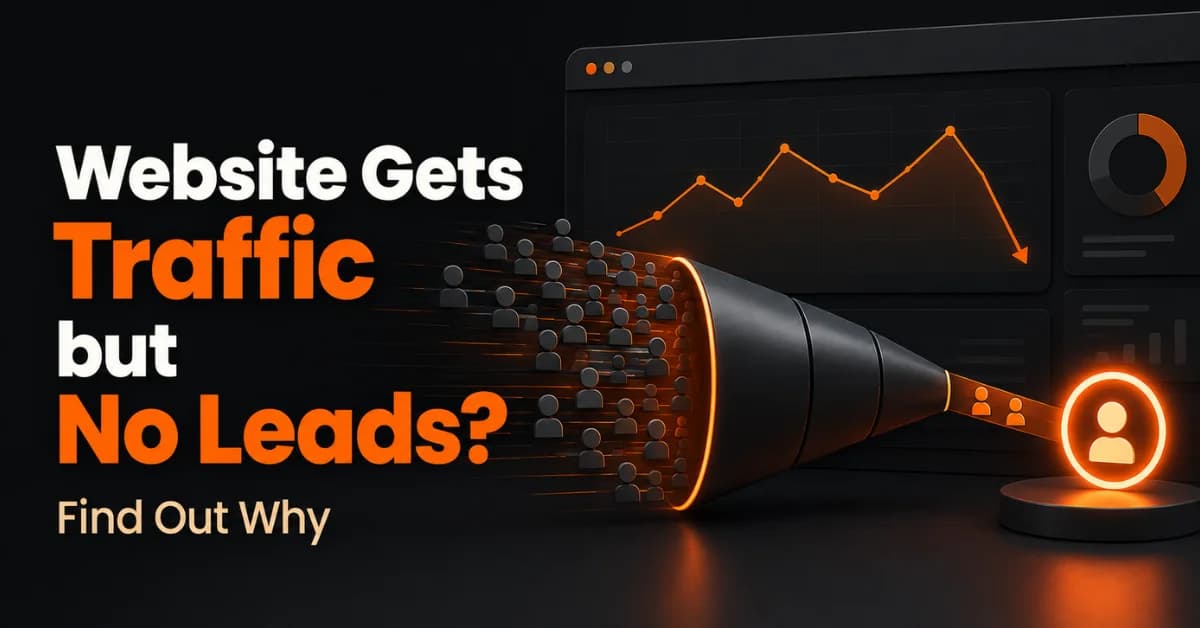
Why Your Website Gets Traffic but No Leads
Getting website traffic feels like a sign that your digital marketing is working. Your pages appear in Google, visitors are clicking through, and analytics show people arriving on your site. Yet the contact form stays quiet, calls remain low, and sales opportunities are nowhere near where you expected them to be.
This situation is more common than many business owners realize.
The problem is not always a lack of SEO or traffic. In many cases, the real issue sits further down the customer journey. You may attract the wrong audience, target the wrong search intent, communicate your value poorly, create friction on your website, or give visitors no compelling reason to take the next step.
Understanding these website conversion problems can help you stop chasing traffic for its own sake and start turning relevant visitors into meaningful business opportunities.
Why Does Your Website Get Traffic but No Leads?
Website traffic and lead generation are two different outcomes. Traffic tells you that people are reaching your website. A lead shows that a visitor has taken a meaningful action, such as submitting a form, calling your business, booking a consultation, sending a WhatsApp message, or requesting a quote.
Think of the customer journey as:
Search → Click → Landing Page → Engagement → Trust → Action → Lead
A weakness at any stage can reduce your results.
For example, imagine a consulting company receives 5,000 monthly visitors but generates only five enquiries. Increasing traffic to 10,000 visitors may not solve the problem. If the same conversion barriers remain, the business could simply double the number of visitors who leave without contacting the company.
Traffic and Leads Are Different Metrics
Businesses should monitor several stages rather than focusing only on sessions or page views:
Traffic: How many people visit your website?
Engagement: Do they interact with your content?
Conversion: Do they take a desired action?
Lead: Does that action create a potential customer?
Qualified lead: Does the enquiry match your target customer?
This distinction matters because a website can have strong organic traffic and still have a low conversion rate.
9 Reasons Your Website Traffic Is Not Converting Into Leads
If your traffic is healthy but enquiries are weak, examine these nine areas before investing heavily in generating even more visitors.
1. You Are Attracting the Wrong Website Visitors
One of the most overlooked causes of traffic not converting is poor traffic quality. Not every person searching for a topic is ready to buy a product or service. Some visitors want information, some are comparing options, and others may never become customers.
For example, an SEO agency could rank for a broad term such as “what is SEO.” That page may attract thousands of visitors, but many of them are students, researchers, or beginners rather than business owners looking for SEO services.
Look beyond traffic volume and ask:
Are visitors part of your target market?
Are they located in the markets you serve?
Do they have a genuine business need?
Are they searching with buying intent?
Relevant traffic is usually more valuable than large amounts of untargeted traffic.
2. Your Keywords Do Not Match Search Intent
SEO can bring visitors to your website, but the wrong search intent can produce disappointing business results.
Searches generally fall into different intent categories:
Informational: The user wants to learn something.
Commercial: The user is researching or comparing solutions.
Transactional: The user is ready to take action.
Navigational: The user is looking for a specific website or brand.
A page targeting an informational query should not necessarily expect the same conversion behavior as a page targeting a transactional query.
For example, someone searching “how much does website development cost?” may be much closer to making a purchasing decision than someone searching “what is a website?”
Your SEO strategy should therefore connect keywords with the stage of the buyer journey.
3. Your Value Proposition Is Not Clear
Visitors should quickly understand what your business does and why it matters to them.
If your homepage says:
“We deliver innovative digital solutions for modern businesses.”
It may sound professional, but it does not tell the visitor enough.
A stronger message explains:
What you offer
Who you serve
What problem you solve
What makes your approach useful
What the visitor should do next
Your headline, supporting copy, and CTA should work together.
A visitor should not need to explore five pages before understanding why your business could be relevant to them.
4. Your Calls to Action Are Weak or Missing
A visitor can like your website and still leave because you never clearly ask them to take the next step.
Every important page should provide an appropriate action.
Depending on the business, that could include:
Get a Quote
Book a Consultation
Request an Audit
Start Your Project
Contact Our Team
Request More Information
Avoid filling every page with competing calls to action.
A service page, for example, might focus on one primary action such as booking a consultation, while supporting links can guide visitors toward case studies or related services.
A clear CTA reduces uncertainty and gives visitors a simple path forward.
5. Your Landing Page Does Not Match the Visitor's Expectation
Imagine someone searches for “SEO services for small businesses” and clicks your result. Instead of reaching a relevant service page, they land on a generic homepage filled with unrelated services.
The visitor now has to search for the information they expected.
That creates friction.
Your message should remain consistent across:
Search query → Search result → Landing page → CTA
This is called message matching.
A dedicated landing page can explain the relevant service, address customer concerns, demonstrate credibility, and provide a clear next step.
If a particular page gets significant traffic but almost no enquiries, review whether the page actually satisfies the intent behind the searches bringing people there.
6. Your Website Does Not Build Enough Trust
People rarely submit their information to a business they do not trust.
This becomes even more important when your service is expensive, complex, or involves an ongoing relationship.
Useful trust signals can include:
Customer testimonials
Relevant case studies
Reviews
Clear company information
Team expertise
Industry experience
Certifications where relevant
Transparent contact details
Useful educational content
Avoid making unsupported claims such as “the best agency” or “number one provider” unless you can substantiate them.
Instead, demonstrate expertise through evidence, useful explanations, real examples, and clear business information.
That approach supports both user confidence and people-first content principles.
7. Your Website Is Difficult to Use
A technically visible website can still provide a poor user experience.
Common problems include:
Slow-loading pages
Poor mobile layouts
Confusing navigation
Broken forms
Excessive pop-ups
Difficult-to-read text
Unclear page hierarchy
Too many distractions
Consider the experience from the visitor's perspective.
Can they understand the page quickly?
Can they find your service?
Can they contact you without searching?
Can they complete the form easily on a phone?
If the answer is no, your website may be creating conversion problems even when your SEO is performing well.
8. Your Forms Create Too Much Friction
A visitor who is ready to enquire may abandon the process if your form feels like a job application.
For most initial enquiries, ask only for information that you genuinely need.
A simpler form might request:
Name
Business email
Phone or WhatsApp
Service required
Short project description
You can collect additional information later during the sales process.
Also check your forms regularly. A broken form can quietly destroy lead generation while your traffic reports continue to look healthy.
9. You Are Not Tracking What Happens After the Click
Traffic reports tell you where visitors come from, but they do not tell the whole business story.
Track meaningful conversion events such as:
Contact form submissions
Phone clicks
WhatsApp clicks
Email clicks
Consultation bookings
Quote requests
Purchases
Downloads
Newsletter sign-ups
Google recommends using Search Console and analytics data together to better understand how users discover and experience a website.
The goal is not to collect every possible metric. The goal is to identify which channels, pages, and actions contribute to valuable outcomes.
How to Diagnose Your Website Conversion Problems
Before changing your entire website, start with the data you already have.
Ask five questions:
Who is visiting the website?
Which pages receive the most traffic?
Which pages generate leads?
Where do visitors leave?
Which conversion actions actually work?
A simple conversion-rate calculation is:
Conversion Rate = Leads ÷ Website Visitors × 100
For example, if 2,000 relevant visitors produce 40 leads:
40 ÷ 2,000 × 100 = 2% conversion rate
That number alone does not tell you whether performance is good or bad. You also need to consider industry, offer, traffic source, sales cycle, audience, and lead quality.
The important thing is to establish a baseline and identify where visitors drop out.
How to Turn Website Traffic Into Leads
Fixing conversion problems usually requires more than changing a button color.
Start with the fundamentals.
Match Content With the Buyer's Journey
Different visitors need different information.
Top of funnel:
Educational articles
Guides
Definitions
Problem-focused content
Middle of funnel:
Comparisons
Case studies
Service explanations
Expert insights
Bottom of funnel:
Service pages
Pricing information
Product pages
Consultation pages
Quote requests
Your internal links should help users move naturally from learning to evaluating and eventually taking action.
Improve Your Website's Conversion Path
Review each important landing page and ask:
Is the headline specific?
Does the page address the visitor's problem?
Is the value proposition obvious?
Does the CTA stand out?
Are trust signals visible?
Does the page work well on mobile?
Is the enquiry process simple?
Can the visitor find answers to common objections?
Small improvements across these areas can make existing traffic more valuable.
Don't Chase More Traffic Before Fixing Conversion Problems
More traffic can help a healthy website grow. It cannot automatically fix a website that fails to convert relevant visitors. If 1,000 qualified visitors produce very few enquiries, investigate the conversion journey before spending more money on traffic acquisition.
The objective should be:
Relevant traffic → Better experience → More qualified leads → Better business outcomes
What Is a Good Website Conversion Rate?
There is no single conversion rate that every website should achieve. A low conversion rate may be reasonable for one business and concerning for another. Performance depends on factors such as:
Industry
Traffic source
Search intent
Offer
Pricing
Audience
Device
Geographic market
Sales cycle
Conversion type
For example, a low-priced ecommerce purchase and a high-value B2B consultation should not be evaluated using exactly the same expectations.
Instead of chasing an arbitrary benchmark, monitor your own conversion rate over time and connect conversions with lead quality and revenue.
Website Traffic but No Leads? Use This Conversion Checklist
Use this quick audit before changing your SEO strategy:
Your target audience is clearly defined
Your keywords match user intent
Your landing pages match search expectations
Your value proposition is clear
Your CTA is visible and relevant
Your website works properly on mobile
Your forms are easy to complete
Your website contains genuine trust signals
Conversion events are being tracked
You measure qualified leads, not just traffic
Your highest-traffic pages have clear next steps
You regularly review conversion performance
This checklist can help identify whether the problem starts with your audience, content, user experience, offer, or measurement.
How BrandVexo Helps Businesses Turn Traffic Into Leads
At BrandVexo, the goal is not simply to help businesses attract more website visitors. A stronger digital strategy connects visibility with meaningful business outcomes.
Our approach can combine:
SEO and Search Intent
We can help businesses identify relevant search opportunities, understand user intent, and create content that attracts audiences with a genuine interest in their products or services.
Conversion-Focused Websites
Your website should make it easy for visitors to understand your offer and take action. That means considering page structure, user experience, landing pages, messaging, CTAs, and mobile usability.
Data and Performance Tracking
Traffic becomes more useful when you understand what happens after visitors arrive. Conversion tracking and performance analysis can help identify which pages and channels contribute to enquiries and qualified opportunities.
If your website already receives traffic but generates fewer leads than expected, the first step may not be “get more traffic.” It may be to understand why your existing traffic is not converting.
Frequently Asked Questions
Why does my website get traffic but no leads?
Your website may attract the wrong audience, target informational rather than commercial search intent, have unclear messaging, weak CTAs, poor user experience, insufficient trust signals, or conversion-tracking problems.
Why is my website traffic not converting?
Traffic not converting can result from a mismatch between visitor intent and your offer. Review your keywords, landing pages, value proposition, CTAs, forms, trust signals, and user experience.
How do I fix website conversion problems?
Start by identifying where visitors drop out. Check traffic quality, search intent, landing-page relevance, messaging, CTAs, forms, mobile usability, trust signals, and conversion tracking.
How can I improve a low conversion rate?
Improve the complete conversion journey rather than focusing on one website element. Make your offer clearer, match landing pages to intent, strengthen CTAs, reduce friction, build trust, and measure meaningful conversions.
How do I turn website visitors into leads?
Give relevant visitors a clear reason to act. Use useful landing pages, strong value propositions, visible CTAs, simple enquiry forms, trust signals, and a smooth user experience.
Should I focus on website traffic or conversions?
You need both. Traffic creates opportunities, while conversions turn those opportunities into business outcomes. The priority should be attracting relevant traffic and giving those visitors a clear path toward becoming leads or customers.
Conclusion
Getting visitors to your website is an important part of digital marketing, but traffic alone does not guarantee business growth. If your website gets traffic but no leads, look beyond SEO rankings. Examine the quality of your visitors, search intent, messaging, landing pages, calls to action, trust signals, user experience, forms, and conversion tracking.
The strongest strategy connects every stage of the journey:
Search visibility → Relevant traffic → Useful experience → Trust → Conversion → Qualified lead
Before investing in more traffic, make sure your website gives the right visitors a compelling and friction-free reason to take the next step.
For businesses looking to improve both visibility and lead generation, BrandVexo can help build a digital strategy that connects SEO, content, web experience, and conversion-focused marketing.
Disclaimer: This article is provided for general informational and educational purposes only. Website traffic, conversion rates, and lead-generation results can vary depending on your industry, audience, offer, website structure, traffic sources, and marketing strategy. The information shared here should not be considered a guarantee of specific SEO, traffic, or business results. Always review your website performance and business requirements before making significant marketing or technical decisions.
Free growth plan
Ready to grow your business?
Reading is a start — now let's build it. Tell us where you want to grow and a senior strategist will map the fastest, most profitable way to get there. Free, no obligation.
Discussion
Join the conversation
Be the first to comment. Comments are reviewed before they appear, so yours won't show up instantly — but we read every one.
Leave a comment
Keep reading
All articles Web
WebWebsite Development Dubai: Costs, Process and Choices
Explore Website Development Dubai, including website cost Dubai, development steps, platform choices, SEO, timelines, and tips for choosing a website company.
 Web
WebWebsite Security Checklist for Small Businesses
Website Security Checklist for small businesses covering HTTPS, backups, MFA, updates, monitoring, access control, and practical website protection tips.
 Web
WebEcommerce Website Design: What Actually Drives Sales
Discover how ecommerce website design drives sales through better UX, mobile design, product pages, trust, speed, and conversion-focused checkout.