

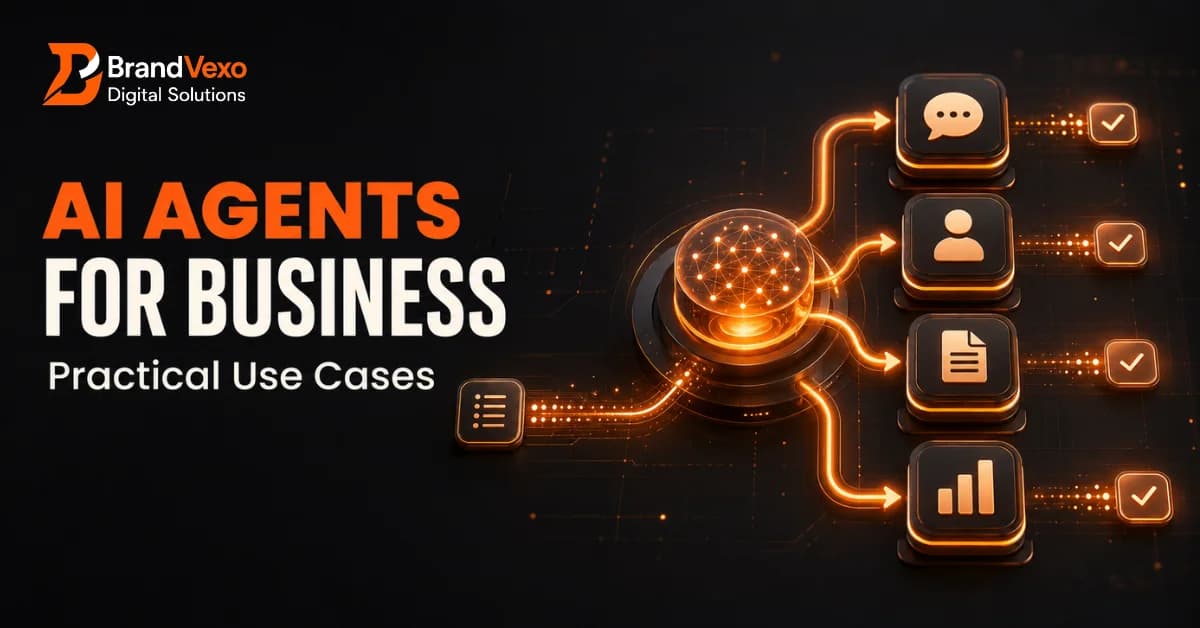
AI Agents for Business: Practical Use Cases
Businesses are moving beyond basic chatbots and experimenting with AI systems that can do more than answer questions. AI Agents for Business can help manage multi-step tasks, connect business tools, organize information, and take action within defined permissions.
For a small business, this could mean qualifying a new lead and scheduling a meeting. For an e-commerce company, it could mean handling an order query, checking information, and escalating a delivery issue. The value comes from applying AI to the right workflow, not from automating everything.
What Are AI Agents for Business?
AI Agents for Business are AI-powered systems designed to work toward a defined business goal by interpreting information, deciding what action to take, using connected tools, and completing a sequence of tasks.
Unlike a basic chatbot that mainly responds to a prompt, an AI agent can potentially perform actions across connected systems. Depending on its configuration, it may read information from a CRM, update a record, send a message, create a task, or escalate an issue to a human.
A typical business AI agent workflow looks like this:
The business gives the agent a goal.
The agent receives relevant information.
It determines the next appropriate action.
It uses approved business tools or systems.
It completes the task or asks for human intervention.
The business monitors the outcome.
The important point is that an AI agent should operate within clearly defined permissions. Greater autonomy does not remove the need for human oversight.
How Do AI Agents Work?
AI agents combine several capabilities rather than relying only on text generation.
An agent may use a language model to understand a request, access a company knowledge base for information, connect to software through APIs, and follow predefined rules for deciding what to do next.
For example, imagine a customer emails an online store about a delayed order. An AI agent could identify the customer, retrieve the order status, check the available delivery information, draft a response, and create an escalation ticket if the shipment appears to require human attention.
The agent is therefore not simply generating an answer. It is coordinating a workflow.
AI Agents vs AI Assistants vs Traditional Automation
These technologies overlap, but they solve different problems.
Traditional automation normally follows predefined rules. If condition A occurs, the system performs action B.
AI assistants for business generally help employees retrieve information, create content, summarize documents, draft responses, or complete tasks with human direction.
AI agents can take a goal and execute a sequence of actions using approved tools and rules.
Agentic AI describes a broader approach in which AI systems can pursue goals through planning, tool use, feedback, and multiple steps.
The best option depends on the process. A simple repetitive task may only need traditional automation. An employee who needs help writing emails may benefit from an AI assistant. A workflow involving multiple systems and decisions may be better suited to an AI agent.
When Should a Business Use an AI Agent?
An AI agent is usually worth exploring when a process:
Happens frequently
Involves several steps
Requires information from multiple systems
Has clearly defined inputs and outputs
Creates repetitive administrative work
Has measurable results
Allows clear boundaries around what the AI can do
Businesses should be more cautious when a workflow involves sensitive decisions, significant financial consequences, legal judgments, or information that requires expert interpretation.
Practical AI Agent Use Cases for Businesses
The strongest AI implementations focus on specific workflows rather than trying to create an all-purpose AI employee.
Here are some practical business AI agent use cases.
1. Customer Service and Support
Customer support is one of the clearest areas for AI automation because many inquiries follow recurring patterns.
An AI agent can help:
Answer frequently asked questions
Identify customer requests
Retrieve account or order information
Classify support tickets
Create helpdesk tickets
Send routine follow-ups
Escalate complex issues
Example: An e-commerce company receives a customer message asking where an order is. The agent can retrieve the order status, provide the relevant information, and escalate the case if the delivery appears delayed.
Human employees can then focus on complaints, unusual cases, and relationship-building rather than repeating basic information.
2. Sales and Lead Qualification
Sales teams often lose time on repetitive lead-management activities.
AI agents can assist with:
Capturing new inquiries
Asking initial qualification questions
Organizing lead information
Updating CRM records
Assigning leads to sales representatives
Scheduling meetings
Sending approved follow-up messages
For example, a business could configure an agent to review an incoming inquiry, identify the customer's requirements, collect missing information, and schedule a meeting with the appropriate salesperson.
The sales representative receives a more organized lead instead of starting the process from scratch.
3. Marketing and Content Operations
Marketing teams can use AI agents to coordinate repetitive activities across their content and campaign workflows.
Potential applications include:
Content research
Topic clustering
Campaign reporting
Content brief preparation
Social media workflow support
Performance summaries
Audience segmentation
Competitor monitoring
However, businesses should keep human review for brand positioning, factual accuracy, originality, and important strategic decisions.
AI can accelerate the process, but marketing strategy still requires context and judgment.
4. Finance, Accounting and Administrative Work
Finance teams manage large amounts of structured information, making selected administrative processes suitable for AI automation.
An AI agent could assist with:
Collecting invoice information
Organizing financial documents
Categorizing expenses for review
Sending payment reminders
Identifying missing information
Preparing internal summaries
Supporting reconciliation workflows
For UAE SMEs, AI can reduce repetitive administrative work around finance processes while qualified professionals remain responsible for accounting judgments, tax matters, compliance, and final approvals.
The goal should be assistance and controlled automation, not unsupervised financial decision-making.
5. HR and Recruitment
Recruitment and employee onboarding also contain repetitive communication and administrative tasks.
AI assistants for business can help HR teams:
Organize candidate information
Schedule interviews
Send approved communications
Answer routine employee questions
Collect onboarding documents
Prepare onboarding checklists
Businesses should use additional controls when AI interacts with sensitive employee information or influences employment-related decisions.
6. Operations and Internal Workflows
AI agents can also coordinate everyday internal operations.
For example, an agent could receive an email containing a project request, identify the required action, create a task in a project-management system, notify the relevant employee, and monitor whether the task receives a response.
Other applications include:
Workflow routing
Internal notifications
Task creation
Document organization
Status reporting
Email triage
Exception alerts
This is where agentic AI can become particularly useful because the system can coordinate several connected steps rather than performing only one isolated task.
How Agentic AI Can Improve Business Productivity
The main advantage of agentic AI is its ability to support goal-oriented workflows.
A traditional process might look like:
Employee → AI tool → Employee takes action → Employee updates system
An agent-enabled process could look more like:
Employee → AI agent → Information gathering → Approved actions → Human review when needed
This can reduce repetitive work and help employees spend more time on tasks requiring judgment, creativity, and customer interaction.
Potential benefits include:
Faster response times
Less repetitive administration
Better workflow coordination
More consistent execution
Faster access to information
Improved employee productivity
Support for round-the-clock routine processes
The actual business impact depends on implementation quality, data accuracy, integrations, permissions, and how well the workflow has been designed.
AI Agent Examples for UAE Businesses
UAE businesses across sectors can explore AI agents without starting with complicated enterprise-wide automation.
UAE E-Commerce Business
An online retailer could use an AI agent to handle order-status enquiries, identify delivery problems, update support tickets, and escalate unusual cases.
UAE Professional Services Firm
A consultancy could use an agent to organize incoming enquiries, collect required information, schedule appointments, and route enquiries to the appropriate team member.
UAE SME Administrative Workflow
A small company could use an AI agent to organize incoming documents, identify missing information, prepare internal summaries, and notify staff when human review is required.
These examples demonstrate an important principle: start with one measurable workflow rather than attempting to automate the entire business at once.
How to Implement AI Agents in a Business
Successful AI implementation starts with the process—not the technology.
Step 1: Identify the Right Workflow
Look for a repetitive process with a clear beginning and end.
Ask:
How often does this happen?
How much employee time does it consume?
How many systems are involved?
What happens when something goes wrong?
Step 2: Define the Agent's Goal
Clearly document what the agent should accomplish. Also define what it cannot do. For example, an agent may prepare a payment request but require human approval before any payment is actually processed.
Step 3: Connect Business Systems
Depending on the workflow, an agent may need controlled access to:
CRM software
Email
Helpdesk systems
Accounting platforms
Project-management tools
Knowledge bases
Internal databases
Only give the agent the permissions it genuinely needs.
Step 4: Add Human Oversight
Human-in-the-loop controls become especially important for high-risk activities.
Require human approval for areas such as:
High-value transactions
Sensitive customer disputes
Legal decisions
Compliance matters
Sensitive employee decisions
Important financial judgments
Step 5: Measure Performance
Do not judge an AI agent simply by how impressive its responses sound.
Track measurable outcomes such as:
Time saved
Completion rate
Error rate
Escalation rate
Response time
Customer satisfaction
Cost per workflow
Conversion rate, where relevant
This allows the business to determine whether the agent is creating real operational value.
Risks and Challenges of AI Agents for Business
AI agents can create efficiency, but greater autonomy also creates additional risks.
Potential challenges include:
Incorrect or misleading outputs
Poor-quality business data
Data privacy issues
Unauthorized system actions
Security vulnerabilities
Integration problems
Excessive automation
Inadequate human oversight
Organizations should treat AI governance as part of implementation rather than something to consider after deployment.
NIST's AI Risk Management Framework provides a voluntary framework for organizations to manage AI risks and promote trustworthy AI development and use. Its generative AI profile also addresses risks associated with generative AI systems and provides risk-management considerations.
How Businesses Can Reduce AI Agent Risks
Businesses can establish safeguards such as:
Limiting system permissions
Setting approval thresholds
Logging agent actions
Testing workflows before launch
Protecting sensitive information
Monitoring outputs
Creating escalation rules
Reviewing performance regularly
The objective is not to eliminate every risk. It is to understand, control, and monitor the risks associated with each use case.
Are AI Agents Worth It for Small Businesses?
Yes, but small businesses do not need to deploy a complex autonomous AI system to benefit from the technology.
A better approach is to start with one workflow that is:
Repetitive
High-volume
Low-risk
Easy to measure
Time-consuming for employees
For example, a small business might begin with lead qualification, customer inquiries, appointment scheduling, document collection, or internal reporting.
Once the business proves that the workflow works reliably, it can gradually expand automation.
Start small, measure the results, improve the workflow, and then scale.
What Should You Automate First?
The best first AI-agent workflow usually has predictable inputs, measurable outcomes, and limited risk.
Good candidates include:
Repetitive customer enquiries
Lead qualification
Email classification
Appointment scheduling
Document collection
Internal reporting
CRM updates
Workflow notifications
Poor first candidates include:
Complex strategic decisions
Sensitive legal judgments
High-risk financial decisions
Processes with unreliable data
Tasks requiring significant human empathy or judgment
A useful rule is simple: automate the process, not the responsibility.
Frequently Asked Questions
What are AI agents for business?
AI agents for business are AI-powered systems that can work toward defined goals by interpreting information, using connected tools, and completing multiple workflow steps within specified permissions.
How can AI agents help a small business?
AI agents can reduce repetitive work in areas such as customer support, lead qualification, appointment scheduling, document collection, CRM updates, and internal reporting.
What is the difference between agentic AI and generative AI?
Generative AI focuses primarily on producing or transforming content such as text, images, or code. Agentic AI can use AI capabilities to pursue a goal through multiple steps, tools, and actions within defined boundaries.
Are AI agents better than AI assistants for business?
Not necessarily. AI assistants for business are useful when employees need direct support with tasks such as research, writing, summarization, or information retrieval. AI agents are more suitable when a workflow requires multiple actions and system interactions.
Can AI agents replace employees?
AI agents can automate parts of jobs and reduce repetitive tasks, but that does not mean they automatically replace employees. People remain important for judgment, accountability, strategy, relationships, creativity, and oversight.
Are AI agents secure for business use?
AI-agent security depends on the systems, permissions, data, integrations, monitoring, and governance used during implementation. Businesses should restrict access, test workflows, monitor actions, and require human approval for higher-risk activities.
How BrandVexo Digital Solutions Can Help
BrandVexo Digital Solutions helps businesses explore practical digital solutions across digital marketing, SEO, web development, AI automation, and business solutions. The focus should not be on adding AI simply because it is trending. A better approach is to identify where automation can solve a genuine business problem, improve a workflow, or reduce repetitive work.
BrandVexo can help businesses assess opportunities for AI automation, connect technology with broader digital strategies, and build solutions around practical business objectives.
Contact BrandVexo Digital Solutions:
Phone: +971 52 356 5409
Email: info@brandvexo.com
Website: www.brandvexo.com
Final Takeaway
AI Agents for Business can move organizations beyond simple chatbots toward more capable, goal-oriented workflow automation. The strongest opportunities usually involve repetitive, measurable processes where an agent can work within clear boundaries.
Businesses should start with one workflow, define permissions, maintain human oversight, and measure the results. When the first implementation proves reliable, the business can expand gradually.
For companies considering agentic AI, the most important question is not “How much can we automate?” but “Which business process can we improve safely and measurably?”
Free growth plan
Ready to grow your business?
Reading is a start — now let's build it. Tell us where you want to grow and a senior strategist will map the fastest, most profitable way to get there. Free, no obligation.
Discussion
Join the conversation
Be the first to comment. Comments are reviewed before they appear, so yours won't show up instantly — but we read every one.
Leave a comment
Keep reading
All articles Automation
WhatsApp Lead Automation for Service Firms: A Guide
Learn how WhatsApp lead automation helps service firms capture leads, automate follow-ups, connect CRM systems, and book more appointments.
 Automation
CRM Automation for Startups: A Practical Guide
CRM Automation for Startups helps streamline lead management, automate sales workflows, improve follow-ups, connect tools, and support scalable business growth.
 Automation
AI Workflow Automation: A Practical Guide for B2B Teams
Learn how AI workflow automation helps B2B teams improve efficiency, automate repetitive tasks, connect systems, measure ROI, and scale business operations.