

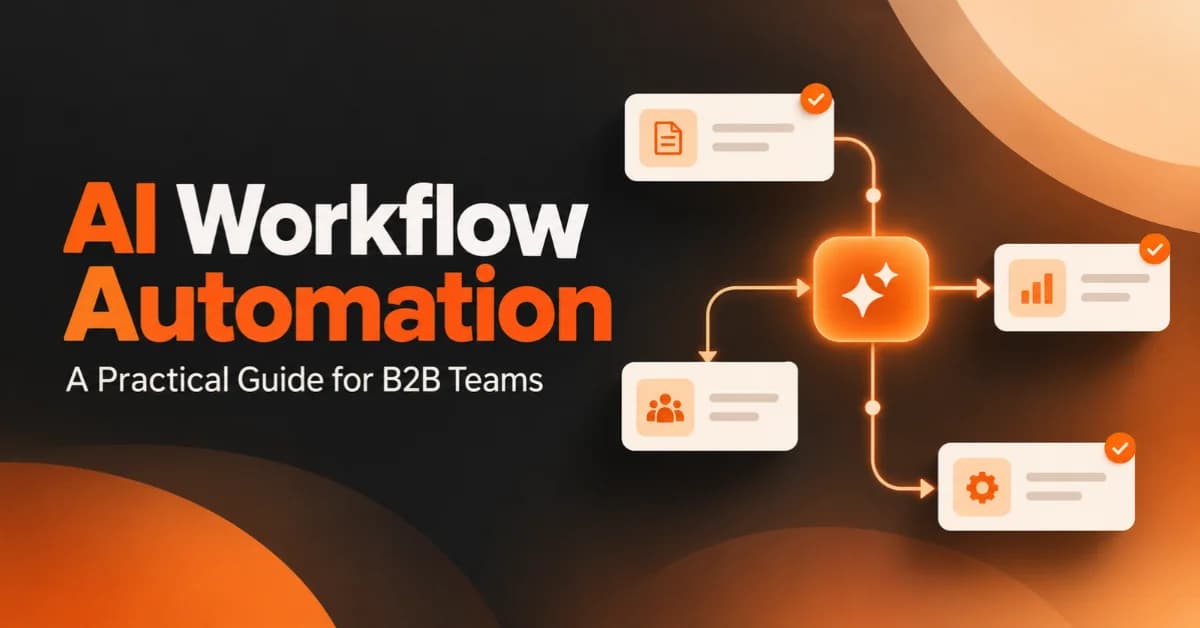
AI Workflow Automation: A Practical Guide for B2B Teams
B2B teams often lose valuable time to repetitive tasks such as updating CRM records, sorting leads, reviewing documents, preparing reports, and responding to routine customer requests. AI Workflow Automation can help businesses reduce this manual workload by combining artificial intelligence with automated business processes. Unlike basic rule-based automation, AI-powered workflows can interpret information, classify requests, generate responses, identify patterns, and support decisions within defined business rules. When implemented carefully, this approach can improve B2B operational efficiency without requiring businesses to automate every process.
For B2B companies, the real opportunity is not simply adding AI to the technology stack. It is identifying the right workflows, connecting existing systems, maintaining human oversight, and measuring whether automation creates measurable business value.
What Is B2B AI Workflow Automation?
B2B AI workflow automation uses artificial intelligence to perform or support tasks within a connected business process. An automated workflow typically starts with a trigger, processes information, performs an action, and moves the task toward a defined outcome.
For example, when a new lead enters a CRM, an AI-enabled workflow could analyze the lead's information, classify its potential, assign a score, update the CRM, and route the lead to the appropriate sales representative.
Traditional automation usually follows fixed rules such as "if X happens, do Y." AI-powered automation can work with less structured information, including emails, documents, customer messages, and large datasets.
Traditional Automation vs AI Workflow Automation
Traditional automation works well when a process follows predictable rules. AI becomes more useful when a workflow requires interpretation or classification.
AI workflow automation can support:
Document and email classification
Lead qualification
Customer request routing
Data extraction
Content generation
Internal knowledge searches
Report summarization
Recommendation and prioritization
Exception detection
This makes AI particularly useful within business process management (BPM) and more complex machine learning workflows.
Why B2B Teams Are Adopting AI Workflow Automation
B2B businesses operate across multiple departments and systems. Sales may use a CRM, marketing may use automation software, finance may use accounting platforms, and customer support may rely on another system.
When these processes remain disconnected, employees often spend time moving information between platforms instead of working on higher-value activities.
AI automation can help teams:
Reduce repetitive administrative work
Improve response times
Reduce manual data entry
Support more consistent processes
Improve information routing
Reduce operational costs using AI
Give employees faster access to useful information
Support data-driven decision making
The goal should not be to automate work simply because automation is possible. Teams should focus on processes where automation can create a clear operational or commercial benefit.
Where AI Automation Creates the Most Value
Common opportunities include:
Sales: lead qualification, follow-ups, CRM updates, and pipeline management
Marketing: campaign analysis, segmentation, reporting, and content workflows
Customer support: ticket classification, response drafting, and escalation
Finance: document processing, invoice classification, and reporting
Operations: task routing, approvals, notifications, and information management
How to Automate B2B Workflows With AI
Successful automation starts with the business process rather than the AI tool. Before selecting technology, identify where employees spend time and where delays, errors, or repetitive work occur.
1. Identify Repetitive Business Processes
Start by reviewing tasks that happen frequently and follow a recognizable pattern. Look for processes involving repetitive data entry, document review, email classification, lead qualification, reporting, or internal requests.
A workflow that consumes several hours every week may offer a better starting point than an occasional complex process.
2. Map the Existing Workflow
Document what happens from beginning to end.
A simple workflow map can include:
Trigger → Input → AI processing → Decision → Action → Human approval → Outcome
This helps the team understand where AI actually adds value and where conventional automation may be sufficient.
3. Choose Where AI Adds Value
Not every workflow needs artificial intelligence. For example, automatically sending an email after a form submission may only require rule-based automation. However, classifying the content of hundreds of incoming emails may benefit from AI.
This distinction can prevent businesses from creating unnecessarily complicated systems.
4. Connect Business Systems
AI automation becomes more useful when it can work with the systems employees already use.
Depending on the process, integrations may include:
CRM platforms
Email systems
Accounting software
ERP platforms
Customer support systems
Project management tools
Databases
Internal knowledge bases
This is where enterprise AI integration and CRM AI integration become important.
5. Add Human Oversight
Human review remains important for workflows involving sensitive information, important customers, financial decisions, or unusual situations. Businesses can create approval checkpoints where employees review AI-generated outputs before the workflow completes the action.
6. Test Before Scaling
Start with a limited workflow and test real-world scenarios. Measure accuracy, processing time, exceptions, failed actions, and employee feedback before expanding the automation across departments.
AI Workflow Automation Examples for B2B Teams
Practical examples make it easier to identify suitable automation opportunities. The following workflows show how businesses can apply AI without attempting to automate entire departments.
AI Sales Workflow Automation
A B2B sales workflow could work like this:
New lead → AI analyzes information → Lead qualification → CRM update → Sales assignment → Follow-up task
The system could extract information from a submitted form, classify the lead, update relevant CRM fields, and notify the appropriate salesperson.
This can improve automated sales pipelines while allowing sales professionals to focus on qualified opportunities.
AI Marketing Workflow Automation
Marketing teams manage large amounts of campaign and customer data. An AI workflow could collect campaign performance information, identify unusual changes, summarize results, segment audiences, and prepare an internal performance report.
This supports implementing AI in B2B marketing without removing human control over campaign strategy.
AI Customer Support Workflow
Customer support provides another strong automation opportunity. A workflow could receive a customer request, identify its category, search an approved knowledge base, draft a response, and route complex issues to a support specialist.
The AI handles repetitive processing while the employee remains responsible for situations that require judgment.
AI Operations and Finance Workflows
Operations and finance teams can also automate structured document and information workflows.
Examples include:
Extracting information from invoices
Classifying documents
Routing approval requests
Summarizing internal reports
Detecting unusual transactions for review
Reconciling information between systems
Creating recurring management reports
These applications can improve operational efficiency without requiring businesses to redesign every internal process.
Best AI Tools for B2B Team Productivity
There is no single best AI tool for every B2B business. The right solution depends on the workflow, existing systems, data requirements, security expectations, budget, and level of technical complexity. Instead of choosing software because it has the largest list of AI features, businesses should evaluate whether the platform can solve a specific operational problem.
Key AI Automation Tool Categories
B2B teams may evaluate:
AI workflow automation platforms
CRM automation tools
B2B marketing automation software
AI assistants
Document processing platforms
Data integration tools
SaaS workflow automation tools
Business intelligence platforms
Customer support automation solutions
When comparing AI productivity tools in 2026, look beyond the interface. Check integrations, permissions, reliability, data handling, human approval options, monitoring, and the total cost of operating the workflow.
How AI Workflow Automation Fits Into the B2B Tech Stack
AI should not become another disconnected application that employees have to manage. A stronger approach is to connect AI capabilities with the existing B2B technology stack.
For example, a company could connect its CRM, email platform, customer support system, and internal knowledge base to create a coordinated workflow.
Common B2B AI Integration Points
Useful integration areas include:
CRM and sales platforms
Marketing automation
ERP and accounting systems
Customer support software
Communication platforms
Project management systems
Data warehouses
Internal documentation and knowledge bases
Good B2B tech stack optimization focuses on how information moves between systems. Integration quality, permissions, data consistency, and workflow reliability can matter more than simply selecting the newest AI model.
How to Measure the ROI of AI Automation in Business
The ROI of AI automation in business should be measured through business outcomes rather than the number of automated tasks. Before implementing a workflow, establish a baseline. For example, record how much time employees currently spend processing leads or preparing weekly reports.
After automation, compare the results.
AI Automation Metrics to Track
Useful metrics include:
Time saved per workflow
Processing cost
Error rate
Lead response time
Customer response time
Workflow completion rate
Employee productivity
Conversion rate
Number of manual interventions
Cost savings
Revenue influenced by the workflow
For example, if a reporting process takes eight employee-hours each week and automation reduces it to two hours while maintaining accuracy, the business has a measurable efficiency improvement.
The most useful measurement combines time savings with quality, reliability, and commercial impact.
Common AI Workflow Automation Mistakes to Avoid
AI automation can create new problems when businesses implement it without understanding the underlying process.
Automating a Broken Process
Automation does not automatically fix inefficient processes. Document and improve the workflow first.
Using AI Where Simple Automation Is Enough
AI can add unnecessary cost and complexity when a straightforward rule can accomplish the same task.
Ignoring Data Quality
Poor-quality or inconsistent data can produce unreliable AI outputs. Clean data should form part of the implementation plan.
Removing Human Oversight
Important decisions should have appropriate review and escalation mechanisms.
Scaling Before Testing
A small workflow can reveal problems that may become expensive when applied across an entire organization.
Choosing Tools Without Considering Integrations
A powerful AI platform is less useful if it cannot connect reliably with the systems employees already use.
A Practical AI Automation Strategy for B2B Teams
Businesses do not need to automate everything at once. A focused enterprise AI strategy can begin with one high-value process.
Use this framework:
Select one repetitive, high-volume workflow.
Document the existing process.
Identify where AI can improve the workflow.
Define human approval and exception points.
Select the necessary tools and integrations.
Build a controlled pilot.
Measure time, quality, cost, and business results.
Improve the workflow based on real usage.
Expand automation to similar processes.
This approach allows companies to scale B2B operations with AI while keeping implementation manageable.
The strongest B2B AI solutions usually solve a clearly defined problem rather than introducing AI simply because it is trending.
The Future of AI Workflow Automation for B2B Teams
AI workflow automation is moving beyond individual AI assistants toward connected processes that can handle multiple steps across business systems.
As AI capabilities improve, businesses may use more intelligent workflows for research, classification, decision support, reporting, customer interactions, and operational coordination.
However, successful adoption will still depend on good data, reliable integrations, clear processes, security controls, and human oversight.
The long-term advantage will not come from using the most AI tools. It will come from designing workflows that help people make better decisions and complete valuable work more efficiently.
FAQs
What is B2B AI workflow automation?
B2B AI workflow automation uses artificial intelligence to interpret information, support decisions, and perform tasks within a connected business process. It can automate activities such as lead qualification, document processing, customer support routing, reporting, and CRM updates while keeping humans involved where judgment is required.
How to automate B2B workflows with AI?
Start by identifying a repetitive business process, documenting each step, and deciding where AI can add value. Then connect the required business systems, define human approval points, test the workflow, measure performance, and gradually scale successful automation.
What are some AI workflow automation examples?
Common examples include AI-powered lead qualification, automated CRM updates, customer support ticket classification, invoice data extraction, marketing performance reporting, document processing, internal knowledge searches, and automated sales follow-ups.
What are the best AI tools for B2B team productivity?
The best tools depend on the workflow and existing technology stack. Businesses should evaluate AI automation platforms, CRM tools, marketing automation software, integration platforms, document processing solutions, and AI assistants based on integrations, security, reliability, scalability, and total cost.
How can AI automation reduce business costs?
AI automation can reduce costs by decreasing repetitive manual work, shortening processing times, reducing data-entry errors, improving workflow consistency, and allowing employees to spend more time on higher-value activities. Businesses should measure actual time, quality, and cost changes after implementation.
How do you calculate the ROI of AI automation?
Compare the measurable benefits of automation with its implementation and operating costs. Useful inputs include employee hours saved, reduced processing costs, improved conversion rates, lower error rates, and additional revenue influenced by the workflow.
Build Smarter Business Workflows With BrandVexo
BrandVexo helps businesses build practical digital growth systems across digital marketing, SEO, web development, AI automation, and business solutions. Our approach focuses on measurable business outcomes rather than vanity metrics. We help businesses identify growth opportunities, improve search visibility, strengthen their digital presence, and connect marketing activity with practical commercial goals. Our services also include social media management and optimization, content strategy, and personal and business branding.
If you are evaluating AI automation opportunities, our team can help you identify practical workflows, connect digital systems, and develop an approach aligned with your business objectives.
Phone: +971 52 356 5409
Email: info@brandvexo.com
Website: www.brandvexo.com
Conclusion
AI Workflow Automation can help B2B teams reduce repetitive work, improve operational efficiency, and create more connected business processes. But successful implementation starts with the workflow, not the technology.
Identify a genuine business problem, map the existing process, select appropriate AI capabilities, maintain human oversight, and measure the results. Starting with one well-defined workflow can provide a clearer path toward broader enterprise AI integration and long-term operational improvement.
For B2B businesses, the objective is not simply to use more AI. It is to build smarter processes that help teams work more efficiently while maintaining quality, control, and measurable business value.
Disclaimer: AI tools, platforms, features, and business applications can change rapidly. The information in this article is provided for general educational purposes and should be evaluated based on your specific business processes, technology stack, security requirements, and operational needs.
Free growth plan
Ready to grow your business?
Reading is a start — now let's build it. Tell us where you want to grow and a senior strategist will map the fastest, most profitable way to get there. Free, no obligation.
Discussion
Join the conversation
Be the first to comment. Comments are reviewed before they appear, so yours won't show up instantly — but we read every one.
Leave a comment
Keep reading
All articles Automation
WhatsApp Lead Automation for Service Firms: A Guide
Learn how WhatsApp lead automation helps service firms capture leads, automate follow-ups, connect CRM systems, and book more appointments.
 Automation
CRM Automation for Startups: A Practical Guide
CRM Automation for Startups helps streamline lead management, automate sales workflows, improve follow-ups, connect tools, and support scalable business growth.
 Automation
AI Automation ROI: How to Calculate the Business Case
Learn how to calculate AI Automation ROI with formulas, UAE examples, costs, payback periods, KPIs, and practical steps for building a business case.