

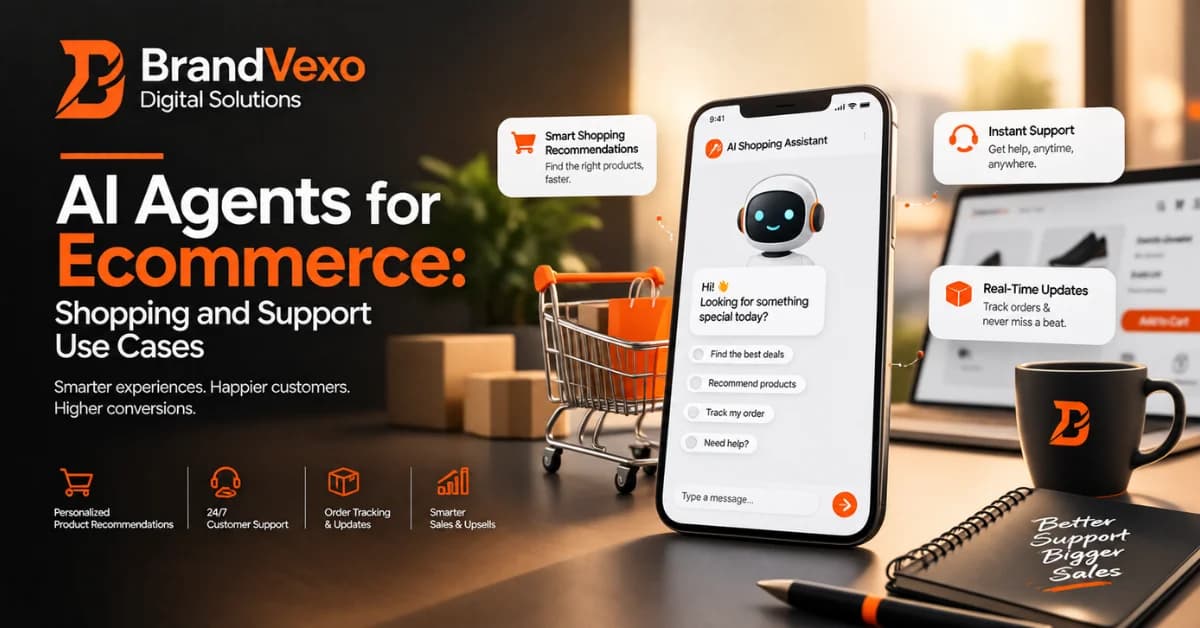
AI Agents for Ecommerce: Shopping and Support Use Cases
Ecommerce customers expect quick answers, relevant products, simple checkout experiences, and reliable support after they place an order. AI Agents for Ecommerce can help businesses meet these expectations by combining conversational AI with product data, customer information, inventory systems, and business workflows.
Unlike a basic chatbot that mainly answers predefined questions, an AI agent can understand a customer's goal, use connected information, and in some implementations take approved actions. This makes AI useful across the ecommerce journey, from product discovery and recommendations to order tracking and returns.
For ecommerce businesses, the opportunity is not simply to automate more conversations. The real value comes from making shopping and support more useful while keeping appropriate human oversight. Google also emphasizes valuable, original, people-first content and clear technical foundations for visibility in both traditional and generative AI search.
What Are AI Agents for Ecommerce?
AI agents for ecommerce are AI-powered systems designed to understand customer requests, access relevant business information, and complete or assist with specific ecommerce tasks.
A customer might ask:
“I need a lightweight laptop for university under $800 with good battery life.”
Instead of simply returning a generic search result, an AI shopping agent can interpret the requirements, search relevant products, compare available options, and explain why certain products match the request.
The same technology can support existing customers. For example, someone could ask:
“Where is my order, and what should I do if it arrives damaged?”
Depending on the systems connected to the agent, it may retrieve order information, explain the return policy, and guide the customer through the next step.
How AI Ecommerce Agents Work
A typical workflow looks like this:
Understand the request — The agent identifies what the customer wants.
Access relevant information — It retrieves information from approved product, order, inventory, or knowledge systems.
Reason about the task — It determines the appropriate response or workflow.
Provide an answer or recommendation — The customer receives useful, contextual assistance.
Take an approved action — Where integrations and permissions allow, the agent can perform a task.
Escalate when necessary — Complex or sensitive cases can move to a human support representative.
The quality of the experience depends heavily on the quality and freshness of the information available to the agent.
AI Agent vs Ecommerce Chatbot
An ecommerce chatbot and an AI agent can both communicate with shoppers, but their capabilities can differ significantly.
Feature | Ecommerce Chatbot | AI Agent |
|---|---|---|
Answers common FAQs | Yes | Yes |
Understands natural language | Varies | Yes |
Product recommendations | Basic to moderate | Contextual |
Handles multi-step requests | Limited | Better suited |
Uses connected business systems | Sometimes | Common use case |
Performs approved actions | Limited | Possible |
Human escalation | Yes | Yes |
The distinction is not always absolute because modern chatbots can include AI capabilities. The important question is what the system can actually do, rather than what the business calls it.
How AI Agents Are Changing the Ecommerce Customer Journey
AI can support customers at several stages of the buying journey instead of appearing only as a chat box on a website.
Before the Purchase
At the discovery stage, an AI agent can help customers:
Find relevant products
Understand product specifications
Compare options
Narrow products by budget
Ask natural-language questions
Find suitable alternatives
This can make product discovery more conversational.
During the Purchase
An agent can help shoppers understand:
Delivery options
Product availability
Promotions and applicable offers
Product compatibility
Checkout-related questions
Return and exchange policies
The goal is to remove uncertainty without creating unnecessary friction.
After the Purchase
Post-purchase support can include:
Order tracking
Delivery updates
Return instructions
Exchange guidance
Warranty information
Reordering assistance
This broader approach turns AI from a simple website chatbot into part of the overall customer journey.
AI Shopping Agent Use Cases for Ecommerce
An AI shopping agent can act as a conversational layer between a customer and an ecommerce catalog.
Personalized Product Recommendations
Traditional product recommendations often rely on browsing behavior, purchase history, or predefined rules. A conversational agent can also use information the customer provides during the interaction.
For example, a customer shopping for headphones might say:
“I travel frequently and want wireless headphones with strong noise cancellation, but I don't want to spend more than $200.”
The agent can use these requirements to narrow the available products and explain the differences between suitable options.
This supports a more personalized shopping experience without requiring the customer to manually apply numerous filters.
Conversational Product Search
Customers do not always know the exact product name they need.
Someone might search a store by typing:
“Show me a waterproof backpack for a weekend trip that can fit a laptop.”
A conversational AI shopping assistant can interpret the intent and use product attributes to find relevant products.
This approach can be particularly useful for large catalogs where conventional category navigation becomes difficult.
Product Comparison
AI can help shoppers compare products based on the criteria that matter to them.
For example, instead of presenting a long technical specification list, an agent could explain:
Which product has more storage
Which option fits the customer's budget
Which model has a longer warranty
Which products are currently available
Which features differ between the options
The agent should base these explanations on reliable product data rather than inventing specifications.
Smart Upselling and Cross-Selling
AI can identify relevant complementary products.
A customer purchasing a camera might receive suggestions for:
Compatible memory cards
Batteries
Camera bags
Suitable lenses
The important point is relevance. Recommendations should help customers complete their purchase rather than overwhelm them with unrelated offers.
Cart Abandonment Assistance
Customers sometimes leave a cart because they have unanswered questions.
An AI agent can address issues involving:
Delivery costs
Estimated delivery times
Product compatibility
Size or specification concerns
Return policies
Available payment options
Rather than automatically pushing a discount, the agent can first identify what is preventing the customer from completing the purchase.
AI Customer Support Ecommerce Use Cases
AI customer support ecommerce solutions can automate repetitive service interactions while giving human teams more time for complicated cases.
24/7 Customer Support
An AI system can respond to common questions outside normal support hours.
Typical requests include:
“Do you deliver to my location?”
“What is your return policy?”
“Is this product available?”
“How long does delivery take?”
“How can I change my order?”
Businesses can provide consistent answers by connecting the agent to an approved knowledge base.
Order Tracking and Delivery Updates
Order tracking is one of the clearest practical applications. Instead of asking customers to search through emails or navigate several pages, an agent connected to the order management system can guide them to the relevant information.
For example:
Customer request → Order verification → Order status → Tracking information → Next step
The agent should only access or expose information that the customer is authorized to receive.
Returns and Exchanges
Returns can involve several steps, including checking eligibility, explaining policy requirements, and providing instructions.
An AI agent can guide a customer through the standard process:
Identify the order
Check the applicable return rules
Explain available options
Provide the next steps
Escalate unusual cases
A human representative can take over when the request falls outside the standard workflow.
FAQs and Product Questions
Customer service teams often spend significant time answering repetitive questions.
An AI agent can handle common questions about:
Product features
Shipping
Returns
Payments
Warranty terms
Store policies
This can make information easier to access while allowing support employees to focus on cases that require judgment or empathy.
Human Handoff for Complex Issues
AI should not handle every customer interaction independently.
Human support remains important for:
Payment disputes
Complex complaints
Sensitive account issues
Unusual return situations
High-value customer cases
Requests outside the agent's permissions
A well-designed system should make escalation easy instead of trapping customers in an automated conversation.
AI Agents for Ecommerce: Practical Examples
Fashion Ecommerce Example
Imagine a customer searching for clothing for a summer business event. Instead of manually browsing hundreds of products, the customer could tell an AI shopping agent the occasion, preferred style, budget, and size.
The agent could then:
Narrow relevant products
Check availability
Explain differences
Suggest complementary items
Provide delivery information
The customer remains in control of the final purchase decision.
Electronics Store Example
A customer may need a laptop for university but not understand technical specifications.
An AI agent could ask about:
Budget
Intended use
Portability
Battery requirements
Storage needs
It could then compare appropriate products using the store's catalog data.
Beauty Ecommerce Example
A beauty retailer could use an AI assistant to help customers navigate its catalog according to stated preferences, product characteristics, budget, or ingredients.
The agent should rely on verified product information and avoid making unsupported claims about products.
Benefits of Using AI Agents in Ecommerce
AI agents can provide benefits across customer experience and internal operations.
Benefits for Customers
Faster answers
Easier product discovery
More conversational shopping
Personalized recommendations
Convenient order assistance
24/7 access to basic support
Benefits for Ecommerce Teams
Automation of repetitive questions
More scalable customer service
Consistent access to approved information
Reduced workload for routine requests
Better routing of complex cases to human teams
More structured customer interactions
The actual impact will depend on the use case, implementation quality, data accuracy, and how customers interact with the system.
Challenges and Limitations of AI Ecommerce Agents
AI agents can create new efficiencies, but businesses should also understand their limitations.
Incorrect or Outdated Information
An AI agent is only as reliable as the information it can access. If product prices, inventory, shipping rules, or return policies are outdated, the agent may provide an incorrect answer.
Businesses should establish processes for keeping connected data current.
Privacy and Customer Data
Ecommerce systems can contain sensitive customer and transaction information.
Businesses should carefully define:
What information the agent can access
Which actions it can perform
Who can access conversation data
How customer information is protected
Trustworthy AI practices should consider security, privacy, transparency, reliability, and accountability. NIST's AI Risk Management Framework provides a useful general framework for organizations managing AI risks.
Hallucinations and Incorrect Recommendations
Generative AI can produce confident-sounding answers that are not supported by the available information.
For ecommerce, this can create problems if an agent invents:
Product specifications
Discounts
Delivery promises
Warranty terms
Stock availability
Businesses can reduce this risk by grounding responses in trusted data, restricting agent permissions, and testing important workflows.
Human Oversight
AI works best when businesses clearly define which tasks it can handle and which require human review. This creates a practical balance between automation and customer care.
How to Implement AI Agents for Ecommerce
Businesses do not need to automate the entire customer journey at once.
1. Identify Repetitive Customer Tasks
Start by reviewing support conversations and identifying frequent, predictable requests.
Good starting points may include:
FAQs
Order tracking
Product information
Shipping questions
Return-policy guidance
2. Define the Agent's Role
Decide exactly what the agent should do.
It might initially:
Answer questions
Search products
Recommend products
Retrieve order information
Start a support workflow
Escalate complex cases
Clear boundaries reduce unnecessary risk.
3. Connect Reliable Ecommerce Data
Depending on the use case, an agent may need access to:
Product catalogs
Inventory systems
Order management
CRM platforms
Shipping information
Knowledge bases
The agent should use the minimum information and permissions necessary for the task.
4. Set Permissions and Guardrails
Define which actions the agent can perform automatically. For example, it might be allowed to provide tracking information but require human approval for a large refund.
5. Add Human Escalation
Create clear rules for when the conversation should move to a human. This prevents customers from becoming stuck when the AI cannot safely or accurately resolve their issue.
6. Test Before Launch
Test normal and unusual situations, including:
Out-of-stock products
Ambiguous product requests
Incorrect order numbers
Refund requests
Product comparisons
Multiple questions in one message
7. Monitor and Improve
Review unsuccessful conversations and customer feedback regularly.
Use these findings to improve:
Knowledge sources
Agent instructions
Product data
Escalation rules
Customer journeys
AI Agent vs Chatbot: Which Ecommerce Tasks Should You Automate?
Not every ecommerce task needs an autonomous AI agent.
Ecommerce Task | AI Agent Suitability | Human Support |
|---|---|---|
Product FAQs | High | Sometimes |
Product discovery | High | Sometimes |
Order tracking | High | Usually not |
Product comparison | High | Sometimes |
Returns | Moderate to high | Complex cases |
Refund disputes | Limited | Often needed |
Complaints | Moderate | Often needed |
Sensitive account issues | Limited | Recommended |
The right approach depends on the complexity and risk of each task.
Key Metrics to Measure AI Ecommerce Agent Performance
Businesses should measure outcomes rather than simply counting conversations.
Customer Experience Metrics
Track:
Customer satisfaction
First-response time
Resolution rate
Escalation rate
Ecommerce Metrics
Depending on the use case, businesses can monitor:
Product discovery engagement
Add-to-cart interactions
Checkout assistance
Conversion-related interactions
Repeat-purchase assistance
Operational Metrics
Useful operational measures include:
Automated resolution rate
Support workload
Average handling time
Human handoff rate
Failed or abandoned conversations
These metrics can help businesses determine whether the AI agent is actually improving the customer journey.
Best Practices for Using AI Agents in Ecommerce
For a reliable implementation:
Keep product and inventory information updated.
Give agents only the permissions they need.
Define clear escalation rules.
Make important policies easy for the agent to access.
Test edge cases before launch.
Monitor conversations after deployment.
Protect customer information.
Review incorrect responses.
Keep human support available for complex cases.
Prioritize customer usefulness over automation volume.
These practices also support the broader principle of trustworthy AI.
The Future of AI Agents for Ecommerce
Ecommerce AI is moving beyond simple question-and-answer experiences. AI agents can increasingly support more connected journeys involving product discovery, comparison, purchasing assistance, post-purchase support, and other multi-step tasks.
The broader concept of agentic commerce is also emerging as AI systems become more capable of interacting with websites and commerce infrastructure. Google has specifically noted the development of agentic experiences and emerging commerce protocols, while emphasizing that foundational SEO remains important for visibility in AI-powered search.
For businesses, the practical lesson is straightforward: focus on reliable data, useful customer experiences, clear permissions, and strong human oversight rather than adopting AI simply because it is trending.
FAQs
What are AI agents for ecommerce?
AI agents for ecommerce are AI-powered systems that understand customer requests, access relevant business information, and can assist with or perform approved ecommerce tasks.
What is an AI shopping agent?
An AI shopping agent helps customers find, compare, and select products using conversational requests, product information, preferences, and other approved data.
How is an AI agent different from an ecommerce chatbot?
A traditional ecommerce chatbot may primarily answer predefined questions, while an AI agent can handle more complex requests, use connected business information, and potentially perform approved actions.
Can AI agents recommend ecommerce products?
Yes. An AI shopping agent can recommend products based on requirements such as budget, features, preferences, availability, or intended use, provided it has reliable product data.
Can AI agents handle customer support?
Yes. AI agents can handle many routine support tasks, including FAQs, order tracking, shipping questions, product information, and standard return guidance.
Can AI agents track ecommerce orders?
They can when they have an appropriate integration with the store's order or fulfillment system and the necessary permissions to access the relevant information.
Can AI agents process returns and exchanges?
They can guide or automate parts of a standard return workflow when the business provides clear rules and system access. Complex or unusual cases may require human support.
Are AI agents suitable for small ecommerce businesses?
They can be useful for smaller stores when applied to specific, repetitive tasks. A business does not necessarily need to automate every customer interaction to benefit from AI.
What data does an ecommerce AI agent need?
Depending on its purpose, it may need product information, inventory data, order details, shipping information, policies, customer-service knowledge, or CRM data.
When should an AI agent transfer a customer to a human?
Human escalation makes sense when an issue involves sensitive information, disputes, unusual circumstances, complex complaints, high-risk actions, or a request outside the agent's permissions.
Conclusion
AI Agents for Ecommerce can support both sides of the online shopping experience. An AI shopping agent can help customers discover and compare products, while AI customer support ecommerce systems can assist with FAQs, order tracking, returns, and other routine requests. However, successful implementation is not about replacing every human interaction. Businesses need accurate information, defined permissions, appropriate integrations, strong testing, and clear human escalation.
Disclaimer: This article provides general information about AI Agents for Ecommerce and should not be considered technical, legal, privacy, or business advice. AI capabilities, integrations, and best practices may vary depending on your ecommerce platform, systems, and business requirements.
Free growth plan
Ready to grow your business?
Reading is a start — now let's build it. Tell us where you want to grow and a senior strategist will map the fastest, most profitable way to get there. Free, no obligation.
Discussion
Join the conversation
Be the first to comment. Comments are reviewed before they appear, so yours won't show up instantly — but we read every one.
Leave a comment
Keep reading
All articles Growth
Google Ads vs Meta Ads: Where Should Ecommerce Brands Spend First?
Google Ads vs Meta Ads for ecommerce: compare shopping ads, search intent, creative, costs, tracking, and strategy to decide where to spend first.
 Growth
Abandoned Cart Optimization: How to Recover More Sales
Learn how abandoned cart optimization can reduce checkout friction, improve cart recovery, and help ecommerce businesses recover more sales.
 Growth
Ecommerce Conversion Optimization: 12 Tests to Try
Test 12 ecommerce conversion optimization ideas, from product pages and CTAs to checkout, mobile UX, payment options and cart recovery.