

AI Chatbot Lead Handoff: How to Connect Bots With Sales Teams
Learn how AI chatbot lead handoff connects bots with sales teams through CRM integration, lead qualification, automated routing and faster follow-ups.
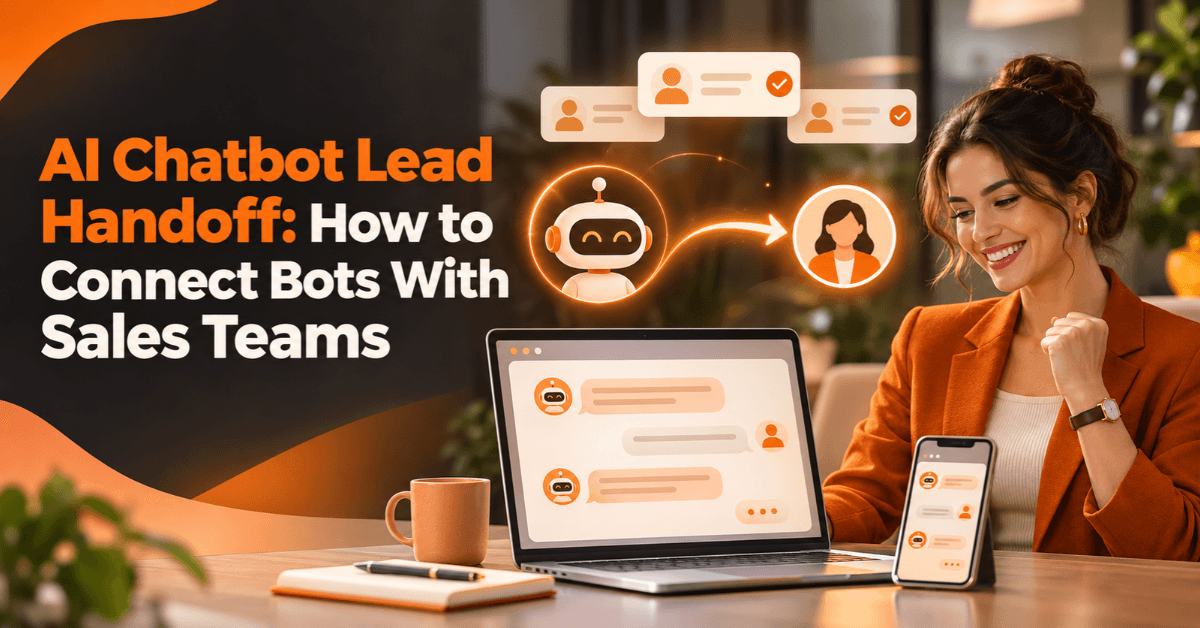
AI chatbots help businesses respond to website visitors, answer common questions, and collect potential customer information. However, capturing a lead is only the first step. Businesses also need a reliable process to transfer qualified prospects to their sales teams before they lose interest. This is where AI Chatbot Lead Handoff becomes important. It connects automated conversations with human sales representatives, allowing businesses to capture inquiries, qualify prospects, and route sales opportunities without relying entirely on manual follow-ups.
When businesses connect chatbots with customer relationship management (CRM) systems, automated notifications, and sales workflows, they can manage inquiries more efficiently. Sales representatives receive useful customer information and can continue conversations without asking prospects to repeat everything.
What Is AI Chatbot Lead Handoff and Why Does It Matter?
AI Chatbot Lead Handoff is the process of transferring a conversation from an automated chatbot to a human sales representative when a visitor needs further assistance or shows buying interest.
Instead of handling every inquiry manually, businesses use AI chatbots to collect information, understand customer requirements, and identify qualified prospects. Once a conversation meets specific conditions, the system transfers the lead to an appropriate sales representative.
For example, a visitor might ask about pricing, request a product demonstration, or explain a specific business requirement. The chatbot can collect the necessary details and notify a sales representative to continue the conversation.
Chatbot-to-Human Handoff vs Traditional Lead Capture
Traditional lead capture usually depends on website forms where visitors enter their contact details and wait for someone to respond.
A chatbot-to-human handoff creates a more interactive process.
Traditional lead capture: Visitors complete forms and wait for manual follow-up.
Basic chatbot: The system answers predefined questions but may struggle with complex inquiries.
AI-powered lead handoff: The chatbot understands visitor intent, collects relevant information, and transfers qualified conversations to human representatives.
This approach offers several benefits:
Faster responses to potential customers.
Better lead qualification before sales involvement.
Fewer missed inquiries.
More organized customer information.
Improved communication between marketing and sales teams.
Less manual administrative work.
The goal is not to replace sales representatives. It is to help them spend more time speaking with relevant prospects.
How Does AI Chatbot Lead Handoff Work?
An AI chatbot lead handoff follows a sequence that connects customer conversations with sales operations.
Here is how the process typically works:
Visitor engagement: A visitor opens the chatbot on a business website and starts asking questions.
Information collection: The chatbot collects relevant details, such as name, email address, company, and service requirements.
Lead qualification: AI evaluates the visitor's needs, budget, and purchasing timeline.
Intent detection: The chatbot identifies buying signals, such as requests for pricing or consultations.
Automated lead routing: The system assigns the qualified prospect to an appropriate sales representative.
Context transfer: The chatbot shares conversation history and collected information.
Human follow-up: The representative continues the discussion and guides the prospect toward the next step.
How Intent-Based Triggering Identifies Sales-Ready Leads
Intent-based triggering allows chatbots to recognize when visitors demonstrate genuine interest in a product or service.
For example, phrases such as "I need a quotation," "Can I schedule a consultation?" or "What is the implementation cost?" may indicate stronger buying intent than general informational questions.
Businesses can configure these triggers to initiate a live chat escalation when a prospect needs human assistance.
How Context-Preserving Escalation Improves Customer Experience
A successful handoff should transfer more than a contact form submission.
It should include:
Customer name and contact information.
Complete conversation history.
Products or services of interest.
Questions already answered by the chatbot.
Budget and purchasing requirements, where provided.
Lead qualification status.
This process prevents customers from repeating information and gives sales representatives enough context to respond appropriately.
How to Connect AI Chatbots With Your Sales Team
Connecting a chatbot with a sales team requires a clear workflow, suitable software, and well-defined handoff conditions.
Businesses can follow these practical steps.
1. Define Your Lead Handoff Rules
Start by deciding when the chatbot should transfer a conversation to a human representative.
For example, configure handoff triggers for:
Visitors requesting a human representative.
Prospects asking for customized quotations.
Customers requesting product demonstrations.
Complex service inquiries.
High-intent purchasing questions.
Conversations involving complaints or frustration.
Clear rules prevent unnecessary transfers and help sales representatives prioritize important inquiries.
2. Connect Your Chatbot With a CRM
CRM chatbot integration allows businesses to store customer information and manage sales opportunities in one place.
Popular CRM platforms include:
HubSpot: Supports contact management, sales pipelines, and marketing automation.
Salesforce: Provides customer relationship management and sales workflow capabilities.
Pipedrive: Helps sales teams organize leads, deals, and follow-up activities.
Depending on the chatbot and CRM capabilities, integration can support automatic contact creation, lead updates, conversation history storage, and follow-up task creation.
For example, when a chatbot qualifies a prospect, it can create a new CRM contact and attach the visitor's requirements to the relevant sales record.
3. Configure Automated Lead Routing
Automated lead routing sends incoming prospects to the appropriate sales representative based on predefined rules.
Businesses can assign leads according to:
Geographic location.
Product or service interest.
Sales representative availability.
Industry specialization.
Lead priority.
Existing customer relationships.
One common method is round-robin lead distribution. This approach distributes incoming leads among available representatives in a rotating order.
For example, a company with three sales representatives can assign the first lead to Agent A, the second to Agent B, and the third to Agent C. The process then repeats.
This helps distribute workloads more evenly.
4. Set Up Real-Time Agent Notifications
Sales representatives should receive immediate notifications when a qualified lead needs attention.
Businesses can use email, CRM alerts, Slack, or Microsoft Teams, depending on their existing systems.
A useful notification should contain:
Prospect's name.
Contact information.
Inquiry summary.
Lead priority.
Conversation history.
Assigned representative.
These real-time agent notifications improve visibility and help teams respond while customer interest remains strong.
5. Enable Calendar Booking Automation
Businesses can connect chatbots with calendar scheduling tools so qualified prospects can book consultations or product demonstrations directly.
For example, after collecting a prospect's requirements, the chatbot can present available meeting slots.
Once the visitor selects a suitable time, the system can create a calendar event and notify the assigned representative.
This reduces unnecessary communication and simplifies appointment scheduling.
How Do AI Chatbots Qualify Leads Before Handoff?
AI chatbots qualify leads by asking relevant questions and evaluating whether a visitor matches the business's target customer profile.
A B2B lead qualification bot can collect information before transferring a conversation to the sales team.
Important Questions an AI Lead Qualification Bot Should Ask
Depending on the business, useful questions include:
What product or service are you interested in?
What challenges are you currently facing?
What is your expected budget?
When do you plan to make a decision?
Are you comparing different service providers?
Would you like to schedule a consultation?
Businesses should avoid asking too many questions at once. A short, relevant conversation creates a better customer experience.
Understanding Lead Scoring and Qualification
Lead scoring helps businesses prioritize prospects according to their potential value and readiness to purchase.
One common qualification framework is BANT:
Budget: Can the prospect afford the proposed solution?
Authority: Does the person have purchasing authority?
Need: Does the business offer a suitable solution?
Timeline: When does the prospect plan to make a decision?
The chatbot can collect these details and assign a qualification score based on business-defined criteria.
However, businesses should treat automated scores as decision-support information rather than a guaranteed prediction of purchase intent. Sales representatives should review important opportunities before making final decisions.
When Should a Chatbot Transfer a Lead to a Human Sales Representative?
A chatbot should transfer a conversation whenever automation cannot provide the level of assistance a visitor needs.
Common handoff situations include:
A visitor directly requests a human representative.
A prospect requests a customized quotation.
Someone demonstrates strong purchasing intent.
A customer asks a complex technical question.
A visitor expresses frustration with automated responses.
A prospect wants to negotiate pricing or service terms.
The chatbot cannot understand the request after reasonable clarification.
How Sentiment Analysis and Fallback Intent Prevent Missed Leads
Sentiment analysis helps AI systems identify emotional signals in customer messages.
For example, repeated complaints, negative language, or expressions of dissatisfaction may indicate that a visitor needs human support.
Fallback intent handles situations where the chatbot cannot confidently identify what someone means.
Instead of repeating the same automated response, the chatbot should offer clarification or transfer the conversation to a human representative.
This creates a more reliable human-in-the-loop sales workflow, where AI handles routine interactions while people manage complex decisions and relationship-building.
AI Chatbot Lead Handoff Best Practices for Better Sales Results
A chatbot integration should make the sales process easier rather than introduce additional steps.
Businesses can improve their handoff workflows by following these practices:
Keep chatbot questions short and relevant.
Transfer complete conversation histories to sales representatives.
Use clear lead assignment rules.
Send real-time notifications for qualified inquiries.
Establish reasonable response-time expectations.
Always provide an option to contact a human.
Avoid asking customers for information they already provided.
Review unsuccessful handoffs regularly.
Monitor lead quality instead of focusing only on conversation volume.
Apply suitable privacy, consent, and customer data access controls.
Common AI Chatbot Handoff Mistakes to Avoid
Some businesses implement chatbots without considering what happens after a visitor requests human assistance.
Avoid these common problems:
Incomplete information: Sales representatives receive leads without useful context.
Poor lead distribution: Every inquiry goes to the same representative.
Delayed responses: Qualified prospects wait too long for human support.
Excessive questions: Chatbots make conversations unnecessarily complicated.
No fallback option: Visitors cannot reach a human when automation fails.
Missing performance tracking: Businesses cannot identify where leads disappear from the sales process.
A reliable handoff workflow should have clear ownership. Every transferred lead needs an assigned person, a recorded status, and an appropriate next action.
How AI Chatbot Lead Handoff Supports Small Business Growth
Small businesses often have limited sales resources. Managing website inquiries, emails, social media messages, and follow-ups manually can become difficult as customer demand increases.
AI chatbot automation helps smaller teams organize these activities without immediately increasing their administrative workload.
For example, a small digital marketing agency might receive inquiries through its website. An AI chatbot can ask visitors about their business, current marketing challenges, and required services.
It can then identify relevant prospects, create CRM records, and notify the appropriate sales representative.
This creates a more organized lead management process.
Connecting Chatbot Automation With Your SEO Plan
Small Business SEO helps potential customers find a business through relevant search queries. However, attracting website visitors does not automatically generate sales.
Businesses also need an effective process to engage visitors and convert suitable inquiries into opportunities.
An integrated SEO plan can connect several activities:
Publish useful content targeting relevant customer searches.
Improve website visibility through technical and on-page SEO.
Attract visitors with genuine interest in business services.
Use conversational lead capture to understand visitor requirements.
Transfer qualified inquiries to sales representatives.
Measure which organic landing pages generate meaningful leads.
For example, someone searching for website development services may land on a relevant service page. A chatbot can answer initial questions and offer a consultation when the visitor shows interest.
Using Chatbots as Part of an Organic Growth Strategy
An organic growth strategy should connect website visibility with a reliable conversion process.
Chatbots can support this process by:
Engaging visitors arriving through organic search.
Collecting common customer questions.
Identifying frequently requested services.
Helping visitors find relevant information.
Supporting lead qualification and follow-up.
Providing insights that help businesses improve website content.
These activities can help businesses make better use of existing website traffic.
However, chatbots do not directly improve Google rankings simply by being installed. SEO performance still depends on useful content, technical accessibility, relevance, and other established search quality considerations.
Businesses can explore BrandVexo's SEO and Local SEO services to understand how search visibility can support a wider lead generation strategy.
How to Measure AI Chatbot Lead Handoff Performance
Businesses should measure the performance of their chatbot and sales integration regularly.
Tracking the right metrics helps identify delays, qualification problems, and opportunities to improve the customer journey.
Important Chatbot and Sales Handoff Metrics
Lead qualification rate: Percentage of chatbot conversations that produce qualified leads.
Handoff rate: Percentage of conversations transferred to human representatives.
Speed to lead: Time between a customer's inquiry and the first meaningful sales response.
Meeting booking rate: Percentage of qualified prospects who schedule meetings.
Lead-to-customer conversion rate: Percentage of leads that become paying customers.
Sales response time: Time representatives take to respond after receiving a handoff.
Customer acquisition cost (CAC): Total sales and marketing cost required to acquire a customer.
Businesses should establish baseline measurements before making changes. They can then compare results over time to understand whether automation improves lead handling and sales efficiency.
How BrandVexo Can Help!
BrandVexo is a digital growth studio helping businesses build stronger online identities and improve their digital performance. We bring together website development, SEO, AI automation, digital marketing, and business solutions under one connected growth strategy.
Our approach focuses on practical technology, effective marketing systems, and measurable business outcomes.
We help businesses turn their digital presence into meaningful customer engagement and growth opportunities.
Contact BrandVexo
Phone: +971 56 410 4881
Email: info@brandvexo.com
Website: www.brandvexo.com
Final Thoughts
AI chatbots can make customer communication faster, but their real value comes from connecting automated conversations with human expertise.
A successful AI Chatbot Lead Handoff combines lead qualification, CRM chatbot integration, automated routing, and timely sales follow-ups. It gives businesses a more organized way to manage inquiries while allowing sales representatives to focus on meaningful customer conversations.
For businesses looking to improve their digital operations, connecting AI automation with website development, SEO, and lead generation can create a stronger growth system.
FAQs
1. What Is AI Chatbot Lead Handoff?
AI Chatbot Lead Handoff is the process of transferring customer conversations from an automated chatbot to a human sales representative. It helps businesses qualify prospects, share customer information, and manage sales inquiries more efficiently.
2. How Does a Chatbot Transfer Leads to a Sales Team?
A chatbot collects visitor information, evaluates buying intent, and identifies qualified prospects. It then transfers the conversation and relevant customer details to a sales representative through a CRM, live chat platform, or automated notification.
3. Can AI Chatbots Automatically Assign Leads to Sales Representatives?
Yes. Businesses can configure automated lead routing using rules based on location, service requirements, representative availability, or round-robin distribution. These rules help teams manage incoming inquiries more efficiently.
4. Which CRM Platforms Can Integrate With AI Chatbots?
Popular options include HubSpot, Salesforce, and Pipedrive. Integration capabilities depend on the chatbot platform and available APIs or connectors. Businesses should check whether their chosen tools support contact synchronization and conversation history transfer.
5. When Should an AI Chatbot Escalate a Conversation to a Human?
A chatbot should escalate conversations when visitors request human assistance, ask complex questions, demonstrate strong buying intent, express frustration, or require customized pricing and professional guidance.
6. How Can Small Businesses Benefit From AI Chatbot Lead Handoff?
Small businesses can use chatbot automation to capture inquiries, qualify prospects, organize customer information, and support timely follow-ups. This helps smaller sales teams manage incoming opportunities without relying entirely on manual processes.
Disclaimer: This article is intended for informational and educational purposes only. AI chatbot features, CRM integrations, and automation capabilities may vary depending on the software provider and business requirements. Businesses should evaluate their specific needs and verify technical compatibility before implementing any solution. BrandVexo does not guarantee specific sales, lead generation, or conversion results.
Free growth plan
Ready to grow your business?
Reading is a start — now let's build it. Tell us where you want to grow and a senior strategist will map the fastest, most profitable way to get there. Free, no obligation.
Discussion
Join the conversation
Be the first to comment. Comments are reviewed before they appear, so yours won't show up instantly — but we read every one.
Leave a comment
Keep reading
All articles
AI Lead Qualification: How to Keep Human Review in the Loop
Explore AI lead qualification, smarter lead scoring and human review practices that help sales teams improve lead quality and manage prospects.
Business Automation Solutions That Save Time and Cut Costs
Explore Business Automation Solutions that save time, reduce costs, improve workflows, and help small businesses increase productivity and support growth.
WhatsApp Lead Automation for Service Firms: A Guide
Learn how WhatsApp lead automation helps service firms capture leads, automate follow-ups, connect CRM systems, and book more appointments.