

AI Lead Qualification: How to Keep Human Review in the Loop
Explore AI lead qualification, smarter lead scoring and human review practices that help sales teams improve lead quality and manage prospects.
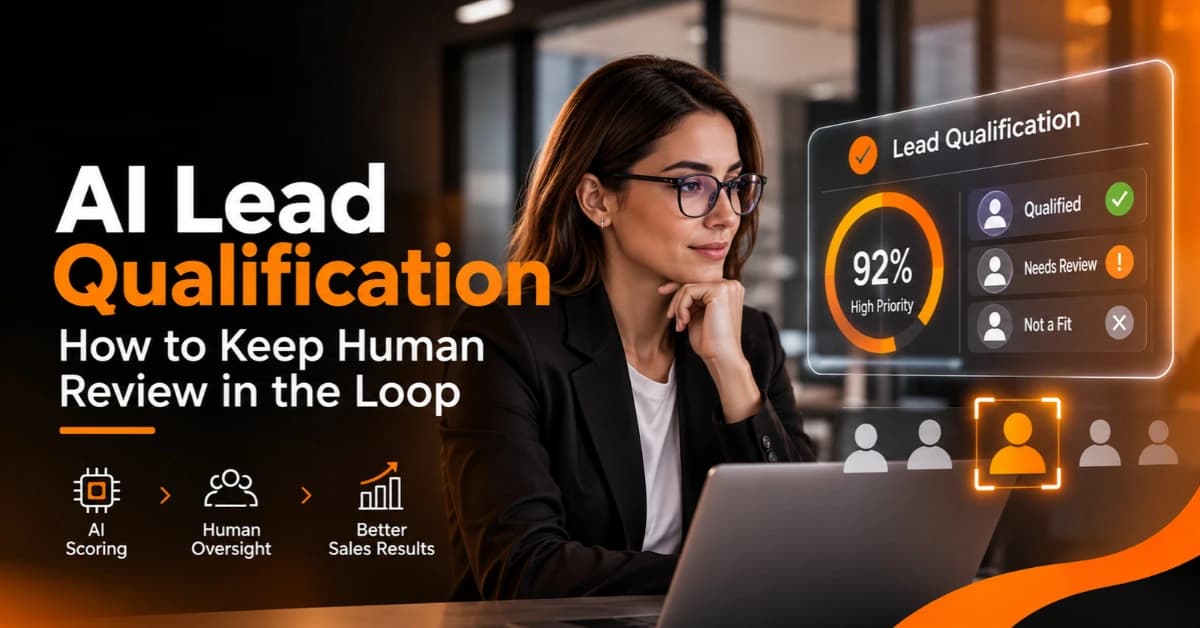
Businesses receive enquiries from websites, social media, paid advertising, email campaigns and other marketing channels. However, not every enquiry represents a genuine sales opportunity. Some people are ready to buy, while others are still comparing options or simply looking for information. Reviewing every enquiry manually can slow down sales teams and make it harder to prioritise promising prospects. This is where AI Lead Qualification becomes useful. Artificial intelligence can analyse customer information, identify buying signals and organise leads according to their potential value.
However, automation should not make every decision independently. AI can misunderstand customer behaviour, rely on incomplete information or assign an incorrect score. Human review helps businesses identify these problems before they affect sales opportunities.
What Is AI Lead Qualification and How Does It Work?
AI Lead Qualification is the process of using artificial intelligence to evaluate incoming prospects based on their customer information, behaviour, engagement and potential buying intent.
Instead of asking sales representatives to review every enquiry individually, an AI-powered system analyses available information and helps determine which prospects deserve attention first.
For example, a business may receive enquiries from a website contact form. An AI system can examine each enquiry, identify the requested service, check the customer's requirements and assign a lead score based on predefined criteria.
The system can then organise prospects into priority groups and send relevant information to a CRM platform.
How AI Qualifies Leads Automatically
A typical automated lead qualification process includes these steps:
Lead collection: The system collects enquiries from website forms, landing pages, social media, email and other connected channels.
Data analysis: AI examines available customer details, engagement history and expressed requirements.
Lead scoring: The system assigns scores based on business-defined qualification criteria.
Lead prioritisation: Prospects are grouped according to their potential fit and sales readiness.
CRM integration: Qualified leads are added to the appropriate sales pipeline.
Follow-up automation: The system can send notifications, create tasks or trigger approved follow-up messages.
What Information Does AI Use to Qualify a Lead?
An AI lead scoring system may evaluate several types of information, including:
Customer details: Job title, company size, industry and business location.
Purchase requirements: Requested services, budget and expected timeline.
Website behaviour: Visits to service pages, pricing pages and enquiry forms.
Marketing engagement: Email interactions, advertising responses and content engagement.
Previous interactions: Earlier enquiries, sales conversations and customer history.
Buying intent: Questions about pricing, implementation, availability or specific business requirements.
These signals help AI identify patterns, but they do not always confirm that someone is ready to purchase. A person who visits a pricing page may still be researching several providers.
Why Human Review Matters in AI-Powered Lead Qualification
AI can analyse large amounts of information quickly, but it does not always understand the full context behind a customer's actions.
A prospect may receive a low score because they have limited online activity, even though they have a genuine business requirement. Another prospect may receive a high score because they frequently visit a website without having the budget or authority to make a purchase.
Human review helps sales teams recognise these differences.
Sales representatives can ask follow-up questions, understand specific requirements and evaluate whether an opportunity is commercially relevant. They can also identify situations where the AI system has interpreted customer information incorrectly.
What Can Go Wrong Without Human Oversight?
Businesses that depend entirely on automated lead qualification may experience several problems:
Incorrect lead scoring: AI may prioritise prospects who show engagement but have little genuine buying intent.
Missed opportunities: Valuable customers may receive low scores because their information is incomplete.
Outdated customer data: Incorrect company details or old contact information can affect qualification results.
Misinterpreted behaviour: Website visits and email clicks do not always indicate purchase readiness.
Limited business context: AI may not understand complex purchasing requirements or internal approval processes.
Poor customer experience: Automated responses may feel irrelevant when they do not address a prospect's actual needs.
Human Judgement vs AI-Based Decisions
AI and human sales representatives offer different strengths.
AI provides speed, consistency and the ability to identify patterns across large datasets. It can organise incoming enquiries, calculate scores and recommend follow-up priorities.
Human representatives provide context, communication skills, critical thinking and relationship-building. They can understand customer concerns and adjust conversations according to individual requirements.
Combining these capabilities creates a more balanced sales qualification process. AI handles repetitive analysis, while people review important recommendations and manage meaningful customer interactions.
How to Build a Human-in-the-Loop AI Lead Qualification Process
A human-in-the-loop approach allows businesses to use automation while keeping people involved in decisions that require judgement.
Rather than checking every routine activity manually, sales teams establish specific review points where human approval, correction or intervention is necessary.
Here is a practical framework businesses can follow.
Step 1: Define Your Ideal Customer Profile (ICP)
Before introducing AI automation, identify the type of customer your business wants to attract.
An ideal customer profile helps the system understand which prospects are more relevant to your products or services.
Consider these factors:
Industry and business type.
Company size and location.
Customer requirements.
Available budget.
Purchasing authority.
Expected buying timeline.
For example, a B2B software company may prioritise businesses with an established team, a suitable budget and a clear need for its software.
Clear qualification criteria give AI a more reliable foundation for evaluating incoming enquiries.
Step 2: Set Clear AI Lead Scoring Rules
An AI lead scoring system should follow criteria connected to actual business goals.
Businesses can combine demographic information, company details, customer engagement and expressed buying intent to assess lead quality.
For example:
A prospect requesting a service quotation may receive a higher priority.
A business owner with a relevant requirement may receive a stronger qualification score.
Someone downloading a general information guide may remain in a lower-priority category.
An enquiry with missing information may require further review.
Avoid treating individual activities as automatic proof of buying intent. Regularly compare scoring recommendations with actual sales outcomes to identify weaknesses.
Step 3: Establish Human Review Checkpoints
Not every AI recommendation needs manual approval. However, businesses should identify situations where human judgement can prevent costly mistakes.
Create review checkpoints for:
High-value prospects with significant potential revenue.
Leads with incomplete or conflicting information.
Unusually high or low AI scores.
Enterprise enquiries involving several decision-makers.
Prospects whose behaviour does not match typical buying patterns.
Cases where the system has low confidence in its recommendation.
Sales representatives should also have the ability to override an AI score. Record the reason for each significant change so managers can identify recurring problems and improve qualification rules.
Step 4: Send Qualified Leads to the Right Sales Representative
Once the system evaluates an enquiry, it should route the prospect to the appropriate person or team.
For example, a business receiving enquiries about website development, SEO and automation may assign each enquiry to a specialist based on the requested service.
An effective CRM workflow can:
Assign leads according to service requirements.
Notify the relevant sales representative.
Prioritise urgent enquiries.
Create follow-up reminders.
Maintain a record of previous interactions.
This reduces unnecessary handoffs and helps ensure that enquiries do not remain unattended.
Step 5: Collect Feedback and Improve the System
AI lead qualification should not remain unchanged after implementation.
Sales teams should regularly review whether the system identifies the right prospects. They can compare AI recommendations with conversations, qualified opportunities and completed sales.
When representatives frequently override particular recommendations, investigate the reason. The scoring model may need better criteria, more reliable data or additional context.
This feedback loop helps businesses improve qualification accuracy while maintaining human accountability.
Which AI Lead Scoring Decisions Should Always Involve Human Review?
Some lead qualification activities are suitable for automation, while others require a closer look.
Businesses should prioritise human review when a decision could significantly affect a sales opportunity or customer relationship.
Important situations include:
High-value prospects: Review opportunities that could generate substantial revenue or long-term business relationships.
Uncertain lead scores: Check recommendations when the system identifies conflicting signals or insufficient information.
Incomplete customer profiles: Verify important details before making qualification decisions.
Complex business enquiries: Evaluate enterprise requirements, multiple stakeholders and detailed purchasing processes.
Unusual customer behaviour: Investigate activity that does not match the prospect's stated requirements.
Potentially unfair decisions: Check that qualification rules do not unfairly disadvantage people based on sensitive or irrelevant personal characteristics.
When Can AI Handle Lead Qualification Independently?
Businesses can allow AI to manage routine, low-risk administrative activities when they have tested the workflow and established clear limits.
Examples include:
Sorting incoming enquiries.
Identifying duplicate records.
Updating approved CRM fields.
Categorising leads using predefined rules.
Sending standard follow-up reminders.
Notifying representatives about new enquiries.
The important distinction is between automating routine work and allowing AI to make unrestricted decisions about customer opportunities.
How to Balance AI Automation and Human Sales Teams
Successful AI sales automation requires a clear division of responsibilities.
If sales representatives must manually check every automated action, the business may not gain much efficiency. On the other hand, removing people from the process completely can create problems when customer requirements become complicated.
A balanced workflow gives AI responsibility for repetitive tasks while keeping sales professionals involved in important interactions.
AI responsibilities:
Collect and organise lead information.
Identify engagement patterns.
Calculate preliminary lead scores.
Recommend follow-up priorities.
Update approved CRM records.
Generate notifications and reminders.
Human sales responsibilities:
Verify important customer information.
Understand business requirements.
Handle objections and negotiations.
Review unusual AI recommendations.
Approve important qualification decisions.
Build relationships with potential customers.
CRM integration connects these activities by giving authorised team members access to relevant lead information and interaction history.
Real-World Example: AI Lead Qualification for a UAE Business
Consider an illustrative example of a digital marketing agency in Dubai receiving 300 enquiries every month through its website, Google Ads and social media campaigns.
The agency's sales team struggles to review every enquiry quickly. Some prospects need SEO services, others want website development, and some are interested in business automation.
The agency introduces an AI-powered lead qualification workflow connected to its CRM.
Here is how the process works:
AI collects incoming enquiries from connected marketing channels.
The system identifies the requested service, business type, budget information and stated requirements.
Each enquiry receives a preliminary score based on the agency's qualification criteria.
High-priority enquiries enter a human review queue.
Sales representatives verify important details and contact relevant prospects.
Leads requiring additional information receive an appropriate follow-up.
The team records the outcome to improve future scoring decisions.
For example, a prospect may request an SEO proposal but leave the budget field blank. Instead of automatically rejecting the enquiry, the system flags the missing information for a sales representative.
A short conversation may confirm that the prospect has a suitable budget and a genuine requirement.
This example shows why human review matters. AI helps organise enquiries, but people provide the context needed to evaluate real business opportunities.
Businesses operating in the UAE should also consider applicable personal data protection requirements when collecting, storing and processing customer information. Review the UAE Personal Data Protection framework when designing customer-data workflows.
Common AI Lead Qualification Mistakes Businesses Should Avoid
Even well-designed automation workflows can produce poor results when businesses overlook important details.
Avoid these common mistakes:
Depending entirely on AI scores: Treat scores as recommendations rather than guaranteed predictions.
Using unreliable customer data: Regularly check records for missing, duplicated or outdated information.
Ignoring sales feedback: Representatives often identify qualification problems that automated reports cannot explain.
Automating every interaction: Keep personal communication available when customers need clarification or assistance.
Using unclear qualification rules: Define what makes a lead relevant before configuring the system.
Ignoring false-positive and false-negative leads: Review both incorrectly prioritised and overlooked prospects.
Overlooking data protection: Collect and process customer information responsibly.
A reliable process requires regular testing, clear responsibilities and ongoing improvements.
How to Measure the Success of AI Lead Qualification
Businesses should measure whether AI lead qualification improves sales performance rather than focusing only on how many enquiries the system processes.
Consider tracking these metrics:
Lead-to-customer conversion rate: Measures how many leads eventually become paying customers.
Lead response time: Tracks how quickly representatives respond to new enquiries.
Sales-qualified lead rate: Shows how many incoming prospects meet the business's sales criteria.
Lead scoring accuracy: Compares AI recommendations with actual qualification outcomes.
False-positive rate: Measures how often unqualified prospects receive high-priority scores.
False-negative rate: Identifies relevant prospects that the system incorrectly deprioritises.
Human override rate: Tracks how frequently representatives change AI recommendations.
Review these metrics over time and compare them with previous sales performance. A high number of automated qualifications does not necessarily mean the system is producing better business opportunities.
The Future of AI Lead Qualification: Smarter Automation with Human Control
AI technology will continue to improve how businesses analyse customer information, identify buying signals and manage sales pipelines.
Predictive lead scoring, CRM integrations and intelligent automation can help sales teams understand which prospects deserve attention. However, these tools still depend on reliable data, appropriate qualification rules and effective oversight.
Businesses that establish clear human review processes can use AI more responsibly while maintaining meaningful customer relationships.
The goal is not to remove people from sales operations. It is to give them better information, clearer priorities and more time to focus on customers.
FAQs
What Is AI Lead Qualification?
AI Lead Qualification uses artificial intelligence to evaluate incoming prospects based on customer information, engagement, business requirements and buying signals. It helps sales teams prioritise enquiries and identify potential opportunities.
How Does AI Lead Scoring Work?
AI lead scoring analyses customer information, website activity, engagement history and qualification criteria. It assigns scores or priority categories to help sales representatives decide which prospects to contact first.
Can AI Replace Human Sales Representatives in Lead Qualification?
No. AI can automate data analysis, lead scoring and routine follow-ups, but human representatives remain important for understanding customer requirements, handling objections, building relationships and reviewing complex decisions.
Why Is Human Review Important in AI Lead Qualification?
Human review helps identify incorrect scores, incomplete information and misunderstood customer behaviour. It also allows sales teams to verify important opportunities before making decisions that could affect customer relationships.
What Is a Human-in-the-Loop AI System?
A human-in-the-loop AI system combines automated processing with human supervision. People review, correct or approve selected AI recommendations while the system handles routine tasks within established limits.
Which CRM Tools Support AI Lead Qualification?
Several CRM platforms offer lead management, scoring and workflow automation capabilities. Businesses should compare available features, integration options, data controls and pricing before selecting a platform.
How Can Small Businesses Implement AI Lead Qualification?
Small businesses can begin by defining an ideal customer profile, setting basic scoring criteria, connecting a CRM system and establishing manual review checkpoints. They can expand automation gradually as they evaluate performance.
Build a Smarter Sales Process with BrandVexo
AI Lead Qualification can make sales operations more organised, but the best results come from combining automation with human judgement.
Businesses need connected systems that capture enquiries, evaluate customer requirements, route opportunities and keep sales teams informed. They also need clear review processes to ensure that important decisions receive the attention they deserve.
At BrandVexo, we help businesses build practical digital growth systems through AI automation, CRM workflows, website development and digital marketing. Our focus is on connecting the right tools and processes so businesses can reduce repetitive work and manage customer opportunities more effectively.
Whether you want to improve lead routing, automate follow-ups or build a more connected sales workflow, we can help you identify a suitable approach.
Let's build a smarter system for your business.
BrandVexo
Phone: +971 52 356 5409
Email: info@brandvexo.com
Website: https://brandvexo.com/
Disclaimer: This article is intended for general informational purposes only and does not constitute professional, legal, or technical advice. AI lead qualification tools and processes should be evaluated according to your business needs, data privacy obligations, and operational requirements. BrandVexo recommends combining AI-driven insights with appropriate human oversight.
Free growth plan
Ready to grow your business?
Reading is a start — now let's build it. Tell us where you want to grow and a senior strategist will map the fastest, most profitable way to get there. Free, no obligation.
Discussion
Join the conversation
Be the first to comment. Comments are reviewed before they appear, so yours won't show up instantly — but we read every one.
Leave a comment
Keep reading
All articles
AI Chatbot Lead Handoff: How to Connect Bots With Sales Teams
Learn how AI chatbot lead handoff connects bots with sales teams through CRM integration, lead qualification, automated routing and faster follow-ups.
Business Automation Solutions That Save Time and Cut Costs
Explore Business Automation Solutions that save time, reduce costs, improve workflows, and help small businesses increase productivity and support growth.

WhatsApp Lead Automation for Service Firms: A Guide
Learn how WhatsApp lead automation helps service firms capture leads, automate follow-ups, connect CRM systems, and book more appointments.