
AI Search Visibility: Strategies to Grow Your Brand Online
Improve AI Search Visibility with practical SEO, GEO, and AEO strategies to strengthen brand authority, earn citations, and reach more potential customers.
AI search is changing how people find businesses, compare services, and choose which brands to trust. Instead of clicking through several search results, users can now ask AI-powered tools for recommendations, explanations, and summaries. This creates new opportunities for businesses to appear where customers research their options. AI Search Visibility refers to how easily a brand's information appears, gets mentioned, or receives citations in AI-powered search experiences. Businesses can improve their chances of being discovered by publishing useful content, strengthening their online reputation, maintaining accessible websites, and providing clear, reliable information.
For growing brands, the goal is not to abandon traditional SEO. It is to build on it. Strong technical foundations, relevant content, and credible brand information can support visibility across conventional search engines and AI-powered discovery tools.
What Is AI Search Visibility?
AI Search Visibility describes a brand's presence in AI-powered search experiences, including whether these systems mention the brand, cite its website, link to its content, or use its information when answering relevant questions.
For example, a business might appear in Google's traditional results for a search such as “digital marketing agency in Dubai.” An AI-powered search experience might instead summarize agency options, explain their services, and link to selected sources.
These experiences can create several types of visibility:
Brand mentions: An AI-generated response names the business.
Website citations: The response links to a page that supports its answer.
Source visibility: The system uses information from the website when generating a response.
Recommendation visibility: The brand appears among options relevant to a user's needs.
These outcomes are not identical, and businesses cannot assume that appearing in one search experience guarantees visibility in another.
How AI Search Engines Discover and Reference Brands
AI-powered search systems can combine language models with information retrieval, search indexes, and other sources of information. Their methods vary by platform.
Large Language Models (LLMs) help systems interpret language and generate responses. Natural Language Processing (NLP) supports tasks such as understanding questions, identifying entities, and interpreting context. Retrieval systems can help locate relevant information to support an answer.
Businesses can make their information easier to understand by using descriptive headings, clear service pages, consistent brand details, and reliable sources. However, no specific wording or formatting technique guarantees a citation.
Where Can Your Brand Appear in AI Search?
Businesses should consider the AI-powered discovery experiences their customers actually use, including:
Google AI Overviews and AI Mode
ChatGPT search
Perplexity
Google Gemini and other AI-assisted research tools
Each platform may use different retrieval methods and produce different results. A practical strategy should therefore combine strong website fundamentals with ongoing observation of relevant customer queries.
Why Is AI Search Visibility Important for Businesses?
AI search visibility matters because customers often research a business before contacting it. They may ask an AI tool to compare providers, explain a service, summarize reviews, or recommend an option for a specific need.
If a business publishes clear, useful, and credible information, it gives search systems better material to interpret and potentially reference. This does not guarantee a recommendation, but it supports a stronger online presence.
Key business benefits include:
Greater brand awareness: Potential customers may encounter your business while exploring a topic.
More relevant discovery: Helpful service pages can address specific customer needs.
Stronger brand credibility: Consistent information and evidence can help people evaluate your business.
Referral opportunities: Users may visit your website through links in AI-generated responses.
Better content planning: Tracking common questions can reveal gaps in your website content.
Why Traditional SEO Still Matters
AI-powered search does not make traditional SEO obsolete. Google's guidance confirms that established SEO practices remain relevant to its AI search experiences, including crawlability, indexing, useful content, internal links, and good page experience.
Businesses should therefore improve their existing SEO foundations while adapting their content to answer more detailed questions and support different stages of customer research.
For a practical starting point, see BrandVexo's SEO strategy for small businesses, which explains how to connect search intent, content, technical improvements, and business goals.
What Is the Difference Between SEO, GEO, and AEO?
SEO, GEO, and AEO share a common goal: helping people find useful information. However, each term emphasizes a different aspect of search visibility.
Search Engine Optimization (SEO)
SEO improves a website's ability to appear in relevant organic search results. It includes keyword research, technical optimization, content quality, internal linking, and authority development.
For example, a Dubai-based marketing agency might optimize its service page for searches related to SEO services in Dubai, making it easier for potential clients to find relevant information.
Generative Engine Optimization (GEO)
Generative Engine Optimization focuses on improving how useful and credible content can be discovered, interpreted, and referenced in AI-generated responses.
A GEO strategy may include publishing original research, explaining concepts clearly, citing trustworthy sources, and providing specific examples that help readers understand a subject.
Answer Engine Optimization (AEO)
Answer Engine Optimization focuses on making information easy to identify and use when people ask direct questions. This can include concise definitions, descriptive headings, step-by-step explanations, and clear answers to common customer queries.
For example, a web development company could answer “How much does a business website cost?” with a clear explanation of pricing factors, scope, and typical project requirements.
In practice, these approaches overlap:
SEO: Make your website discoverable in organic search.
GEO: Make your information useful and credible for generative search experiences.
AEO: Make answers clear and easy to extract or understand.
Treat them as complementary practices rather than separate campaigns with entirely different rules.
How to Improve AI Search Visibility: 7 Practical Strategies
The most sustainable AI SEO strategies focus on useful information, strong website foundations, and a trustworthy digital presence. The following actions can help businesses improve their chances of being discovered.
1. Create Helpful Content That Answers Real Questions
Start with the questions your customers ask before choosing a product or service. Build content around their problems, concerns, comparisons, and decisions instead of repeating the same keywords across multiple pages.
For example, a digital marketing agency could publish guides explaining SEO costs, campaign timelines, reporting metrics, and how businesses can evaluate service providers.
To make content more useful:
Answer the main question near the beginning.
Use descriptive H2 and H3 headings.
Explain unfamiliar terms in simple language.
Include examples, original insights, and relevant evidence.
Remove repetitive sections that add no value.
Google recommends creating distinctive, valuable content rather than simply repeating information that other websites already provide.
2. Build Topical Authority With Relevant Content Clusters
A single article rarely answers every question a potential customer may have. A connected group of useful pages can provide broader coverage of a subject. Start with a core service or pillar page, then publish supporting articles that answer related questions. Link these pages so readers can move naturally between topics.
For example, a business investing in SEO could connect its main service page with guides about keyword research, content strategy, technical SEO, and performance measurement.
BrandVexo's guide to SEO content briefs provides a useful starting point for planning content around search intent, topic coverage, and internal links.
Avoid publishing many nearly identical pages just to target small variations of a search query. Each page should serve a distinct user need.
3. Strengthen Your Brand Identity and Online Consistency
Search engines and AI-powered systems need to interpret which business a page describes and how its information relates to a user's question.
Build a clear brand identity by keeping details consistent and accurate across your website and relevant business profiles.
Focus on:
Your official business name and website.
Clear descriptions of your services and expertise.
Accurate contact information and business location, where applicable.
Genuine customer reviews and relevant professional profiles.
Author biographies that reflect real experience and qualifications.
Also create detailed service pages that explain what you offer, whom you help, and what customers can expect.
For example, a UAE-based digital agency should explain whether it provides technical SEO, content strategy, local SEO, or paid advertising instead of relying on a vague description such as “complete digital solutions.”
4. Support Your Content With Reliable Evidence
Credibility matters when readers evaluate business advice, product comparisons, and technical recommendations. Original evidence can also make content more useful than generic summaries.
Strengthen your articles by:
Linking to official documentation and original research.
Including statistics only when you can verify their source and context.
Explaining how case-study results were measured.
Identifying authors and providing accurate professional biographies.
Updating information when important facts change.
If you publish a case study, describe the starting problem, actions taken, measurement period, and observed results. Do not present illustrative figures as real client outcomes.
For AI Search Visibility content, authoritative references such as Google Search Central's guidance on AI features help readers distinguish documented search practices from speculation.
5. Improve Technical SEO and Structured Data
Even excellent content may struggle to gain visibility if search engines cannot access or understand the page.
Review these technical foundations:
Check crawling and indexing using Google Search Console.
Ensure important content appears in accessible text.
Fix broken internal links and confusing navigation.
Improve mobile usability and page performance.
Use descriptive titles, URLs, and headings.
Add relevant structured data that accurately represents the page.
Article structured data can help Google interpret details such as a page's headline, author, and publication dates. Organization structured data can clarify business information. Neither guarantees rankings or AI citations.
6. Earn Relevant Brand Mentions and Quality Links
Your website is only one part of your online presence. Relevant industry publications, credible partner websites, professional directories, and genuine customer discussions can help people evaluate your brand.
Focus on earning attention through useful contributions:
Publish original insights that others can reference.
Share expert commentary on relevant industry topics.
Create practical resources that solve specific problems.
Build relationships with legitimate industry publications.
Keep relevant professional and business profiles accurate.
Avoid buying artificial mentions or using automated link schemes. There is no reliable method to force an AI platform to recommend your business simply by increasing the number of mentions.
7. Optimize Content for Conversational Search Queries
People often ask AI search tools complete questions rather than entering short keyword phrases. Your content should address the underlying intent, not just match the wording.
Consider the difference between these searches:
“AI search visibility”
“How can a small business improve AI search visibility?”
“Why does my business not appear in AI-generated recommendations?”
A useful article can explain the concept, provide a step-by-step process, and address common reasons visibility may be limited.
Use natural question-based headings when they improve navigation. Include comparisons, examples, practical steps, and clear definitions where they genuinely help.
This approach supports readers who need quick answers as well as those who want deeper explanations.
How to Measure AI Search Visibility and Brand Mentions
AI search visibility requires a different measurement approach from traditional keyword rankings. A brand may appear in one AI response and not another, even when users ask similar questions. Results can vary by platform, query, location, and time.
Track several indicators rather than relying on a single AI visibility score.
Key Metrics to Monitor
Brand mentions: How often your brand appears in a consistent set of relevant AI responses.
Citations and links: Whether AI responses reference your website or specific pages.
Referral traffic: Visits arriving from identifiable AI search sources.
Organic search performance: Impressions, clicks, and relevant queries in Google Search Console.
Business outcomes: Qualified enquiries, conversions, and leads associated with organic and referral traffic.
A Simple AI Visibility Tracking Process
Create a list of 15–20 questions your ideal customers might ask.
Test those questions across relevant AI search platforms.
Record brand mentions, citations, linked pages, and competing sources.
Repeat the process regularly using comparable questions.
Compare results with website traffic and qualified enquiries.
This approach helps identify opportunities without assuming that one test represents every user's experience.
For broader performance tracking, explore BrandVexo's SEO and local SEO services, which cover technical SEO, content optimization, authority building, and reporting.
Common AI Search Optimization Mistakes to Avoid
Businesses can waste time on AI SEO when they focus on shortcuts instead of improving the quality and accessibility of their information.
Avoid these common mistakes:
Publishing generic AI-generated content: Add original insights, fact-check claims, and provide useful examples instead of simply reproducing existing information.
Overusing keywords: Write naturally and prioritize the question the reader needs answered.
Adding misleading structured data: Ensure schema accurately reflects the content users can see.
Using unsupported statistics: Verify figures against credible original sources.
Ignoring technical SEO: Check whether important pages can be crawled and indexed.
Expecting guaranteed AI mentions: No content strategy can guarantee that a particular platform will cite or recommend a brand.
Abandoning traditional SEO: Continue improving website accessibility, relevant content, internal links, and page experience.
Google's guidance warns against producing large volumes of low-value content primarily to manipulate search results. AI tools can assist with research and organization, but the published content still needs accuracy, originality, and meaningful value for readers.
How Businesses Can Apply AI Search Visibility Strategies
Consider a hypothetical digital marketing agency based in Dubai that wants to appear when business owners ask AI tools to recommend an SEO provider.
Rather than focusing only on its homepage, the agency could develop a broader content strategy.
First, it could create a detailed service page explaining its SEO process, target customers, deliverables, and reporting methods. It could then publish helpful articles answering questions about SEO costs, technical audits, local SEO, and campaign performance.
Next, the agency could publish genuine case studies, maintain accurate business information, and link related articles to its service pages. It could also monitor relevant customer questions across AI search platforms to identify missing topics.
Finally, the agency could measure website traffic, enquiries, and brand mentions over time.
These steps create a stronger foundation for discoverability, although they cannot guarantee inclusion in AI-generated recommendations.
The same approach applies to consultants, software companies, professional service firms, and other businesses that rely on online research to attract customers.
FAQs
How can I improve my AI Search Visibility?
Create useful, original content that answers customer questions clearly. Improve technical SEO, maintain consistent brand information, support claims with credible sources, and build relevant internal links. Monitor brand mentions and citations across the AI platforms your customers use.
Does traditional SEO still matter for AI search?
Yes. Traditional SEO remains an important foundation for AI-powered search experiences. Search accessibility, indexing, relevant content, and a good website experience continue to matter, although individual platforms may use different retrieval and response-generation methods.
What is the difference between SEO and GEO?
SEO focuses on improving visibility in organic search results. GEO focuses on improving how useful content can be discovered and referenced in generative search experiences. The two approaches overlap, so businesses should use GEO as a complement to sound SEO practices.
How can I get my brand mentioned in ChatGPT or Perplexity?
Publish relevant, accurate information, build clear service pages, maintain a consistent brand identity, and earn legitimate references from credible sources. Test relevant questions regularly to understand when your brand appears. No method guarantees a mention or recommendation.
How long does it take to improve AI Search Visibility?
There is no fixed timeline. Results depend on your website's current condition, competition, content quality, search demand, and the platform you are targeting. Track changes over time and assess whether visibility improvements contribute to relevant traffic and business enquiries.
Build a Stronger AI Search Visibility Strategy With BrandVexo
AI Search Visibility is not about finding a shortcut into AI-generated answers. It is about making your business easier to understand, trust, and discover through useful content and strong digital foundations.
BrandVexo helps businesses connect SEO, content strategy, web development, and digital marketing with practical growth goals. If you want to strengthen your organic search presence and prepare your website for evolving search experiences, visit BrandVexo to discuss the opportunities that fit your business.
Disclaimer: This article is for informational purposes only and reflects general SEO and AI search optimization practices. Search engine features, algorithms, and AI-generated results may change over time, so results can vary depending on your website, industry, and strategy.
Free growth plan
Ready to grow your business?
Reading is a start — now let's build it. Tell us where you want to grow and a senior strategist will map the fastest, most profitable way to get there. Free, no obligation.
Discussion
Join the conversation
Be the first to comment. Comments are reviewed before they appear, so yours won't show up instantly — but we read every one.
Leave a comment
Keep reading
All articles
How to Build a Local SEO Strategy for Growing Businesses
Build a local SEO strategy that improves search visibility, attracts nearby customers, strengthens your Google presence, and supports business growth.
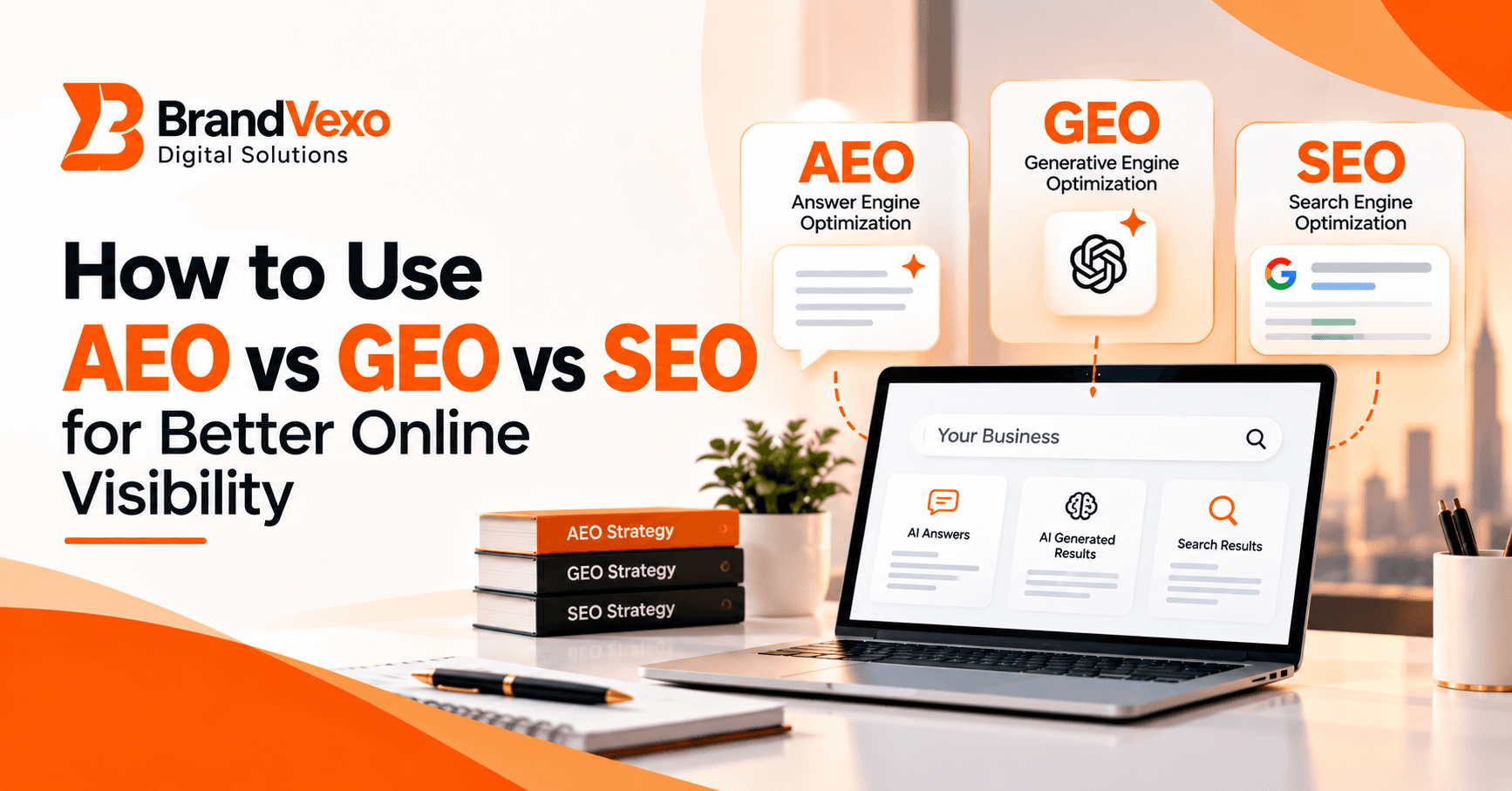
How to Use AEO vs GEO vs SEO for Better Online Visibility
Compare AEO vs GEO vs SEO and learn how to improve organic rankings, answer visibility, and AI search presence with a practical strategy for your business.
International vs Multilingual SEO: What You Need to Know
International vs Multilingual SEO explained. Compare key differences, URL structures, hreflang tags, and strategies for reaching global audiences.