

International vs Multilingual SEO: What You Need to Know
International vs Multilingual SEO explained. Compare key differences, URL structures, hreflang tags, and strategies for reaching global audiences.
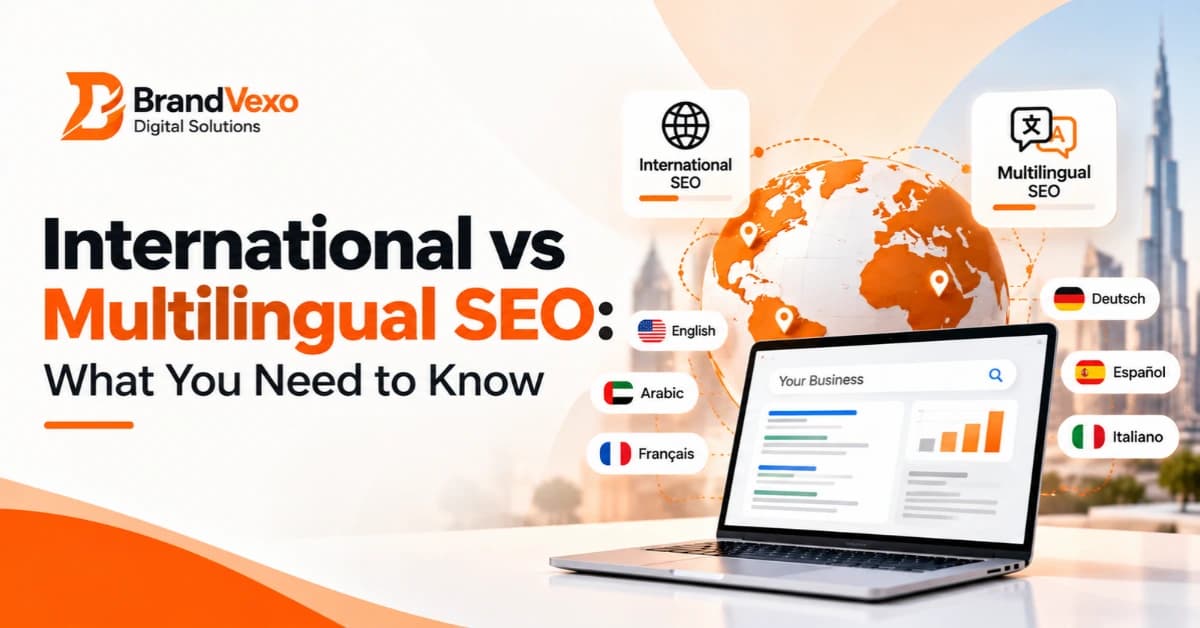
International SEO and multilingual SEO help businesses reach audiences beyond a single market, but they solve different problems. International SEO focuses on reaching customers in specific countries or regions, while multilingual SEO helps people find and use content in their preferred languages. For businesses expanding from the UAE into Saudi Arabia, the UK, or other international markets, understanding the difference between international vs multilingual SEO can help prevent wasted marketing spend, improve organic visibility, and create a better website experience.
A successful global SEO strategy starts with three decisions: which markets to target, which languages to support, and how to structure the website for search engines and users. Some businesses need international SEO alone, while others benefit from combining geographic targeting with multilingual content.
What Is International SEO?
International SEO is the process of optimizing a website so search engines can identify the countries or regions it serves and present relevant pages to users in those markets. It helps businesses attract qualified visitors from different geographic locations by aligning website content, technical signals, and keyword targeting with local search behavior.
For example, a Dubai-based software company might target businesses in the UAE, Saudi Arabia, and the UK. Although the company offers the same core service, each market may have different search terms, customer expectations, competitors, and purchasing requirements.
How International SEO Works
A strong international SEO strategy typically includes:
Country-specific keyword research: Identify how customers search in each target market.
Website structure: Choose suitable country domains, subdomains, or subdirectories.
Geographic relevance: Provide useful local information, pricing, contact details, and market-specific content where appropriate.
Technical SEO: Help search engines crawl, index, and understand pages intended for different markets.
Local authority: Build relevant relationships, mentions, and links within target markets.
Performance tracking: Measure organic traffic, leads, and conversions by country.
Businesses should not assume that hosting a website in a particular country automatically makes it rank there. Google considers multiple signals, including the domain, page content, hreflang annotations, and local relevance.
International SEO is particularly useful when a business wants to expand its customer base, sell across borders, or compete in markets with distinct search behavior.
What Is Multilingual SEO?
Multilingual SEO is the process of optimizing website content for people who search in different languages. It helps search engines understand each language version and helps users find content that matches their language preferences.
A multilingual website does not necessarily target multiple countries. For example, a company operating only in the UAE may serve English-speaking and Arabic-speaking customers within the same market.
Multilingual SEO makes each language version useful, searchable, and technically accessible.
Key Elements of Multilingual Search Engine Optimization
An effective multilingual SEO strategy includes:
Native-language keyword research: Identify the terms people actually use rather than translating English keywords word for word.
Localized titles and descriptions: Write relevant page titles, meta descriptions, and headings in each target language.
Language-specific URLs: Give each language version a distinct, crawlable URL.
Hreflang annotations: Help Google understand relationships between alternate language or regional pages.
Localized content: Adapt examples, terminology, and calls to action to the intended audience.
Consistent user experience: Provide clear language-switching links and ensure navigation works in every language.
For example, a UAE consultancy might publish English and Arabic versions of its services, blog articles, and contact pages. Each version should provide a complete experience rather than simply translating a few headings while leaving most of the content unchanged.
Multilingual SEO works best when translation, keyword research, technical implementation, and user experience support one another.
What Is the Difference Between International and Multilingual SEO?
The main difference between international and multilingual SEO is their primary focus. International SEO helps search engines understand which countries or regions a business targets. Multilingual SEO helps search engines serve content in the appropriate language.
Businesses may need either approach or both, depending on their customers and expansion plans.
Consider these differences:
Primary goal: International SEO focuses on geographic markets; multilingual SEO focuses on language audiences.
Keyword research: International SEO examines country-specific search intent, while multilingual SEO identifies relevant queries in each language.
Content strategy: International SEO adapts pages to regional needs; multilingual SEO adapts content to language and cultural context.
Technical setup: International SEO may involve country-specific domains, regional pages, and hreflang annotations. Multilingual SEO requires clearly accessible language versions and appropriate language annotations.
User experience: International SEO may require local pricing, contact details, and market-specific information. Multilingual SEO requires understandable content, navigation, and language switching.
Measurement: International SEO tracks performance across countries and regions, while multilingual SEO examines performance across language versions as well.
These approaches overlap. A business targeting several countries in one language may prioritize international SEO. A business serving multiple languages in one country may prioritize multilingual SEO.
A company targeting multiple countries and languages will often need a combined strategy. Google distinguishes multilingual websites from multi-regional websites, while recognizing that a site can belong to both categories.
International SEO vs Multilingual SEO: Which Strategy Should You Choose?
The right choice depends on where your customers live, which languages they use, and whether their search needs differ between markets.
Choose International SEO When You Target Multiple Countries
International SEO is a suitable priority when your business already communicates in the necessary languages but needs to reach customers in additional geographic markets.
For example, a UAE-based B2B service provider may want to attract English-speaking businesses in the UAE, Saudi Arabia, and the UK. It could need country-specific keyword research, relevant landing pages, and regional business information without creating a separate language version for every market.
Choose Multilingual SEO When You Serve Different Language Audiences
Multilingual SEO is the stronger starting point when customers need information in different languages, even if they live in the same country.
For instance, a Dubai-based healthcare provider, retailer, or consultancy may serve English- and Arabic-speaking residents. Creating useful, properly optimized content in both languages can improve accessibility and help each audience find relevant pages.
Use Both When You Target Different Countries and Languages
A combined approach is often appropriate when businesses expand across borders and language groups.
Imagine a UAE-based software company targeting English-speaking businesses in the UAE and UK, as well as Arabic-speaking businesses in Saudi Arabia. It may need regional keyword research, localized landing pages, appropriate language alternatives, and clear geographic signals.
The key is to build pages around genuine differences in audience needs rather than creating multiple versions that offer little additional value.
How to Build an Effective International and Multilingual SEO Strategy
A practical global SEO strategy combines market research, content planning, technical implementation, and ongoing measurement. Follow these steps before expanding your website into new markets.
1. Research Your Target Markets
Start by identifying the countries and audiences that offer realistic business opportunities. Consider search demand, competition, customer needs, purchasing behavior, and the resources required to support each market. For a UAE company, this might mean comparing demand in Saudi Arabia with demand in the UK before investing in separate landing pages.
Do not choose a market based only on population size. Focus on whether your business can meet customer needs and convert relevant organic traffic into enquiries or sales.
2. Conduct Region-Specific and Multilingual Keyword Research
Research keywords separately for each target country and language. People may use different expressions for the same service, even when they speak the same language. For example, a business targeting English-speaking users in the UAE and UK should investigate local terminology and search intent instead of assuming that identical keywords perform equally well in both markets.
For multilingual SEO, use native-language research to identify common phrases, synonyms, and commercial queries. Literal translations can miss the way people naturally search.
Also consider search engine market share. Google is important in many markets, but businesses targeting China or Russia may need to evaluate search platforms such as Baidu or Yandex, respectively, according to current market conditions and audience behavior.
3. Choose the Right URL Structure
Your URL structure should make the website easy to manage and help users and search engines identify relevant versions.
Common options include:
Country-code top-level domains (ccTLDs):
example.aeorexample.co.uk. These provide a clear country association but can require more separate domain management.Subdomains:
ae.example.comorar.example.com. These separate sections of a website while retaining a connection to the main domain.Subdirectories:
example.com/ae/orexample.com/ar/. These organize market or language versions within one domain.
Each option has trade-offs. Subdirectories may simplify centralized management, while ccTLDs can provide a clearer country association. No URL structure guarantees higher rankings, and the best choice depends on your technical resources, branding, and expansion plans.
For further guidance, review Google's documentation on multi-regional and multilingual websites.
4. Localize Content Instead of Translating Word for Word
Translation changes the language. Localization adapts the content to the audience.
An effective localization process considers:
Local terminology and cultural nuances
Currency, measurements, and pricing where relevant
Regional examples and customer concerns
Appropriate calls to action
Local legal or regulatory requirements where applicable
For example, a UAE business targeting Saudi customers should review its service descriptions, terminology, and customer journey for relevance to that market. It should not assume that changing the country name is enough.
Have qualified language reviewers check important commercial pages, especially when technical terminology or regulated services are involved.
5. Implement Hreflang and Review Canonical Tags
Hreflang annotations help Google understand alternate language or regional versions of a page. They can help Google select the appropriate version for a user, but they do not guarantee indexing or improve rankings directly.
Check that:
Each language or regional version has its own crawlable URL.
Hreflang values correctly identify the intended language and, when appropriate, region.
Alternate pages reference one another consistently.
Canonical tags identify the preferred URL for each page.
Similar regional pages do not incorrectly canonicalize to an unrelated language version.
Canonical tags and hreflang serve different purposes. Canonical tags consolidate duplicate or substantially similar URLs, while hreflang describes alternate versions intended for different language or regional audiences. Their implementation should work together rather than send conflicting signals.
6. Monitor Performance by Country and Language
Once the pages go live, measure whether they attract the right visitors and produce meaningful business outcomes.
Use Google Search Console and your analytics platform to review:
Organic clicks and impressions by country and landing page
Search queries and rankings in target languages
Indexing and crawling of localized URLs
Engagement and conversions by market
Qualified leads or sales generated by organic traffic
Review these results regularly. If a translated page receives impressions but few relevant clicks or conversions, investigate whether the keywords, page content, search intent, or user experience match the audience's needs.
Common International and Multilingual SEO Mistakes to Avoid
Even a well-designed website can struggle to reach international audiences when its content or technical setup sends unclear signals. Avoid these common mistakes:
Translating keywords literally: Research how people search in each language and market instead.
Publishing low-value localized pages: Give each page useful information that meets the audience's needs.
Implementing hreflang incorrectly: Check language and regional codes, reciprocal references, and destination URLs.
Using incorrect canonical tags: Keep canonical signals consistent with the intended page structure.
Relying on automatic redirects: Let visitors access alternative language versions instead of forcing them into a version based only on inferred location or browser settings.
Ignoring local search behavior: Investigate relevant search engines, competitors, and regional terminology before entering a new market.
Google recommends using separate URLs for language versions and making those versions accessible through links. Automatic language switching can prevent users and search engines from accessing the right content.
How to Measure International and Multilingual SEO Performance
Measure success through relevant traffic and business results, not rankings alone.
Use Google Search Console to evaluate organic impressions, clicks, queries, and page performance. Use an analytics platform to understand how visitors engage with localized pages and whether they complete meaningful actions.
Track these indicators:
Organic traffic and visibility by target country
Search performance by language and landing page
Indexing of country-specific and language-specific URLs
Qualified enquiries, purchases, or bookings
Conversion rates across localized landing pages
Compare results against your starting performance and business objectives. A market with fewer visitors may still be valuable if it produces more qualified leads. Likewise, high traffic from an irrelevant audience may not justify further investment.
FAQs
What Is the Difference Between Multilingual and International SEO?
International SEO focuses on reaching users in different countries or regions. Multilingual SEO focuses on serving users who search in different languages. A website can use both approaches when it targets multiple countries and languages.
When Should I Use International SEO?
Use international SEO when you want to attract customers from different countries and need your website to reflect their search behavior, regional needs, and market requirements. You may need localized landing pages, appropriate URL structures, and geographic relevance signals.
How Do I Set Up a Multilingual SEO Strategy?
Start with native-language keyword research, create useful content for each audience, assign separate crawlable URLs to language versions, implement appropriate hreflang annotations, and monitor performance. Review translations for accuracy and cultural relevance before publishing.
Do I Need a Separate Domain for International SEO?
No. You can use country-specific domains, subdomains, or subdirectories. Choose based on your market strategy, technical resources, branding, and long-term maintenance requirements. A separate domain is not automatically better for rankings.
What Is the Best URL Structure for a Global Website?
There is no universally best structure. Country-code domains provide a clear country association, while subdomains and subdirectories offer different ways to organize international content. Choose a structure you can maintain consistently as your website grows.
How Do Hreflang Tags Affect International SEO?
Hreflang annotations help Google understand relationships between alternate language or regional pages and may help it serve the appropriate version to users. They do not guarantee rankings or indexing, so accurate implementation and accessible content remain important.
Build a Global SEO Strategy That Reaches the Right Audience
International SEO and multilingual SEO serve different purposes, but they work well together when a business expands across countries and languages. Start by researching your markets, understanding local search intent, and creating useful content for each audience. Then implement a consistent URL structure, review technical signals, and measure organic performance against qualified leads and sales.
A clear strategy helps businesses expand sustainably without creating unnecessary pages or technical complexity.
BrandVexo
BrandVexo Digital Solutions helps businesses strengthen their online visibility through SEO, website development, digital marketing, and AI automation. Our approach connects search strategy with useful content, technical performance, and commercial goals. We focus on practical improvements that support sustainable growth rather than vanity metrics. If you are planning to reach new markets, our team can help you assess your website and identify opportunities for improvement.
Website: www.brandvexo.com
SEO services: SEO & Local SEO
Phone: +971 52 356 5409
Email: info@brandvexo.com
Get in touch with BrandVexo to discuss your international SEO goals, multilingual website requirements, and opportunities to reach the right audiences.
Disclaimer: This article provides general information about international and multilingual SEO for educational purposes only. SEO results may vary depending on your target markets, competition, website structure, and implementation. Always consult current search engine guidelines before making technical SEO decisions.
Free growth plan
Ready to grow your business?
Reading is a start — now let's build it. Tell us where you want to grow and a senior strategist will map the fastest, most profitable way to get there. Free, no obligation.
Discussion
Join the conversation
Be the first to comment. Comments are reviewed before they appear, so yours won't show up instantly — but we read every one.
Leave a comment
Keep reading
All articles
How to Use AEO vs GEO vs SEO for Better Online Visibility
Compare AEO vs GEO vs SEO and learn how to improve organic rankings, answer visibility, and AI search presence with a practical strategy for your business.

AI Search Visibility: Strategies to Grow Your Brand Online
Improve AI Search Visibility with practical SEO, GEO, and AEO strategies to strengthen brand authority, earn citations, and reach more potential customers.

How to Boost Local SEO for Multi-Location Ecommerce Stores
Boost Local SEO for multi-location ecommerce stores with better location pages, Google Business Profiles, local inventory, schema markup, and SEO tracking.